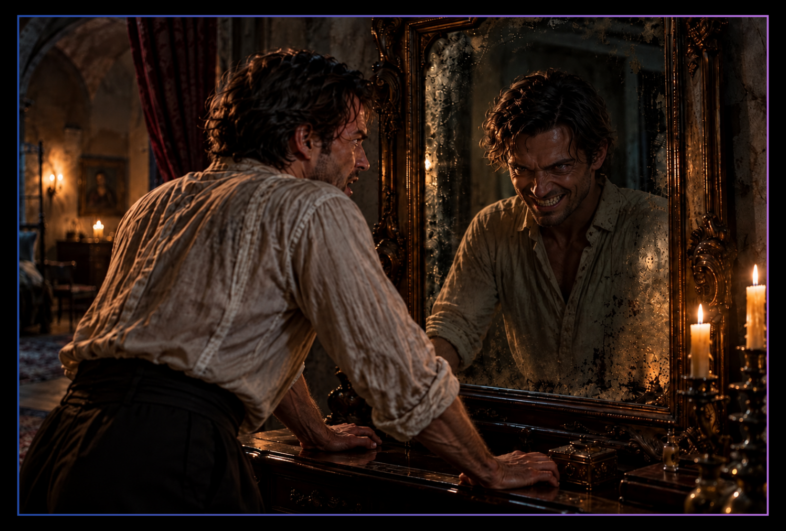
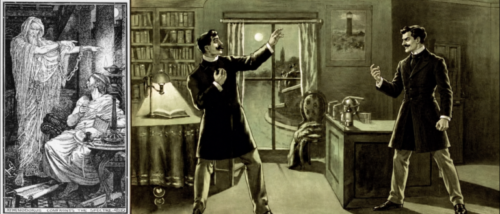

Your Wraith has come for you. It possesses your likeness, understands your weaknesses and has come to prove which of you deserves to remain among the living. Outsmart and outlast your supernatural double in a four-round contest where every punishment cuts both ways.
π Introduction
The Wraith is a head-to-head functional fitness competition in which two participants challenge one another across four tactical exercise circuits. Each competitor selects two exercises per round, forcing both athletes to confront a mixture of their own strengths and their opponent’s chosen challenges. The fastest competitor wins each round, with a final sudden-death contest deciding any draw.
Folklore has long warned of spectral doubles and uncanny apparitions resembling the living. Meeting your own likeness was seldom considered a fortunate occurrence. Particularly when it knew all your weaknesses.
π» The Legend of the Wraith
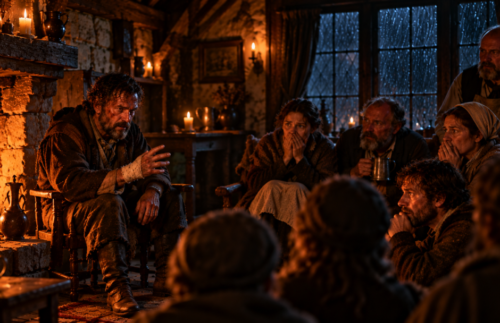
In the shadowy folklore of Scotland and the British Isles, the Wraith was a spectral double of a living person, an apparition whose appearance often foretold approaching death. Closely associated with second sight, these mysterious phantoms could appear in distant places, imitating people who were still very much alive.
In his seventeenth-century work, The Secret Commonwealth, the Scottish minister Robert Kirk described the Co-Walker, a supernatural counterpart resembling its living original. An especially disturbing account from St Kilda tells of a man haunted by his own double, which followed him into the fields and copied his movements. To test the apparition, he replaced his ordinary garters with ones made from straw rope. When the phantom returned, it wore identical garters. The unfortunate man subsequently fell ill and died.
From ancient ghost stories to the sinister DoppelgΓ€nger of European literature, the Wraith and its spectral counterparts have long inspired tales of supernatural doubles, impending death and misfortune.
Similar beliefs existed in Ireland, where the apparition was known as a Fetch. Encountering one in the morning could foretell a long life, while an evening appearance warned of approaching death. In German literature, the sinister DoppelgΓ€nger became another manifestation of the supernatural double, a mysterious counterpart whose appearance challenged the very nature of personal identity.
Was the Wraith a messenger of death, a wandering spirit or some dreadful reflection of the living soul? Whatever its origins, encountering your own likeness was seldom considered a fortunate omen.
After all, there are few things more disturbing than meeting yourself. Particularly when the other you appears to know something you don’t.
πͺ Face Your Double
π Rules of Engagement
π Format: Head-to-head competition. Two participants, four rounds of four stations, with exercises drafted from five categories.
βοΈ Choose Your Weapons: Each competitor selects two exercises per round, taking alternating turns. Competitor A picks first in Rounds I and III; Competitor B in Rounds II and IV.
Each round must contain four exercises from four different categories. Once selected, an exercise cannot be chosen again during the opening four rounds.
πͺ The Challenge: Both competitors race through the same four exercises, in the same order, using pre-agreed repetitions, distances, loads and movement standards. Invalid repetitions must be repeated.
All workloads and individual scaling must be agreed before the contest begins and cannot be changed mid-round, except for safety. Use challenging but manageable resistance (generally RPE 7β8). Where identical equipment is unavailable, competitors may use separately timed attempts.
π Scoring: The first competitor to complete all four stations correctly wins the round and earns one point. After four rounds:
4β0: Decisive Victory
3β1: Victory
2β2: Dead Heat β Sudden Death
π Dead Heat β Only One Shall Remain
A 2β2 draw triggers one final four-station circuit.
Competitor A opens the final draft, with both competitors selecting two exercises under the same alternating rules. Four different categories must be represented, but all thirty exercises become available again, including previously selected movements.
The first competitor to complete the final circuit correctly wins the contest. One showdown. One winner.
π€ The Wraith Circuit
βοΈ Exercise Selection Rules
Each round requires four exercises, choose from one of the categories below.
Competitor A selects two exercises.
Competitor B selects the remaining two, from the categories not yet represented.
Both complete the identical four-station workout.
The first competitor to finish with valid repetitions wins the round.
The order of selection alternates between competitors each round.
Whoever wins most rounds out of 4 wins. If tied 2-2 at end of 4 rounds. Goes to a final βDead Heatβ 5th round.
ποΈ Exercise Categories
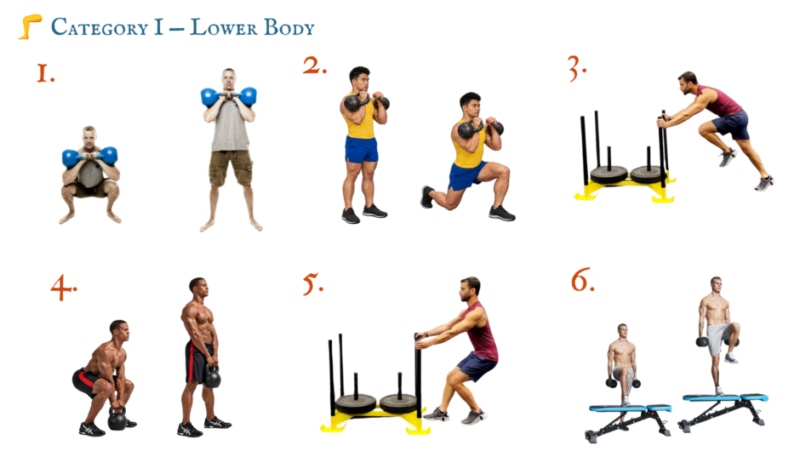
𦡠Category I β Lower Body
Double Kettlebell Front Squats.
Kettlebell Front-Rack Lunges.
Sled Push.
Dumbbell Deadlift.
Sled Pull.
Dumbbell Step-ups to Knee Drive.
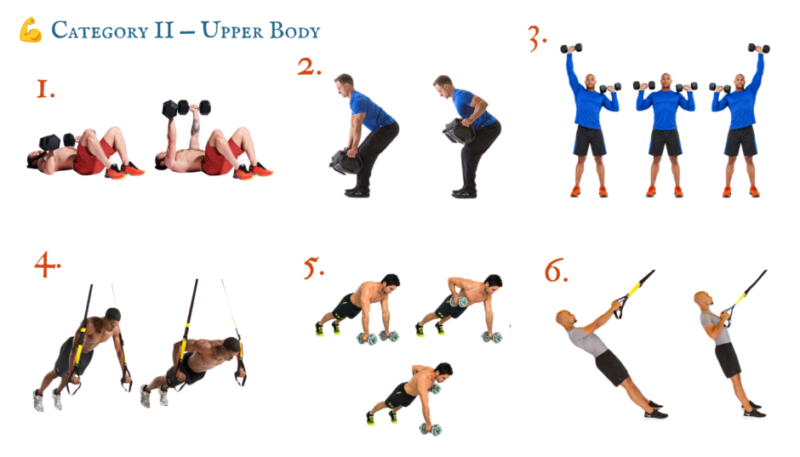
πͺ Category II β Upper Body
Dumbbell Floor Press.
Sandbag Bent-Over Rows.
Dumbbell Alternating Shoulder Press.
TRX Chest Press.
Dumbbell Renegade Rows.
TRX Mid Rows.
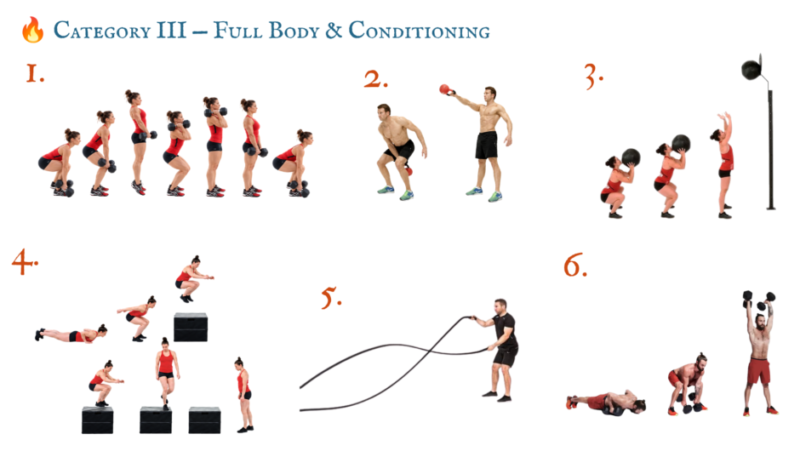
π₯ Category III β Full Body & Conditioning
Dumbbell Power Cleans.
Kettlebell Single-Arm Swings.
Wall-Ball Shots.
Burpee Box Jumps.
Battle-Rope Alternating Waves.
Dumbbell Devil’s Press.
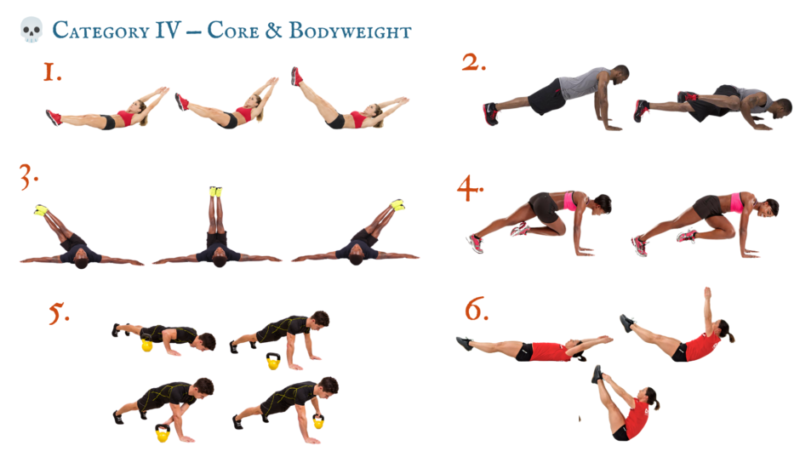
π Category IV β Core & Bodyweight
Hollow Body Rocks.
Spiderman Push-ups.
Lying Windshield Wipers.
Cross-Body Mountain Climbers.
KB Pull-Throughs.
V-Ups.
π« Category V β Cardiovascular Endurance
400m Run.
500m Row.
400m SkiErg.
20-Calorie Assault Bike.
8 Γ 20m Shuttle Runs (160m total).
200m Hill/Incline Run (5β8% gradient).
π Suggested Workload Guidelines
Rather than prescribing the same repetitions to every exercise, we establish sensible ranges based on movement demands.
Exercise Type
Suggested Workload
Heavy compound movements
10β15 reps
Moderate resistance exercises
15β20 reps
Unilateral movements
8β12 per side
Core/bodyweight movements
20β30 reps
Explosive conditioning
10β20 reps
Loaded pushes
20β40m
Battle ropes
30β40 seconds
These are starting ranges, not interchangeable prescriptions. Exact workloads and equipment resistance should be agreed before the competition, so participants can’t manipulate difficulty after selecting an exercise.