


🧠 The Science of Sleep β€” How Sleep Actually Works

Sleep isn’t random. It is governed by biological processes that determine when you feel awake, when you become tired, and how sleep unfolds once it begins. Understanding those processes makes it much easier to recognise why sleep sometimes breaks down and how to improve it.

πŸ“‘ Table of Contents

πŸ” Recap

In the first article of this series, we explored why sleep matters, looking at its role in physical recovery, cognitive performance, hormone regulation, emotional resilience, and long-term health.

Now we go beneath the surface.

Despite feeling effortless, sleep is a highly regulated biological process. Across every 24-hour period, the brain responds to internal timing, light exposure, accumulated sleep pressure, and chemical signals that influence when we feel alert and when we become sleepy.

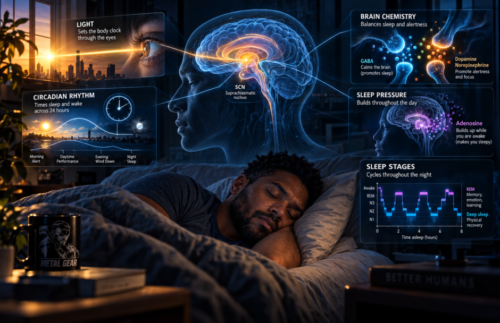
Futuristic sleep control centre illustrating the brain systems involved in circadian rhythm, sleep pressure, melatonin release and sleep stages.

Sleep is not controlled by a single switch. Circadian timing, sleep pressure, brain chemistry and multiple neural systems work together to determine when we feel awake and when the body is ready for sleep.

When these processes remain aligned, falling asleep and waking generally feels natural. When that alignment is disrupted by stress, shift work, travel, stimulants, irregular routines, or modern lifestyles, sleep can become shorter, lighter, or more fragmented.

Understanding these mechanisms will not solve every sleep problem. What it does provide is a clearer picture of why sleep succeeds or fails and what may be interfering with it.

Once we understand the system, we can begin to identify the obstacles getting in its way.

βš™οΈ Understanding the Sleep System

Sleep doesn’t simply happen because you’re tired.

Every day, the brain responds to internal timing, light exposure, chemical signals, and the length of time you’ve been awake. Together, these influences help determine when you feel alert, when sleepiness begins to build, and what happens once sleep begins.

Sleep regulation is often explained through two major interacting processes: the circadian rhythm, which helps determine when the body expects to sleep, and sleep pressure, which reflects how strongly the body needs it.

To understand sleep more practically, however, we’ll examine four closely connected components:

  • Circadian Rhythm – Your internal body clock, helping regulate when you naturally feel awake and when you become sleepy.
  • Chemical Signals – Hormones, neurotransmitters, and other messengers involved in alertness, sleepiness, and the transition between wakefulness and sleep.
  • Sleep Pressure (Homeostasis) – The biological drive for sleep that generally increases the longer you remain awake.
  • Sleep Architecture – The repeating pattern of NREM and REM sleep that determines how sleep is organised across the night.

πŸ”„ How They Work Together

These are not four separate or equivalent regulatory systems.

Circadian rhythm and sleep pressure are the two major processes used to explain the regulation of sleep and wakefulness. Chemical signals form part of the biological machinery through which sleep and wakefulness are coordinated, while sleep architecture describes how sleep is structured once it begins.

In practical terms, the circadian rhythm helps determine when sleep should occur, while sleep pressure influences how strongly the body wants to sleep. Chemical signals help coordinate the transition between wakefulness and sleep, while sleep architecture describes how different stages are organised across the night.

When these processes remain well aligned, sleep usually feels natural. When that alignment is disrupted, sleep can become harder to initiate, maintain, or complete effectively.

The rest of this article breaks down each component before showing how everyday habits and circumstances can interfere with the system as a whole.

πŸŒ… Circadian Rhythm

Your Internal Body Clock

Every one of us carries an internal biological clock.

Known as the circadian rhythm, this system runs on an approximately 24-hour cycle and helps regulate when we naturally feel alert, when we become sleepy, and how many other physiological processes change throughout the day and night.

Although it is often discussed in relation to the sleep-wake cycle, circadian timing influences far more than sleep alone. It also affects body temperature, hormone release, digestion, metabolism, mental alertness, and physical performance.

At the centre of this system is the suprachiasmatic nucleus (SCN), a small region of the brain that acts as the body’s master clock. It receives information about the external environment and helps synchronise internal timing with the outside world.

One of its most powerful timing signals is light.

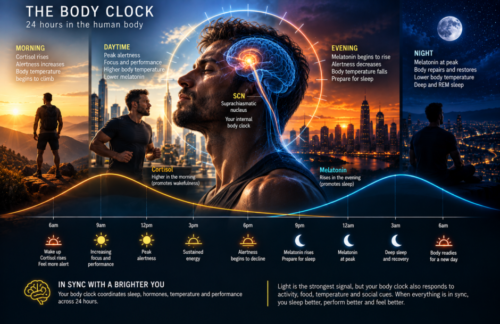
Circadian rhythm infographic showing changes in alertness, cortisol, melatonin and body function across a 24-hour day.

The circadian system coordinates daily changes in alertness, hormones, body temperature and sleep readiness, helping the body anticipate the changing demands of day and night.

β˜€οΈ Light: The Master Timekeeper

When light enters the eyes, specialised cells in the retina send information to the brain about the surrounding light-dark cycle. This helps synchronise the circadian clock and influences processes involved in alertness and melatonin production.

As evening approaches and light levels fall, the biological night begins to emerge. Melatonin levels typically rise, alertness begins to decline, and the body gradually prepares for sleep.

For most of human history, this cycle was closely tied to natural daylight.

Modern life has changed that relationship.

Artificial lighting, smartphones, computers, televisions, shift work, and irregular sleep schedules can expose us to substantial light long after sunset. This does not simply “trick” the brain into thinking it is daytime, but sufficiently bright or prolonged evening light can delay circadian timing and interfere with the body’s normal preparation for sleep.

πŸ“ˆ A Daily Rhythm

When the circadian rhythm is well aligned, the day tends to follow a broadly predictable pattern:

  • Morning light helps reset and reinforce the body clock.
  • Alertness generally increases after waking.
  • Mental and physical performance varies throughout the day.
  • As evening approaches, the biological drive for wakefulness begins to decline.
  • Darkness helps signal that the biological night is beginning.

Most of this happens without conscious effort.

Problems arise when the signals controlling that rhythm become inconsistent. Irregular bedtimes, rotating shifts, jet lag, frequent late nights, and prolonged evening light exposure can all push the internal clock away from the schedule we are trying to follow.

This can contribute to:

  • Difficulty falling asleep at the desired time.
  • Feeling unusually alert late at night.
  • Waking feeling groggy or poorly rested.
  • Reduced concentration and daytime fatigue.
  • Difficulty adapting to new sleep schedules.

The body has not forgotten how to sleep. Its timing has become misaligned.

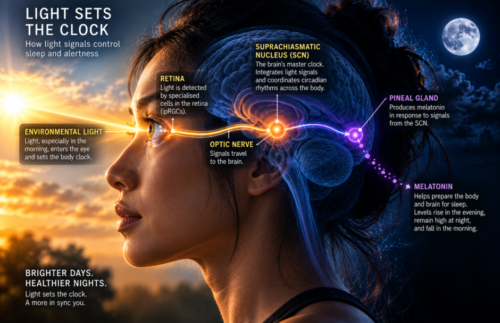
Woman shown in profile with light entering the eye and signalling the suprachiasmatic nucleus and pineal gland to regulate melatonin and sleep timing.

Light detected by the eyes provides one of the strongest signals to the brain’s circadian clock. The SCN uses this information to coordinate biological timing, including the nightly rise and morning decline of melatonin.

Circadian rhythms are adaptable, which is why changes in light exposure, sleep timing, and daily routine can gradually shift the body clock. We’ll look at how to use those signals more effectively in the final article of this series.

πŸ§ͺ Chemical Signals

The Chemistry of Sleep and Wakefulness

While circadian timing and sleep pressure help regulate when and how strongly we are driven towards sleep, a network of hormones, neurotransmitters, and other chemical messengers helps coordinate the changing balance between sleep and wakefulness.

There is no single chemical that switches sleep on or off. Instead, sleep and wakefulness emerge from interactions between systems that promote alertness, arousal, relaxation, and sleep.

Several chemical signals play particularly important roles.

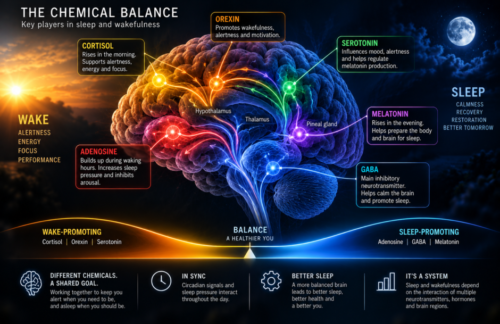
Human brain illustration showing interacting chemical systems involved in wakefulness and sleep, including orexin, cortisol, serotonin, adenosine, GABA and melatonin.

Sleep and wakefulness emerge from the interaction of multiple chemical and neural systems. Some promote alertness and arousal, while others support sleep, inhibition and the biological transition into night.

πŸŒ™ Melatonin, Adenosine and Cortisol

While circadian timing and sleep pressure help regulate when and how strongly we are driven towards sleep, a network of hormones, neurotransmitters, and other chemical messengers helps coordinate the changing balance between sleep and wakefulness.

There is no single chemical that switches sleep on or off. Instead, sleep and wakefulness emerge from interactions between systems that promote alertness, arousal, relaxation, and sleep.

Several chemical signals play particularly important roles.

Click on links below for more

Melatonin is a hormone released primarily during biological night, with its production strongly influenced by the light-dark cycle.

Often called the “sleep hormone”, its role is not to knock you unconscious. Instead, it acts primarily as a biological night-time signal, helping communicate that the body has entered its circadian night and supporting the preparation for sleep.

Bright evening light can delay or suppress melatonin production, particularly when exposure is sufficiently intense or prolonged.

Adenosine plays a different role.

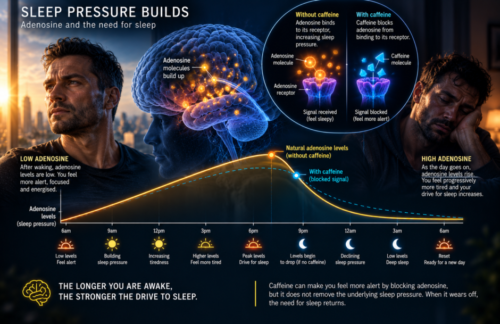
It is one of the chemical signals involved in the homeostatic regulation of sleep, contributing to the increasing drive for sleep during prolonged wakefulness. Its exact role is more complex than a simple chemical “tank” filling throughout the day, but adenosine signalling is an important part of how the brain responds to time spent awake.

Caffeine interferes with this signalling by blocking adenosine receptors. It does not eliminate the underlying need for sleep. Instead, it temporarily reduces our perception of sleepiness and promotes continued alertness.

Cortisol is often associated with stress, but it is also part of the normal circadian system.

Levels typically rise towards morning, helping support wakefulness and alertness, before generally declining across the day. Stress can alter this pattern and increase physiological arousal at times when the body would normally be preparing for rest.

GABA is the brain’s main inhibitory neurotransmitter.

Rather than stimulating neural activity, it reduces the activity of many neural circuits and plays an important role in allowing wake-promoting systems to become quieter as sleep approaches.

Wakefulness, meanwhile, is supported by several interacting chemical messengers, including:

  • Orexin (hypocretin) – Helps stabilise wakefulness and prevent inappropriate transitions into sleep. Loss of orexin signalling is strongly associated with narcolepsy.
  • Histamine – Helps promote alertness, which is why some antihistamines can cause drowsiness.
  • Norepinephrine – Supports attention and arousal, with activity changing substantially across the sleep-wake cycle.
  • Acetylcholine – Plays an important role in both wakefulness and REM sleep.
  • Serotonin and dopamine – Influence mood, arousal, motivation, and multiple aspects of the sleep-wake cycle.
  • Glutamate – The brain’s main excitatory neurotransmitter and an important contributor to neural activity.

βš–οΈ A Constantly Shifting Balance

Healthy sleep depends on these signals working together, rather than any one chemical taking control.

During wakefulness, arousal-promoting systems help maintain alertness. As biological night approaches and sleep pressure increases, the balance gradually shifts. Circadian signals, homeostatic drive, melatonin signalling, inhibitory neural activity, and changes within wake-promoting networks all contribute to the transition towards sleep.

That is why reducing sleep to a single hormone or neurotransmitter is misleading.

Sleep is not produced by one chemical. It emerges from multiple biological systems working together to move the brain between wakefulness and rest.

⏳ Sleep Pressure (Homeostasis)

The Drive to Sleep

If the circadian rhythm helps determine when your body expects to sleep, sleep pressure reflects how strongly it needs to.

Scientists refer to this as sleep-wake homeostasis, the process through which the biological drive for sleep generally increases the longer we remain awake and decreases during sleep.

The longer you remain awake, the stronger that drive usually becomes.

πŸ§ͺ Building Sleep Pressure

Think of sleep pressure as an internal pressure gauge.

When you first wake after sufficient sleep, that pressure is relatively low. As the day progresses and you remain awake, it gradually increases. By evening, sleep pressure should be strong enough to work alongside your circadian rhythm and make sleep feel increasingly natural.

This is one reason why staying awake for an unusually long period can eventually make sleepiness feel overwhelming.

The biology behind this process is complex. Adenosine is one of the chemical signals thought to contribute to homeostatic sleep pressure, with adenosine signalling changing as wakefulness continues. It is therefore useful for understanding sleep pressure, but the two should not be treated as exactly the same thing.

πŸŒ™ Reducing Sleep Pressure

Sleep allows homeostatic sleep pressure to fall.

Across a sufficient period of sleep, the biological drive that accumulated during wakefulness is progressively reduced. By morning, sleep pressure should be low enough for the circadian drive for wakefulness to help us begin the next day.

Several factors can alter how this process is experienced:

  • Caffeine blocks adenosine receptors, temporarily masking some of the sleepiness associated with prolonged wakefulness without eliminating the underlying need for sleep.
  • Long or late naps can reduce sleep pressure before bedtime, making it harder to fall asleep later.
  • Extended wakefulness allows sleep pressure to continue rising.
  • Repeated sleep restriction can leave an accumulating need for additional sleep from one day to the next.
Sleep pressure infographic showing adenosine accumulating during waking hours and caffeine temporarily blocking its receptors.

Adenosine accumulates during wakefulness, progressively increasing the drive to sleep. Caffeine can temporarily reduce the sensation of tiredness by blocking adenosine receptors, but it does not remove the underlying sleep pressure.

πŸ’³ Understanding Sleep Debt

This accumulated need for sleep is often described as sleep debt.

A single short night may leave you tired the next day. Several short nights in a row can produce a much more noticeable decline in concentration, reaction time, mood, and physical performance.

The body can recover from occasional sleep loss, but there is no simple one-for-one calculation where every lost hour can immediately be repaid with a lie-in.

Extra sleep and well-timed naps can help after short-term sleep loss, but recovery from repeated restriction generally requires sufficient sleep across subsequent nights.

Sleep pressure is not a flaw in the system.

It is one of the mechanisms that helps ensure that the longer you remain awake, the stronger the biological drive towards sleep becomes.

πŸŒ™ Sleep Architecture

The Structure of Sleep

Sleep is not a single, unchanging state.

Throughout the night, the brain repeatedly moves through different stages of sleep, each with its own characteristics. Together, these stages form what sleep scientists call sleep architecture, the overall structure and pattern of sleep across the night.

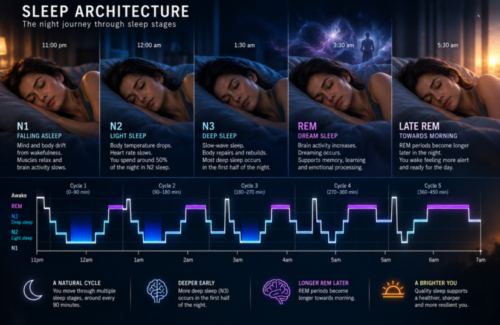
Rather than remaining in one stage until morning, we cycle through periods of non-REM (NREM) and REM sleep. A complete cycle commonly lasts around 90–110 minutes, although its length and composition vary between individuals and across the night.

Most adults typically complete several of these cycles before waking.

😴 Non-REM Sleep β€” From Light to Deep Sleep

Non-REM sleep is divided into three stages.

Stage N1 β€” Falling Asleep

This is the lightest stage of sleep and represents the transition between wakefulness and more established sleep.

During this phase:

  • Heart rate begins to slow.
  • Muscles relax.
  • Brain activity begins to change.
  • You can still be awakened relatively easily.

Some people also experience a sudden muscle twitch or sensation of falling during this stage.

Stage N2 β€” Stable Sleep

N2 usually makes up the largest proportion of a typical night’s sleep.

During this stage:

  • Heart rate slows further.
  • Body temperature falls.
  • Distinctive patterns of brain activity emerge.
  • Awareness of the external environment decreases.

Sleep is more established during N2, and waking generally becomes more difficult than during N1.

Stage N3 β€” Deep Sleep

N3 is often called deep sleep or slow-wave sleep.

This stage is particularly associated with physical restoration. Growth hormone release is prominent during deep sleep, while tissue repair, immune regulation, and other restorative processes are supported across sleep.

N3 is also the stage from which people are most likely to feel groggy or disorientated if suddenly awakened.

πŸ’€ REM Sleep β€” The Brain Becomes Active

As sleep cycles continue, the brain periodically enters Rapid Eye Movement (REM) sleep.

During REM, brain activity increases substantially and in several respects resembles patterns seen during wakefulness.

REM sleep is associated with:

  • Vivid dreaming.
  • Memory consolidation.
  • Emotional processing.
  • Learning.
  • Integration of information and experience.

At the same time, most skeletal muscles become temporarily inhibited. This natural paralysis, known as REM atonia, greatly reduces movement during REM sleep and normally prevents complex movements associated with dreams from being acted out.

Architecture Woman shown across N1, N2, N3 and REM sleep stages through the night with a hypnogram showing repeated sleep cycles.

Sleep unfolds in repeating cycles of NREM and REM sleep. Deep N3 sleep is concentrated more heavily in the first part of the night, while REM periods generally become longer towards morning.

πŸ”„ The Night Changes as You Sleep

The balance between sleep stages changes throughout the night.

Earlier sleep cycles tend to contain more deep NREM sleep, while REM periods generally become longer and more prominent towards morning.

This means that cutting sleep short does not simply remove “more of the same”. Waking several hours early can disproportionately reduce the later REM-rich portion of sleep, while severe restriction of total sleep also reduces the opportunity for the normal sequence of sleep stages to unfold.

No single stage does all the work.

Healthy recovery depends on allowing the full architecture of sleep to unfold across the night, with NREM and REM contributing in different ways.

⚠️ When Sleep Architecture Is Disrupted

Healthy sleep depends not only on how long you sleep, but also on how continuously and naturally sleep unfolds across the night.

Frequent awakenings can repeatedly interrupt the normal progression through NREM and REM sleep. Even when total time in bed appears adequate, fragmented sleep can leave you feeling poorly rested and reduce the opportunity for normal sleep architecture to unfold.

πŸ”„ What Can Fragment Sleep?

A number of factors can repeatedly disturb sleep, including:

  • Alcohol, particularly later in the evening.
  • Stress and anxiety.
  • Sleep disorders, such as sleep apnoea.
  • Pain or illness.
  • Noise, temperature, or other environmental disturbances.
  • Certain medications.

Some of these factors cause repeated awakenings, while others can alter the timing, continuity, or distribution of sleep stages across the night.

This helps explain why someone can spend eight hours in bed and still wake feeling exhausted.

Sleep quantity matters, but continuity and quality matter too.

The goal is not to maximise one particular stage or chase a perfect sleep score. It is to give the brain and body enough uninterrupted time for the normal pattern of NREM and REM sleep to unfold.

⚠️ What Disrupts the System?

Sleep can be disrupted in many different ways because different behaviours interfere with different parts of the system.

Some alter circadian timing. Others affect sleep pressure, chemical signalling, physiological arousal, or sleep architecture.

The result may look similar β€” difficulty falling asleep, waking during the night, or feeling poorly rested β€” but the underlying mechanism can be very different.

🧩 Different Problems, Different Mechanisms

For example:

πŸ’‘ Bright evening light can delay circadian timing and suppress or delay melatonin production.

β˜• Caffeine can block adenosine receptors and temporarily reduce the perception of sleepiness.

😴 Long or late naps can reduce sleep pressure before bedtime.

😰 Stress and anxiety can maintain physiological and mental arousal when the brain should be transitioning towards sleep.

🍺 Alcohol may initially make sleep onset easier but can disrupt sleep continuity and architecture later in the night.

πŸ•’ Shift work and jet lag can place the internal circadian clock in conflict with the schedule imposed by the outside world.

🩺 Sleep disorders can interfere with sleep through mechanisms that behavioural changes alone may not resolve.

This is why understanding the mechanism matters.

Two people can both say “I can’t sleep” while experiencing very different problems.

πŸ”„ Small Problems Can Combine

Sleep disruption is also rarely caused by one factor operating in isolation.

A late caffeine dose may reduce sleepiness. Evening light may delay circadian timing. Stress may maintain arousal. Alcohol may fragment sleep later in the night.

Individually, each factor may have a modest effect. Together, they can create a much larger disruption.

This is one reason sleep can sometimes appear to deteriorate without a single obvious cause. Several relatively small influences can accumulate until the normal transition into and through sleep becomes increasingly difficult.

Understanding which parts of the system are being disrupted makes it easier to identify where intervention is most likely to help.

🎯 Key Takeaways

Sleep is governed by several closely connected biological processes.

The circadian rhythm helps determine when the body expects to sleep, while sleep pressure reflects how strongly the body needs it. Chemical signals help coordinate the transition between wakefulness and sleep, while sleep architecture describes how NREM and REM sleep are organised across the night.

The key points are:

  • Circadian rhythm provides an approximately 24-hour timing system, strongly influenced by the light-dark cycle.
  • Sleep pressure generally increases the longer we remain awake and decreases during sleep.
  • Chemical signals such as melatonin, adenosine, cortisol, GABA, and several wake-promoting neurotransmitters help coordinate sleep and wakefulness.
  • Sleep architecture consists of repeating NREM and REM cycles whose composition changes across the night.
  • Sleep continuity matters because repeated disruption can interfere with the normal progression of those stages.
  • Different sleep problems can arise through different mechanisms, even when the symptoms appear similar.
  • Multiple small disruptions can combine, producing a larger effect on sleep than any one factor alone.
Two male commuters sitting together, one visibly exhausted with coffee while the other appears rested and focused while reading.

The effects of sleep follow us into the next day. More consolidated, restorative sleep supports alertness, mood and concentration, while disrupted sleep can leave even a full night in bed feeling far less restorative.

The important lesson is that sleep is not controlled by a single switch.

It emerges from the interaction between biological timing, accumulated sleep need, chemical signalling, and the structure of sleep itself.

Understanding those mechanisms makes it easier to recognise what may be interfering with sleep and, importantly, what can be changed.

➑️ Next Up: How to Improve Sleep

We now understand the basic biology behind sleep.

The circadian rhythm helps determine when the body expects to sleep. Sleep pressure builds the biological drive for it. Chemical signals help coordinate the transition between wakefulness and sleep, while sleep architecture determines how sleep unfolds once it begins.

But understanding the system is only half the job.

Modern life can interfere with these processes in countless ways: artificial light, caffeine, stress, irregular schedules, shift work, alcohol, poor sleep environments, and habits that work against the body’s natural timing.

The good news is that many of these influences can be changed.

In the final article of this series, we’ll turn the science into practice and look at how to improve sleep quality, strengthen the signals that support healthy sleep, and remove the obstacles that get in the way.

Next: πŸŒ™ Enter Sandman β€” How to Improve Sleep Quality

πŸ“š References and Further Reading

National Institute of Neurological Disorders and Stroke (NINDS): Information on sleep, sleep disorders, and the biological processes involved in sleep and wakefulness.

NINDS β€” Sleep

Β 

American Academy of Sleep Medicine (AASM): Professional guidance and educational resources covering healthy sleep, insomnia, sleep apnoea, CBT-I, and other sleep disorders.

American Academy of Sleep Medicine β€” Patient Information

Β 

Sleep Research Society: Scientific organisation supporting research into sleep, circadian rhythms, sleep health, and sleep disorders.

Sleep Research Society

Β 

Centers for Disease Control and Prevention (CDC): Public-health information on sleep duration, sleep quality, healthy sleep habits, and the relationship between sleep and health.

CDC β€” Sleep

Β 

NHS: Practical guidance on sleep, tiredness, insomnia, and when persistent sleep problems may require medical advice.

NHS β€” Sleep and Tiredness

Β 

Harvard Health Publishing, Harvard Medical School: Accessible medical information covering sleep physiology, sleep stages, sleep deprivation, sleep hygiene, and the effects of sleep on physical and mental health.

Harvard Health β€” Sleep

Β 

Mayo Clinic: Medical information on insomnia, sleep apnoea, restless legs syndrome, circadian sleep disorders, narcolepsy, and other common sleep disorders.

Mayo Clinic β€” Sleep Disorders

Β 

Sleep Foundation: Consumer-focused information on sleep health, sleep hygiene, circadian rhythms, sleep disorders, and strategies for improving sleep.

Sleep Foundation

If you have enjoyed this post please share or feel free to comment below πŸ™‚

Our Other Posts

Leave a Reply

Your email address will not be published. Required fields are marked *

This site uses Akismet to reduce spam. Learn how your comment data is processed.

error: Content is protected !!

Join the Super Soldier Project Mailing List Today!!