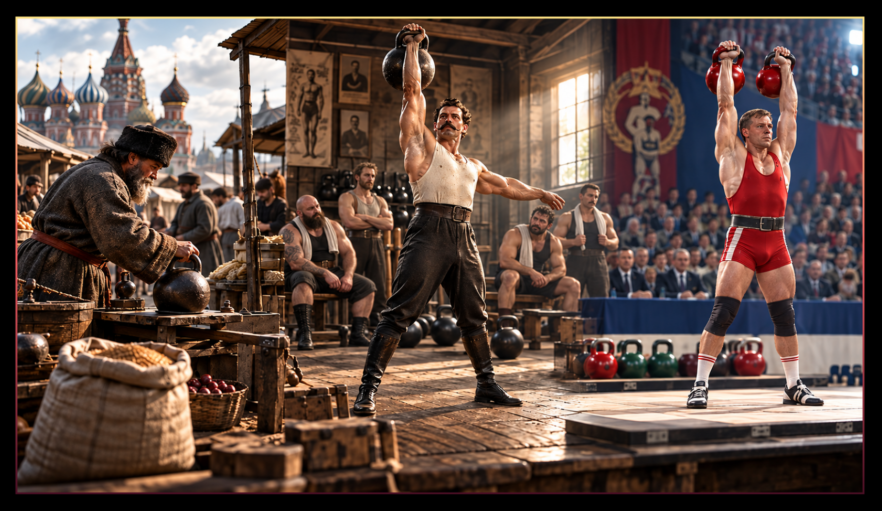

Historical progression from a Russian market weight to nineteenth-century physical culture and organised Soviet kettlebell competition.

๐Ÿ’ฃ Kettlebell History: Myth, Russia and Modern Training

New to kettlebells? You don’t need a rack full of weights or a catalogue of complicated exercises. This beginner’s guide covers everything you need to get started, from choosing your first kettlebell to learning the fundamental movements and building your training from the ground up.

๐Ÿ“‘ Table of Contents

๐Ÿ“ Introduction

Few pieces of modern fitness equipment carry as much mythology as the kettlebell. Depending on which version of the story you hear, its ancestors were lifted by Ancient Greek athletes, Shaolin monks, Scottish strongmen or Russian farmers before finding their way into military training, competitive sport and gyms around the world.

Some of those stories contain fragments of truth. Others confuse similar pieces of strength equipment with a direct historical lineage that is much harder to demonstrate. Kettlebells have deep roots, but the clearest documented trail runs through Russia and Eastern Europe, where a practical handled weight became part of organised physical culture and eventually a competitive sport.

The story becomes much more interesting once we separate what can reasonably be established from what has simply been repeated often enough to sound established.

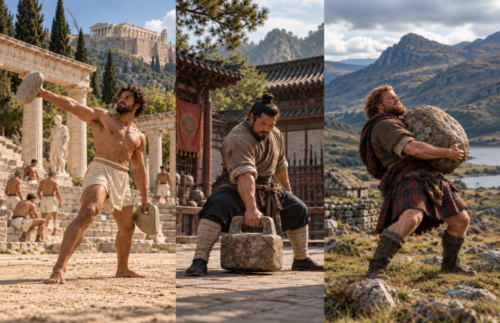
Ancient Greek athlete lifting halteres, Chinese strength practitioner using a stone lock and Scottish strongman lifting a heavy stone.

Similar solutions appeared in very different cultures. Greek halteres, Chinese stone locks and Scottish lifting traditions show that humans were training with awkward weights long before the modern kettlebell.

๐Ÿบ Before the Kettlebell

That distinction matters. It is easy to build a neat evolutionary story by connecting every old weight with a handle, but there is little evidence for an unbroken line leading from any of these traditions to the modern kettlebell. The trail becomes much stronger when we stop asking who first lifted something kettlebell-shaped and instead ask where the recognisable kettlebell tradition actually developed.

For that, the story turns decisively toward Russia.

๐Ÿ‡ท๐Ÿ‡บ Enter the Girya

The Russian word girya refers to a kettlebell or handled weight, and this is where the historical trail becomes much firmer. The term appears in Russian lexicography as early as 1704, when girya were used primarily as standardised weights for measuring goods in markets and trade.

That practical role matters. These were not originally pieces of exercise equipment, but durable working weights already embedded in everyday commercial life. In an environment where manual labour, fairs and public tests of strength often overlapped, it is easy to see how a weighing implement could acquire a second life.

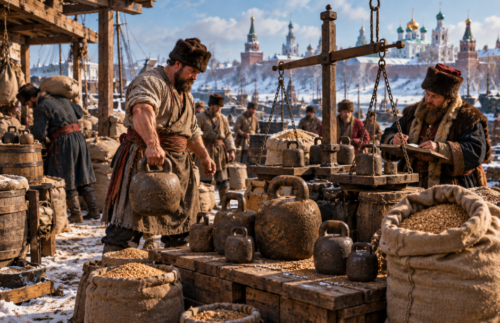
Historical Russian market where workers handle iron girya beside grain sacks, barrels and a traditional weighing scale.

Before it became training equipment, the girya had a job. Standardised handled weights were used in Russian trade before finding another life in feats of strength and physical culture.

Traditional accounts describe workers lifting, throwing and competing with the weights, turning an ordinary tool into a test of strength and skill. The exact point at which this informal use became organised training is difficult to pin down, but by the nineteenth century the girya had moved well beyond the marketplace and become increasingly associated with Russian strength culture.

From there, the kettlebell was ready to enter a more organised world of physical training.

โš–๏ธ The Pood: Why 16, 24 and 32 kg?

Those early marketplace weights were measured using the pood, an old Russian unit of mass equal to approximately 16.38 kg. Because the girya began life as a practical weighing implement, the pood became closely tied to the traditional sizes that later carried over into kettlebell training.

That gives us the familiar progression: 16 kg is roughly one pood, 24 kg one and a half, and 32 kg two poods. Although modern kettlebells are labelled in kilograms, those traditional jumps survived and became deeply embedded in both kettlebell training and sport.

It is a small historical detail, but one that still sits on the rack in front of us: the familiar 16, 24 and 32 kg bells are remnants of the old Russian system.

๐Ÿ’ช The Rise of Russian Physical Culture

By the late nineteenth century, Russian strength training was becoming far more organised. Kettlebells were no longer simply associated with markets, fairs and feats of strength; they were entering a developing culture of systematic physical training.

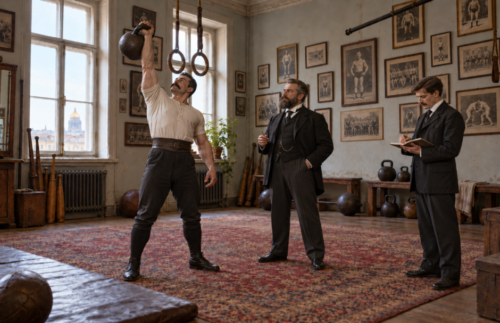
One of the key figures in that transition was the physician Vladislav Kraevsky, often regarded as an important influence on the development of Russian weightlifting and physical culture. In 1885, he founded an amateur athletic circle in St Petersburg where athletes trained with barbells, dumbbells and kettlebells as part of a broader programme of strength development.

Nineteenth-century Russian strongman lifting a girya while Vladislav Kraevsky observes and an associate records his performance.

In Kraevsky’s St Petersburg athletic circle, strength became something to train, observe and develop systematically. With kettlebells joining barbells and dumbbells as recognised training tools.

That matters because the kettlebell was now being used alongside established training tools within a structured environment. It was becoming less of a curiosity or performance object and more clearly recognised as a legitimate instrument for developing strength and physical capacity.

Around this growing movement gathered weightlifters, wrestlers, strongmen and other athletes, helping turn Russian physical culture into something increasingly organised, purposeful and influential. The kettlebell was not developing in isolation; it was becoming part of a much larger system of strength, training and athletic preparation.

๐ŸŽช Strongmen, Circuses and Public Displays

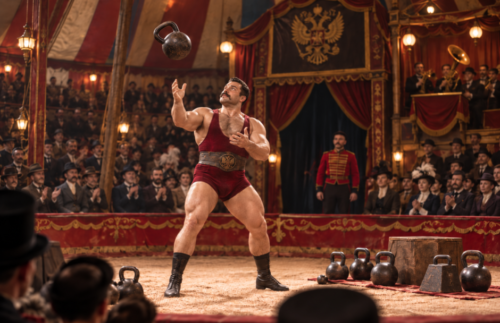
As organised strength training developed, kettlebells also found a natural home in the world of strongmen, circuses and public exhibitions. Their shape made them especially versatile: unlike a barbell, they could be pressed, swung, thrown and juggled, turning strength into something that could also be displayed.

That made the kettlebell useful both as a training tool and as part of the spectacle surrounding physical culture. Strongmen, wrestlers and weightlifters often moved through the same athletic circles, so the boundary between performance, competition and preparation was not always clear.

Russian circus strongman juggling an iron kettlebell above a sawdust ring as a period audience watches.

Kettlebells were made for spectacle as well as strength. Pressing, throwing and juggling allowed strongmen to turn a simple iron weight into a public demonstration of power, timing and skill.

These public displays helped keep kettlebell lifting visible, but they were not the main engine of its development. The more important shift was already underway: the kettlebell had moved from practical weight to recognised strength-training implement, and the next stage would see it absorbed into an even more organised system of physical preparation.

๐Ÿšฉ From Russian Tradition to Soviet Physical Culture

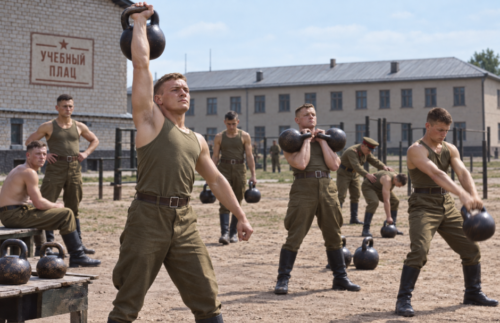
After the Russian Revolution, physical training became increasingly organised within Soviet society. Kettlebells fitted naturally into that system, appearing in military training, sport and general physical preparation alongside other established forms of strength work.

At the same time, kettlebell lifting began to develop more clearly as a competitive activity. Rules and events still varied between regions, but the emphasis was gradually shifting away from isolated feats of strength toward repeatable lifts, sustained effort and organised competition.

Kettlebells became part of military and general physical preparation across the Soviet system, valued as simple, durable tools for building strength, conditioning and work capacity.

A major milestone came in 1948, when a large Soviet kettlebell competition helped establish the foundations of what would become modern Girevoy Sport. From there, the discipline continued to spread through regional competition while rules, classifications and techniques became increasingly standardised.

The kettlebell had now travelled a long way from the marketplace. What began as a practical weight had become part of a national culture of training, performance and competition.

๐Ÿ† The Birth of Modern Girevoy Sport

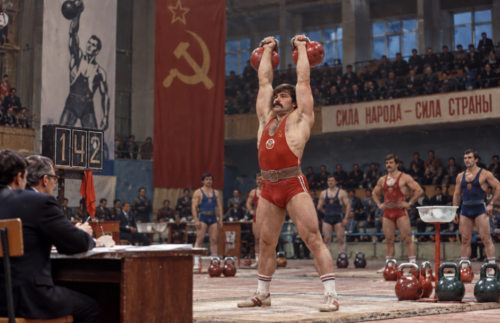
Through the 1970s and 1980s, kettlebell lifting became increasingly formalised across the Soviet sporting system. Regional variations still existed, but rules, classifications and competition structures were becoming far more consistent.

A major step came in 1985, when the first official USSR Kettlebell Sport Championship was held. Four years later, competition sets were standardised around the familiar ten-minute format, helping define the structure associated with modern Girevoy Sport.

Soviet kettlebell athlete lifting two competition kettlebells overhead during an organised competition in a 1980s sports hall.

Under the Soviet sporting system, kettlebell lifting became increasingly organised, standardised and competitive, laying the foundations of modern Girevoy Sport.

That standardisation changed the character of the discipline. Success was no longer simply about producing a powerful lift; athletes had to develop technical efficiency, pacing, breathing and the ability to repeat work under fatigue.

By this point, kettlebell lifting had become something distinct: not merely a branch of strength culture, but a competitive sport with its own methods, demands and identity.

๐ŸŒŽ The Kettlebell Heads West

Kettlebells were never completely unknown outside Eastern Europe, but for much of the twentieth century they remained a specialist tool. That changed rapidly around the turn of the millennium, when Russian kettlebell training began reaching a much wider Western audience.

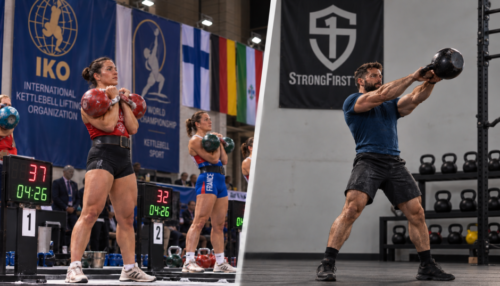
Two influential figures helped drive that expansion in very different directions. Valery Fedorenko brought greater attention to the competitive traditions of Girevoy Sport, where success depended on technical efficiency, pacing and sustaining repeated lifts over time.

Split image showing women competing in international Girevoy Sport beside a man performing a Hardstyle kettlebell swing in a StrongFirst gym.

One implement, two influential traditions. Girevoy Sport developed around efficiency, pacing and repeated effort; Hardstyle emphasised tension, strength and explosive power.

At roughly the same period, Pavel Tsatsouline was promoting a different interpretation of Russian kettlebell training, placing greater emphasis on strength, explosive power and muscular tension. That approach became closely associated with Hardstyle, later spreading through organisations such as the RKC and StrongFirst.

The result was not one Western kettlebell system, but two prominent branches growing from the same Russian roots: efficiency and endurance on one side, power and tension on the other.

That split still shapes modern kettlebell training and helps explain why the same piece of iron can be used in such different ways.

๐ŸŒ From Oddity to Gym Staple

From the early 2000s onward, kettlebells moved rapidly from specialist strength circles into commercial gyms, personal training, combat-sport conditioning, group exercise and home training.

Different systems helped drive that spread. Hardstyle organisations expanded internationally, Girevoy Sport continued developing beyond Eastern Europe, and CrossFit exposed huge numbers of trainees to kettlebell swings and mixed-modal conditioning.

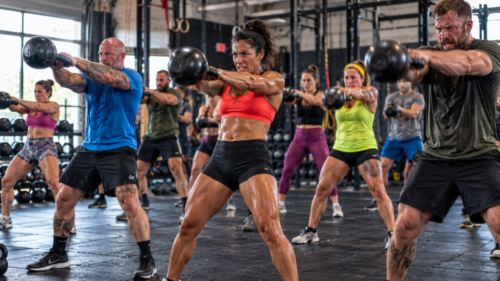
Diverse group of athletes performing kettlebell swings in unison during a high-intensity gym class.

Once a specialist strength tool, the kettlebell is now a familiar sight in gyms worldwide, from group classes to mainstream strength and conditioning.

Manufacturers followed the demand, producing everything from traditional cast-iron bells to standardised competition models and adjustable designs. The implement itself had changed very little; what changed was its reach.

Within a relatively short period, the kettlebell went from niche training tool to mainstream gym staple, used for strength, power, conditioning, sport and general fitness.

๐Ÿงญ History, Myth and the Modern Kettlebell

So who invented the kettlebell?

There probably is no satisfying single answer. Humans have trained with heavy objects for thousands of years, and kettlebell-like implements appeared in several cultures. But resemblance alone does not prove a direct historical line.

What we can trace far more clearly is the development of the Russian girya, its place within nineteenth-century physical culture, its evolution through Soviet kettlebell lifting and Girevoy Sport, and its eventual spread into modern international training.

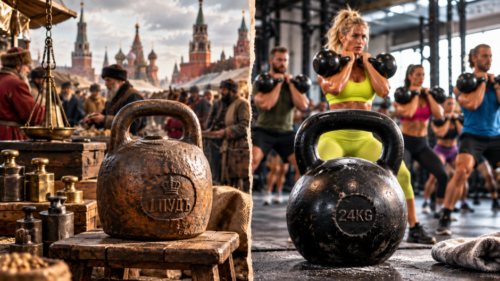
Split image showing an old Russian market weight beside a modern cast-iron kettlebell, with a contemporary kettlebell class performing double cleans in the background.

From marketplace weight to global training tool, the kettlebell has changed remarkably little in form while the ways we use it have evolved enormously.

That history is already interesting enough without turning every ancient handled weight into the worldโ€™s first kettlebell.

The kettlebell endured because it kept finding new purposes: from practical weight to strength implement, from physical culture to competitive sport, and from an Eastern European tradition to a global training tool.

The iron changed very little. What people learned to do with it changed enormously.

If you have enjoyed this post please share or feel free to comment below ๐Ÿ™‚

๐Ÿ”— Our Other Posts

Leave a Reply

Your email address will not be published. Required fields are marked *

This site uses Akismet to reduce spam. Learn how your comment data is processed.

error: Content is protected !!

Join the Super Soldier Project Mailing List Today!!