🏗️ SSP Foundations
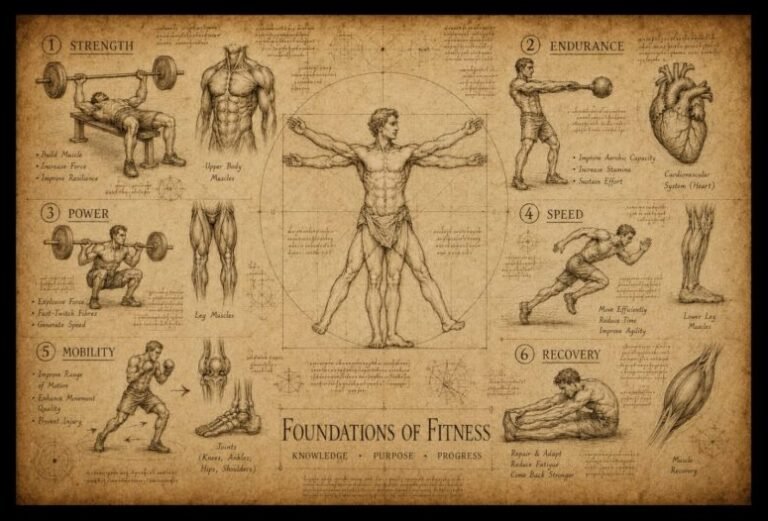
Every fitness journey is built on the same core principles. Whether you’re new to training or looking to deepen your understanding, this guide explains the key concepts, terminology, and training fundamentals you’ll encounter throughout Super Soldier Project.
Table of Contents
🔍 Introduction
Whether you’re new to fitness or simply unfamiliar with a particular term, this page is designed to help you understand the core concepts you’ll encounter throughout Super Soldier Project.
From Progressive Overload and Recovery to HIIT, Energy Systems, and Training Variables, these principles form the foundation of effective training regardless of your goal.
You don’t need to read this page from start to finish. Instead, use it as a quick reference whenever you come across a concept you’d like to understand better.
The stronger your understanding of these fundamentals, the easier it becomes to train smarter, make informed decisions, and get the most from your workouts.
🧭 Principles of Training
Regardless of whether your goal is strength, fat loss, muscle gain, athletic performance, martial arts, or general health, every successful training programme is built upon a handful of core principles.
These principles explain how the body adapts to exercise, why progress occurs, and what separates effective training from wasted effort.
Understanding them will help you train smarter, avoid common mistakes, and get better results from your efforts.
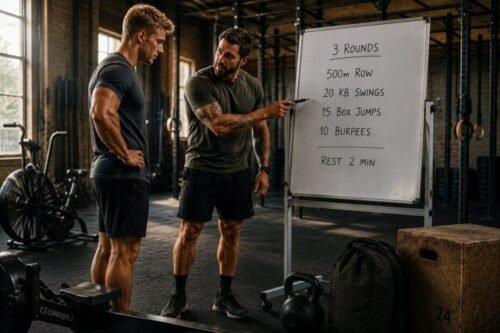
In this section we’ll cover:
- Specificity – Train for the goal.
- Progressive Overload – Gradually increase demands.
- Adaptation – How the body responds to stress.
- Recovery – Where improvement actually occurs.
- Consistency – Small efforts repeated over time.
- Diminishing Returns – Why progress slows as you improve.
- Individual Differences – Why everybody responds differently.
Master these principles and you’ll understand the foundation upon which all fitness is built.
📖 Toggle to Read More:
🎯 Specificity
The principle of specificity is simple:
You get better at what you train.
If you want to build strength, you must train for strength. If you want to improve endurance, you must train for endurance. Practice a sport or skill consistently, and your body becomes more efficient at performing it.
This is why different athletes train differently. A powerlifter, marathon runner, boxer, and Hyrox athlete all have different physical demands, so their training reflects those demands.
General fitness has its place, but as you move towards a specific goal, your training should increasingly focus on the qualities needed to achieve it.
Ask yourself one simple question: “Does my training match the results I want to achieve?” If the answer is yes, you’re training with purpose.
📈 Progressive Overload
The body adapts remarkably well to training. Over time, exercises that once felt difficult become easier as strength, endurance, skill, and fitness improve.
To continue progressing, the body must be given a new challenge. This principle is known as Progressive Overload. In simple terms, to improve, you must gradually ask more of your body over time.
Progressive Overload doesn’t simply mean lifting heavier weights. Progress can also come from performing more repetitions, completing additional sets, improving technique, increasing training volume, reducing rest periods, or progressing to a more challenging exercise.
The key is gradual progression. Small, consistent improvements are far more effective than making large jumps that lead to injury, excessive fatigue, or burnout.
Small, consistent improvements produce big results over time.
🔄 Adaptation
Every workout places stress on the body. In response, the body attempts to become better equipped to handle that stress in the future. This process is known as Adaptation.
Whether your goal is strength, endurance, muscle gain, or athletic performance, improvement occurs because the body responds to the demands placed upon it. Lift weights and muscles become stronger. Run regularly and your cardiovascular system becomes more efficient. Practise a skill repeatedly and movement becomes smoother and more coordinated.
As your body adapts, the same workout becomes less effective. Continued improvement therefore requires a new challenge through Progressive Overload, balanced with adequate Recovery.
Adaptation is the body’s natural response to training. Every improvement in fitness begins with this process.
⚖️ Recovery
Many people assume that fitness improvements occur during training. In reality, training provides the stimulus, but Recovery is where Adaptation takes place.
Every workout places stress on the body. Recovery allows muscles, joints, the nervous system, and energy stores to repair and rebuild, helping you return stronger and better prepared for future training.
How well you recover is influenced by factors such as sleep, nutrition, hydration, stress, and training load. When these are neglected, fatigue accumulates, performance declines, and the risk of injury increases.
Recovery doesn’t mean doing nothing. Light activity such as walking, mobility work, stretching, or easy cardio can often support the recovery process while keeping the body moving.
Training provides the stimulus. Recovery is where the results are earned.
🔁 Consistency
The most effective training programme in the world is useless if you cannot stick to it. While people often search for the perfect workout, diet, or training method, long-term success is usually built upon something far simpler: Consistency.
Fitness is rarely determined by what you do occasionally. It’s determined by what you do consistently. The most successful people don’t rely on motivation alone—they build habits and routines they can maintain over the long term.
Consistency also allows the other principles of training to work. Progressive Overload, Adaptation, and Recovery all depend on showing up regularly over time. One outstanding workout won’t transform your fitness, but months of steady training will.
Perfection isn’t the goal. Everyone misses sessions because of work, holidays, illness, or life getting in the way. What matters is getting back on track rather than giving up altogether.
Consistency beats perfection. Every time.
📉 Diminishing Returns
Progress is often fastest when you first begin training. As your fitness improves, however, further gains become increasingly difficult to achieve. This is known as the principle of Diminishing Returns.
When you first begin training, your body responds quickly to a new stimulus, leading to rapid improvements in strength, fitness, and skill. As you become more experienced, those gains naturally begin to slow. Progress is still possible, but it usually requires smarter programming, greater consistency, and closer attention to Recovery.
This is why elite athletes devote so much time and effort to achieving marginal gains. At higher levels, even small improvements can make a meaningful difference.
Slower progress isn’t a sign that your training has stopped working—it’s often a sign that you’re becoming more advanced.
The closer you get to your potential, the harder every improvement becomes—but every improvement is still worth pursuing.
🧱 Plateau
A Plateau is a period in which progress slows significantly or appears to stop altogether. You may stop lifting heavier weights, improving your times, gaining muscle, losing body fat, or noticing changes in your fitness despite continuing to train.
Plateaus are a normal part of the training process. They often occur because the body has adapted to its current routine, but they can also result from accumulated fatigue, insufficient Recovery, poor nutrition, stress, or inconsistent training.
Before making major changes, take a step back and assess the bigger picture. You may need to adjust your Load, Volume, Intensity, Frequency, exercise selection, or recovery habits. Sometimes, reducing training through a short deload is more effective than simply doing more.
It’s also important to distinguish a plateau from Diminishing Returns. As you become more experienced, progress naturally slows. That doesn’t mean progress has stopped—it simply means improvements take longer to achieve.
A plateau isn’t the end of progress—it’s a signal to reassess, recover, and adapt.
👤 Individual Differences
No two people respond to training in exactly the same way. Age, genetics, training history, lifestyle, recovery ability, injury history, and personal goals all influence how quickly someone progresses and which training methods work best.
One of the biggest mistakes in fitness is assuming that what works for one person will work equally well for everyone. This is why beginners and experienced athletes rarely follow the same programmes, and why copying someone else’s routine doesn’t always produce the same results.
The principles of training—such as Progressive Overload, Adaptation, Recovery, and Consistency—apply to everyone. What differs is how those principles are applied to meet individual needs, goals, and circumstances.
Rather than searching for the “perfect” programme, focus on finding one that fits your goals, lifestyle, and ability to recover.
The best training programme is the one that works for you—not someone else.
💪 Understanding Muscle Actions
Every movement you perform relies on your muscles producing force in different ways. Whether you’re lifting a weight, lowering it under control, or holding a position, your muscles are constantly contracting to create or resist movement.
Understanding these different muscle actions will help you better understand exercise technique, training methods, and how the body responds to different types of physical activity.

📖 Toggle to Read More:
⬆️ Concentric Contractions
A concentric contraction occurs when a muscle shortens while producing force. This is often referred to as the “lifting” phase of an exercise, where you move a weight against resistance. Examples include standing up from a squat, pressing a barbell during a bench press, or pulling yourself upwards during a pull-up.
In many exercises, this is the phase people naturally think of as the “working” part because it involves lifting, pushing, or pulling against a load. Concentric contractions are important for developing strength, power, and athletic performance, but they are only one part of a complete movement. The eccentric and isometric phases are equally important for building strength, control, and stability.
Concentric contractions generate movement by overcoming resistance.
⬇️ Eccentric Contractions
An eccentric contraction occurs when a muscle lengthens while still producing force. This is often referred to as the “lowering” phase of an exercise, where the muscle controls the movement rather than simply letting gravity take over. Examples include lowering into a squat, bringing a barbell back to your chest during a bench press, or descending from a pull-up.
Although many people focus on lifting a weight, the lowering phase is just as important. Controlled eccentric movements help maintain good technique, absorb force, and place the muscles under significant tension. Eccentric training is widely used to develop strength and muscle growth, and it is one of the main reasons you may experience muscle soreness after unfamiliar or demanding exercise.
Eccentric contractions control movement by resisting a load as the muscle lengthens.
🧱 Isometric Contractions
An isometric contraction occurs when a muscle produces force without changing length. In simple terms, the muscle is working, but there is little or no visible movement. Common examples include planks, wall sits, and holding a weight in a fixed position.
Unlike concentric and eccentric contractions, isometric exercises generate tension without movement at the joint. Holding a position for time develops muscular endurance, stability, and body control, while reinforcing proper positioning during movement. Isometric training is commonly used to improve posture, strengthen stabilising muscles, and build strength at specific joint angles.
Isometric contractions build strength by maintaining tension without movement.
⏱️ Time Under Tension
Time Under Tension (TUT) refers to how long a muscle remains under load during a set. Rather than focusing solely on the number of repetitions performed, Time Under Tension considers how much time the muscle spends working. A set of 10 controlled repetitions will usually place the muscle under tension for much longer than 10 rushed repetitions.
Every repetition includes time spent lifting, lowering, and sometimes pausing during an exercise. Slowing a movement—particularly the eccentric phase—or adding brief pauses increases the amount of time your muscles spend working, even if the number of repetitions stays the same. This is one way of making an exercise more challenging without increasing the weight.
Time Under Tension isn’t about doing more reps—it’s about making each rep count.
📌 Related Concepts
⏱️ Tempo
Tempo refers to the speed at which you perform each repetition. Changing the tempo can alter an exercise’s difficulty, increase Time Under Tension, and influence the overall training effect without changing the load.
⚖️ Stability
Stability is the ability to maintain control of your body or a joint during movement. Good stability supports efficient technique, improves balance, and helps reduce the risk of injury.
📏 Range of Motion (ROM)
Range of Motion (ROM) describes how far a joint moves during an exercise or everyday activity. Performing exercises through an appropriate range of motion can improve strength, mobility, and movement quality.
📊 Fitness Attributes
Fitness is not a single quality. It is made up of a number of different physical attributes, each contributing to overall performance, health, and capability.
Some activities require strength and power. Others rely on endurance, speed, mobility, or coordination. Understanding these attributes can help you identify your strengths, weaknesses, and training priorities.

In this section we’ll cover:
- Strength – The ability to produce force.
- Muscular Endurance – The ability to sustain repeated effort.
- Cardiovascular Endurance – The ability to sustain activity over time.
- Power – The ability to produce force quickly.
- Speed – The ability to move rapidly.
- Agility – The ability to change direction efficiently.
- Coordination – The ability to perform movements smoothly and accurately.
- Balance – The ability to maintain control and stability.
- Mobility – The ability to move freely through a range of motion.
- Flexibility – The ability of muscles and tissues to lengthen.
- Body Composition – The proportion of fat, muscle, bone, and other tissues that make up the body.
Mastering these attributes can improve sporting performance, enhance everyday function, and help create a more well-rounded level of fitness.
📖 Toggle to Read More:
🏋️ Strength
Strength is the ability to produce force against resistance. It underpins many physical activities, from lifting weights and carrying shopping bags to sprinting, climbing, and athletic performance.
While often associated with the gym, strength plays an important role in both sport and everyday life. Resistance training is the most effective way to develop it, gradually increasing your muscles’ ability to produce greater force as the demands placed upon them increase.
Strength is also relative to the individual. For a beginner, small improvements can make everyday tasks noticeably easier. More experienced athletes often require greater effort and more structured training to continue progressing.
Whatever your goal—improving health, building muscle, enhancing athletic performance, or simply making everyday life easier—a solid foundation of strength is almost always beneficial.
Strength is the foundation upon which many other physical qualities are built.
🔋 Muscular Endurance
Muscular Endurance is the ability of a muscle or group of muscles to perform repeated contractions over an extended period. Rather than focusing on maximum force, it is concerned with how long a muscle can continue working before fatigue becomes a limiting factor.
While Strength determines how much force a muscle can produce, Muscular Endurance determines how long it can continue producing that force. It is an important quality in activities involving repeated effort, from endurance sports and bodyweight training to physically demanding jobs and everyday tasks.
Muscular Endurance is typically developed through higher-repetition resistance training, sustained exercise, and repeated bouts of work over time. As it improves, you’ll often find you can maintain good technique, recover more effectively between efforts, and perform physical activities with less fatigue.
Muscular endurance isn’t about how hard you can work—it’s about how long you can keep working.
❤️ Cardiovascular Endurance
Cardiovascular Endurance is the ability of the heart, lungs, and circulatory system to supply oxygen to working muscles during prolonged activity. Often referred to simply as cardio fitness, it allows you to sustain physical effort for longer periods without excessive fatigue.
Your cardiovascular system delivers oxygen and nutrients to working muscles while helping remove waste products. The more efficiently it works, the longer you can sustain physical activity before fatigue begins to limit performance.
Cardiovascular Endurance is developed through activities such as running, cycling, swimming, rowing, or brisk walking. Improving it doesn’t just benefit endurance sports—it can increase energy levels, improve recovery between efforts, support long-term health, and make everyday activities feel less demanding.
Whether you’re training for a marathon, Hyrox, martial arts, or simply a healthier lifestyle, a strong cardiovascular system provides the foundation for sustained physical performance.
A strong engine makes every journey easier.
⚡ Power
Power is the ability to produce force quickly. While Strength is concerned with how much force you can generate, Power is concerned with how fast you can generate it. This makes power an important attribute in sports and activities that require speed and explosiveness.
Power combines strength and speed. An athlete may be extremely strong, but if they cannot generate force rapidly, they won’t be particularly powerful. Likewise, speed without sufficient strength limits the amount of force that can be produced.
Power is developed through explosive movements such as sprinting, jumping, throwing, striking, plyometrics, Olympic lifting, kettlebell training, and sprint work. Although often associated with athletes, it is valuable for everyone, supporting both physical performance and the ability to move quickly in everyday life.
Power is strength applied at speed.
🚀 Speed
Speed is the ability to move the body, or parts of the body, as quickly as possible. It is a key component of many sports and physical activities, influencing performance in everything from sprinting and striking to team and combat sports. While genetics play a role, speed can be improved through targeted training.
When most people think of speed, they picture sprinting. In reality, speed takes many forms, from running and striking to changing direction or reacting quickly to a situation.
Speed is influenced by strength, power, technique, mobility, and the efficiency of the nervous system. Training methods such as sprint work, explosive drills, technical practice, and strength training can all improve movement efficiency and athletic performance.
Speed is more than moving fast—it’s moving fast with purpose and control.
⚖️ Body Composition
Body Composition refers to what your body is made up of. Rather than focusing solely on bodyweight, it looks at the proportion of muscle, fat, bone, water, and other tissues that make up the body. Two people can weigh exactly the same yet have very different body compositions and levels of fitness.
Many people judge their progress by bodyweight alone, but the scales only tell part of the story. It’s possible to lose body fat while gaining muscle, resulting in little or no change on the scales despite significant improvements in appearance, performance, and overall health.
Body composition is influenced by factors such as training, nutrition, genetics, age, and lifestyle. Rather than chasing the lowest possible body fat percentage, aim for a body composition that supports your health, performance, and personal goals.
The scales tell you how much you weigh. Body composition tells you what that weight is made of.
📌 Other Fitness Attributes
The attributes above are among the most commonly discussed throughout Super Soldier Project, but they are not the only qualities that contribute to overall fitness.
Other important attributes include:
- 🔄 Agility – The ability to change direction quickly and efficiently.
- 🤝 Coordination – The ability to perform movements smoothly and accurately.
- ⚖️ Balance – The ability to maintain stability while stationary or moving.
- 🤸 Flexibility – The ability of muscles and connective tissues to lengthen through a range of motion.
Although these qualities may not receive the same level of attention as strength, endurance, or mobility, they remain important for many sports, activities, and everyday movement.
⚡ Energy Systems
Most physical activities rely on energy. Whether you’re sprinting, lifting weights, running a marathon, or competing in Hyrox, your body must constantly produce fuel to power movement.
To do this, the body uses three primary energy systems. Each contributes differently depending on the intensity and duration of the activity being performed.
Understanding these systems can help explain why different sports require different training methods and why no single type of exercise develops every aspect of fitness.
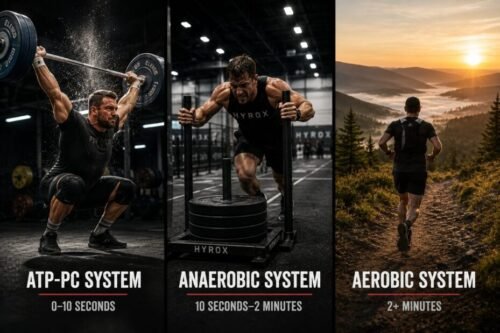
In this section we’ll cover:
- ATP-PC System – Short, explosive efforts.
- Anaerobic System – High-intensity efforts lasting up to several minutes.
- Aerobic System – Sustained activity over longer periods.
Although these systems are discussed separately, they rarely work in isolation. Most activities rely on a combination of all three.
📖 Toggle to Read More:
💥 ATP-PC System
The ATP-PC System is the body’s fastest and most powerful energy system. It provides immediate energy for short bursts of maximum effort lasting roughly 0–10 seconds, powering explosive movements such as sprinting, jumping, throwing, and heavy lifting.
It uses small stores of energy already available within the muscles, allowing the body to produce maximum power almost instantly. The trade-off is that these energy stores are very limited, so after only a few seconds of all-out effort the body must begin relying more on its Anaerobic and Aerobic energy systems.
The ATP-PC System is most active during explosive activities and is typically trained through brief, high-intensity efforts followed by adequate recovery.
The ATP-PC System is your body’s instant power source for short, explosive efforts.
🔥 Anaerobic System
The Anaerobic System provides energy for high-intensity efforts lasting longer than the ATP-PC System can sustain. It becomes increasingly important during hard work lasting from roughly 10 seconds to a few minutes, where intensity remains high but maximum power cannot be maintained.
As the body’s immediate energy stores begin to run low, the Anaerobic System takes over to fuel continued high-intensity exercise. Unlike the Aerobic System, it can produce energy rapidly without relying primarily on oxygen, although it can only sustain this level of effort for a limited time before fatigue begins to build.
The Anaerobic System is heavily involved in activities such as interval training, rowing, combat sports, Hyrox, and other demanding workouts involving repeated bursts of effort. Training it improves your ability to work hard, tolerate fatigue, and recover between intense efforts.
The Anaerobic System keeps you going when the effort is too intense for your Aerobic System alone.
🫀 Aerobic System
The Aerobic System is the body’s primary source of energy during longer-duration activities. It uses oxygen to produce energy and can continue supplying fuel for extended periods, making it essential for endurance, recovery, and overall fitness.
The Aerobic System produces energy more slowly than the ATP-PC and Anaerobic Systems, but its greatest strength is endurance. As long as oxygen is available, it can continue supplying energy for extended periods.
It powers activities such as running, cycling, swimming, rowing, hiking, and other forms of steady-state exercise. It also plays an important role in recovery between repeated bursts of high-intensity effort, making it valuable for both endurance athletes and those simply looking to improve their overall fitness.
The Aerobic System is your body’s endurance engine, keeping you moving long after the other energy systems begin to fade.
🎛️ Training Variables
Training is not just about choosing exercises. The way those exercises are performed can dramatically influence the results you achieve.
These factors are known as training variables.
By adjusting them, you can make a workout easier or harder, increase strength, build muscle, improve endurance, or develop sport-specific fitness.
Understanding these variables gives you greater control over your training and helps explain why different programmes produce different outcomes.
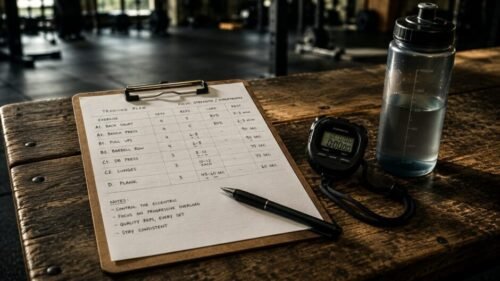
In this section we’ll cover:
- Sets – How many groups of repetitions you perform.
- Repetitions (Reps) – How many times you perform a movement.
- Load – The amount of resistance used.
- Volume – The total amount of work performed.
- Intensity – How hard the effort is.
- Frequency – How often you train.
- Rest Periods – Recovery between efforts.
These variables can be manipulated individually or together to create almost endless training possibilities.
📖 Toggle to Read More:
🔢 Repetitions (Reps)
A repetition, or rep, is a single complete performance of an exercise. Each time you perform a movement and return to the starting position, you have completed one repetition. Repetitions are one of the simplest ways to measure training volume and track progress.
Different repetition ranges are often used to emphasise different training goals. Lower repetitions are commonly associated with Strength, moderate repetitions with muscle growth, and higher repetitions with Muscular Endurance.
However, repetitions are only one part of the picture. The amount of weight used, the number of Sets performed, the effort involved, and your overall training programme all influence the results you achieve.
A repetition is one complete movement—the building block of every set.
📚 Sets
A set is a group of repetitions performed consecutively before taking a rest. Sets help organise training, manage workload, and provide a simple way to measure how much work is being performed during a workout. Most exercises are performed for multiple sets rather than a single effort.
Sets organise repetitions into manageable blocks, making it easier to structure a workout and monitor training volume. For example, if you perform 10 squats, rest, and then repeat the process three times, you’ve completed 3 sets of 10 repetitions.
The number of sets you perform influences the total amount of work completed during a session. The ideal number of sets depends on your goals, the exercise being performed, and your ability to recover between sessions.
Repetitions measure the work. Sets organise the work.
📦 Load
Load refers to the amount of resistance used during an exercise. In Strength Training this is usually measured as weight on a barbell, dumbbell, kettlebell, or machine. In bodyweight training, load can also be influenced by leverage, exercise difficulty, or additional resistance.
Increasing the load generally makes an exercise more challenging, while reducing it makes the movement easier. Adjusting load is one of the simplest ways to apply Progressive Overload, but heavier isn’t always better. The right load depends on your goal, whether that’s building Strength, developing Muscular Endurance, improving technique, or recovering from injury.
Load isn’t just the weight you lift—it’s the resistance you overcome.
📊 Volume
Volume refers to the total amount of work performed during training. It is one of the most important training variables because it has a major influence on fitness, performance, Recovery, and Adaptation.
In simple terms, volume is how much work you do.
Volume can be measured in different ways depending on the type of training. In resistance training, it’s commonly calculated using sets × repetitions × load. In endurance activities, it is often measured by distance, duration, or total weekly mileage.
Increasing training volume generally provides a greater stimulus for improvement. However, more isn’t always better. The goal is to perform enough work to stimulate progress while still allowing adequate time for recovery and adaptation.
Volume isn’t about doing as much as possible—it’s about doing enough to improve.
🔥 Intensity
Intensity refers to how hard an exercise or training session is. While Volume measures how much work you do, Intensity measures how demanding that work is. The two often work together, but they are not the same thing.
The meaning of intensity depends on the type of training. In strength training, it often relates to the amount of weight being lifted relative to your maximum ability. In cardio and conditioning, it usually refers to your level of effort, pace, or heart rate.
A short sprint is an example of high intensity and low volume, while a long walk is low intensity but may involve high volume. Most effective training programmes combine both hard and easy sessions to achieve consistent long-term progress.
Volume is how much you do. Intensity is how hard you do it.
📅 Frequency
Frequency refers to how often you train. It can describe how many workouts you perform each week, how often you train a specific muscle group, or how frequently you practise a particular skill. Finding the right balance between training and Recovery is an important part of effective programme design.
Training more often provides more opportunities to improve, but only if your body has enough time to recover between sessions. The ideal frequency depends on your goals, training experience, and ability to recover.
Rather than trying to train as often as possible, aim for a schedule you can maintain consistently over the long term.
The best training frequency isn’t the highest—it’s the one you can recover from and sustain consistently.
😮💨 Rest Periods
Rest Periods are the recovery intervals taken between sets, exercises, or training sessions. Although often overlooked, they are an important training variable that can influence Strength, muscle growth, Muscular Endurance, performance, and Recovery.
Rest periods give your body time to recover between efforts, allowing you to maintain performance throughout a workout. Longer rest periods are often used during Strength and Power training, while shorter rest periods increase fatigue and are commonly used in conditioning and muscular endurance training.
The key is matching your rest periods to the purpose of the session rather than using the same recovery time for every workout.
How you rest is part of how you train.
📌 Related Concepts
🎯 Rate of Perceived Exertion (RPE)
Rate of Perceived Exertion (RPE) is a simple way of measuring how hard an exercise feels. Most strength training uses a scale from 1–10, where 10 represents maximum effort and 1 represents very light activity. RPE allows you to adjust training intensity based on how you feel on a given day rather than relying solely on fixed weights or percentages.
🏋️ Reps in Reserve (RIR)
Reps in Reserve (RIR) estimates how many more repetitions you could have completed before reaching muscular failure. For example, finishing a set with 2 RIR means you believe you could have performed two more good-quality repetitions. RIR is commonly used alongside RPE to help manage training intensity, recovery, and progressive overload.
❤️ Cardio & Conditioning
Many people use the terms cardio and conditioning interchangeably, but they are not quite the same thing.
Cardio focuses primarily on improving the efficiency of the heart, lungs, and circulatory system. Conditioning is broader, encompassing your ability to perform work, recover from effort, and sustain performance over time.
Whether your goal is health, sport, fat loss, Hyrox, martial arts, or general fitness, both play an important role.
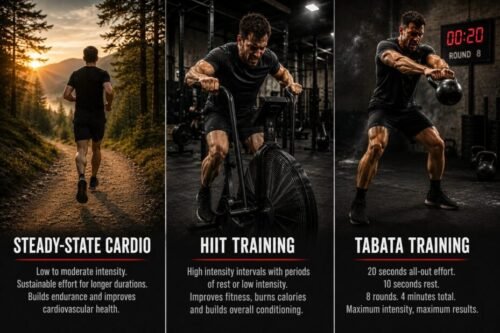
In this section we’ll cover:
- Steady-State Cardio.
- High-Intensity Interval Training (HIIT).
- Tabata Training.
- Aerobic Base Training.
- Work Capacity.
- VO₂ Max.
Understanding these concepts will help you choose the right conditioning method for your goals.
📖 Toggle to Read More:
🚶 Steady-State Cardio
Steady-State Cardio involves maintaining a consistent pace and effort level for an extended period. Examples include walking, jogging, cycling, rowing, swimming, or hiking at a sustainable intensity. It remains one of the simplest and most effective ways to improve cardiovascular fitness.
Steady-state cardio is typically performed at a pace you can maintain comfortably, often while still being able to hold a conversation. This type of training primarily develops the Aerobic System, improving endurance, cardiovascular health, and your ability to recover between harder efforts.
Although high-intensity workouts often receive more attention, steady-state cardio remains one of the best ways to build a strong aerobic foundation. It places relatively low stress on the body, making it suitable for regular training and active recovery.
Build your engine first. Everything else becomes easier.
⚡ High-Intensity Interval Training (HIIT)
High-Intensity Interval Training (HIIT) involves alternating short periods of hard work with periods of recovery. Rather than maintaining a steady pace, HIIT repeatedly pushes the body to work at a high intensity before allowing partial recovery and repeating the process. It is a popular and time-efficient method of improving fitness and conditioning.
The defining feature of HIIT is alternating periods of high-intensity effort with short recovery intervals. This allows you to work harder than you could if exercising continuously.
HIIT can improve cardiovascular fitness, conditioning, and work capacity in relatively short training sessions. Because it places significant demands on the body, it should be balanced with lower-intensity training and adequate Recovery.
HIIT isn’t about training for longer—it’s about making every minute count.
⏱️ Tabata Training
Tabata is a specific form of interval training that alternates 20 seconds of work with 10 seconds of rest, repeated for eight rounds. A complete Tabata lasts just four minutes, but when performed correctly it can be extremely demanding.
Tabata is a specific HIIT protocol that challenges both the Aerobic and Anaerobic energy systems. Although the workout is brief, maintaining a high level of effort throughout every interval makes it surprisingly demanding.
It can be performed using a wide variety of exercises and is often used as a standalone workout, a conditioning finisher, or when training time is limited.
Four minutes may not sound like much—but done properly, Tabata is anything but easy.
📌 Related Concepts
🫀 Aerobic Base
Your aerobic base is the foundation of your cardiovascular fitness. Developing it improves endurance, supports recovery between harder efforts, and makes sustained physical activity feel easier.
💪 Work Capacity
Work capacity is your ability to perform work and recover from it. Improving work capacity allows you to train harder, recover more quickly between efforts, and sustain higher workloads over time.
🫁 VO₂ Max
VO₂ Max measures the maximum amount of oxygen your body can utilise during intense exercise. It is commonly used as an indicator of cardiovascular fitness and endurance potential.
Sign up today and receive a FREE pdf booklet on Callisthenics and Bodyweight Workouts!!!