Protein powders, creatine, pre-workouts, fat burners and countless other supplements promise better results. But which ones actually deliver? We cut through the marketing, examine the science and reveal which supplements are worth considering, which are overhyped and how to use them effectively.
📑 Table of Contents
🔥 Supplements Are the Final Few Percent
Walk into any supplement shop and it can look as though progress depends on what is in the tub. Protein powders promise muscle growth, pre-workouts promise harder sessions, fat burners promise easier weight loss, and an ever-growing collection of amino acids, vitamins, herbs and extracts claims to improve everything from recovery to concentration.
Some supplements are genuinely useful. A smaller number have strong enough evidence to improve performance in the right circumstances, while others can help correct a nutritional deficiency or simply make a good diet easier to follow. The problem is that these very different products are often marketed as though they all belong in the same category.
Not every supplement deserves equal confidence. Effectiveness, individual needs and practical value all matter.
They do not. Creatine monohydrate, caffeine and a protein shake used for convenience deserve a very different level of confidence from a proprietary fat burner, testosterone booster or fashionable herbal blend. The purpose of this guide is to separate those categories and show where supplementation can genuinely help.
👇 Click on links below for more
🥗 Start With the Foundation
Supplements sit on top of the nutrition and training programme. Enough food, adequate protein and carbohydrate, micronutrient-rich meals, hydration, progressive training and sufficient recovery still account for the overwhelming majority of what drives progress.
Creatine cannot rescue a badly designed strength programme. Caffeine may improve today’s workout, but repeatedly using it to compensate for poor sleep will eventually create another problem. Protein powder is useful when it helps you reach your protein target, but it does not become superior nutrition simply because it comes in a shaker.
This is also why the word supplement matters. These products are supposed to add something useful to an already functioning diet or solve a specific practical problem. When powders and capsules begin replacing the foundations, the priorities have been turned upside down.
🧪 The Evidence Is Not Equal
One of the biggest mistakes in supplement advice is giving every product roughly equal attention. A supplement shop may place creatine beside BCAAs, an electrolyte drink beside a fat burner, or caffeine beside a proprietary “muscle matrix”, but those products do not have comparable evidence behind them.
Some ingredients have been studied repeatedly across different groups and sporting situations. Others have interesting early research but much less certainty. A third group survives largely because the biological explanation sounds convincing, the marketing is aggressive or people can physically feel something after taking it.
Feeling a supplement does not necessarily mean it is improving performance. The tingling produced by beta-alanine, the stimulant rush from a high-caffeine pre-workout or the sweating produced by a thermogenic formula may make a product feel powerful without telling you how much useful adaptation or fat loss it is actually producing.
⚙️ Mechanism Versus Meaningful Result
Sports nutrition is full of ingredients that can influence something measurable inside the body. A compound may alter a hormone, increase fat oxidation, affect blood flow or activate a cellular pathway. Those findings can help explain how a supplement might work, but they do not automatically prove that taking it produces a meaningful improvement in the gym or on the track.
For the person buying the supplement, the more useful question is what happened to strength, muscle gain, endurance, recovery or body composition when the product was properly tested. A tiny change in a laboratory marker matters far less if nobody can demonstrate a worthwhile difference in actual performance.
This is where supplement marketing frequently outruns the research. An interesting mechanism becomes a performance claim, the claim becomes a selling point, and before long an optional ingredient is presented as something every serious trainee supposedly needs.
🥇 The Supplements Most People Should Actually Know About
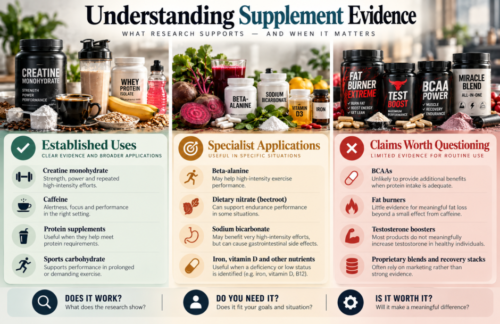
For the average person lifting weights, running, doing CrossFit or training for general fitness, the list of supplements worth serious attention is surprisingly short. Protein powder, creatine monohydrate and caffeine cover most of the common reasons people reach for supplements: meeting protein needs, improving repeated high-intensity performance and supporting training output when it matters.
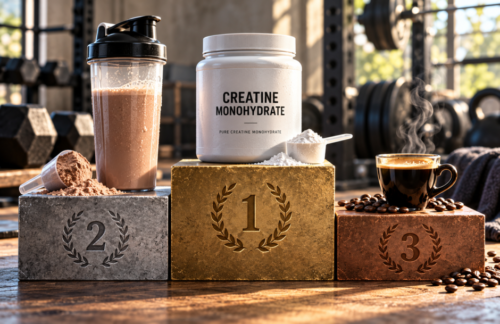
Creatine, protein and caffeine are among the standout options in sports nutrition, each with a different job to do.
That does not mean everybody needs all three. Protein powder may be unnecessary if the diet already provides enough protein, creatine is most obviously useful for resistance training and repeated high-intensity work, and caffeine is a poor choice for someone who is highly sensitive to stimulants. The point is that these products have clear purposes and considerably stronger evidence than most of what surrounds them on the supplement shelf.
🥛 Protein Powder — Convenient Food
Protein powder is probably the least complicated supplement in this guide. Whey, casein and good plant-based powders provide dietary protein in a convenient form, supplying amino acids that contribute towards the same overall protein target as meat, fish, eggs, dairy, legumes and other protein-rich foods.
For anyone training regularly, daily protein intake matters far more than whether that protein came from a shaker or a plate. A protein shake becomes useful when work, travel, appetite or convenience makes another meal awkward, or when someone simply struggles to reach an appropriate intake through food alone. That makes protein powder useful without making it nutritionally magical.
The old idea that you must drink a shake immediately after training has been exaggerated. Total daily protein intake and regular protein-containing meals matter far more than hitting a tiny post-workout window. If a normal protein-rich meal is coming soon, there is no emergency; if the next meal is several hours away, a shake becomes an easy solution.
Whey protein is popular because it is easy to use, digests well for many people and provides a strong essential-amino-acid profile. Casein digests more slowly, while well-formulated plant proteins can also work effectively. The practical choice comes down to dietary preference, digestion, taste, cost and whether the product helps you meet your daily target comfortably.
If you already eat enough protein without thinking about it, adding several shakes will not automatically produce more muscle. Protein powder earns its place through convenience, not superiority over food.
💥 Creatine Monohydrate
Creatine is different because it can improve performance even when the underlying diet is already well organised. The body stores creatine mainly inside skeletal muscle, where it forms part of the phosphocreatine system used to rapidly regenerate ATP during short, intense efforts.
ATP is the immediate energy source used for muscular work. During maximal lifting, sprinting or repeated high-intensity efforts, available ATP and phosphocreatine are used rapidly. Increasing muscle creatine stores helps replenish ATP more quickly between efforts, allowing slightly more high-intensity work to be performed before fatigue takes over.
That extra capacity may look small within a single set, but repeated across weeks and months of training it can contribute to greater training volume, strength development and gains in lean mass. This is why creatine has particular value for resistance training, sprinting, repeated efforts, combat sports and high-intensity conditioning.
👇 Click on links below for more on Creatine
✅ Stick With Monohydrate
Supplement companies sell creatine in numerous forms, including hydrochloride, buffered products and various branded formulations. For most people, there is little reason to move beyond creatine monohydrate.
Monohydrate is the form with the deepest research base, it is widely available and usually inexpensive. More exotic versions may sound more advanced, but they have not demonstrated a consistent practical advantage large enough to justify replacing the standard product.
This is one area where boring is good.
⚖️ How Much Do You Need?
A straightforward approach is 3–5 g per day. Taken consistently, this gradually increases muscle creatine stores and avoids the need for a complicated protocol.
A loading phase can speed the process by taking around 20 g per day, usually split into four smaller doses, for roughly five to seven days before moving to the usual maintenance dose. Loading is optional. Taking 3–5 g per day from the start will still increase muscle creatine stores; it simply takes longer.
Consistency matters far more than perfect timing. Creatine does not work like caffeine, where a dose produces an acute effect before a session. Its value comes from keeping muscle stores elevated over time.
💧 What About Water Weight?
Creatine often produces a small increase in bodyweight as muscle creatine stores rise and additional water is retained within muscle tissue. This is a normal part of creatine supplementation and should not be confused with gaining body fat.
For most gym-goers, this is not a problem. Athletes competing in strict weight categories need to think about it more carefully because even a modest change on the scale can affect weigh-ins or competition planning.
🩺 Is Creatine Safe?
Creatine monohydrate has been studied extensively and has a strong safety record in healthy adults when used at established doses. Current evidence does not support the claim that recommended creatine supplementation damages kidney function in healthy people.
Anyone with known kidney disease or another relevant medical condition should still seek appropriate medical advice before supplementing. Large loading doses can also cause stomach discomfort in some people, which is another reason many trainees simply use the lower daily dose and let muscle stores build gradually.
☕ Caffeine — Useful, Effective and Easy to Overdo
Caffeine is one of the most widely used performance aids in the world, whether it comes from coffee, tablets, energy drinks or a pre-workout powder. It acts mainly through the central nervous system, where it blocks adenosine receptors involved in tiredness and sleep pressure. The result can be greater alertness, reduced perception of effort and an improved ability to sustain demanding exercise.
That makes caffeine useful across a broad range of activities. Endurance athletes can benefit from being able to maintain pace despite rising fatigue, while lifters, combat athletes and people performing repeated high-intensity efforts may experience improvements in concentration, power or work capacity.
Caffeine can improve today’s workout, but poorly timed doses may compromise tonight’s recovery.
👇 Click on links below for more on Creatine
📏 How Much?
More caffeine does not automatically mean a better workout. Performance benefits can occur at relatively modest doses, with around 2–3 mg per kilogram of bodyweight providing a useful starting point for many athletes. Individual response varies considerably, and some people benefit from less.
Higher doses increase the likelihood of jitters, anxiety, elevated heart rate, gastrointestinal discomfort and disrupted sleep. Start conservatively rather than assuming that a stronger stimulant effect means a stronger performance benefit.
⏱️ Timing Matters
Unlike creatine, caffeine is used for an acute effect, so timing matters. Standard caffeine products are commonly consumed before exercise, although exact timing depends on the source and the individual.
The more important issue is whether caffeine is still active when you are trying to sleep. A late-afternoon pre-workout may improve one session and then damage recovery later that night.
😴 Protect Your Sleep
Caffeine can become a double-edged tool. One person can drink coffee in the afternoon and sleep normally, while another notices disrupted sleep from a much earlier dose. Habit, genetics and total daily caffeine all influence the response.
Pay attention to what happens after the workout, not only how energetic you feel during it. If caffeine repeatedly delays sleep or leaves you needing even more the next morning, it is beginning to work against the programme. Count caffeine from all sources across the day, including coffee, energy drinks and pre-workouts, rather than treating each one in isolation.
⚡ More Specialised Performance Aids
Beyond creatine and caffeine, several supplements have legitimate evidence behind them, but their usefulness depends much more heavily on the type of training being performed. For most recreational lifters, these are optional rather than essential.
👇 Click on links below for more
🔥 Beta-Alanine
Beta-alanine helps increase muscle carnosine, which contributes to buffering the build-up of hydrogen ions during very hard exercise. This makes it most relevant to sustained or repeated high-intensity efforts rather than low-intensity cardio or a single heavy lift.
It works through regular supplementation over time, not because you swallowed it twenty minutes before training. The familiar tingling sensation, known as paraesthesia, is simply a side effect and should not be mistaken for proof that a pre-workout is working.
Dietary Nitrate
Dietary nitrate is found naturally in foods such as beetroot and leafy green vegetables. In the body, nitrate can be converted to nitrite and then to nitric oxide, which influences blood flow, muscle function and exercise efficiency.
Concentrated beetroot products may help in certain endurance and high-intensity situations, although the response varies. For runners, cyclists and hybrid athletes chasing small gains, nitrate can be worth investigating. For the average gym-goer, it belongs much further down the priority list.
🧂 Sodium Bicarbonate
Sodium bicarbonate can increase blood bicarbonate and extracellular buffering capacity, which may help delay the effects of rising acidity during sustained or repeated high-intensity exercise.
The drawback is gastrointestinal distress. Useful amounts can cause bloating, nausea, stomach pain or diarrhoea, so anyone considering it for competition should test it carefully in training first.
This is a legitimate performance aid, but also a good example of why evidence-based does not mean everybody needs it.
🍌 Sports Foods & Intra-Workout Fuel
Some products sold alongside supplements are better understood as convenient forms of fuel and hydration. Gels, carbohydrate powders, sports drinks and electrolyte products can make it easier to meet energy and fluid needs when ordinary food or drink becomes impractical.
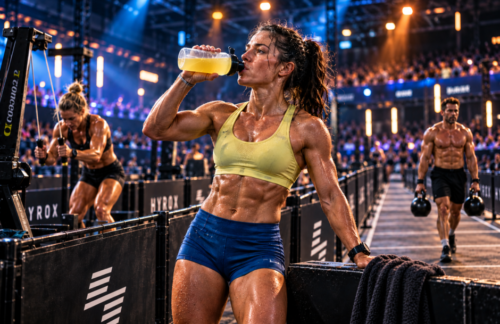
When the demands increase, fuelling and hydration strategies become increasingly important to performance.
Their usefulness depends heavily on session duration and intensity. A carbohydrate gel during a marathon may be extremely useful. The same gel during a short gym workout probably offers little beyond additional calories.
👇 Click on links below for more
🍬 Carbohydrate During Training
During prolonged or hard exercise, carbohydrate can help maintain blood glucose and support performance as glycogen stores are used. Sports drinks, gels and chews provide carbohydrate in forms that are easy to carry and consume while moving.
For most normal gym sessions, they are unnecessary. Their value increases during longer endurance work, repeated high-intensity sessions or competition.
💧 Electrolytes
Electrolyte products become more useful when sweat losses are high, particularly during prolonged exercise or hot conditions. Sodium is usually the main mineral of interest because it helps replace some of what is lost through sweat and supports fluid balance. Products vary considerably, however, so check the actual sodium content rather than assuming every electrolyte tablet or powder provides a meaningful amount.
Someone finishing a short indoor session with minimal sweating does not need the same strategy as someone running for two hours in the heat.
🏃 Practise Your Fuel
As covered in the Gut Health article, fuelling during exercise should be practised when larger carbohydrate intakes are involved. A gel that seems perfectly fine at home may feel very different ninety minutes into a hard run.
Long training sessions are therefore the place to test products, amounts and fluid intake. By competition day, the strategy should already be familiar.
🥈 Supplements That Depend on Your Needs
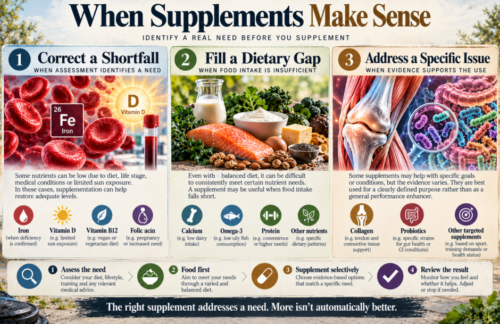
Some supplements can be useful without functioning as direct performance enhancers. Their value depends on the individual: correcting a nutrient shortfall, supporting a particular dietary pattern, addressing a specific problem or complementing rehabilitation.
The right supplement addresses a specific need. Taking more than necessary does not guarantee better results.
Iron, vitamin D and calcium are obvious examples where correcting inadequate intake or low status can restore normal function, but taking more once requirements are already covered does not automatically create an additional advantage.
👇 Click on links below for more
🩸 Iron
Iron is essential for haemoglobin and oxygen transport, so poor iron status can contribute to fatigue and reduced exercise capacity. Certain athletes are more vulnerable, particularly those with low dietary iron intake, heavy menstrual losses, low energy availability or high endurance-training loads.
That does not make iron a sensible “just in case” supplement. If deficiency is suspected, appropriate assessment and blood testing are far more useful than guessing.
☀️ Vitamin D
Vitamin D supports bone health, muscle function and immune function, and low status becomes more likely when sunlight exposure is limited.
Correcting low vitamin D status can be important for health and normal function. Once status is adequate, however, taking progressively more vitamin D should not be expected to produce additional performance benefits. This belongs in the category of nutritional support rather than direct ergogenic supplementation.
🦴 Calcium
Calcium is essential for bone health and normal muscle and nerve function. Most people should obtain the bulk of it from food, with supplementation becoming more relevant when dietary intake is consistently low or there is a specific clinical reason.
A calcium supplement cannot compensate for chronic under-fuelling or a wider diet that fails to support bone health and recovery.
🐟 Omega-3
The long-chain omega-3 fatty acids EPA and DHA are found mainly in oily fish and play important roles in general health. Supplementation may therefore be useful for people who rarely eat oily fish, using either fish oil or an appropriate algae-based source.
Research has explored possible effects on soreness and recovery, but omega-3 should not be treated as an essential sports supplement. Its strongest case is usually nutritional rather than performance-based.
🦵 Collagen
Collagen has attracted attention because it is a major structural protein in tendons, ligaments, cartilage and bone. Supplementation may have a supporting role in some connective-tissue rehabilitation strategies, particularly when combined with appropriate progressive loading.
The evidence is promising rather than definitive, and collagen should not be treated as a replacement for rehabilitation or confused with a complete protein for building muscle.
🦠 Probiotics
Different probiotic strains can produce different effects, so evidence for one product cannot automatically be applied to every capsule claiming to support the microbiome.
Some may help particular digestive problems, but there is little reason for every healthy athlete to take one routinely. Food variety, fibre, appropriate fuelling and individual tolerance remain the foundation.
🥉 Supplements You Probably Don’t Need
A large part of the supplement market consists of products with weak, inconsistent or highly context-dependent evidence. Some may still have niche uses, but for most trainees they belong well behind the fundamentals and the better-supported options covered earlier.
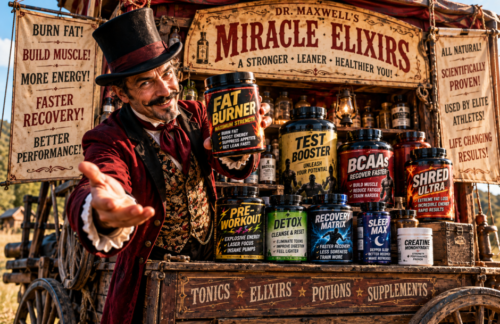
Miracle promises have been around for centuries. The packaging has changed, but the need for scepticism hasn’t.
👇 Click on links below for more
🧬 BCAAs
BCAAs are leucine, isoleucine and valine, three essential amino acids involved in muscle metabolism. The problem is that muscle protein synthesis requires all the essential amino acids, not just those three.
Anyone eating enough complete protein is already getting substantial amounts of BCAAs along with the other essential amino acids needed for repair and growth. EAA supplements provide the full set of essential amino acids, but they are still unnecessary for most people who already consume sufficient high-quality protein.
🌡️ Fat Burners
Fat burners commonly combine caffeine, green tea extract, CLA, L-carnitine and assorted stimulants. Some ingredients can influence energy expenditure or fat metabolism, but that does not translate into large or reliable reductions in body fat. Any effect on long-term fat loss is generally small compared with calorie intake, activity and adherence.
Caffeine often provides much of what the user actually feels. Increased alertness, sweating or heart rate can make the product seem powerful without demonstrating significant additional fat loss.
For most people, the money is better spent improving the diet than buying another thermogenic blend.
🌙 ZMA & Recovery Blends
ZMA combines zinc, magnesium and vitamin B6 and has long been marketed for better sleep, recovery and testosterone production.
Zinc and magnesium are important nutrients, but correcting a deficiency is different from enhancing recovery beyond normal levels in someone whose intake is already adequate. The same applies to multi-ingredient night-time recovery blends.
Sleep, sufficient food, adequate protein and sensible training volume remain far more influential than a bedtime supplement stack.
🌿 Adaptogens
Adaptogens such as ashwagandha, rhodiola and ginseng are marketed as helping the body handle physical or psychological stress. Some studies report potentially useful effects, particularly for ashwagandha and rhodiola, but results vary between products, doses and outcomes.
The evidence remains much less established than it is for creatine or caffeine. These products are better treated as optional experiments than foundations of a supplement programme.
There is little need to build an encyclopaedic stack of roots, mushrooms and extracts simply because each has an interesting mechanism.
💪 Testosterone Boosters
Products claiming to naturally increase testosterone deserve considerable scepticism. Correcting a genuine nutrient deficiency may restore normal physiology, but that is very different from pushing hormones above normal levels or producing steroid-like gains in muscle and strength.
For a healthy trainee, adequate energy and nutrient intake, resistance training, sufficient sleep and sensible management of training stress are far more relevant than over-the-counter “testosterone boosters”.
🍊 High-Dose Antioxidants
Exercise increases the production of reactive oxygen species (ROS). In excessive amounts these can contribute to oxidative damage, which has encouraged the idea that taking large doses of antioxidant vitamins after training should improve recovery.
The physiology is more complicated. Reactive oxygen species also contribute to signalling processes involved in adaptation to exercise, so aggressively suppressing them may not always be desirable.
Antioxidant-rich foods remain valuable. The concern is mainly with routinely taking very large isolated doses of vitamins such as C and E in the belief that more antioxidant activity automatically means better recovery.
🛒 Buying Supplements Without Getting Ripped Off
Finding an ingredient with good evidence is only half the job. You also need to know whether the product contains a useful dose, whether the label tells you what is actually inside, and whether the manufacturer has taken reasonable steps to control contamination.
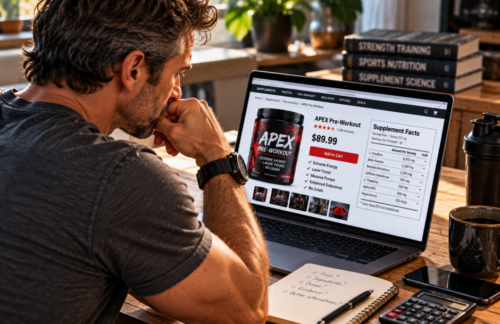
An impressive label and a premium price don’t guarantee better results. Check what’s actually inside.
A supplement can contain a legitimate ingredient and still be poor value. A pre-workout may advertise several evidence-based compounds while providing some of them at amounts too small to reproduce the effects found in research.
👇 Click on links below for more
🏷️ Read the Actual Dose
The front of the tub is advertising. The useful information is usually on the back.
If a product contains creatine, caffeine or beta-alanine, check how much is present rather than assuming the ingredient’s appearance on the label means the dose is meaningful. Long ingredient lists can look impressive while hiding the fact that several compounds are included mainly for marketing.
🕵️ Be Wary of Proprietary Blends
A proprietary blend may list numerous ingredients while revealing only the total weight of the mixture. This makes it difficult to compare individual ingredients with doses that have actually been studied.
Proprietary blends are not automatically ineffective, but transparent dosing makes a product much easier to evaluate intelligently.
🧾 Third-Party Testing
Independent certification is particularly useful for competitive athletes. Programmes such as Informed Sport and NSF Certified for Sport provide additional checks for prohibited substances and manufacturing quality.
Certification does not prove that a supplement is effective. It provides greater confidence that the product has undergone independent checks for prohibited substances, contamination and manufacturing quality. Efficacy and product quality are separate questions, and a well-tested supplement can still contain an ingredient that offers little practical benefit.
⚠️ Be Sceptical of Dramatic Claims
Supplements promising rapid fat loss, extreme stimulation, hormonal enhancement or steroid-like muscle gain deserve more scrutiny than ordinary nutritional products.
Claims such as “shreds fat” or “boosts testosterone by 300%” should immediately raise the standard of evidence you expect to see. Testimonials and impressive mechanisms are not enough.
The same caution applies to “natural” products. Herbal extracts are biologically active too and can interact with medications or produce side effects.
💷 Think About Value
Even when a supplement works, the size of the benefit matters. A product producing a tiny effect may technically be effective while still offering poor value compared with cheaper changes elsewhere in the programme.
Creatine is a useful benchmark because it is inexpensive, extensively studied and capable of producing a meaningful benefit for many trainees. An expensive herbal blend supported by a handful of small studies has a very different cost-to-benefit ratio.
🎯 What Should You Actually Take?
A supplement strategy should start with the training goal and the problem that needs solving, not with a pre-built stack.
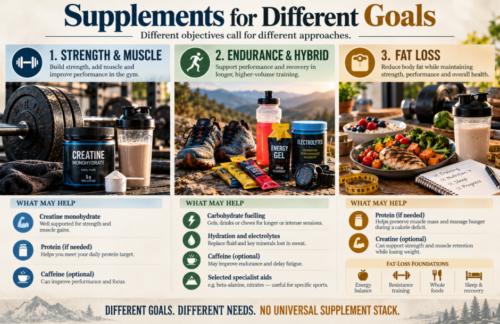
Different goals demand different strategies. There is no universal supplement stack.
🏋️ Strength & Muscle
For someone primarily interested in strength and muscle gain, creatine monohydrate is the clearest performance supplement to consider. Protein powder can help when daily protein requirements are difficult to meet through food, while caffeine can be useful before particularly demanding sessions if it does not interfere with sleep.
For many lifters, creatine, optional protein powder and occasional caffeine are enough.
🏃 Endurance & Hybrid Training
Endurance athletes often benefit more from fuel and hydration than from conventional bodybuilding supplements. Carbohydrate gels, sports drinks and electrolytes can become highly useful during longer events, while caffeine has a strong role in many endurance settings.
Nitrate, beta-alanine and sodium bicarbonate become more relevant when the event specifically matches their physiological effects. Hybrid athletes may borrow selectively from both the endurance and strength sides of the toolbox.
📉 Fat Loss
Fat loss is where the supplement list should usually become shorter rather than longer. The central requirement remains a sustainable calorie deficit while consuming enough protein and continuing to train effectively.
Protein powder can make that easier, creatine can help support training quality, and caffeine may be useful for selected sessions. Traditional fat burners contribute far less than improving food choices, portions, daily activity and adherence.
🧭 General Fitness
For someone training several times per week for health and general fitness, there may be very little that genuinely needs supplementing.
Creatine remains a reasonable option for people performing resistance or high-intensity training, while protein powder is useful when convenience demands it. Vitamins and minerals become more relevant when diet, lifestyle or appropriate testing identifies a genuine shortfall.
No supplement stack at all can be a perfectly sensible choice.
📌 Practical Takeaways
Some supplements can provide a useful additional benefit when the fundamentals are already in place, but the worthwhile list is much shorter than the supplement industry suggests. Every product should earn its place through evidence, relevance and a clear purpose.
Lasting progress comes from consistent habits. Supplements earn their place when they add something genuinely useful.
A few principles cover most decisions:
- Food, training, sleep and recovery come first.
- Use protein powder for convenience, not because it is superior to food.
- Creatine monohydrate remains one of the strongest choices for strength and repeated high-intensity training.
- Use caffeine strategically and protect your sleep.
- Match specialist supplements to the actual demands of your sport.
- Use sports drinks, gels and electrolytes when the session genuinely requires fuel or fluid replacement.
- Supplement vitamins and minerals when there is a real nutritional reason to do so.
- Treat BCAAs, fat burners, testosterone boosters and large proprietary stacks with appropriate scepticism.
- Check dose transparency and product quality before spending money.
- Keep the supplement routine as simple as the goal allows.
🏁 The Bottom Line
Supplements are useful precisely because some of them can provide a small additional advantage once the larger pieces are already in place. That advantage can matter to an athlete chasing performance, while convenience alone can make certain products worthwhile for ordinary trainees.
For one person, an effective routine might consist of creatine and an occasional protein shake. For another, competition demands may justify caffeine, carbohydrate, electrolytes or one of the more specialised performance aids. Someone else may need nothing at all.
The best supplement strategy is not the biggest stack. It is the one where every product has a clear job, the evidence supports its use, and nothing is included simply because the fitness industry says it should be.
🔗 Our Other Posts

European Martial Arts: From the Battlefield to the Arena
From boxing and wrestling to fencing, military combatives, and modern combat sports, Europe’s martial traditions


Kettlebell Havoc: Heart of Darkness
Fluid movement. Explosive transitions. Kettlebell Havoc is a full-body flow assault built around rhythm, endurance,