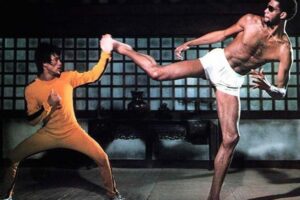
Capoeira practitioners exchanging dynamic kicks and evasive movements during a traditional Capoeira game.

Capoeira – From Slaves to Masters

Capoeira is one of the most unusual martial arts ever created. Part fight, part game, and part cultural expression, it disguises combat within rhythm, movement, and deception. What looks playful on the surface often hides timing, traps, and survival instincts underneath.

Table of Contents

🇧🇷 Introduction

Capoeira is an Afro-Brazilian martial art that blends combat, movement, music, acrobatics, and rhythm into a single flowing system. Known for its spinning kicks, evasive footwork, and flowing movement, it is one of the most visually distinctive martial arts in the world.

At first glance, Capoeira can look more like dance or performance than fighting. Practitioners sway rhythmically to music, cartwheel across the floor, and exchange movements in a constant flowing game. Beneath this, however, lies a martial art built around timing, deception, mobility, and control of space. Rather than relying on rigid stances or direct exchanges, Capoeira uses rhythm, evasions, feints, and unpredictable angles to create openings while avoiding clean attacks.

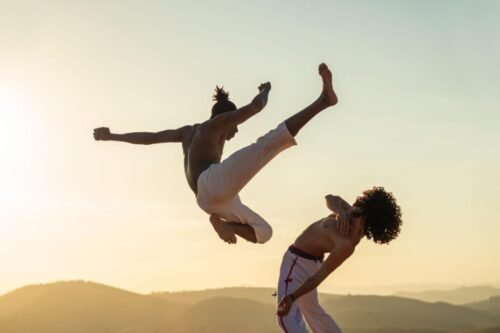
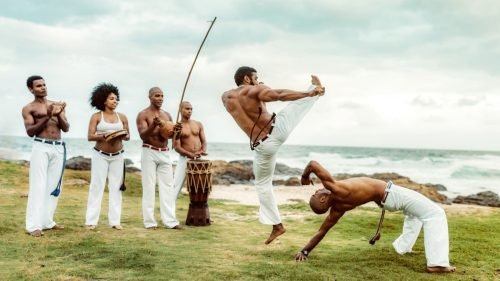
Capoeirista executing a spinning aerial kick as an opponent evades during a live exchange.

Beneath Capoeira’s flowing movements lies a martial art built around timing, mobility, deception, and creating openings through movement rather than direct force.

Capoeira developed in Brazil during the era of slavery, where African cultural traditions merged and evolved under harsh conditions into something entirely new. Over time it passed through many phases—survival tool, street fighting method, criminalised activity, ritual game, and eventually global cultural symbol. Each phase left its mark on the art.

Today, Capoeira exists somewhere between martial system, movement practice, and cultural expression. While it is rarely used as a primary fighting style in modern combat environments, it still offers unique value through its movement, rhythm, athleticism, and emphasis on deception and awareness. Even now, traces of its original survival-driven mentality remain visible beneath the music and movement.

🧭 Origins and Evolution

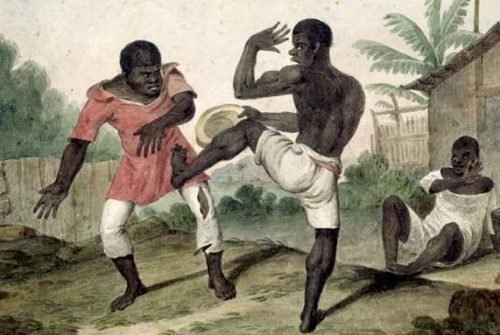
Capoeira emerged in Brazil during the era of the transatlantic slave trade, shaped by enslaved Africans brought primarily from Central and West Africa. Over generations, traditions of movement, music, ritual, and combat merged and evolved into a unique fighting system built around rhythm, deception, and mobility. One of the most commonly discussed influences is the Angolan combat dance Engolo, though Capoeira was likely shaped by several African traditions rather than a single source.

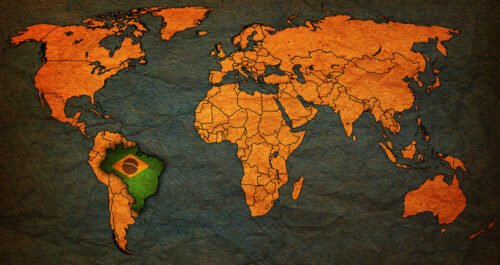
Brazil home to the acrobatic and culturally rich martial art of Capoeira.

Practised under oppression and often concealed within music and dance, Capoeira developed as both cultural expression and survival tool. It evolved further within the isolated quilombos—settlements formed by escaped slaves—and later within the violent streets of Brazilian cities such as Rio de Janeiro and Salvador, where Capoeiristas became associated with gangs, bodyguards, and street fighting. During the late nineteenth century the art was heavily suppressed and eventually outlawed, before later being revived and formalised by influential mestres such as Mestre Bimba and Mestre Pastinha in the early twentieth century.

Today, Capoeira exists as both a martial art and cultural symbol, carrying traces of every phase of its evolution—from survival system and street fighting method to ritual game and global cultural practice.

📜 Want the Full Story?

From African roots and quilombos to gang warfare, suppression, and the rise of the great mestres, Capoeira’s history is one of the most fascinating in martial arts.

⚙️ Core Principles of Capoeira

Capoeira is built around continuous movement, unpredictability, rhythm, and positional awareness rather than static exchanges or direct force. Unlike many martial arts that emphasise planted stances, combinations, or defensive guards, Capoeira functions through flow and reaction. Practitioners remain in near-constant motion, shifting angles and forcing opponents to adapt.

Two Capoeira practitioners facing one another and reading movement, distance, and positioning during a Capoeira game.

Rather than remaining static, Capoeira practitioners stay in constant motion, adjusting angles and searching for opportunities while forcing their opponents to adapt.

This creates a style that can feel unusual even to experienced martial artists. Movements often appear loose, playful, or improvised, yet beneath them lie recurring principles that define how Capoeira operates. Timing matters more than strength. Position matters more than trading blows. Creating openings is often valued more highly than direct aggression.

The result is a martial art that often feels less like a conventional fight and more like a moving tactical game. Even during friendly exchanges, practitioners are constantly reading one another, testing distance, and searching for opportunities to gain an advantage.

Click on links below to read more.

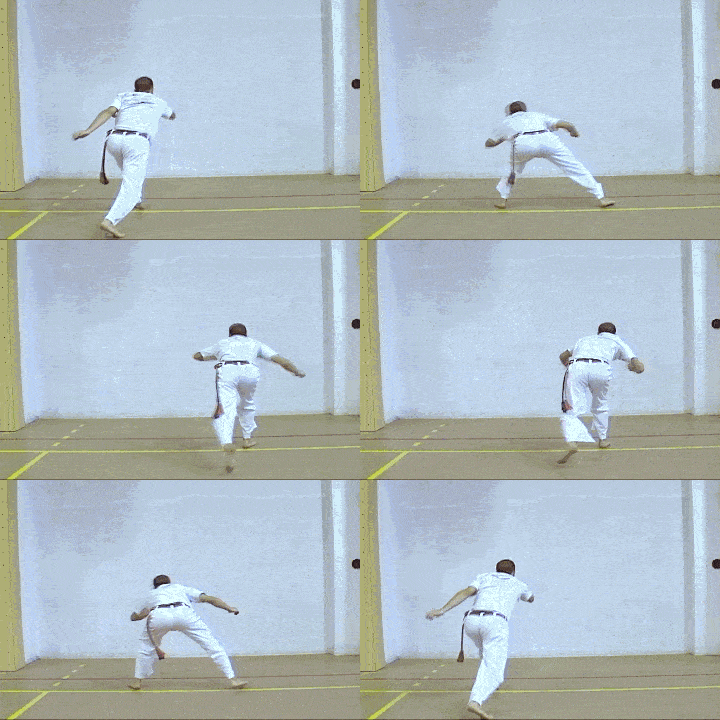
The foundation of Capoeira is the Ginga, a rhythmic shifting movement that functions as a type of moving stance. Rather than standing planted, the capoeirista continuously shifts weight between positions in a triangular pattern, keeping the body mobile and unpredictable.

The Ginga serves several purposes at once. It keeps the practitioner in motion, making them harder to target cleanly. It also disguises attacks and setups, allowing kicks, sweeps, evasions, and counters to emerge naturally from movement rather than from obvious fighting positions. In many ways, the Ginga is the engine that drives the entire art.

To someone unfamiliar with Capoeira, the movement can initially appear exaggerated or dance-like. In practice, however, it creates momentum, mobility, and unpredictability while preventing the practitioner from becoming static. Almost every offensive and defensive action in Capoeira flows out of the Ginga or returns back into it afterwards.

If the Ginga is the movement of Capoeira, then malícia is its mindset.

Malícia is difficult to translate directly into English because it represents far more than simple deception. It combines tactical awareness, manipulation, timing, and psychological control into a single concept. A skilled capoeirista is not simply reacting physically to an opponent. They are constantly observing, influencing, and attempting to shape the flow of the exchange.

This is one of the defining characteristics that separates Capoeira from many other martial arts. The goal is often not simply to defeat an opponent physically, but to influence how they think, react, and behave. A skilled practitioner seeks to create hesitation, provoke mistakes, and guide opponents into unfavourable positions long before a technique is ever thrown.

Within the Roda, this creates a constant tactical conversation between the two players. Every movement carries potential meaning. A slow movement may hide intent. A retreat may invite pursuit. A seemingly playful exchange may conceal a deeper tactical battle taking place beneath the surface.

Capoeira rewards practitioners who remain calm, observant, and adaptable. Experienced capoeiristas learn to read posture, balance, rhythm, and emotional reactions while masking their own intentions in return.

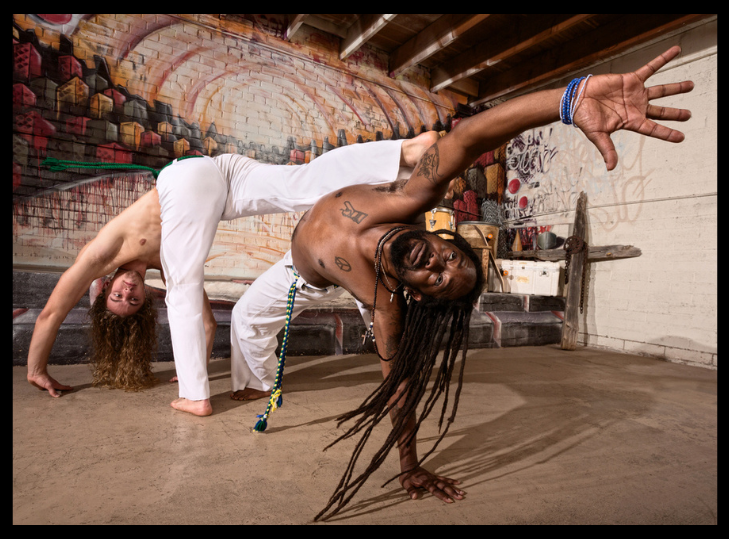
Rhythm is central to how Capoeira functions. Movement is closely tied to tempo, with attacks, evasions, and transitions flowing continuously rather than occurring as isolated actions. Different rhythms can create very different types of games, ranging from slow and tactical exchanges to fast and aggressive encounters.

Timing is equally important. Success often depends less on power and more on acting at the right moment, whether during a transition, a shift in balance, or a lapse in awareness. Sweeps, counters, and many of Capoeira’s most effective techniques rely on recognising these brief opportunities.

At higher levels, practitioners learn to read and influence the tempo of an exchange, constantly adjusting rhythm, spacing, and movement in real time. This ability to control timing is one of the key skills that gives Capoeira its distinctive character.

Capoeira practitioner demonstrating the Ginga movement used to maintain mobility and transition between attacks and evasions.

The Ginga is a type of ‘moving stance’ used in Capoeira to keep the user in perpetual motion.  This enables the fast chaining together of kicks or evasions.

🎭 Attacking Through Deception

Capoeira rarely attacks in a direct or predictable manner. Rather than marching forward behind combinations or overwhelming opponents with pressure, the capoeirista seeks to create confusion through misdirection, movement, and unpredictability.

Many attacks emerge from transitions rather than obvious fighting positions. A cartwheel may become a kick. An evasion may become a sweep. A retreat may actually be an invitation to advance into a trap. The practitioner is constantly attempting to manipulate distance, timing, and expectation.

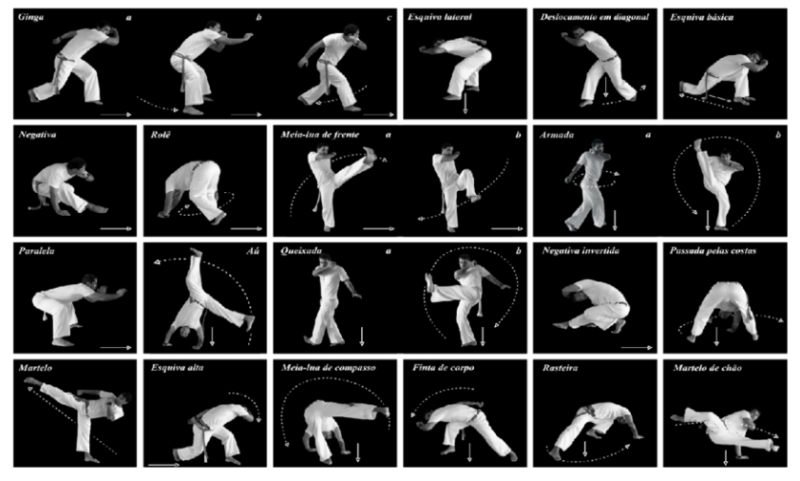
Various Capoeira kicking techniques demonstrating the martial art's unique blend of acrobatics, mobility, and striking.

Capoeira is a martial art full of swirling and acrobatic style kicks and leaps.

This reflects one of Capoeira’s core ideas: the attack itself is often less important than the setup that created it. A successful sweep may have been prepared several movements earlier. A spinning kick may only land because the opponent was distracted by a previous feint or forced to react to an entirely different threat.

Many attacks are deliberately disguised within flowing movement. Spins, transitions, and evasions can suddenly transform into kicks, sweeps, or takedowns with little visual separation between movement and attack.

At its best, Capoeira feels less like a contest of force and more like a game of misdirection. The opponent is encouraged to look in one direction while the real attack arrives from another.

Click on links below to read more.

The majority of Capoeira’s offensive techniques are delivered with the legs. Common attacks include spinning kicks, crescent kicks, roundhouse variations, front stomping kicks, sweeps (rasteiras), and scissor takedowns (tesouras), often linked together through continuous movement and transitions.

Capoeira places heavy emphasis on rotational power and angular attacks. Kicks often arrive from unusual trajectories, particularly when combined with spinning movement or inverted positioning. Even when attacks are not thrown with full force, they can create disruption, force reactions, or expose openings for follow-up techniques.

Sweeps are especially important within Capoeira. In many ways, the rasteira embodies the art’s tactical philosophy. Rather than meeting force with force, the practitioner waits for commitment, creates a mistake, and removes the opponent’s base when they are least prepared for it. A well-timed sweep delivered during movement can quickly disrupt even experienced practitioners.

Capoeira is famous for its acrobatic movement, including cartwheels, inverted kicks, spins, and aerial transitions. While some modern demonstrations heavily emphasise spectacle and athleticism, these movements originally served practical purposes within the art.

Inverted movement allows attacks to emerge from unusual angles while also helping practitioners evade and reposition quickly. Acrobatics can disrupt rhythm, create hesitation, and make attacks difficult to read. However, many of the more elaborate aerial techniques seen in demonstrations are better understood as expressions of athleticism and creativity than as high-percentage fighting tools.

This distinction is important. Capoeira contains effective techniques, but modern performance-focused practice can sometimes blur the line between practical movement and visual spectacle.

Compared with systems such as Boxing or Wrestling, Capoeira places relatively little emphasis on punching combinations, clinch fighting, or sustained grappling exchanges.

Hand strikes, elbows, and headbutts do exist within the art, but they are generally secondary to kicks, movement, and takedowns. In many cases, the hands are used more for distraction, setup, balance, or maintaining flow than for sustained striking exchanges.

Likewise, Capoeira does not generally seek prolonged grappling control in the way systems such as Brazilian Jiu-Jitsu or Judo do. Its focus remains rooted in mobility, evasiveness, and freedom of movement rather than controlling positions on the ground.

🛡️ Defensive Strategy

Defence in Capoeira is built around evasion rather than resistance. Instead of absorbing force or meeting attacks head-on, practitioners aim to avoid, redirect, or flow around incoming attacks while remaining mobile and balanced.

This creates a very different defensive philosophy from martial arts built around tight guards, hard blocks, or direct exchanges. A capoeirista is rarely expected to stand planted and trade strikes. The emphasis is instead on movement, reactions, and repositioning.

Rather than relying on hard blocks, Capoeira often uses esquivas to slip, duck, lean, and move clear of incoming attacks.

Esquivas (evasions) allow the Capoeirista to avoid the attacks of their opponents.

In many ways, Capoeira treats defence and offence as part of the same continuous motion. An evasion can immediately become a counterattack, transition, or setup for a sweep without any obvious pause between the two.

Click on links below to read more.

The core defensive movements of Capoeira are known as esquivas. These evasions involve slipping, ducking, leaning, rolling, or shifting out of the line of attack rather than stopping strikes directly.

Some evasions are subtle and economical, while others involve dramatic movement such as cartwheels or low rotational escapes. To outsiders these movements can sometimes appear overly theatrical, but within Capoeira they serve an important purpose: maintaining mobility while avoiding clean impact.

Historically, many practitioners believed that directly blocking powerful strikes or bladed attacks carried too much risk. Whether against armed opponents, street violence, or chaotic environments, avoiding force entirely was often seen as safer than attempting to absorb it.

Capoeira’s defensive system is heavily tied to counterattacking. Rather than treating defence as passive survival, practitioners use evasions to create openings and disrupt balance.

A missed kick, overextended movement, or poorly timed attack can immediately expose an opponent to sweeps, spinning kicks, takedowns, and angular counters.

Because Capoeira practitioners remain in motion, attacks can emerge quickly from unusual positions. A movement that initially appears defensive may suddenly rotate into an attack from an unexpected angle.

This creates much of the art’s unpredictability. Opponents unfamiliar with Capoeira can struggle to determine where defence ends and offence begins.

Capoeira develops exceptional coordination, reflexes, balance, spatial awareness, and body control.

The constant movement forces practitioners to remain aware of positioning, rhythm, and timing at all times. Over time, experienced capoeiristas become extremely comfortable moving through awkward angles, inverted positions, and rapid transitions.

This mobility is one of Capoeira’s greatest strengths. Even critics of the art generally acknowledge its ability to develop fluid movement and athletic control. However, it is also one of the reasons Capoeira can be difficult to apply in confined environments or situations where space is limited.

Like many aspects of the art, its strengths and weaknesses are closely connected.

🔄 The Roda — Playing Capoeira

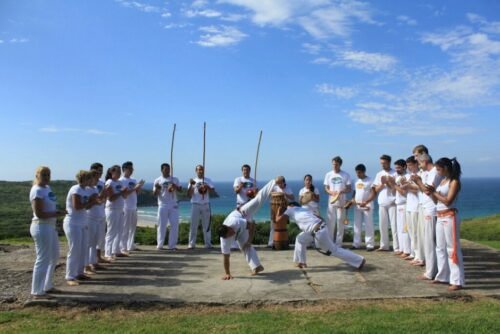
Capoeira is traditionally practised inside a Roda, a circle formed by practitioners, musicians, and spectators. The Roda functions as far more than a sparring area. It is simultaneously training method, ritual, game, cultural gathering, and social test.

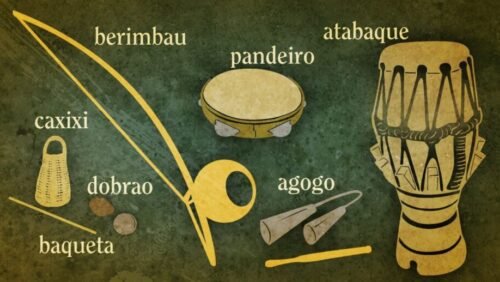
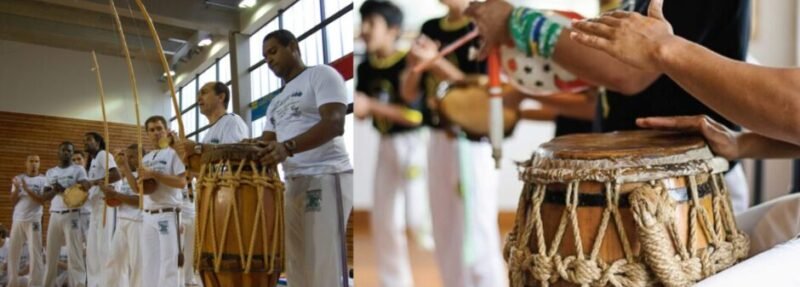
Traditional Capoeira musical instruments including the berimbau, pandeiro, atabaque, and agogô.

Traditional Capoeira instruments include the berimbau, atabaque, pandeiro, and agogô. Together they provide the musical foundation that supports the art’s rhythms and traditions.

Inside the circle, two practitioners engage in a flowing exchange of movement, timing, deception, and reaction. To outsiders this can sometimes appear choreographed, but in reality the interaction is dynamic and unpredictable. Every exchange is shaped by the skill levels, intentions, aggression, rhythm, and personalities of the players involved.

The Roda is one of the defining features that separates Capoeira from most martial arts. Combat training does not occur in silence or isolation. It unfolds within music, rhythm, singing, and constant social interaction.

Capoeira musicians playing berimbau and drums while practitioners perform inside a Roda.

Musicians guide the pace and atmosphere of the Roda. Different rhythms played on the berimbau can influence the style, intensity, and tempo of the game being played.

Click on links below to read more.

Music is central to Capoeira. It controls the pace, energy, and emotional atmosphere of the game being played inside the Roda. Without music, Capoeira loses much of its identity and rhythm.

Traditional instruments include the berimbau, atabaque, pandeiro, and agogô, each contributing to the rhythm and atmosphere of the Roda.

Among these, the berimbau holds the greatest authority. Different rhythms, known as toques, influence how the game is played. Some rhythms encourage slower and more tactical exchanges, while others create faster, more aggressive interactions.

The songs themselves also carry importance. Many reference history, slavery, resistance, religion, famous mestres, and everyday life. Others contain humour, warnings, philosophy, or coded messages understood within Capoeira culture. Combined with the movement and rhythm of the Roda, they help create an atmosphere unlike almost any other martial art.

Players usually enter the Roda from the foot of the circle near the musicians, often beginning with a cartwheel or low transitional movement before engaging one another.

Once inside, the two capoeiristas begin a flowing exchange of kicks, sweeps, evasions, feints, acrobatics, and counters.

Unlike many combat sports, Capoeira does not always aim for clean impact or domination. In many rodas, techniques are intentionally pulled short or controlled before impact. The emphasis is often placed on skill, timing, creativity, and tactical superiority rather than outright damage.

This creates the “game” aspect of Capoeira. Practitioners are not simply trying to defeat one another—they are attempting to outplay one another.

A strong Capoeira culture values control. Experienced practitioners will often slow attacks before contact against less experienced players, demonstrating superiority without unnecessary injury.

At higher levels, however, the atmosphere can become far more intense. Faster rodas may involve hard sweeps, aggressive kicks, psychological pressure, and attempts to dominate or humiliate opponents through timing and control. To inexperienced observers, the transition between friendly play and dangerous exchange can sometimes be difficult to detect.

This dual nature is part of what makes Capoeira unusual. It exists somewhere between fight, game, performance, and ritual, with the balance between those elements shifting depending on the practitioners involved and the atmosphere inside the Roda.

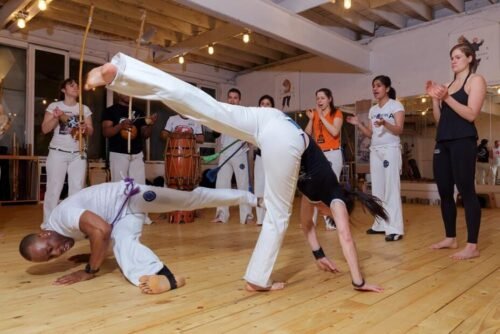
Capoeira practitioners playing inside a Roda surrounded by musicians and spectators.

Capoeira practice takes place within the Roda, where players test movement, timing, and skill under the guidance of music and tradition.

🔪 Weapons and Street Reality

Although modern Capoeira is primarily practised as an unarmed martial art, its development took place in environments where street violence and armed confrontations were common. Historical Capoeiristas were often associated with knives, straight razors, clubs, and other improvised weapons, particularly in the crowded streets of nineteenth-century Brazil.

While Capoeira itself remained largely unarmed, many of its defining traits—mobility, evasions, angle changes, and avoiding direct collisions of force—make more sense when viewed within this harsher historical context. Even Mestre Bimba recognised the importance of practical self-defence, reportedly including instruction involving weapons and defence against armed attacks in some of his specialised courses.

Today, weapons training is uncommon within mainstream Capoeira schools. Most groups focus on movement, music, culture, and the Roda, although traces of the art’s more dangerous past remain visible in its emphasis on deception, mobility, and avoiding direct confrontation.

Traditional weapons associated with Capoeira, including machetes, knives, and straight razors.

The traditional weapons of Capoeira come from farming tools (machetes) and street fighting weapons (blades and razors).

🎓 Ranking Systems

Historically, Capoeira did not have a single unified ranking structure. For much of its history, practitioners learned through observation, repetition, and participation within the Roda rather than through formal grading systems.

Modern groups often use coloured cords or ropes known as cordas or cordões to represent progression and experience. However, colours, structures, and requirements vary between organisations, meaning there is no universal ranking system across Capoeira as a whole.

Advancement is typically judged by more than technical ability alone. Rhythm, timing, understanding of malícia, control within the Roda, knowledge of music and traditions, and contribution to the wider Capoeira community are often considered alongside physical skill.

As a result, progression in Capoeira is generally viewed as a combination of technical development, cultural understanding, and participation within the art itself.

🌿 Sub-Styles of Capoeira

Like many martial arts that evolved over long periods of time, Capoeira eventually split into different approaches and interpretations. Some schools emphasised tradition, ritual, and deception, while others pushed the art toward greater structure, athleticism, and direct combat application.

Modern Capoeira is generally divided into three major sub-styles: Angola, Regional, and Contemporânea. Although they share the same roots, the atmosphere, movement, and training methods can feel very different depending on which style is being practised.

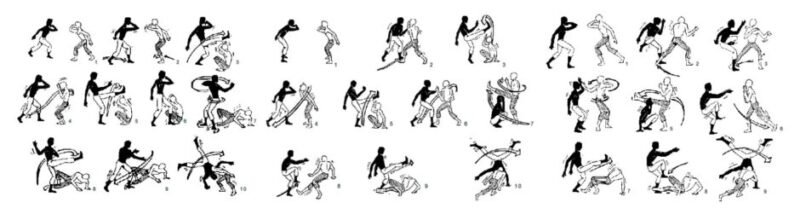
Illustrated training sequences created by Mestre Bimba showing fundamental Capoeira techniques and partner drills.

Several of the eight training sequences were developed by Mestre Bimba.  Covering the basic fundamental moves of capoeira.

Click on links below to read more.

Capoeira Angola is generally considered the older and more traditional form of the art. It emphasises patience, strategy, deception, and close interaction between players rather than speed or spectacle.

Games are often played lower to the ground and at a slower tempo, allowing practitioners to focus heavily on timing, malícia, traps, feints, and tactical exchanges.

Angola practitioners typically place strong importance on preserving Capoeira’s cultural roots, rituals, and traditions. The movements can appear slower on the surface, but experienced Angola players are often highly deceptive and capable of sudden explosive attacks or sweeps.

For many practitioners, Angola represents the philosophical and historical heart of Capoeira.

Mestre Bimba developed Capoeira Regional during the early twentieth century as an attempt to strengthen and formalise the martial side of the art.

Regional generally places greater emphasis on structure, directness, precision, athleticism, and counterattacking.

Compared with Angola, the movement is usually faster, more upright, and more aggressive. Bimba removed or reduced aspects of Capoeira that he felt were overly theatrical or impractical for fighting, while introducing more structured training methods and teaching sequences.

Regional played a major role in helping Capoeira gain wider legitimacy and public acceptance within Brazil.

Capoeira Contemporânea emerged later as a hybrid approach combining elements of both Angola and Regional. Today it is probably the most widespread version of Capoeira internationally.

Contemporânea often incorporates faster pacing, greater athleticism, more acrobatic movement, and influences from multiple schools and styles.

Because it is less rigidly tied to older traditions, the style can vary greatly from one academy to another. Some groups maintain a strong martial focus, while others lean more heavily toward performance, movement, or spectacle.

Critics sometimes argue that highly acrobatic modern Capoeira drifts too far from the art’s original intent. Supporters, however, see it as a natural evolution of a system that has always adapted and changed over time.

⚖️ Why Study Capoeira?

Capoeira is one of the most unique martial arts in the world. While it contains genuine combat elements, most modern practitioners are drawn to the art for its movement, athleticism, culture, and creativity rather than purely for self-defence. It develops qualities that many martial arts neglect, particularly coordination, rhythm, body control, and spatial awareness.

The art is also deeply connected to music, history, and community. Training often feels very different from a conventional martial arts gym, with the Roda creating an environment that blends movement practice, cultural tradition, and social interaction.

✅ Strengths

  • Excellent agility, balance, and coordination.
  • Develops flexibility and full-body mobility.
  • Strong emphasis on timing, rhythm, and awareness.
  • Encourages creativity, deception, and adaptability.
  • Unique movement patterns rarely found in other martial arts.
  • Rich cultural heritage involving music, language, and tradition.
  • Supportive and highly social training environment.

Capoeira’s greatest strength is arguably not fighting ability, but its ability to develop fluid movement, body control, and athletic expression while connecting practitioners to a vibrant cultural tradition.

⚠️ Limitations

  • Limited emphasis on grappling and ground fighting.
  • Less focus on clinch work than arts such as Muay Thai.
  • Many modern schools place greater emphasis on culture and movement than combat application.
  • Some techniques require significant space to perform effectively.
  • Limited pressure-testing compared to combat sports such as Boxing, Wrestling, or MMA.

While Capoeira can certainly produce effective movement, timing, sweeps, and unorthodox attacks, it is rarely trained today as a complete fighting system. Most practitioners therefore benefit from viewing Capoeira as a movement art with martial roots rather than a comprehensive modern self-defence method.

🌍 Capoeira in the Modern World

Over the last century, Capoeira has transformed from a suppressed Brazilian street art into a global cultural phenomenon. Once outlawed and associated with gangs, fugitives, and marginalised communities, it is now practised openly in gyms, academies, universities, cultural centres, and festivals worldwide.

This transformation accelerated during the second half of the twentieth century as Capoeira mestres began teaching internationally. As schools spread beyond Brazil, practitioners were drawn to its martial aspects, athletic movement, music, history, and cultural identity.

Today, Capoeira occupies a unique position within the martial arts world, functioning simultaneously as a martial art, movement system, cultural tradition, performance art, and social community. Few systems operate comfortably across all of those spaces at once.

Click on links below to read more.

Although Capoeira is rarely used as a complete fighting system in modern MMA, elements of the art have found success at the highest levels of competition. Fighters such as Anderson Silva, José Aldo, Junior dos Santos, and Michel Pereira have all trained in Capoeira or incorporated aspects of its movement into their games.

The art’s emphasis on timing, angle changes, unpredictability, and unorthodox kicking techniques can create difficult problems for opponents unfamiliar with those movements. However, modern MMA has also highlighted Capoeira’s limitations. Fighters who successfully utilise Capoeira almost always combine it with more pressure-tested systems such as Boxing, Wrestling, Muay Thai, and Brazilian Jiu-Jitsu rather than relying on Capoeira alone.

Capoeira is now practised throughout Europe, North America, Asia, and beyond. International festivals, workshops, competitions, and rodas have helped create a worldwide Capoeira community connected through shared traditions, music, and training.

For many practitioners, learning Capoeira becomes about far more than movement alone. Training often provides an introduction to Brazilian culture, Portuguese language, Afro-Brazilian history, and the musical traditions that sit at the heart of the art. This cultural depth is one of the major reasons Capoeira continues to attract practitioners around the world despite not being a dominant combat sport.

In 2014, the Capoeira Circle was officially recognised by UNESCO as part of the Intangible Cultural Heritage of Humanity. The recognition acknowledged Capoeira not only as a martial practice, but as an important cultural tradition tied to music, identity, social interaction, and historical memory.

In many ways, this recognition reflects what Capoeira ultimately became. While traces of its survival-driven past still remain visible, the art today stands primarily as a living cultural system built around movement, rhythm, expression, and community.

MMA fighters Anderson Silva and Michel Pereira, both known for incorporating Capoeira techniques and movement into their fighting styles.

Well-known capoeiristas in MMA include UFC Hall of Famer Anderson Silva (left) and up-and-coming fighter Micheal Pereira (right).

🧠 Final Thoughts

Capoeira is one of the few martial arts that comfortably exists in several worlds at once. It is part martial art, part movement practice, part cultural tradition, and part social experience. Few arts blend rhythm, athleticism, music, history, and martial technique so completely.

Modern practitioners are rarely drawn to Capoeira purely for fighting effectiveness. Instead, they are attracted by its movement, creativity, cultural depth, and unique way of viewing combat and interaction. Yet beneath the music and flowing movements, traces of the art’s harder origins still remain visible in its emphasis on timing, deception, adaptability, and awareness.

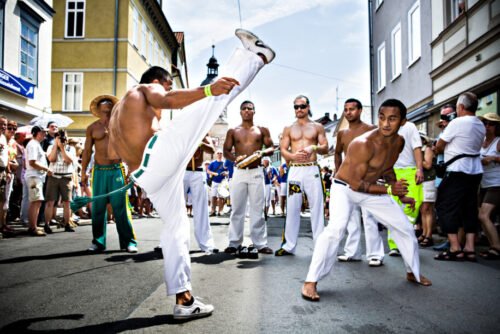
Capoeira practitioners playing in a street roda in a modern urban setting.

Capoeira has changed dramatically over the centuries, yet its emphasis on movement, adaptability, rhythm, and community continues to define the art today.

Whether viewed as a martial art, a cultural practice, or something that exists between the two, Capoeira remains one of the most distinctive traditions in the martial arts world.

The movements can appear playful one moment and dangerous the next. Perhaps that balance is what has made Capoeira endure for centuries.

If you have enjoyed this post please share or feel free to comment below 🙂

Related Posts

Our Other Posts

Leave a Reply

Your email address will not be published. Required fields are marked *

This site uses Akismet to reduce spam. Learn how your comment data is processed.

error: Content is protected !!

Join the Super Soldier Project Mailing List Today!!