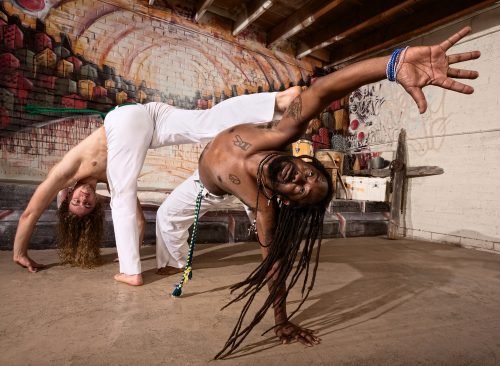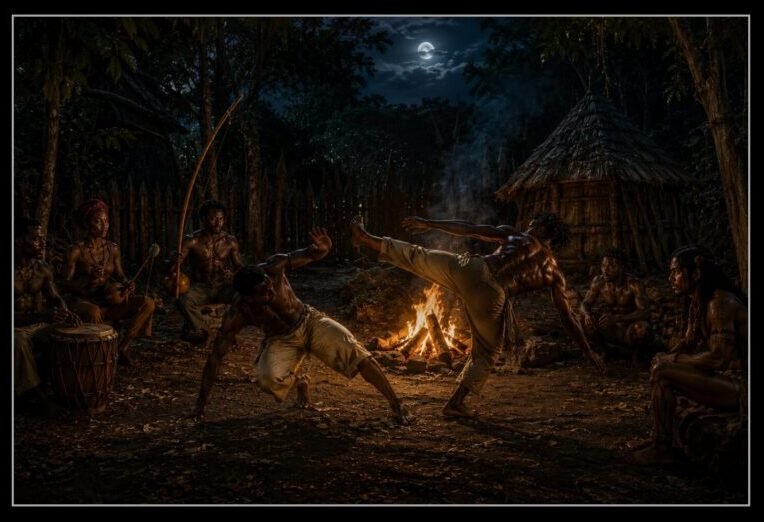
Capoeira did not emerge from a single style, tribe, or moment in history. It evolved under pressure, shaped by slavery, survival, street violence, resistance, ritual, and adaptation. Every phase of its history left marks that can still be seen in the art today.
Table of Contents
🌍 Out of Africa
Capoeira’s origins remain difficult to trace with complete certainty. Unlike many martial traditions preserved through written records or formal systems, the roots of Capoeira emerged through oral tradition, cultural exchange, and fragmented memory carried across the Atlantic during one of history’s darkest periods.
Between the sixteenth and nineteenth centuries, millions of Africans were forcibly transported to the Americas through the transatlantic slave trade. Brazil received one of the largest slave populations in the world, particularly from regions corresponding to modern-day Angola, Congo, and parts of West Africa. These populations carried with them languages, religions, music, rituals, and movement traditions that would gradually merge and evolve inside Brazil.
What eventually became Capoeira was not imported as a complete martial art. It was shaped over generations as displaced communities preserved fragments of older traditions while adapting to entirely new realities.
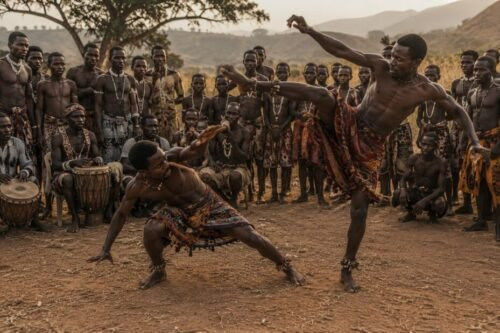
Engolo, a ritual combat game from southern Angola often cited as a possible influence on the development of Capoeira. The exact relationship between Engolo and Capoeira remains debated by historians.
🦓 Engolo and the "Dance of the Zebras"
One of the most commonly discussed influences on Capoeira is Engolo, sometimes referred to as the “Dance of the Zebras,” a ritual combat game associated with southern Angola.
Descriptions of Engolo speak of evasive movement, kicking exchanges, acrobatics, and ritualised combat performed during ceremonies and initiations. The similarities to Capoeira are obvious enough that many early researchers viewed Engolo as the direct ancestor of the art.
NB: About Engolo
Modern historians tend to treat this claim more cautiously. While Engolo likely influenced Capoeira, hard evidence remains limited. Most researchers now believe Capoeira emerged from multiple African traditions rather than from a single source or tribe. Even so, the comparison remains important because it highlights how deeply movement, rhythm, ritual, and combat were already intertwined within many African cultural systems long before Capoeira existed in Brazil.
🥁 Music, Ritual, and Oral Tradition
Music and rhythm were already central parts of many African communal traditions before the development of Capoeira. Songs preserved history, reinforced identity, transmitted knowledge, and maintained social bonds within displaced communities.
This became especially important under slavery, where written traditions were often destroyed or inaccessible. Knowledge instead survived through storytelling, ceremony, song, repetition, and physical practice passed between generations.
Capoeira inherited this oral and physical tradition. Long before it became recognised as a martial art, it already existed as something broader—a mixture of movement, ritual, rhythm, survival, and communal identity.
🎭 Disguised as Dance
One of the most enduring stories surrounding Capoeira is that it was disguised as dance in order to conceal combat training from slave owners and colonial authorities. While the details are often simplified or romanticised, the underlying logic makes historical sense.
Open training in fighting skills would have attracted punishment and suspicion. Movement hidden within rhythm, music, and performance, however, could pass more easily beneath the eyes of overseers and authorities. Over time, the distinction between dance and combat became increasingly blurred. Capoeira did not simply hide fighting techniques beneath movement—the rhythm itself became part of how the art functioned.
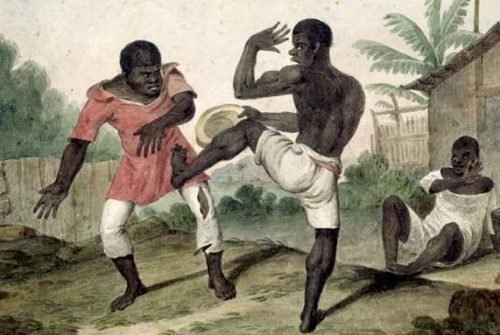
One of the earliest known visual depictions associated with Capoeira. Painted by Augustus Earle around 1824, the artwork shows two enslaved men engaged in a combat game that many historians believe may represent an early form of Capoeira.
The conditions in which Capoeira developed also rewarded deception, adaptability, and unpredictability. Direct confrontation with armed authorities was often a losing proposition, making cunning and mobility more valuable than straightforward aggression. Practitioners learned to disguise intention, conceal attacks, manipulate reactions, and create openings through movement that appeared playful or harmless until the moment it became dangerous.
This mentality survives today within the concept of malícia. A Capoeirista was expected not only to move well, but also to read situations, exploit mistakes, and conceal their true intentions. In this sense, deception became embedded not only within Capoeira’s movements, but within its entire mindset.
🌿 Quilombos
Freedom Beyond the Plantations
As colonial conflict and instability spread throughout Brazil, increasing numbers of escaped slaves fled plantations and disappeared into forests, mountains, and isolated terrain. Many of these fugitives formed independent settlements known as quilombos.
The quilombos varied enormously in size and structure. Some were small hidden communities struggling simply to survive. Others evolved into large organised settlements with internal economies, trade networks, defensive systems, and populations numbering in the thousands. These communities became places where displaced Africans, indigenous peoples, fugitives, and outcasts could exist outside direct colonial control.
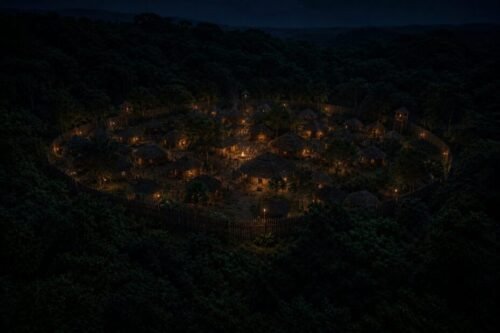
Quilombos were fortified communities established by escaped slaves in colonial Brazil. Hidden within remote forests, they became powerful symbols of resistance, survival, and freedom.
NB: About the Name “Capoeira”
The exact origin of the word Capoeira remains debated, but one of the most widely accepted theories links it to the Tupi language. The term is often associated with areas of low vegetation or cleared forest where escaped slaves and fugitives could move, hide, or establish hidden settlements away from colonial control. Other theories exist, and the true origin may never be known with certainty. Like much of Capoeira’s early history, the meaning of the name reflects a mixture of oral tradition, cultural blending, and fragmented historical record.
Click on the links below to read more.
🏹 Guerrilla Survival
Life inside the quilombos was harsh and dangerous. Colonial authorities viewed them as threats that needed to be destroyed, leading to constant raids, military expeditions, and violent suppression attempts.
As a result, survival depended heavily on mobility, knowledge of terrain, concealment, ambush tactics, and defensive preparation. The inhabitants fought using whatever weapons they could acquire or improvise, including bows, spears, blades, clubs, and firearms obtained through trade or raids.
NB: About Capoeira in the Quilombos
There is little evidence that Capoeira alone was used to defeat organised colonial forces in direct battle, despite some exaggerated modern claims. It is far more likely that Capoeira existed alongside broader systems of guerrilla survival, armed resistance, and practical violence rather than functioning as a standalone battlefield method.
🌱 Space to Evolve
What made the quilombos important was not simply combat, but freedom from constant surveillance. Away from plantations and urban authorities, African traditions could survive more openly and continue evolving over generations.
Within these isolated environments, movement systems, music, rituals, and combat practices continued to merge and adapt. Capoeira gradually developed its own identity shaped not only by survival, but also by cultural preservation and reinvention.
🏛️ Palmares — The Most Famous Quilombo
The most famous quilombo was Quilombo dos Palmares, a vast settlement that survived for decades despite repeated Portuguese attacks.
Palmares became a symbol of resistance throughout Brazilian history. At its height, Palmares may have housed tens of thousands of inhabitants, making it one of the largest and most successful fugitive communities in the Americas.
Although eventually destroyed, its legacy helped cement the image of Capoeira as something tied not only to combat, but also to defiance, survival, and cultural identity.
🔪 Streets, Gangs, and Urban Violence
As Brazil expanded and urbanised, Capoeira gradually moved beyond plantations and isolated quilombos into the growing cities of Rio de Janeiro, Salvador, and Recife. Here the art evolved again, adapting to an environment shaped by poverty, overcrowding, political instability, and street violence.
Capoeira became closely associated with the urban underclass. Many former slaves and marginalised people found themselves with few opportunities, little protection, and almost no place within Brazil’s social order following abolition. In these harsh conditions, fighting ability carried real value. Capoeiristas developed reputations as bodyguards, dockworkers, street toughs, enforcers, and hired muscle operating within the crowded districts and ports of Brazil’s major cities.
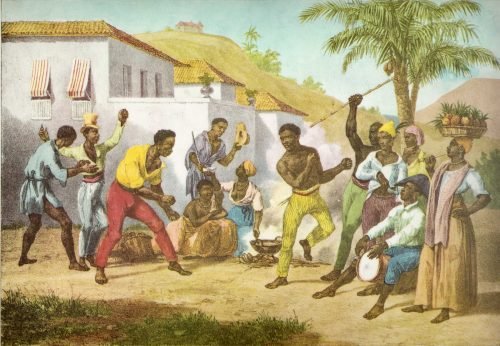
Created by Johann Moritz Rugendas in 1825 and published in 1835, this famous illustration captures Capoeira during its early development in Brazil.
Click on the links below to read more.
🌆 Capoeira Enters the Cities
By the eighteenth and nineteenth centuries, Capoeira had become deeply embedded within urban life. Police records from Rio de Janeiro frequently mentioned Capoeiristas involved in disturbances, assaults, gang activity, and violent clashes with authorities. The art’s mobility, evasive movement, and aggressive sweeps made practitioners difficult opponents in chaotic street encounters.
Unlike the more ritualised and controlled rodas associated with modern Capoeira, many urban confrontations were brutal and unpredictable. Violence commonly erupted in the crowded streets and dock districts of Brazil’s growing cities, particularly around taverns, gambling dens, marketplaces, festivals, and carnival gatherings where rival groups and factions collided.
Capoeira was no longer simply tied to cultural survival. In the cities, it increasingly became associated with intimidation, criminality, territorial disputes, and political violence.
⚔️ Gangs and Political Violence
In Rio de Janeiro, organised street gangs known as maltas emerged during the nineteenth century. These groups often recruited skilled Capoeiristas and became heavily involved in organised violence and territorial disputes throughout the city.
Some maltas developed close ties to political factions and were used as unofficial enforcers during elections, demonstrations, and periods of unrest. Capoeiristas intimidated rivals, disrupted gatherings, protected allies, and projected influence through street violence and sheer physical presence.
In some respects, the maltas functioned almost like informal street militias. Certain groups aligned themselves with monarchist interests, while others supported republican causes, making Capoeira entangled with the political struggles shaping Brazil during the late nineteenth century.
This period played a major role in shaping the authorities’ fear of Capoeira. The art was no longer viewed simply as a cultural practice associated with slaves and the poor—it had become linked to organised disorder, political influence, and resistance within Brazil’s largest cities.
🔪 Razors, Clubs, and Concealed Weapons
Urban Capoeira was closely tied to weapons culture. Straight razors, knives, clubs, and concealed blades became common tools within street fighting circles. Many Capoeiristas carried weapons hidden inside ordinary objects such as hats, canes, or umbrellas in order to avoid police attention.
Combined with Capoeira’s movement, these weapons made practitioners especially dangerous in crowded urban environments. The ability to shift angles quickly, evade attacks, and launch sudden counters created opponents who were difficult to predict or control during violent encounters.
NB: Capoeira’s Criminal Reputation
Modern Capoeira schools often emphasise the art’s cultural and communal dimensions, but its urban history was deeply tied to violence and criminality during certain periods. Ignoring this aspect oversimplifies how the art actually evolved inside nineteenth-century Brazil.
🎭 Carnival Violence in Recife
In Recife, Capoeira became heavily associated with carnival celebrations and rival music groups moving through the streets during festivals. These gatherings could quickly descend into organised violence whenever competing groups encountered one another.
What began as celebration often ended in brutal brawls involving clubs, blades, and coordinated attacks. Within this environment, Capoeira functioned not only as performance or ritual, but as practical street fighting woven directly into the culture of the city itself.
🚫 Suppression and Criminalisation
As Capoeira became increasingly associated with gangs, street violence, and public disorder, the Brazilian authorities began treating it as a serious threat. To the ruling classes, Capoeira represented more than simple criminality. It symbolised groups of highly mobile, physically capable men operating outside social control within already unstable cities.
The fear surrounding Capoeira intensified during periods of political uncertainty and social tension. Brazil remained a deeply unequal society built upon slavery and rigid class structures, and the authorities were acutely aware that the enslaved and impoverished populations vastly outnumbered them. Any activity that encouraged unity, confidence, or resistance among marginalised communities was viewed with suspicion.
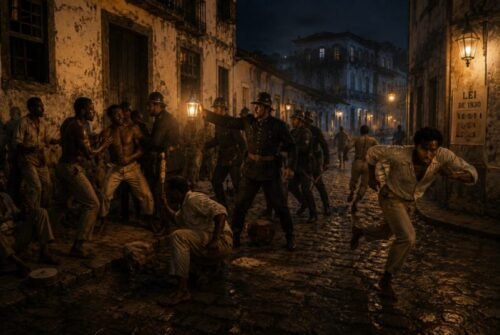
During the late nineteenth and early twentieth centuries, Capoeira faced intense suppression from the authorities. While some practitioners became associated with gangs, political violence, and organised disorder, the resulting crackdowns often affected the wider Capoeira community as a whole.
Click on the links below to read more.
👑🇵🇹 Portuguese Rule and Fear of Rebellion
The arrival of the Portuguese royal court in Brazil during the early nineteenth century intensified this atmosphere. After fleeing Napoleon’s invasion of Portugal, the monarchy became increasingly concerned with maintaining authority and stability within the colony.
Capoeira attracted particular attention because it combined several qualities the authorities feared. It fostered group identity, encouraged physical capability, and existed largely outside official structures. To colonial officials, gatherings of Capoeiristas looked dangerously similar to organised resistance movements waiting to happen.
At the same time, the art was becoming more visible within the cities, where confrontations involving Capoeiristas, gangs, and political factions were already contributing to public disorder.
⛓️ Arrests, Punishment, and Police Crackdowns
Throughout the nineteenth century, practitioners faced repeated crackdowns, arrests, and violent punishment. Police records from the period contain numerous references to Capoeira-related arrests, particularly in Rio de Janeiro.
Capoeiristas were routinely beaten, imprisoned, forced into labour, and publicly punished in an attempt to crush the art and intimidate those associated with it. The authorities hoped that severe repression would eventually destroy Capoeira altogether.
NB: Why Capoeira Alarmed the Authorities
Capoeira was feared not only because of violence, but because it created confidence, coordination, and social bonds among groups already viewed as dangerous by the ruling classes. In many ways, the authorities saw Capoeira as both a fighting method and a symbol of resistance.
⚖️ Outlawed in Brazil
Following the abolition of slavery and the political turmoil surrounding the fall of the Brazilian Empire, Capoeira became even more heavily associated with gangs and organised street violence. The new Republican government viewed the art as incompatible with its vision of order and modernisation.
In 1890, Capoeira was officially outlawed under the Brazilian penal code. Practising the art could result in imprisonment, forced labour, or deportation in some cases. This pushed Capoeira even further underground, particularly outside the Bahia region where elements of the tradition managed to survive more openly.
The criminalisation of Capoeira marked one of the harshest periods in the art’s history. Yet despite decades of repression, it never disappeared completely. Instead, like many aspects of its evolution, Capoeira adapted once again in order to survive.
🌴 Bahia — The Stronghold of Capoeira
While Capoeira declined or disappeared in many parts of Brazil during periods of repression, Bahia became one of the art’s most important centres of survival. The region’s strong Afro-Brazilian cultural traditions helped preserve older forms of Capoeira, particularly in Salvador and the surrounding areas.
Many of the figures most closely associated with Capoeira’s revival, including Mestre Bimba and Mestre Pastinha, emerged from Bahia. It was here that older traditions survived long enough to be refined, taught, and eventually passed on to future generations.
For this reason, Bahia is often regarded as the spiritual home of modern Capoeira. Much of the art’s music, rituals, terminology, and cultural identity remain closely connected to the region today.
🥋 The Great Mestres
By the early twentieth century, Capoeira stood at a crossroads. Decades of repression, criminalisation, and association with gangs had pushed the art to the edge of extinction in many parts of Brazil. Outside Bahia especially, much of the older street culture surrounding Capoeira had either disappeared or been violently suppressed.
At the same time, attitudes inside Brazil were beginning to shift. Ideas surrounding national identity and cultural heritage were gaining importance, and Capoeira slowly began moving out of the shadows. A number of influential teachers helped reshape the art during this period, but two figures would become central to its survival and modern identity: Mestre Bimba and Mestre Pastinha.
Although both men sought to preserve Capoeira, their visions of what the art should become were very different.
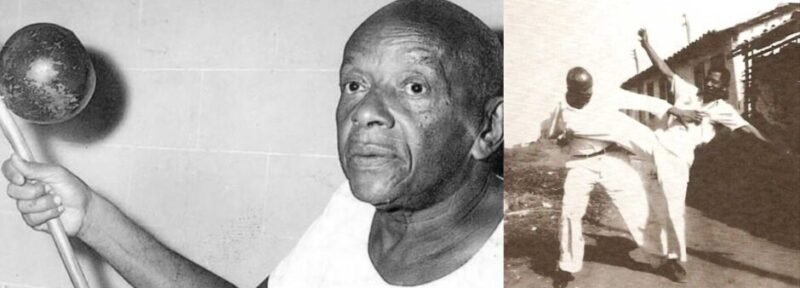
Mestre Bimba helped transform Capoeira from a persecuted street art into a recognised Brazilian martial art through the creation of Capoeira Regional.
Click on the links below to read more.
🔵 Mestre Bimba — Structure and Legitimacy
Mestre Bimba, born Manuel dos Reis Machado, believed Capoeira was losing its effectiveness and discipline. In his view, too much of the art had become fragmented, informal, or overly theatrical, while its martial side was fading.
During the 1920s and 1930s, Bimba began restructuring and formalising Capoeira into a more organised system that became known as Capoeira Regional. His approach emphasised athleticism, efficiency, directness, conditioning, and structured training methods. He introduced formal sequences, partner drills, and a more disciplined teaching structure designed to restore Capoeira’s credibility as a serious fighting system.
NB: Why “Regional”?
Because Capoeira was still illegal during this period, Bimba initially referred to his system as Luta Regional Baiana (“Regional Fight of Bahia”) rather than openly calling it Capoeira.
Bimba’s efforts proved hugely influential. In 1932, he opened what is widely considered the first official Capoeira academy. Public demonstrations and growing political support gradually helped transform Capoeira’s image from criminal street activity into recognised Brazilian cultural practice.
Mestre Bimba is widely regarded as the most important figure in Capoeira’s modern survival.
⚫ Mestre Pastinha — Tradition and Malícia
Where Bimba focused on reform and structure, Mestre Pastinha dedicated himself to preserving the older traditions and philosophy of the art.
Pastinha believed Capoeira’s essence lay not in spectacle or rigid systems, but in patience, deception, rhythm, ritual, and malícia. His approach became strongly associated with Capoeira Angola, the slower, lower, and more strategic style rooted in older traditions.
Under Pastinha, Capoeira remained deeply tied to improvisation and psychological interaction inside the Roda. The game between practitioners mattered as much as the techniques themselves. Timing, manipulation, awareness, and control were treated as signs of mastery rather than simply athletic ability.
Pastinha saw Capoeira as something broader than combat alone. To him, it carried philosophy, history, culture, and identity within it.
NB: About Pastinha’s Final Years
Despite his importance to Capoeira’s preservation, Pastinha’s later life was marked by hardship. After losing control of his academy under controversial circumstances, he spent his final years in poverty and declining health. He died in 1981, largely blind and financially destitute. Many practitioners regard his treatment as one of the great injustices in Capoeira’s history.
⚔️ Two Visions of Capoeira
The contrast between Bimba and Pastinha helped shape the two major currents that still influence Capoeira today.
Bimba pushed the art toward structure, legitimacy, and practical efficiency. Pastinha sought to preserve its ritual, cultural depth, and deceptive nature. One aimed to modernise Capoeira for survival within Brazilian society, while the other fought to ensure its older spirit was not lost in the process.
Modern Capoeira ultimately emerged from the tension between those two visions.
That tension still exists today. Some schools lean heavily toward athleticism, combat application, and modernisation, while others prioritise tradition, ritual, music, and slower tactical games within the Roda. Most modern Capoeira groups exist somewhere between those two poles, carrying traces of both men whether consciously or not.
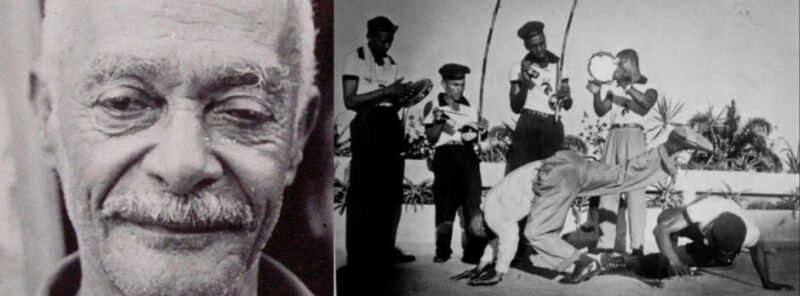
Mestre Pastinha dedicated his life to preserving the traditions of Capoeira Angola, helping ensure the survival of its older philosophies, rituals, and methods.
🇧🇷 From Outlaw Art to National Symbol
By the mid-twentieth century, Capoeira had undergone a remarkable transformation. What had once been criminalised, heavily policed, and associated with gangs and disorder was slowly being reframed as part of Brazil’s national culture.
This shift did not happen overnight. Capoeira’s image remained controversial for decades, particularly among older authorities who still associated the art with violence and criminality. Yet changing political attitudes inside Brazil created opportunities for Capoeira to move beyond the underground world where it had spent so much of its history.
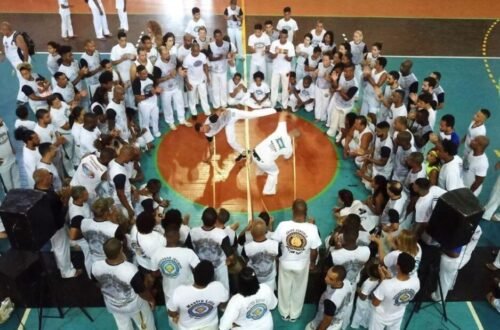
In 2014, the Capoeira Circle was recognised by UNESCO as part of the Intangible Cultural Heritage of Humanity, reflecting Capoeira’s transformation from a persecuted practice into a globally recognised cultural tradition.
Click on the links below to read more.
🏛️ Legalisation Under Getúlio Vargas
A major turning point came during the rule of Getúlio Vargas, whose government promoted forms of culture considered uniquely Brazilian. Vargas understood the political value of national identity and sought to reshape practices once viewed as backward or dangerous into symbols of Brazilian heritage.
Capoeira benefited enormously from this change in attitude. Public demonstrations became more accepted, academies began operating more openly, and the art slowly lost some of its criminal stigma. Mestre Bimba’s efforts to formalise and present Capoeira as a disciplined martial system also played a major role in making this transition possible.
The legalisation and growing acceptance of Capoeira fundamentally changed its future. For the first time, the art could survive openly rather than through concealment and constant adaptation to repression.
🥁 Capoeira and Brazilian Identity
As Capoeira spread more widely throughout Brazil, it increasingly became linked to ideas surrounding national culture, Afro-Brazilian identity, music, and tradition. The art’s mixture of movement, rhythm, ritual, and history made it stand out as something distinctly Brazilian despite its African roots.
This period also softened parts of Capoeira’s public image. The harsher associations with gangs, blades, and organised street violence gradually gave way to more positive portrayals centred around athleticism, folklore, performance, and cultural celebration.
That transformation helped Capoeira survive internationally, but it also created tension within the art itself. Some practitioners believed Capoeira’s dangerous and practical aspects were being diluted in favour of spectacle and public acceptance, while others saw this evolution as necessary for survival.
🌐 Global Recognition
During the second half of the twentieth century, Capoeira spread far beyond Brazil as mestres established schools throughout Europe, North America, Asia, and beyond. What had once been a localised practice associated with slavery, resistance, and urban violence gradually became a global cultural tradition.
In 2014, the Capoeira Circle was recognised by UNESCO as part of the Intangible Cultural Heritage of Humanity. The recognition reflected a remarkable transformation. Capoeira had travelled from hidden rodas and persecuted communities to become one of Brazil’s most recognisable cultural exports.
Despite this success, many of the art’s defining characteristics, rhythm, malícia, movement, and communal practice, still carry traces of the conditions that shaped its origins.
✊🏿⛓️ Legacy of Resistance
Few martial arts have undergone a transformation quite like Capoeira’s. It emerged from slavery, repression, and marginalisation, yet eventually became associated with celebration, cultural identity, and national pride. Over centuries, it evolved from a practice of survival and resistance into one of Brazil’s most recognisable cultural traditions.
Its journey was never straightforward. Capoeira survived quilombos, city streets, gangs, police crackdowns, criminalisation, and near extinction before finding acceptance within mainstream Brazilian society. At each stage, it adapted to new circumstances without completely abandoning the influences that shaped it.
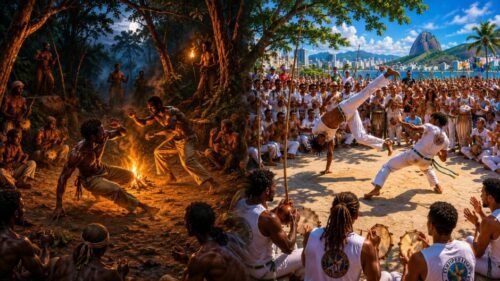
From hidden forest rodas to public celebrations around the world, Capoeira’s journey reflects a remarkable story of survival, adaptation, and cultural resilience.
Perhaps that ability to adapt explains Capoeira’s survival. Few martial arts have undergone such dramatic transformations while retaining such a strong connection to their origins. From hidden rodas and persecuted communities to global recognition, Capoeira’s story remains one of the most remarkable in the martial arts world.