



Meal Planning and Prepping For Fitness

With energy balance, macronutrients, and portion control in place, the final step is execution. This section covers how to plan and prepare meals so your intake stays consistent under real-world conditions.

Table of Contents

🔥 Introduction

This is Part 5 of the nutrition series. Up to this point, we’ve built the system.

In Part 2, we covered energy balance—how much you need to eat. In Part 3, we broke down macronutrients—what that intake should consist of. In Part 4, we introduced portion control—how to manage intake consistently.

Meal prep is a powerful tool for saving time, reducing stress, and ensuring consistent, healthy eating throughout the week.

This final step is about making that system automatic.

Most people do not fail because they lack knowledge. They fail because decisions are made in the moment—when time is limited, energy is low, and convenience takes over. Meal planning and preparation remove that problem. They reduce decision-making, create structure, and make consistency the default rather than the exception.

🧠 Why Meal Planning Matters

Nutrition breaks down when it relies on daily decisions.
After a long day, when you are tired, busy, or distracted, you are far more likely to default to whatever is easiest rather than what aligns with your goals. Meal planning removes that variable. It allows you to decide in advance what you are going to eat, rather than reacting in the moment.
Over time, this reduces decision fatigue and improves consistency without requiring constant effort.
Your environment also plays a role. If low-quality food is constantly available, it will eventually be eaten—regardless of your plan. Keeping structured meals visible and accessible, while reducing exposure to less useful options, makes adherence significantly easier.

🧭 Control Your Food Environment

Your environment influences your decisions more than intention alone.
If food that does not align with your goals is constantly available, it will eventually be eaten. Adjusting your environment—by making structured options more accessible and reducing exposure to less useful choices—reduces the need for willpower.

⚙️ Planning vs Preparation

It is useful to separate two related concepts.
Meal planning is the process of deciding what you will eat across the week. It is strategic and forward-looking, built around your schedule, training, and goals. Meal preparation is the practical step—cooking, portioning, and storing meals so they are ready when needed.
Planning sets direction. Preparation removes friction.
This process begins at the shop, not the kitchen. A repeatable shopping approach—buying the same core foods, using a consistent list, and prioritising simple ingredients—reduces unnecessary decisions and makes the rest of the system easier to run.

🛒 Simplify Your Shopping

Meal prep starts before you enter the kitchen.
A repeatable shopping approach—buying the same core foods, using a consistent list, and prioritising simple ingredients—reduces unnecessary decisions and makes the system easier to maintain over time.

🧱 The Simple System

Effective meal prep does not require complexity. It requires consistency.
Most people benefit from a simple structure built around a small number of repeatable meals. Rather than constantly creating new recipes, the focus should be on preparing a few reliable options that can be rotated across the week.
A practical example would be selecting two protein sources, two carbohydrate sources, and a small number of vegetables, then combining them in different ways. This keeps preparation simple while still allowing enough variation to avoid monotony.
The goal is not to create perfect meals. It is to create meals that are easy to repeat under real-world conditions.

⏱️ Schedule Your Preparation

Meal prep only works when it is planned.
Treat it like a training session. For most people, a single longer session at the start of the week, followed by a shorter top-up midweek, is enough to maintain structure.
Without a defined time, it becomes optional—and optional tasks are easily skipped.

🍽️ Building Your Meals

Each meal should follow a consistent structure.
Start with a clear protein source, then add carbohydrates based on your activity level. Fats are included to support overall function, and vegetables provide volume and nutritional coverage.

Smart shopping is the foundation of effective meal prep, helping you stock up on nutritious ingredients while saving time and money.

A simple visual guide helps anchor this:

  • Half the plate: vegetables.
  • Quarter: protein.
  • Quarter: carbohydrates.
  • Fats can be adjusted depending on your goal and total intake.

This approach aligns with the principles from earlier posts without requiring constant recalculation. You are not aiming for precision in isolation—you are aiming for consistency over time.

🛠️ Structuring Your Day

Meal timing does not need to be complicated, but it should reflect your routine.
Most people will operate effectively with two to four meals per day, with protein distributed across those meals and carbohydrates placed around periods of activity.
On training days, your structure should revolve around the session itself. Eating beforehand supports performance, while eating afterwards supports recovery. The rest of the day fills in around that anchor point.
The exact timing matters less than precision. What matters is that your intake supports your output and remains stable from one day to the next.

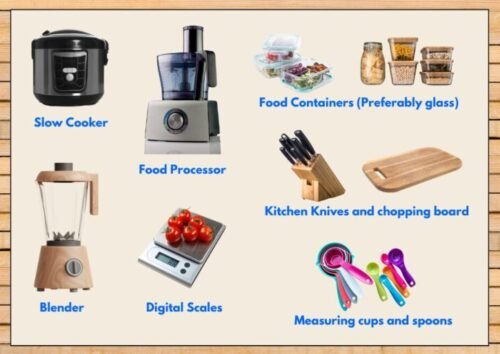
Some of the basic equipment you might want to have on hand to make meal prep easier, and more efficient.

🔁 Keeping It Flexible

One of the most common mistakes is overcomplicating meal prep.
You do not need a different meal every day. In practice, repeating meals is often more effective. It reduces planning time, simplifies shopping, and makes preparation faster.
Flexibility still has a place, but it needs boundaries. Meals can change, but the framework should remain intact.
A simple approach is to keep the majority of meals structured, while allowing a small proportion to remain flexible. This creates room for variation without disrupting the system.
Consistency is more valuable than novelty.

⚖️ Use the 80/20 Approach

You do not need every meal to be perfect.
Keeping the majority of meals structured while allowing a small degree of flexibility creates balance without breaking consistency.
Meals can change. The framework does not.

Like the Boy Scouts say, “Be prepared”—keep ready-made healthy snacks on hand for those moments when hunger overrides discipline.

🚨 When Things Go Wrong

No system works perfectly all the time.

There will be days where meals are not prepared, schedules change, or circumstances interfere. What matters is how quickly you return to structure.

The rule is simple: return to the plan at the next meal.

Not the next day. Not the next week. The next decision.

This prevents small disruptions from becoming prolonged inconsistency.

🍏 Snacks and Backup Options

Snacks and simple meal options act as support tools when structure is disrupted.

These become useful when meals are delayed, when you are travelling, or when access to food is limited. Having a small number of reliable options reduces the likelihood of poor decisions under pressure.

🧱 Default Meals

Having one or two meals that require no thought is a major advantage.

These should be simple, repeatable, and built from ingredients you always have available. They allow you to maintain structure when time, energy, or motivation is limited.

⚙️ Cooking Once, Eating Multiple Times

Efficiency comes from scale.

Instead of preparing each meal individually, it is more effective to cook core components in bulk—protein sources, carbohydrates, and vegetables—and reuse them across multiple meals.

This reduces total preparation time while maintaining consistency.

You are not cooking individual meals. You are building a system of reusable components.

🔁 Batch Cooking as Standard

Cooking once and eating multiple times is one of the most effective ways to reduce effort while maintaining consistency.

Preparing food in bulk allows you to maintain structure without needing to cook from scratch every day.

⚠️ Common Mistakes

Most issues with meal planning are not due to lack of effort, but poor structure.

Common patterns include overcomplicating meals, trying to introduce too much variety, failing to prepare enough food in advance, and relying on motivation rather than a repeatable system. Another common failure point is the absence of fallback options when plans change.

These are structural issues, not discipline issues.

🎯 Final Takeaway — Making It Automatic

Meal planning and preparation are what turn nutrition from a decision into a system.

When meals are planned, prepared, and structured in advance, you remove the need to constantly think about what to eat. You reduce decision fatigue, improve consistency, and make your intake more predictable.

This is what allows the rest of the series to work.

Because progress does not come from knowing what to do. It comes from doing it consistently—without relying on motivation to carry the load.

📌 Simple Rules That Work

Keep meals simple and repeatable.
Prepare food in advance where possible.
Build meals around protein.
Align intake with your routine.
Always have a fallback option.

Consistency comes from reducing friction, not increasing effort.

➡️ What’s Next — Putting It All Together

Across this series, we’ve built the system.

In Part 1, we established the foundation—why nutrition matters, and how it affects performance, recovery, and long-term progress.

In Part 2, we established energy balance—how much you need to eat.

In Part 3, we broke down macronutrients—what that intake should consist of.

In Part 4, we applied structure through portion control—how to manage it consistently.

Together, these form a complete framework.

But the outcome is not driven by any single part. It comes from how well they are applied over time.

Because progress does not come from knowing what to do. It comes from doing it consistently—without relying on motivation to carry the load.

The goal now is simple.

Keep it structured.
Keep it repeatable.
Keep it consistent.

That is what makes the system work.

⚠️ Disclaimer

Nutrition is complex and individual. While these principles provide a solid foundation, factors such as allergies, medical conditions, and specific deficiencies will influence what works best for you.

Use these guidelines as a starting point. If you require personalised advice, consult a qualified professional such as a registered dietitian.

Related Posts

Other Posts

Leave a Reply

Your email address will not be published. Required fields are marked *

This site uses Akismet to reduce spam. Learn how your comment data is processed.

error: Content is protected !!

Join the Super Soldier Project Mailing List Today!!