Split image of Kai struggling to sleep at night and exhausted during a group HIIT workout the following day.

๐Ÿ›Œ The Power of Sleep โ€” Recovery, Performance and Health

Sleep is not downtime. It is where recovery, adaptation, and resilience are built. If sleep breaks down, everything else, training, nutrition, focus, mood, and long-term health starts to follow.

๐Ÿ“‘ Table of Contents

๐Ÿ”ฅ Introduction

Sleep is one of the most fundamental biological processes we have, yet it is also one of the most neglected.

Most people carefully plan their training, monitor their nutrition, organise their work, and make time for family or social commitments. Sleep, however, is often treated as whatever time happens to be left at the end of the day. In a culture that celebrates being busy, sacrificing sleep has almost become a badge of honour.

Tired IT professional working on his laptop after midnight while his bedroom and bed wait in the background.

Work, training and everyday responsibilities can easily push sleep to the bottom of the priority list, but consistently sacrificing rest eventually comes at a cost to recovery, health and performance.

The problem is that sleep isn’t lost time. It is a highly active period of repair and regulation. While we sleep, the body repairs tissue, regulates hormones, consolidates memories, supports immune function, and prepares both brain and body for the demands of the following day.

When sleep is consistently compromised, the effects spread far beyond feeling tired. Physical performance declines. Recovery slows. Decision-making becomes less reliable. Appetite becomes harder to control, while stress tolerance falls. Over time, these deficits accumulate, quietly undermining health and performance.

Sleep is not time taken away from performance. It is part of what makes sustained performance possible.

In this first article of our three-part series, we’ll explore why sleep matters, how it influences both body and mind, and what happens when we fail to get enough of it. In Part 2, we’ll examine the science behind sleep itself, before finishing with practical strategies for improving sleep quality in Part 3.

โš™๏ธ Sleep Is Not Passive

When we fall asleep, it can seem as though the body simply shuts down for the night. In reality, sleep is an active and highly organised biological state.

While conscious awareness fades, the brain and body remain busy. Sleep cycles through different stages, hormones continue to regulate essential processes, tissues undergo repair, immune activity shifts, and memories are processed and consolidated.

๐Ÿ”ง Maintenance While You Sleep

Sleep provides the conditions for important biological processes that are difficult to achieve in the same way while we are awake. When sleep is repeatedly cut short or disrupted, those processes can be compromised.

This is why poor sleep affects far more than energy levels. It can influence physical recovery, cognitive performance, emotional resilience, metabolism, immune function, and long-term health.

Many problems associated with heavy training loads, chronic stress, or demanding lifestyles can also be made worse when inadequate sleep is added to the equation.

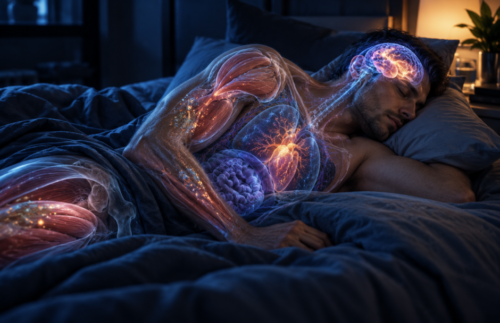
Sleeping man shown with the brain, nervous system, muscles and internal organs active during sleep and recovery.

Sleep may look passive, but beneath the surface the brain and body remain remarkably active, coordinating the repair, regulation and restoration that prepare us for the day ahead.

Sleep, then, is not simply time away from the day. It is an essential part of how the brain and body maintain themselves and prepare for what comes next.

In the following sections, we’ll look at some of the main ways sleep supports both body and mind, and why protecting it deserves the same attention as training and nutrition.

๐Ÿ’ช Physical Recovery and Training

Every training session places the body under stress.

Whether you’re lifting weights, running, practising martial arts, or recovering from a physically demanding day at work, your muscles, connective tissues, nervous system, and energy systems all need time to recover and adapt.

Training provides the stimulus. Recovery is where the body responds to it.

๐Ÿ”ง Where Adaptation Is Built

Sleep plays a major role in that process. During the night, the body supports tissue repair, protein synthesis, immune function, hormonal regulation, and the restoration of energy reserves. Deep sleep is particularly associated with physical restoration, including increased growth hormone release.

When sleep is consistently compromised, recovery becomes less efficient. You may still complete your workouts, but the quality of your adaptation can begin to suffer.

Over time, poor sleep can contribute to:

  • Slower recovery between training sessions.
  • Reduced strength, power, and endurance.
  • Increased fatigue and reduced motivation.
  • Poorer technique and decision-making under fatigue.
  • Greater risk of illness and injury.
  • Plateaus in performance despite consistent effort.
Female athlete training with barbell, sleeping overnight and returning recovered and ready to train the following day.

Training provides the stimulus, but recovery drives the adaptation. Quality sleep gives the body time to repair, rebuild and prepare for the next challenge.

๐Ÿ“ˆ More Training Is Not Always More Progress

One of the biggest misconceptions in fitness is that progress always comes from doing more.

Adding extra sessions, volume, or intensity can work, provided the body has enough capacity to recover from them. When recovery is inadequate, additional training simply adds more stress to a system already struggling to adapt.

Progress is the result of stress followed by sufficient recovery.

The harder you train, the more important that recovery becomes. Sleep is not the only factor involved, but it is one of the most important. Without enough of it, even a well-designed programme can eventually produce diminishing returns.

๐Ÿงฌ Hormones, Appetite and Body Composition

Sleep influences far more than how energetic you feel the next day. It also plays an important role in regulating systems involved in hunger, stress, blood sugar, metabolism, and recovery.

When sleep is consistent, these systems generally function more effectively. Appetite is easier to manage, energy levels are more stable, and the body is better able to regulate blood glucose and use nutrients efficiently.

When sleep is repeatedly restricted, that balance can begin to shift.

๐Ÿฝ๏ธ Why Poor Sleep Makes Eating Harder

Sleep loss can alter the hormonal and neurological signals involved in hunger and appetite. Ghrelin and leptin are often discussed here, with ghrelin promoting hunger and leptin helping to signal satiety, but the response is more complex than simply one rising and the other falling in everyone.

What is clearer is the practical outcome: poor sleep tends to increase hunger, cravings, and the appeal of calorie-dense foods, while also making dietary restraint harder to maintain.

At the same time, sleep restriction can impair insulin sensitivity and affect the body’s ability to regulate blood glucose effectively. Stress may compound the problem by increasing cortisol and encouraging more impulsive or comfort-driven eating.

Poor sleep can therefore contribute to:

  • Increased hunger throughout the day.
  • Stronger cravings for sugary or high-fat foods.
  • Greater likelihood of overeating.
  • Reduced dietary discipline.
  • More difficulty losing fat or maintaining a healthy body composition.
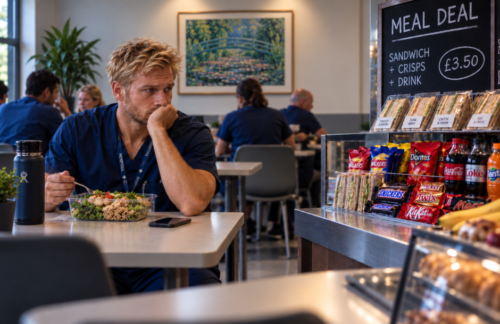
Tired healthcare worker eating a healthy meal in a hospital canteen while looking towards tempting snacks, chocolate and crisps.

Poor sleep can disrupt appetite regulation and increase the pull of high-calorie foods, making hunger, cravings and healthy eating harder to manage.

โš–๏ธ Sleep and Body Composition

None of this means that one bad night’s sleep will suddenly cause weight gain.

The problem is repeated sleep loss. When increased appetite, poorer food choices, reduced activity, and impaired recovery occur night after night, maintaining a healthy body composition becomes progressively harder.

This is why sleep and nutrition should not be viewed in isolation. You can have an excellent training programme and a well-designed diet, but if sleep is consistently poor, you’re making both harder to sustain.

Good sleep doesn’t replace good nutrition, but it makes good nutrition much easier to follow.

๐Ÿง  Cognitive Function and Decision-Making

Sleep is just as important for the brain as it is for the body.

Throughout the night, the brain remains highly active. Information gathered during the day is processed, important memories are strengthened, and learning is consolidated. This helps prepare us to think clearly, solve problems, and respond effectively to the demands of the following day.

When sleep is good, concentration improves, reaction times are sharper, memory is more reliable, and complex decisions become easier to make.

When sleep is poor, the opposite begins to happen.

โš ๏ธ Fatigue Changes How You Think

As sleep loss builds, attention drifts, reaction times slow, and decision-making becomes less reliable. Tasks that would normally feel straightforward require more mental effort, while errors become more frequent.

Judgement can also become more impulsive. Under fatigue, people are more likely to overlook details, misread situations, and make poorer decisions.

These effects influence far more than work or study. They can affect:

  • Training intensity and technique.
  • Food choices and portion control.
  • Driving and reaction time.
  • Problem-solving.
  • Memory, learning, and concentration.
  • Communication and emotional judgement.
Tired air traffic controller suppressing a yawn while monitoring aircraft, with coffee and an energy drink beside his workstation.

Sleep loss can impair attention, reaction time and decision-making, while stimulants may temporarily increase alertness without restoring the cognitive performance that adequate sleep provides.

๐Ÿ“‰ Small Errors Add Up

This is one of the ways chronic sleep deprivation quietly undermines progress.

It is rarely one catastrophic mistake. More often, fatigue makes dozens of small decisions each day slightly worse than they otherwise would have been.

You train with poorer technique. You reach for easier food choices. You lose concentration more quickly. You react more emotionally. You take longer to solve problems.

Individually, those mistakes may seem minor. Repeated day after day, they begin to matter.

Poor sleep doesn’t simply reduce performance. It changes the quality of the decisions behind it.

โš–๏ธ Emotional Regulation and Stress

Sleep does more than restore the body. It also helps regulate the mind.

Every day brings frustrations, pressures, and emotionally charged situations. During sleep, the brain continues processing those experiences, helping to regulate emotion, consolidate memories, and restore psychological balance.

When sleep is adequate, we generally cope better. Patience is greater, stress is easier to manage, and emotional reactions are more proportionate to the situation.

When sleep is repeatedly disrupted, that resilience begins to erode.

๐Ÿ˜ค When Small Problems Feel Bigger

Poor sleep can make us more irritable, reactive, and mentally drained. Minor inconveniences become harder to tolerate, while problems that would normally be handled calmly can feel disproportionately stressful.

Over time, this can affect:

  • Patience and emotional control.
  • Relationships and communication.
  • Motivation and confidence.
  • Stress tolerance.
  • Decision-making under pressure.
  • Recovery from mentally demanding days.

Sleep loss can also increase physiological stress, making recovery harder and potentially interfering further with sleep itself.

Same man shown after poor sleep and good sleep, contrasting late-night doomscrolling and next-day irritability with restful sleep and calmer communication at work.

Poor sleep can reduce emotional resilience, making everyday frustrations feel harder to manage. Better sleep helps restore patience, perspective and the ability to respond calmly under pressure.

๐Ÿ”„ The Stressโ€“Sleep Cycle

This creates a cycle many people recognise:

  • Poor sleep increases stress.
  • Higher stress makes it harder to switch off.
  • Reduced sleep lowers emotional resilience.
  • The following day feels harder to manage.
  • Bedtime arrives with even more mental tension.

Without intervention, that cycle can continue for weeks or months.

Good sleep does not remove life’s problems. It gives you a stronger buffer against them and makes it easier to respond rather than simply react.

๐Ÿ“‰ When Sleep Breaks Down

Missing the occasional night’s sleep is part of life. Most people recover quickly from the odd late night, long shift, or disrupted night.

The real problems begin when poor sleep becomes the norm rather than the exception.

Sleep loss often accumulates gradually. At first, the effects may be subtle: slightly more fatigue, slower reactions, reduced motivation, or poorer concentration. Because these changes develop gradually, people can become accustomed to functioning below their best without realising how much their performance has declined.

โš ๏ธ The Effects Begin to Stack Up

The real problem with persistent sleep loss is that its effects do not occur in isolation. They begin to interact.

Poor recovery can make training and everyday demands feel harder. Greater fatigue can reduce motivation and make convenient food choices more appealing. Reduced concentration increases the likelihood of mistakes, while lower emotional resilience can make ordinary pressures feel more stressful.

That increased stress can then make it harder to switch off and sleep properly the following night.

A pattern begins to form:

  • Poor sleep reduces recovery.
  • Fatigue makes training and everyday tasks feel harder.
  • Poor food choices become more likely.
  • Stress levels increase.
  • Falling asleep becomes more difficult.
  • The cycle repeats.

What begins as a sleep problem can therefore become a self-reinforcing cycle, with each consequence making the others harder to manage.

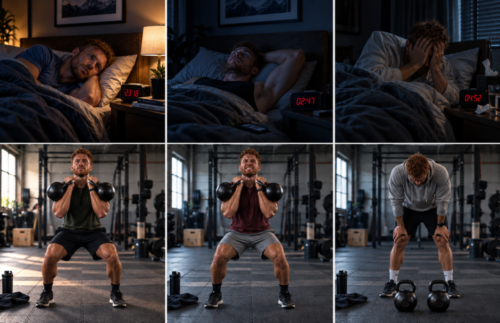
Ginger-haired athlete shown across three restless nights and three progressively harder kettlebell training sessions as sleep loss accumulates.

One poor night may be manageable, but repeated sleep loss can accumulate, progressively undermining energy, concentration, motivation and physical performance.

๐Ÿฉบ The Long-Term Cost

Over time, consistently inadequate sleep is associated with a higher risk of numerous health problems, including cardiovascular disease, obesity, type 2 diabetes, depression, and impaired immune function.

These conditions do not develop because of one bad night. The concern is persistent sleep loss over months or years, particularly when combined with other lifestyle and health risks.

Poor sleep rarely causes dramatic failure overnight. More often, it quietly erodes performance until functioning below your potential begins to feel normal.

๐Ÿฉบ When It's More Than Poor Sleep Habits

Not all sleep problems are caused by poor routines, late nights, stress, or too much screen time.

For some people, persistent sleep disruption is linked to an underlying sleep disorder or medical condition that requires proper assessment. In these cases, improving sleep habits may help, but it will not necessarily resolve the underlying problem.

โš•๏ธ Common Sleep Disorders

Some of the most common conditions include:

  • Insomnia โ€“ Persistent difficulty falling asleep, staying asleep, or waking earlier than intended.
  • Sleep apnoea โ€“ Repeated interruptions in breathing during sleep, often accompanied by loud snoring, choking or gasping, and excessive daytime sleepiness.
  • Restless legs syndrome (RLS) โ€“ An uncontrollable urge to move the legs, usually accompanied by uncomfortable sensations that worsen during periods of rest.
  • Circadian rhythm sleep-wake disorders โ€“ Conditions where the body’s internal clock is misaligned with the required sleep-wake schedule.

๐Ÿšจ Know When to Get Help

If poor sleep persists despite improving your routine, or if you experience symptoms such as excessive daytime sleepiness, loud snoring, gasping, breathing pauses, or persistent insomnia, it is worth seeking medical advice.

The same applies if sleep problems begin affecting work, training, concentration, mood, or day-to-day functioning.

Good sleep habits matter, but they are not a substitute for diagnosis when something more serious is going on.

Recognising when poor sleep needs professional assessment is just as important as learning how to improve sleep in the first place.

โฐ Sleep Needs and Reality

So how much sleep do we actually need?

For most healthy adults, around seven to nine hours per night is a useful general target. But sleep requirements are not identical for everyone, and there is no single number that guarantees perfect recovery.

Age, genetics, training load, illness, stress, and lifestyle can all influence how much sleep an individual needs.

โฑ๏ธ The Eight-Hour Myth

Eight hours is often treated as the universal standard, but it is better viewed as a useful reference point than a biological rule.

Some people function well toward the lower end of the typical range, while others genuinely need more. Sleep requirements can also change depending on what is happening in your life.

A demanding training block, illness, accumulated sleep loss, or periods of unusually high physical or mental stress may increase the need for sleep and recovery.

The more useful question is not simply:

โ€œDid I get eight hours?โ€

It is:

โ€œAm I getting enough sleep to recover and function well?โ€

๐ŸŒ™ Quality Matters Too

Duration is only part of the picture.

Eight hours in bed does not necessarily mean eight hours of restorative sleep. Frequent awakenings, breathing disturbances, or environmental disruption can all reduce sleep quality

Signs that your sleep may be insufficient include:

  • Struggling to wake without repeated alarms.
  • Persistent daytime tiredness or sleepiness.
  • Difficulty concentrating.
  • Irritability or low motivation.
  • Heavy reliance on caffeine to function.
  • Poor recovery despite appropriate training and nutrition.
  • Regularly sleeping much longer whenever you get the opportunity.

The goal is therefore not to chase a perfect number every night. It is to build a consistent pattern of sufficient, good-quality sleep that allows you to recover, perform, and function effectively.

๐ŸŽฏ Key Takeaways

Sleep is not passive downtime. It is an active biological process that supports recovery, adaptation, brain function, emotional regulation, metabolism, and long-term health.

The key lessons are simple:

  • Sleep is part of recovery. Training provides the stimulus, but adaptation depends on giving the body sufficient opportunity to recover.
  • Poor sleep affects both body and mind. Strength, endurance, reaction time, concentration, judgement, and emotional resilience can all suffer.
  • Sleep influences appetite and body composition. Repeated sleep loss can increase hunger and cravings while making dietary discipline harder to maintain.
  • The effects accumulate. Persistent sleep loss can create a self-reinforcing cycle of fatigue, poorer recovery, increased stress, and further sleep disruption.
  • Seven to nine hours is a useful general target for most adults, but individual sleep needs vary.
  • Quality matters as well as quantity. Frequent awakenings or disrupted sleep can leave you poorly recovered even after spending enough time in bed.
  • Persistent sleep problems should not simply be ignored. Symptoms such as excessive daytime sleepiness, loud snoring, gasping, breathing pauses, or persistent insomnia may warrant medical assessment.

Sleep should therefore be treated with the same seriousness as training and nutrition.

You can optimise your programme, improve your diet, and work harder, but if sleep is consistently neglected, you are making every one of those things more difficult.

Better performance begins with better recovery, and better recovery begins with better sleep.

Kai looking refreshed and confident as he leaves home in gym clothes with his training bag after a good nightโ€™s sleep.

Quality sleep restores the body and mind, helping you wake refreshed, recover properly and face the day ready to perform.

โžก๏ธ Next Up: The Science of Sleep

Understanding why sleep matters is only the first step.

In the next article, we’ll look beneath the surface and explore how sleep actually works. We’ll examine the body’s internal clock, the chemical signals involved in sleep and wakefulness, how sleep pressure develops throughout the day, and how different stages of sleep are organised across the night.

Together, these processes help explain when we become sleepy, why we wake, and what happens while we sleep.

Understanding the mechanisms behind sleep makes it easier to recognise what may be disrupting it and, ultimately, what can be done to bring those systems back into balance.

Next: ๐Ÿง  The Science of Sleep โ€” How the Body Knows When to Rest

๐Ÿ“š References and Further Reading

National Institute of Neurological Disorders and Stroke (NINDS): Information on sleep, sleep disorders, and the biological processes involved in sleep and wakefulness.

NINDS โ€” Sleep

ย 

American Academy of Sleep Medicine (AASM): Professional guidance and educational resources covering healthy sleep, insomnia, sleep apnoea, CBT-I, and other sleep disorders.

American Academy of Sleep Medicine โ€” Patient Information

ย 

Sleep Research Society: Scientific organisation supporting research into sleep, circadian rhythms, sleep health, and sleep disorders.

Sleep Research Society

ย 

Centers for Disease Control and Prevention (CDC): Public-health information on sleep duration, sleep quality, healthy sleep habits, and the relationship between sleep and health.

CDC โ€” Sleep

ย 

NHS: Practical guidance on sleep, tiredness, insomnia, and when persistent sleep problems may require medical advice.

NHS โ€” Sleep and Tiredness

ย 

Harvard Health Publishing, Harvard Medical School: Accessible medical information covering sleep physiology, sleep stages, sleep deprivation, sleep hygiene, and the effects of sleep on physical and mental health.

Harvard Health โ€” Sleep

ย 

Mayo Clinic: Medical information on insomnia, sleep apnoea, restless legs syndrome, circadian sleep disorders, narcolepsy, and other common sleep disorders.

Mayo Clinic โ€” Sleep Disorders

ย 

Sleep Foundation: Consumer-focused information on sleep health, sleep hygiene, circadian rhythms, sleep disorders, and strategies for improving sleep.

Sleep Foundation

If you have enjoyed this post please share or feel free to comment below ๐Ÿ™‚

Our Other Posts

Leave a Reply

Your email address will not be published. Required fields are marked *

This site uses Akismet to reduce spam. Learn how your comment data is processed.

error: Content is protected !!

Join the Super Soldier Project Mailing List Today!!