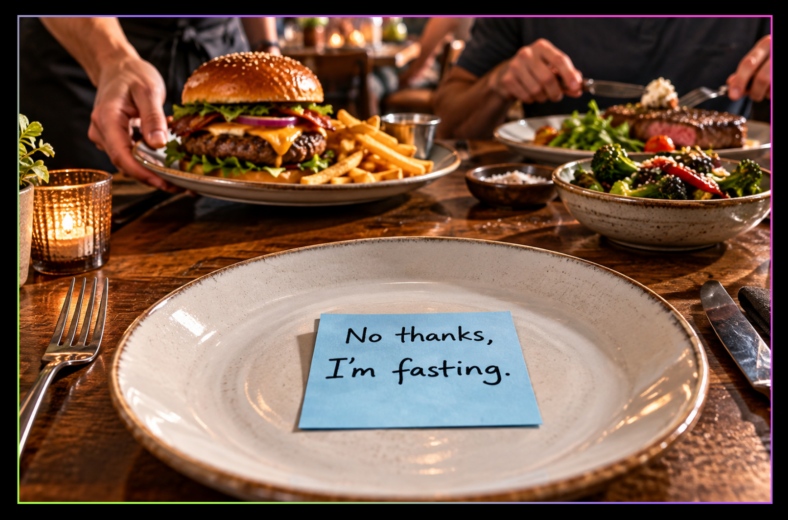
Can intermittent fasting really help you lose fat, improve your health and boost performance, or is it another overhyped diet trend? We examine how fasting works, its potential benefits and limitations, and whether changing when you eat can genuinely help you achieve your goals.
📑 Table of Contents
🍽️ Introduction
Intermittent fasting has become one of the most popular approaches to weight management, with methods ranging from extending the normal overnight fast to restricting food to a defined daily window or reducing intake on selected days of the week. Its appeal is simple: instead of constantly tracking food, you place some structure around when you eat.
Fewer meals, fewer decisions. A little planning can make intermittent fasting easier, provided your eating window still delivers the nutrition you need.
For some people, that makes nutrition easier. A shorter eating window can reduce snacking, simplify meal planning and make it easier to control total calorie intake without weighing every portion. Others find that longer periods without food leave them excessively hungry, interfere with training or make normal social eating more awkward. The method can therefore be useful, but its value depends heavily on whether the structure actually suits the person following it.
⚖️ A Tool, Not a Shortcut
Intermittent fasting does not bypass energy balance. Weight loss still requires a sustained calorie deficit, and research generally shows that fasting-based approaches and conventional calorie restriction can both work when they produce a similar reduction in energy intake.
Where IF can help is adherence. Someone who prefers two or three larger meals may find an eight- or ten-hour eating window easier than spreading food across the entire day. Another person may manage hunger, training and recovery better with regular meals from morning to evening. Neither approach has a monopoly on fat loss.
The useful way to think about intermittent fasting is therefore as a method of organising food intake. It can make calorie control easier, reduce unnecessary eating and give the day more structure, but it still has to support good nutrition, training and recovery.
⚙️ How Intermittent Fasting Works
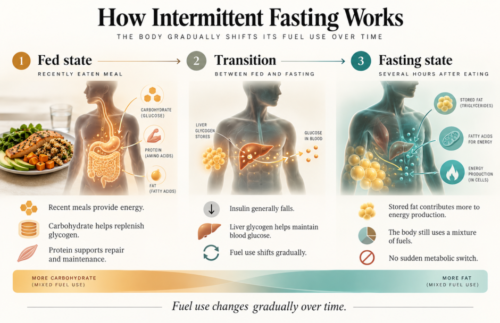
After eating, carbohydrate, fat and protein are absorbed and used for energy, repair and storage. Carbohydrate helps replenish glycogen in the liver and muscles, amino acids support tissue repair, and surplus energy can be stored for later use. As time passes after the meal, insulin levels generally fall and the body gradually relies more heavily on stored fuels.
No magic switch at sixteen hours. The body constantly adjusts its fuel mix according to food intake, activity and energy demands.
That transition is continuous. The body is always using a mixture of carbohydrate and fat, with the balance shifting according to recent food intake, activity, glycogen availability and the length of the fast. There is no precise moment at twelve or sixteen hours when the body suddenly flips from “fed” to “fat-burning mode”.
🔄 Fed and Fasted States
During the fed state, nutrients from recent meals are readily available. Carbohydrate can replenish glycogen, protein supplies amino acids for repair and adaptation, and dietary fat contributes to energy use and storage.
As the fasting period continues, liver glycogen helps maintain blood glucose while stored fat makes a larger contribution to energy production. Muscle glycogen remains largely available to the muscles themselves, which is why previous carbohydrate intake can still matter even if someone trains before breakfast.
The exact response differs between people and depends on what they ate previously, how active they are and how demanding their training has been. Fasting therefore changes the balance of fuel use gradually rather than creating a sudden metabolic switch.
🔥 Fat Burning and Fat Loss
Fasting can increase fat oxidation, meaning a greater proportion of energy is coming from stored fat during that period. This is often used to promote fasting as a superior fat-loss strategy, but the distinction between fuel use and actual body-fat loss matters.
Someone can burn more fat during a fasted morning and then replace that energy later in the eating window. Another person can eat breakfast every day and still lose body fat if their total intake remains below expenditure. Fat oxidation describes what the body is using for fuel at a particular moment; fat loss reflects the balance across days and weeks.
Intermittent fasting therefore helps with fat loss when the eating pattern makes a calorie deficit easier to maintain. That is its practical strength, and it is more useful than trying to turn fasting into a metabolic loophole.
📉 Why IF Can Help With Weight Loss
One of the main advantages of intermittent fasting is that it can reduce the number of opportunities to eat. Someone who normally eats from early morning until late at night may accumulate a surprising amount of energy through snacks, drinks and unplanned meals. A defined eating window can remove some of those opportunities without requiring detailed calorie tracking.
Finish your meal, close the kitchen, get on with your evening. Sometimes a little structure is all it takes to make calorie control easier.
For people who prefer clear rules, that simplicity can be useful. Two or three substantial meals may feel easier to manage than constantly deciding whether another snack fits, how much to reduce each portion, or whether the previous meal was too large. The fasting schedule provides structure, while the calorie deficit still does the actual work.
🧩 Fewer Decisions
A shorter eating window can reduce habitual eating that happens through boredom, routine or convenience rather than hunger. Late-night snacking is a common example. Removing that eating occasion may lower total intake without the person feeling as though they are dieting at every meal.
This does not guarantee weight loss. Someone can still consume a large amount of energy within six or eight hours, particularly if the eating window becomes an excuse for oversized meals or constant grazing. IF works best when the restriction makes the day easier to manage rather than shifting all the same calories into a shorter period.
🧠 Appetite & Adherence
Hunger response varies considerably. Some people adapt well to longer gaps between meals and eventually find the schedule comfortable, while others become distracted, irritable or excessively hungry. In those cases, fasting can make portions harder to control once eating begins and may become more difficult to sustain.
That makes adherence more important than the exact fasting window. A moderate schedule that fits work, training and social life will usually be more useful than an aggressive protocol maintained through constant effort. If 14:10 works comfortably, there is no prize for forcing 18:6 simply because it sounds more disciplined.
For weight loss, the useful question is straightforward: does this eating pattern make a calorie deficit easier to maintain without making hunger, training or everyday life worse? If the answer is yes, intermittent fasting can be a very effective tool. If not, a conventional meal pattern may work just as well.
🕒 Common Intermittent Fasting Approaches
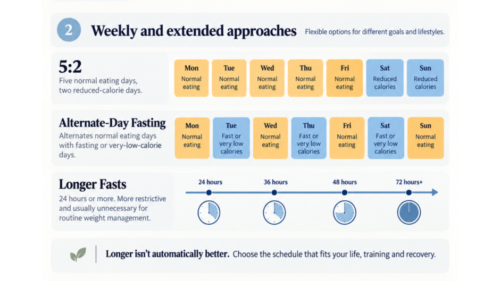
Intermittent fasting covers several different eating patterns, from simply extending the normal overnight fast to restricting food on selected days of the week. The best option depends on appetite, training demands, work schedule and how comfortably you can still meet your nutritional needs. More restriction does not automatically mean better results.
👇 Click on the links below for more.
🌙 12:12
A 12-hour fast followed by a 12-hour eating window is the least restrictive approach. Someone finishing dinner at 8:00 PM and eating breakfast at 8:00 AM is already doing something very similar.
Its main benefit is often simply creating a clear end to evening eating. It leaves plenty of room for normal meals, protein distribution and food around training, making it a sensible starting point for anyone who wants more structure without dramatically changing their routine.
⏱️ 14:10
A 14-hour fast with a 10-hour eating window adds slightly more restriction while still allowing three conventional meals for many people. A schedule such as 9:00 AM to 7:00 PM or 10:00 AM to 8:00 PM can reduce grazing without making adequate food intake especially difficult.
For active people, this often provides a useful middle ground: enough structure to influence eating habits while still leaving room to fuel training and spread protein and carbohydrate across the day.
🕓 16:8
The 16:8 approach restricts food to an eight-hour period each day. A common version runs from midday until 8:00 PM, although the window can be moved earlier or later to suit work and training.
Eight hours is still enough for two or three substantial meals, but higher energy requirements become harder to meet as the window narrows. Someone using IF during fat loss may find that helpful, while a person trying to gain muscle or support high training volumes may find it unnecessarily restrictive.
There is also no requirement to skip breakfast. An earlier eating window can work just as well if it better suits appetite, concentration or training.
📅 5:2
The 5:2 method spreads restriction across the week rather than each day. Food intake remains relatively normal on five days, while two days involve a substantial reduction in calories rather than necessarily a complete fast.
Some people prefer this because most of the week remains unchanged. The reduced-intake days still need placing carefully, particularly around hard training, long shifts or social commitments, because very low food intake can make performance and recovery harder to support.
🔄 Alternate-Day Fasting
Alternate-day fasting generally alternates normal eating days with fasting or very-low-calorie days. It can create a sizeable weekly energy deficit, but the stronger restriction also makes training, recovery and social eating more complicated.
For some people, that clear structure is easier than controlling intake every day. For others, repeated low-intake days simply create excessive hunger and make the following day harder to manage. The method only earns its place if the extra restriction actually improves adherence.
⏳ Longer Fasts
Fasts lasting 24 hours or more are sometimes promoted for additional metabolic, cellular or longevity benefits. They also interfere much more with normal eating, protein distribution and training fuel.
For ordinary weight management, long fasts are rarely necessary. A similar weekly calorie deficit can usually be achieved with less disruption through shorter fasting windows or conventional calorie control. Longer fasting periods therefore need a clearer reason than simply assuming that more fasting must produce more benefit.
🏋️ Intermittent Fasting & Training
Intermittent fasting can work alongside regular training, but the eating window has to support the demands of the programme. The harder, longer and more frequent the training becomes, the more important energy, carbohydrate and protein become, and the less useful it is to protect the fast at the expense of performance or recovery.
Running on empty or ready for action? Fasted training isn’t automatically better. When the workout gets demanding, adequate fuel can make all the difference. Let the programme lead.
For someone training recreationally a few times per week, this is usually easy enough to manage. For athletes doing high-volume strength work, long endurance sessions, repeated conditioning or twice-daily training, a narrow eating window can become much less practical because there are fewer opportunities to fuel and recover.
👇 Click on the links below for more.
💪 Resistance Training
For strength and muscle gain, total daily protein remains one of the main priorities. An eight- or ten-hour eating window still gives plenty of room for several useful protein servings, but very short windows make that harder and can force larger meals into a compressed period.
This matters most for larger athletes, older adults and anyone trying to preserve muscle during fat loss. Intermittent fasting can coexist with resistance training perfectly well, but the fasting period itself does not provide a special advantage for strength or hypertrophy. Progress still depends far more on the quality of the training programme, adequate protein and enough total energy.
⚡ Training Fasted
Some people train comfortably before their first meal, especially during shorter or lower-intensity sessions. Others feel flat, distracted or less capable when they have not eaten. Both responses are normal, and there is no requirement to train fasted simply because the eating window starts later in the day.
Previous meals still matter. Training before breakfast does not mean the muscles are empty of glycogen, particularly when carbohydrate intake the previous day was adequate. Problems are more likely when the session becomes long, high-intensity or high-volume, because carbohydrate availability becomes increasingly important as the workload rises.
🧯 Fat Burning vs Fat Loss
Fasted exercise often increases fat oxidation during the session, meaning a greater proportion of energy is coming from fat at that moment. That does not automatically mean greater long-term body-fat loss.
Someone may burn more fat during a fasted run and then use more carbohydrate later after eating. Another person can train after breakfast and still lose body fat if their overall energy intake remains lower than expenditure. The body shifts fuel use constantly across the day, so what is being burned during one workout does not tell you the whole story.
This is why fasted training should be judged mainly on comfort, convenience and performance rather than on claims of superior fat loss.
🍚 Carbohydrate & Performance
Carbohydrate becomes increasingly important as training becomes harder or longer. Strength training, repeated sprint work, intervals and endurance sessions all increase carbohydrate demand to different degrees.
An easy morning run may be perfectly comfortable before breakfast. A long endurance session or demanding conditioning workout may benefit substantially from food before, during or soon after training.
If eating beforehand improves work rate, volume or recovery, there is little value in forcing the session to remain fasted. The training goal should dictate the fuelling strategy, not the other way around.
🧭 Let the Programme Lead
For recreational training, intermittent fasting can be easy to fit around the day. For performance-focused training, the schedule needs more flexibility.
The simplest rule is to keep easier sessions where they feel comfortable and place harder or longer sessions close enough to food that they can be fuelled properly. If the fasting window repeatedly makes training worse, the window is too restrictive for the programme.
🧬 Autophagy, Longevity & Hormones
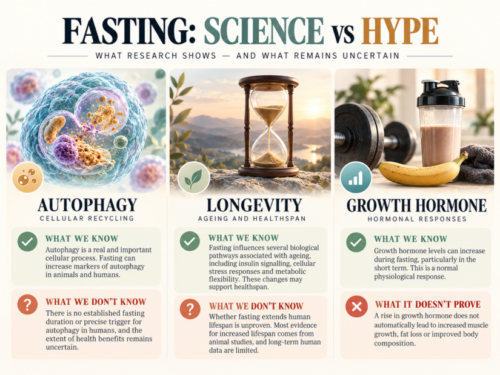
Some of the biggest claims surrounding intermittent fasting involve autophagy, lifespan and hormone production. These are genuine areas of scientific research, but they are also where fasting is most often oversold. Animal studies, cellular mechanisms and short-term human experiments are frequently presented as though they prove benefits that have not yet been demonstrated in people.
Cellular recycling, ageing pathways and hormone changes are real science. Claims of guaranteed longevity or muscle growth? The evidence hasn’t caught up with the hype.
👇 Click on the links below for more.
♻️ Autophagy
Autophagy is a cellular recycling process that helps break down and reuse damaged or unnecessary cellular components. It operates continuously at varying levels and can increase in response to stresses such as nutrient deprivation and exercise.
Fasting clearly influences pathways associated with autophagy, but human research remains difficult because the process is hard to measure directly inside living tissues. There is currently no reliable timetable showing that autophagy suddenly “switches on” after eighteen, twenty-four or forty-eight hours without food. Those precise claims go further than the evidence allows.
⏳ Longevity
Fasting and calorie restriction can influence biological pathways involved in ageing and have extended lifespan in some experimental organisms. Whether a particular fasting schedule does the same in humans is much less certain.
Human studies are nowhere near long enough to establish that an eight-hour eating window or regular fasting directly extends lifespan. Fasting may improve health markers when it helps someone reduce excess bodyweight or improve metabolic health, which is useful without needing to turn it into a longevity guarantee.
📈 Growth Hormone
Fasting can increase growth hormone secretion, particularly during longer fasts. This is sometimes presented as evidence that fasting creates an anabolic state or provides a shortcut to muscle growth.
That interpretation misses the wider physiology. During fasting, growth hormone is involved in helping the body adapt to reduced nutrient availability and regulate fuel use. Building muscle still depends far more on resistance training, adequate protein and sufficient energy than on a temporary rise in one hormone.
The useful conclusion is straightforward: fasting produces real physiological changes, but a measurable biological response is not automatically a meaningful health or performance advantage. Autophagy, longevity and hormone changes are interesting reasons to keep studying fasting, not reasons to assume that longer fasts are automatically better.
🍽️ Making IF Work in the Real World
A fasting schedule only changes when you eat. The eating window still has to provide enough energy, protein, carbohydrate, fat, fibre, vitamins and minerals to support health, training and recovery. As the eating window becomes shorter, meeting those needs comfortably can become more difficult, particularly for active people with higher energy requirements.
Miles behind you, food in front of you. Whether you’re training, travelling or working long hours, make the fasting window fit your routine, not the other way around.
This is where a sensible fasting plan separates itself from simply skipping meals. The aim is to create structure without making the rest of the diet harder to manage.
👇 Click on the links below for more.
🥩 Keep Protein High Enough
Daily protein intake remains one of the main nutritional priorities for preserving and building muscle. An eight- or ten-hour eating window can usually accommodate several substantial protein-containing meals without difficulty.
Problems become more likely when eating is compressed into a very short period. Larger athletes, older adults and anyone trying to gain muscle may find it uncomfortable to squeeze enough protein into one or two large meals. A fasting schedule that repeatedly makes adequate protein intake difficult is working against the training goal.
🍚 Keep Carbohydrate Where Training Needs It
Carbohydrate requirements still depend on the workload. Hard conditioning, repeated sprint work, strength training and endurance sessions all use glycogen to different degrees, so carbohydrate intake still needs to reflect the demands of the programme.
That may mean moving or widening the eating window around difficult sessions. There is little value in protecting a fasting period if doing so repeatedly leaves training under-fuelled or recovery delayed.
🥦 Don’t Let the Window Wreck Food Quality
Short eating windows can encourage people to focus heavily on calories and protein while forgetting the rest of the diet. Fruit, vegetables, legumes, whole grains, nuts, seeds and other nutrient-dense foods still matter because they provide fibre, micronutrients and dietary variety.
Trying to cram a full day’s intake into one enormous meal can also become physically uncomfortable. A useful eating window should leave enough room for several balanced meals rather than turning the final hours of the day into a race against the clock.
🕒 Choose the Window Around Your Routine
The schedule should fit work, training and normal life. Someone who trains early may prefer an earlier eating window, while an evening trainee may benefit from eating later. Shift workers may need a more flexible pattern rather than forcing the same hours every day.
Breakfast does not have to disappear. If you train, concentrate or manage appetite better after eating in the morning, keep breakfast and close the eating window earlier instead. The clock should serve the routine rather than control it.
⏱️ Keep Hard Training Near Food
Strength sessions, intervals and long endurance work are generally easier to support when food is available reasonably close to training. This matters even more for anyone training twice per day, where replacing carbohydrate, protein and fluid between sessions can directly affect recovery.
If moving the eating window slightly improves training quality or recovery, that flexibility strengthens the plan rather than undermining it. There is no useful benefit in preserving a fasting streak while repeatedly under-fuelling demanding work.
☕ Hydration Still Counts
Water, unsweetened tea and black coffee are commonly used during fasting periods, and normal hydration should continue throughout the day. Caffeine can be useful, particularly around training, but repeatedly increasing coffee intake to suppress hunger can become counterproductive if it starts affecting sleep or appetite control.
The fasting window should not become a reason to ignore basic hydration or rely on stimulants to drag yourself through the morning.
🤸 Keep It Flexible
Travel, social events, competition days and changes in work or training will occasionally make the usual schedule inconvenient. Moving or widening the eating window for a day has very little significance within an otherwise consistent pattern.
Extending a fast simply to hit an arbitrary number of hours offers little value when it makes eating, training or recovery harder. A useful fasting routine should eventually feel fairly uneventful: it gives structure, removes some unnecessary decisions and leaves the fundamentals of good nutrition intact.
⚠️ Who Should Be Cautious?
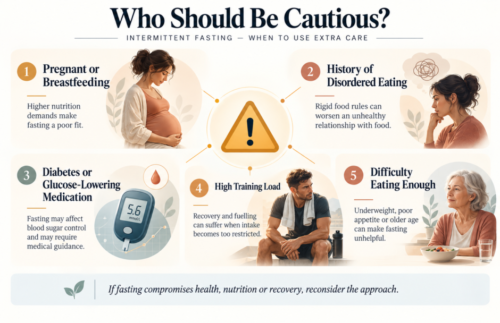
Intermittent fasting is not suitable for everyone. The main concerns arise when fasting interacts with medication, disordered eating, unusually high nutritional requirements or difficulty eating enough food. In those situations, reducing the number of eating opportunities can create problems that outweigh any benefit from the fasting structure.
Fasting isn’t suitable for everyone. Medical conditions, medication, nutritional needs and training demands all matter. If the schedule compromises your health or recovery, rethink the approach.
👇 Click on the links below for more.
🧠 Eating Disorders & Restrictive Behaviour
Anyone with a current or previous eating disorder should be particularly cautious. Rules around delaying meals, skipping food or extending fasts can reinforce restrictive behaviour, increase preoccupation with eating and contribute to cycles of under-eating followed by overeating.
A fasting schedule should never be treated as a test of discipline. If it begins increasing anxiety around food or encouraging increasingly rigid rules, the structure itself has become part of the problem.
💊 Diabetes & Medication
People using insulin or certain glucose-lowering medications may be at greater risk of hypoglycaemia when meals are delayed or removed. Changing meal timing can alter the relationship between food, blood glucose and medication, so substantial fasting protocols require more care in this group.
Some people with type 2 diabetes may still be able to use time-restricted eating successfully, but major changes should be considered alongside medication and glucose control rather than adopted casually. The same principle applies to any medication that needs to be taken with food or around regular meals.
🏋️ High Training Loads & Low Energy Availability
Highly active people can also run into problems when the eating window becomes too short to replace the energy used in training. This becomes more likely during heavy endurance work, repeated daily sessions, competition preparation or aggressive fat-loss phases.
Persistent under-fuelling can impair performance and recovery and may contribute to low energy availability, where the body no longer has enough energy left after exercise to support normal physiological function. If a fasting schedule makes it consistently difficult to eat enough, the window needs to widen.
🤰 Pregnancy, Breastfeeding & Growth
Pregnancy and breastfeeding increase nutritional requirements and are poor situations for restrictive fasting without appropriate clinical guidance. Adequate energy, protein, micronutrients and fluid take priority over maintaining an elective fasting schedule.
Children and adolescents are also still growing and developing. Adult weight-loss fasting protocols are generally inappropriate in this group without specialist involvement, particularly when sport, body image or intentional restriction are already influencing food intake.
👴 When Eating Enough Is Already Difficult
Older adults, underweight people and anyone experiencing poor appetite or unintended weight loss may find fasting counterproductive. Fewer opportunities to eat can make adequate energy and protein intake harder precisely when preserving bodyweight and muscle becomes more important.
The same warning applies to otherwise healthy adults who repeatedly experience dizziness, persistent fatigue, poor concentration, deteriorating training or increasing preoccupation with food while fasting. Those signs suggest the schedule is creating more difficulty than benefit.
The common thread is simple: intermittent fasting should make nutrition easier to manage. If it begins interfering with health, adequate food intake or normal eating behaviour, there is little reason to force it.
📌 Practical Takeaways
Intermittent fasting can be a useful way to organise food intake, particularly for people who prefer fewer meals, clearer boundaries around eating and less day-to-day decision-making. Its main strengths are simplicity and structure, but those advantages only matter when the approach still allows good nutrition, effective training and a routine that can actually be maintained.
A few principles cover most situations:
- Use fasting as a scheduling tool, not a shortcut around energy balance.
- Choose a fasting window that fits work, training, appetite and social life.
- Keep protein, carbohydrate, fibre, fats and micronutrients adequate.
- Place demanding training where it can be fuelled and recovered from properly.
- Treat fasted exercise as an option rather than a superior fat-loss method.
- Be cautious with precise claims about autophagy, growth hormone and longevity.
- Avoid making the fasting window progressively stricter simply because longer sounds better.
- Change the approach if it begins to compromise health, performance, recovery or normal eating behaviour.
For weight loss, intermittent fasting is most useful when it makes a sustainable calorie deficit easier to maintain. For muscle gain, high-volume training or endurance performance, a wider eating window may provide more flexibility and make adequate fuelling easier.
There is no prize for going the longest without eating. The value of intermittent fasting lies in whether it helps you eat well, train effectively and maintain the approach without unnecessary friction. When it supports those goals, it can be a useful tool. When the fasting schedule starts working against them, there is little reason to keep tightening it.
If you have enjoyed this post please share or feel free to comment below 🙂
🔗 Our Other Posts