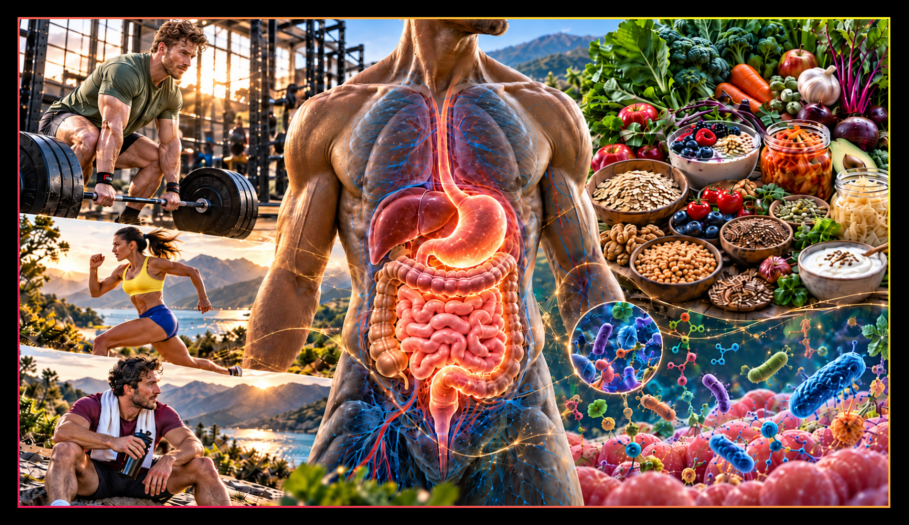
Illustration representing gut health as the internal system that supports energy, recovery, and peak physical performance.

The Internal Engine – Gut Health & Peak Performance

Your digestive system plays a bigger role in fitness than you might think. From nutrient absorption and the gut microbiome to exercise-related stomach problems, discover how gut health influences training, recovery and performance, and what you can do to keep your internal engine running smoothly.

📑 Table of Contents

🔥 The Forgotten Part of Performance

Most people think about training in terms of muscle, strength, endurance and recovery. Nutrition usually enters the conversation through calories, protein, carbohydrates and supplements. The digestive system gets far less attention until something goes wrong.

That matters because every nutrition strategy eventually depends on the gut doing its job. Food has to be digested, its nutrients absorbed and the whole process tolerated comfortably before nutrition can properly support training and recovery. If meals regularly leave you bloated, nauseous, constipated, rushing to the toilet or struggling to train comfortably, the problem is no longer theoretical. Your nutrition plan is being disrupted before the fuel can be put to use.

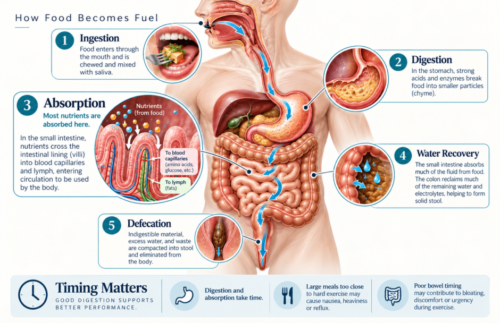
Educational anatomy infographic illustrating the five stages of the digestive journey: ingestion, digestion, nutrient absorption through intestinal villi, water recovery and defecation, with explanations of how digestive timing affects exercise.

Food doesn’t become usable fuel the moment you swallow it. Digestion, nutrient absorption and bowel function take time. Ignore that process, and even the healthiest meal can leave you battling heaviness, nausea or digestive discomfort when you should be concentrating on performance.

For athletes and regular gym-goers, this becomes especially important during harder training. Long runs, intense conditioning, heat, dehydration and badly timed meals can all place additional stress on the gastrointestinal system. Endurance athletes know this better than most, but anyone who has tried to train hard after a huge meal, suffered reflux during burpees or discovered that a new pre-workout does not agree with them has experienced the same principle on a smaller scale.

🤔 What Do We Mean by Gut Health?

Gut health is broader than having a supposedly “good” microbiome. It includes digestion, nutrient absorption, bowel function, intestinal integrity and the ability to tolerate food comfortably. The microbiome is part of that picture, but it is not the whole picture.

The gut microbiome is the vast community of bacteria and other microorganisms living in the digestive tract, particularly the large intestine. These microbes interact with the food we eat, help break down certain fibres and produce compounds that can influence the intestinal environment and wider health. Researchers are also studying links between the microbiome, immune function, metabolism, exercise and the brain.

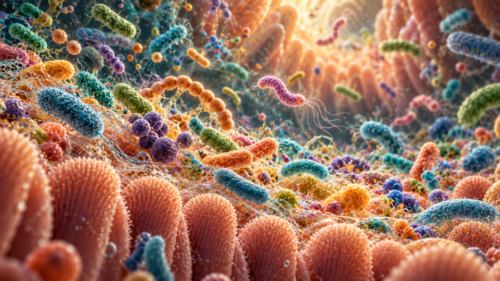
Detailed microscopic illustration showing diverse gut bacteria, including rod-shaped and spherical microorganisms, within a colourful intestinal environment.
A microscopic ecosystem of microorganisms helps shape the intestinal environment, interacting with our diet and wider physiology.

The science is fascinating, but it is easy to oversell. There is no single “perfect” microbiome that every athlete should try to build, and gut health cannot be reduced to eating yoghurt, taking probiotics or chasing particular bacterial species.

For practical purposes, the foundation is much simpler: eat a varied diet, consume enough fibre and fluid, fuel training appropriately, and learn which foods and meal timings work best for your own digestive system.

🏃 What Hard Training Does to the Gut

Training places stress on the digestive system as well as the muscles and cardiovascular system. Most ordinary gym sessions cause little trouble, but longer, harder or hotter sessions can make digestion less comfortable and increase the chances of nausea, cramping, reflux, bloating or an urgent trip to the toilet.

Exhausted male trail runner in a turquoise vest and orange shorts clutching his abdomen on a rocky mountain path as two competitors continue running behind him.
Even well-trained athletes can be stopped in their tracks when intense exercise and digestive discomfort collide.

This is particularly common among runners and endurance athletes, although anyone doing long conditioning sessions, HYROX-style work or high-volume training can experience it. These symptoms do not necessarily indicate an unhealthy gut; they can simply reflect the physiological and mechanical demands of hard exercise.

👇 Click on links below for more

During hard exercise, the body prioritises blood flow to the working muscles and skin, where it is needed for movement and temperature control. The digestive system receives less. This reduction in splanchnic blood flow, the circulation supplying the stomach and intestines, can make digestion and absorption less efficient while exercise is underway.

During prolonged or particularly intense exercise, reduced blood flow can temporarily affect the integrity of the intestinal barrier. Researchers sometimes describe this as increased intestinal permeability, meaning the barrier becomes somewhat less selective for a period of time.

This is a genuine physiological response, but it should not be confused with the much broader internet use of the phrase “leaky gut”, where almost any symptom gets blamed on a damaged intestinal wall. In healthy athletes, these exercise-related changes are usually temporary and become more relevant when combined with heat, dehydration and a heavy digestive load.

Hot conditions add another challenge because more blood needs to reach the skin to control body temperature. If dehydration develops as well, circulating blood volume falls and the gastrointestinal system is placed under greater strain.

This helps explain why a drink or gel that feels perfectly comfortable during a cool training session may become much harder to tolerate during a hot race. The nutrition has not necessarily changed; the conditions under which the gut has to process it have.

Adequate hydration can reduce some of that strain, although trying to force excessive amounts of fluid creates another problem. The aim is to replace enough fluid to support performance and avoid substantial dehydration, not to overwhelm the stomach in an attempt to stay perfectly topped up.

Running creates another challenge because the gastrointestinal tract is repeatedly moving with every stride. That mechanical stress, combined with altered blood flow and changes in gut motility, helps explain why cramping, urgency and diarrhoea are particularly common during distance running.

Other sports create their own issues. Cycling posture may aggravate reflux in some people, while repeated jumping, bending or abdominal pressure can make a large pre-training meal increasingly uncomfortable.

Gut tolerance can therefore be sport-specific. A meal that sits comfortably before strength training may perform very differently before a long run.

The digestive system also has to deal with whatever you give it before training. A large meal, particularly one high in fat, fibre or total volume, may sit heavily and become uncomfortable when intense exercise begins shortly afterwards.

Fat and fibre still belong in a healthy diet. The issue is timing. Foods that work perfectly well during the rest of the day may be better reduced immediately before demanding exercise when gastrointestinal comfort matters more.

Lower-fibre carbohydrate-rich foods are often easier to tolerate before demanding exercise and become especially useful before or during longer sessions, although the amount and form still need to suit the individual. Someone who tolerates a banana and toast before training may struggle with a huge bowl of oats, nuts and fruit eaten thirty minutes before the same workout.

🍞 Train Your Gut

Endurance athletes spend weeks building fitness, yet race-day nutrition is sometimes treated as something that can be improvised. The gut needs practice too.

Gut training means repeatedly using the foods, drinks and carbohydrate amounts you intend to rely on during longer sessions or competition. The purpose is to become comfortable consuming fuel while the body is already under exercise stress.

Female trail runner wearing a blue training top and hydration vest consumes an energy gel while running through scenic hills overlooking a lake.

Train your gut alongside your muscles. Practise fuelling during training so there are fewer surprises on race day.

This matters because eating or drinking while running is very different from doing the same thing while sitting at home. Exercise already changes gut blood flow and motility, and suddenly adding several gels, sports drinks or large amounts of fluid can overwhelm a strategy that looked perfectly reasonable on paper.

👇 Click on links below for more

Gut training is mainly about tolerance and adaptation. Repeatedly consuming carbohydrate and fluid during relevant training sessions can help an athlete become more comfortable eating and drinking under exercise stress and may improve the gut’s capacity to absorb and tolerate larger carbohydrate intakes.

You do not need to imagine this as building a stronger stomach. It is closer to rehearsing a skill. If your event requires you to take fuel every thirty minutes, that strategy should appear regularly in relevant training sessions so you know whether the quantity, timing and product actually work once fatigue builds.

Someone who currently tolerates one gel per hour should not suddenly decide to consume three or four on race day because a fuelling guide recommends a higher carbohydrate target. Large jumps increase the chance of bloating, nausea and diarrhoea, particularly when combined with hard effort and heat.

Increase intake progressively during longer training sessions. Start with an amount you already tolerate, then build towards the quantity likely to be useful for the event. Gels, chews, sports drinks and solid foods can all work. The best option is the one that supplies enough fuel without turning the stomach into the limiting factor.

This is mostly relevant to endurance and longer conditioning events. Someone completing a forty-five-minute gym session does not need to train their gut to tolerate gels.

Fluid strategy deserves the same rehearsal. Drinking a large amount suddenly can produce fullness, sloshing or nausea, especially during running, while drinking too little during long or hot sessions can allow dehydration to make gastrointestinal problems worse.

Practice helps establish how much you can comfortably drink and how that changes with conditions. Important sessions should occasionally resemble likely competition demands closely enough to expose problems before race day.

The old endurance rule still holds up: nothing new on race day.

Do not suddenly change breakfast, double your gel intake or try a supplement because somebody handed you a free sample at registration. By competition day, you should already know what you can eat beforehand, which products sit comfortably and roughly how much carbohydrate and fluid you can tolerate.

For the ordinary gym-goer, gut training may never need to become more complicated than learning which meals sit well before a workout. For endurance athletes, runners and anyone tackling prolonged events, it can become a genuine part of performance preparation.

🥦 Feed Your Gut Properly

Most everyday gut-health advice comes back to the same basic idea: give the digestive system a varied diet that provides enough fibre, fluid and overall nutrition to function properly. You do not need specialist powders, detoxes or an expensive microbiome test to start improving the quality of what reaches the gut.

Athletic Japanese-American woman preparing a nutritious rice bowl with vegetables, edamame, avocado and seaweed in a sunlit home kitchen, with kimchi and other ingredients nearby.

Feed the ecosystem. Fibre-rich plants, dietary variety and fermented foods provide a practical foundation for gut health.

For most people, the best place to begin is with ordinary foods. Vegetables, fruit, whole grains, beans, lentils, nuts and seeds provide different types of fibre and plant compounds, while foods such as yoghurt and kefir can add fermented foods to the mix.

👇 Click on links below for more

Fibre is carbohydrate that passes through the small intestine without being fully digested. Some types help add bulk and support normal bowel movements, while others are fermented by bacteria in the colon.

That fermentation produces compounds including short-chain fatty acids, which help support the cells lining the colon and are involved in wider metabolic and immune processes. You do not need to memorise the chemistry, but it explains why fibre does more than simply “keep you regular”.

Different foods provide different fibres, so variety usually works better than relying heavily on one source. Oats, beans, lentils, whole grains, vegetables, fruit, nuts and seeds all contribute in slightly different ways.

Someone moving from a low-fibre diet to huge amounts of bran, beans and vegetables overnight may simply end up bloated and uncomfortable. Increase fibre gradually, particularly if current intake is low, and keep fluid intake sensible alongside it.

Microbiome research has created a huge market for foods claiming to feed specific “good bacteria”. The science is interesting, but predicting exactly how one food will change one person’s microbiome is far harder than the marketing suggests.

A simpler approach is to eat a broad range of plant foods across the week. Rotate vegetables, fruits, grains, legumes, nuts and seeds rather than eating exactly the same handful of foods every day.

You will sometimes see targets such as thirty different plant foods per week. That can be a useful way to encourage variety, but it should not be treated as a scientifically established threshold for gut health. The principle matters more than the scorecard.

Fermented foods such as yoghurt, kefir, kimchi and sauerkraut can be useful additions to the diet. Fermentation changes food through the activity of microorganisms, altering its flavour, composition and sometimes digestibility. Some fermented foods contain live cultures when eaten, while others do not, so a fermented food is not automatically a probiotic.

If you enjoy yoghurt or kefir, use them. If you hate sauerkraut, there is no need to force it down because somebody online told you your microbiome needs saving.

Probiotics are specific live microorganisms that have been shown to provide a health benefit when taken in an adequate amount. That definition matters because evidence for one strain cannot automatically be applied to every capsule or multi-strain product on the shelf.

Some probiotics may help particular digestive problems or reduce certain gastrointestinal symptoms, and research in athletes continues to develop. The results are mixed, so probiotics should be treated as targeted tools rather than universal performance supplements.

If you have no particular digestive problem and already eat a varied diet, there is no strong reason to assume you need a probiotic supplement. If you decide to try one, use it for a specific reason and test it during normal training rather than introducing it immediately before an important event.

Fluid helps support normal digestion and stool consistency, particularly when fibre intake is reasonably high. Training increases those requirements because sweat adds another source of fluid loss.

For most gym-goers, this simply means arriving at training reasonably hydrated and replacing fluid afterwards. Longer sessions, hot weather and heavy sweating require more deliberate attention.

More fluid is not automatically better. Aim to begin training reasonably hydrated and replace enough fluid to account for meaningful sweat losses, with greater attention during long sessions, hot conditions or heavy sweating.

🧠 Stress, Nerves & the Gut

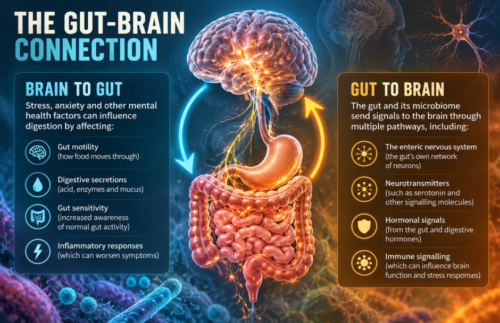
The digestive system does not operate independently from the brain. The two communicate through the gut-brain axis, a two-way network involving the nervous system, hormones, immune signalling and the microbiome.

That connection helps explain why stress can produce very physical digestive symptoms. Nausea before competition, loss of appetite under pressure or repeated toilet trips before a race are familiar examples.

Medical infographic showing the brain and digestive system connected by two-way arrows, explaining how stress affects digestion and how neural, hormonal and immune pathways communicate with the brain.

The gut and brain are in constant communication. Stress can disrupt digestion, while signals from the gut contribute to the body’s wider responses.

👇 Click on links below for more

When the body perceives stress, the sympathetic nervous system becomes more active and digestion becomes a lower immediate priority. Gut motility, secretion and sensitivity can change, while normal sensations may feel much stronger than usual.

For athletes, psychological stress can arrive at the same time as hard exercise, heat and race-day fuelling. Several pressures are therefore stacking together rather than one mysterious food suddenly becoming harmful.

Researchers are investigating whether microbial metabolites and other gut signals influence mood, stress and brain function. The field is promising, but claims such as “fix your gut and fix your mood” run much further than the evidence.

Mental health cannot be reduced to bacterial balance, and probiotics are not substitutes for appropriate psychological or medical treatment.

Stress can affect digestion, and digestive problems can affect how you feel and perform.

Competition nerves can be much harder on the gut when they are combined with a huge breakfast, unfamiliar supplements or far more caffeine than usual.

Keep the controllable variables predictable. Use familiar foods, avoid unnecessarily large meals and keep caffeine within amounts you already know you tolerate.

If digestive symptoms appear mainly before competition or during stressful periods, look beyond the food itself before eliminating half the diet.

🛠️ Troubleshooting Gut Problems

When digestive problems begin affecting training, start with the obvious variables before blaming the microbiome. Meal size, timing, fibre, fat, hydration, caffeine, supplements, training intensity and stress can all influence how the gut behaves.

The useful question is not simply “what food caused this?” Look at what was happening around the symptom.

Female doctor palpating the abdomen of a younger brown-haired male athlete lying on a medical examination couch, with the patient showing mild discomfort.

Persistent digestive problems deserve proper investigation. Seek professional advice rather than relying on guesswork or unnecessary dietary restrictions.

👇 Click on links below for more

If bloating, reflux, nausea or stomach heaviness repeatedly appear during training, examine what and when you ate. Large meals high in fat or fibre generally need more time to digest, while large portions can feel uncomfortable regardless of how healthy the food is.

Often the simplest fix is to leave more time between a substantial meal and training or choose something lighter when the session is close.

There is no universal pre-workout meal. Find foods that provide useful energy while allowing you to train comfortably.

Pre-workouts, energy drinks, large coffees and supplements can complicate the picture. Caffeine can increase gut motility in some people, while sugar alcohols, large magnesium doses and certain concentrated ingredients may trigger bloating or diarrhoea.

If symptoms repeatedly appear after one particular supplement, test that variable before redesigning the whole diet.

The same applies to endurance nutrition. Several gels, sports drinks, caffeine and large volumes of fluid taken together create a much greater digestive load than any one product on its own.

A fibre-rich diet supports gut health, but very high-fibre food immediately before demanding exercise can be troublesome for some people.

Large servings of beans, bran or highly fermentable foods may increase fullness, gas or urgency when combined with hard running. Keep overall fibre intake adequate while shifting the heavier sources away from important sessions if necessary.

More restrictive approaches such as a low-FODMAP diet can help some people with specific gastrointestinal problems, but they are best used deliberately rather than adopted indefinitely. The aim is usually to identify and manage individual triggers, not to label all FODMAP-containing foods as inherently problematic.

*low-FODMAP diet: temporarily reducing certain fermentable carbohydrates that can trigger digestive symptoms.

If the same problem keeps returning, keep a simple record for a few comparable sessions. Note what you ate, meal timing, caffeine, supplements, training duration, intensity, weather, fluid intake and symptoms.

You do not need months of obsessive tracking. A handful of sessions can reveal that the problem only appears after one breakfast, only during running, only in hot weather or only when food is eaten too close to training.

That is far more useful than randomly cutting foods out.

Digestive symptoms often push people towards increasingly restrictive diets. Gluten disappears, then dairy, then legumes, fruit, onions and whatever else was blamed online that week.

Sometimes an elimination strategy is appropriate, but removing several foods simultaneously makes it very difficult to identify the real trigger and can reduce fibre, micronutrients and dietary variety.

Conditions such as coeliac disease, lactose intolerance and irritable bowel syndrome require different approaches. Persistent symptoms deserve a proper assessment rather than a generic diagnosis of “bad gut health”.

Most training-related digestive problems are temporary and manageable, but some symptoms warrant medical assessment.

Blood in the stool, unexplained weight loss, persistent changes in bowel habit, severe or recurrent abdominal pain, repeated vomiting or symptoms that progressively worsen should not be written off as ordinary training problems.

Symptoms that continue on rest days or regularly interfere with eating and everyday life also deserve more attention than another supplement experiment.

Troubleshoot methodically. Move the meal earlier. Reduce pre-workout fibre. Cut the caffeine. Practise a smaller carbohydrate dose. Adjust fluid intake.

Change one obvious variable, repeat a similar session and see what happens.

Most gym-goers do not need a complicated digestive protocol. They need to work out which habits consistently help them eat comfortably and train without their stomach getting in the way.

📌 Practical Takeaways

Gut health does not need to become another complicated performance project. For most people, the biggest gains come from eating a varied diet, getting enough fibre, staying appropriately hydrated, timing meals sensibly around training and paying attention to individual tolerance.

A few principles cover most situations:

  • Build everyday meals around a broad range of nutritious, fibre-rich foods.
  • Include regular fibre from vegetables, fruit, legumes, whole grains, nuts and seeds.
  • Increase fibre gradually if your current intake is low.
  • Use fermented foods such as yoghurt or kefir if you enjoy and tolerate them.
  • Treat probiotics as targeted tools rather than essential daily supplements.
  • Allow enough time for large meals to digest before hard training.
  • Reduce very high-fat or high-fibre foods close to sessions if they repeatedly cause problems.
  • Practise carbohydrate and fluid intake during longer training before relying on it in competition.
  • Consider stress, caffeine, hydration and exercise intensity when troubleshooting symptoms.
  • Change one variable at a time rather than removing half the diet at once.
  • Seek medical advice when symptoms are persistent, worsening or accompanied by obvious red flags.

For the average gym-goer, that is usually enough. You do not need to know the exact composition of your microbiome or chase a perfect bacterial profile. You need a digestive system that lets you eat properly, train comfortably and recover without constant disruption.

Native American-looking male athlete kneeling in a gym while packing a gym bag with a banana, water bottle and prepared oats container before training.

Good gut health starts with everyday habits: sensible fuelling, practical hydration and learning what works for your body.

For endurance athletes, the gut deserves more deliberate practice because race-day nutrition can become part of performance itself. Learning how much carbohydrate and fluid you tolerate, which products work and how your stomach behaves under fatigue is every bit as practical as testing shoes, pacing or equipment.

The science of the microbiome will continue to develop. For now, the strongest advice remains reassuringly straightforward: feed the gut well, give it variety, train it when the sport demands it, and do not make it more complicated than it needs to be.

🔗 Our Other Posts

Leave a Reply

Your email address will not be published. Required fields are marked *

This site uses Akismet to reduce spam. Learn how your comment data is processed.

error: Content is protected !!

Join the Super Soldier Project Mailing List Today!!