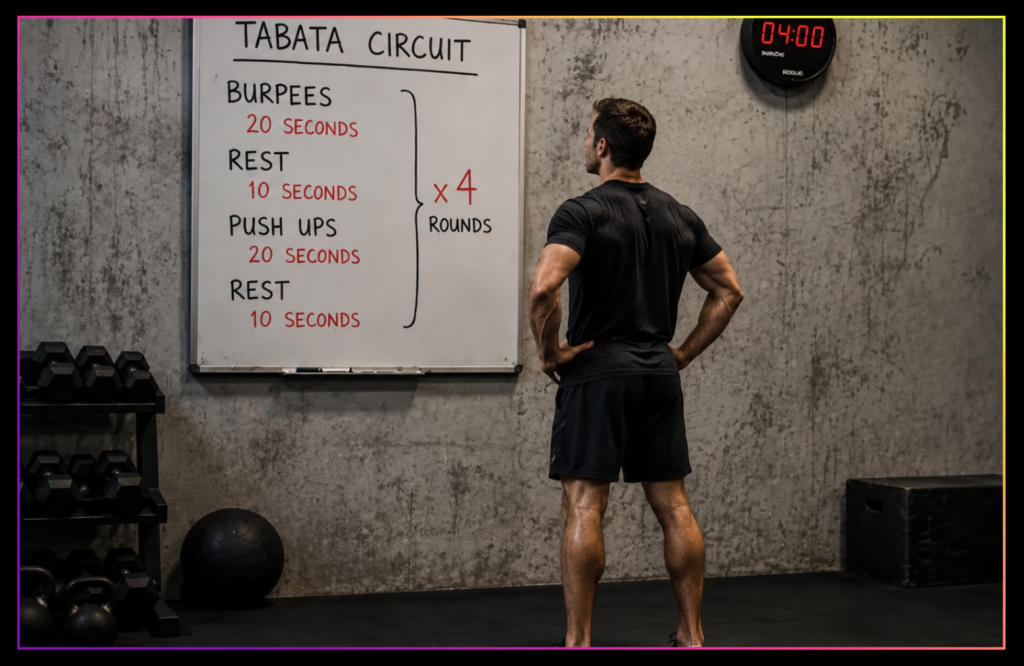





Athlete preparing for a Tabata workout in an industrial gym while studying a whiteboard showing a 20-second work, 10-second rest interval circuit beside a four-minute countdown timer.

⏳ No Time? No Problem – The Complete Tabata Workout Guide

Four minutes. Twenty seconds of work. Ten seconds of rest. In this post, we explore the Tabata Protocol and why this deceptively simple workout remains one of the most effective conditioning tools in fitness.

Table of Contents

⚡ Introduction

Time is one of the biggest obstacles people face when trying to exercise consistently. Between work, family commitments, travel, and the general demands of everyday life, exercise is often one of the first things to be pushed aside.

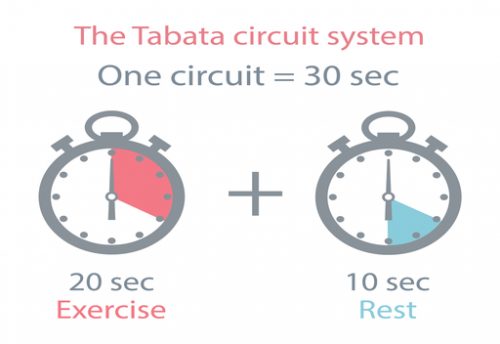
This is where Tabata training comes in. Developed from research into high-intensity interval training, Tabata is designed to deliver a challenging workout in a remarkably short space of time. The formula is simple: 20 seconds of work, 10 seconds of rest, repeated eight times for a total of four minutes.

Athletes performing kettlebell swings and push-ups during a high-intensity Tabata workout in an industrial gym with a digital interval timer.

Simple exercises. Relentless intensity. Tabata remains one of the fastest ways to challenge your conditioning.

It sounds almost too good to be true, yet anyone who has attempted a genuine Tabata session knows just how demanding those four minutes can be. Performed correctly, the protocol pushes your cardiovascular system hard, challenges both aerobic and anaerobic fitness, and can leave even experienced athletes counting down the seconds until the timer stops.

Whether you’re training at home, travelling, or simply trying to squeeze exercise into a busy day, Tabata offers a fast and effective way to improve your conditioning.

In this guide, we’ll explore the origins of Tabata, examine the science behind the protocol, and look at how you can build your own brutally effective four-minute workouts.

🧬 The Origins of Tabata

🇯🇵 Dr. Izumi Tabata and the Original Study

Tabata training takes its name from Dr. Izumi Tabata, a Japanese exercise physiologist who conducted groundbreaking research into high-intensity interval training during the 1990s. Working with researchers at the National Institute of Fitness and Sports in Tokyo, Tabata sought to compare traditional endurance training with a much shorter but significantly more intense training protocol.

Dr. Izumi Tabata supervising athletes during high-intensity interval training research that led to the development of the Tabata Protocol.

Conducted in Japan during the 1990s, Dr. Tabata’s research helped establish one of the most influential high-intensity training methods ever developed.

🔬 The Study

The study used highly trained athletes, dividing them into two groups. One group performed five sessions of steady-state endurance training per week, with each session lasting around an hour. The second group undertook four high-intensity interval sessions alongside one steady-state workout each week.

The interval group followed a demanding protocol consisting of 20 seconds of maximal effort followed by 10 seconds of rest, repeated eight times. Although the work period lasted only four minutes, the intensity was extremely high, with participants exercising close to their physical limits throughout the session.

📈 The Results

The results were surprising. Both groups improved their aerobic fitness, measured through increases in VO₂ max, the body’s ability to utilise oxygen during exercise. However, the high-intensity group also demonstrated significant improvements in anaerobic capacity, suggesting that the shorter protocol was capable of developing multiple energy systems simultaneously.

The findings attracted considerable attention within the fitness world and eventually gave rise to what we now know as the Tabata Protocol. Nearly thirty years later, the 20-second work and 10-second rest format remains one of the most recognised conditioning methods in sport and fitness.

⚠️ Side Note

Not every timed circuit is Tabata. The original protocol consisted of eight rounds of 20 seconds of near-maximal effort followed by 10 seconds of rest. Many commercial classes and online workouts borrow the name while using different work-rest ratios, longer durations, or lower exercise intensities. This does not mean these variations are ineffective. Protocols such as 40/20 intervals, double Tabatas, and other HIIT formats can be excellent training tools in their own right. However, they are technically variations inspired by Tabata rather than the original protocol described in Dr. Tabata's research.

⏱️ The Tabata Protocol

The Tabata Protocol is deceptively simple. It consists of 20 seconds of all-out work followed by 10 seconds of rest, repeated for a total of eight rounds. The entire workout lasts just four minutes.

At first glance, this may not seem particularly challenging. After all, four minutes is less time than most people spend scrolling through social media or waiting for the kettle to boil.

The reality is very different.

Athlete preparing to perform wall balls during a Tabata workout, demonstrating the high-intensity intervals that define the Tabata Protocol.

The magic of Tabata lies in its simplicity. The suffering comes from trying to maintain intensity as the rounds accumulate.

The effectiveness of Tabata does not come from its duration but from its intensity. During each 20-second work period, the goal is to perform as much quality work as possible while maintaining good technique. The short 10-second recovery period is just enough time to catch a breath before the next round begins.

As the workout progresses, fatigue accumulates rapidly. Heart rate rises, breathing becomes increasingly difficult, and the brief rest periods feel shorter with every passing round. By the final minute, most people find themselves working through significant discomfort as the body struggles to keep pace with the demands being placed upon it.

Tabata Workouts.

🔥 The Formula

  • Work: 20 seconds.
  • Rest: 10 seconds.
  • Total Rounds: 8.
  • Total Time: 4 minutes.

Simple to understand. Difficult to execute.

⚡ Intensity Is Everything

The biggest mistake people make with Tabata is treating it like a normal circuit workout. The original protocol was designed around near-maximal effort, not moderate exercise performed for a set time.

This does not mean sacrificing technique or moving recklessly. Rather, it means working as hard as you can safely sustain for the duration of each interval. If the workout feels comfortable by the final rounds, the intensity is probably too low.

A true Tabata session should leave little doubt that you have been working hard. The short duration is what makes the intensity possible. Four minutes may not sound like much on paper, but when every second is attacked with purpose, it can feel considerably longer.

🫀 Why Tabata Works

Tabata has remained popular for nearly three decades because it offers a highly efficient way to improve conditioning. While it will never replace a well-structured strength programme or sport-specific training plan, it can deliver significant fitness benefits in a very short period of time.

The combination of intense work intervals and minimal recovery forces the body to work hard, challenging both the cardiovascular system and the muscles simultaneously. This makes Tabata a useful tool for improving overall fitness, increasing work capacity, and burning calories when time is limited.

Click on the links below for more on benefits of Tabata training.

Aerobic fitness refers to your body’s ability to deliver and utilise oxygen during exercise. A well-developed aerobic system allows you to work for longer periods, recover more quickly between efforts, and generally feel less fatigued during physical activity.

Although Tabata workouts are short, the repeated high-intensity intervals place considerable demands on the cardiovascular system. Over time, this can help improve aerobic conditioning and support better overall endurance.

The anaerobic system is responsible for producing energy during short bursts of intense activity when the body cannot supply oxygen quickly enough to meet demand. Sprinting, explosive movements, combat sports exchanges, and heavy conditioning work all rely heavily on this energy system.

Because Tabata requires repeated efforts with very limited recovery, it places significant stress on the anaerobic system. This can improve your ability to perform high-intensity work and recover between bouts of effort.

One reason Tabata became so popular is its reputation as a fat-loss tool. While no workout can compensate for poor nutrition, Tabata can be an effective way to increase energy expenditure in a short period of time.

The workouts are demanding, involve large amounts of muscle mass, and elevate heart rate quickly. As a result, they can burn a significant number of calories relative to the time invested, making them attractive for people looking to improve body composition alongside a sensible diet.

You may have heard claims that Tabata continues burning calories long after the workout has ended. This phenomenon is known as Excess Post-Exercise Oxygen Consumption (EPOC), often referred to as the afterburn effect.

Following intense exercise, the body requires additional energy to recover, restore normal function, and replenish fuel stores. This can result in a modest increase in calorie expenditure after training.

While the afterburn effect is real, it is often exaggerated online. The biggest benefit still comes from the hard work performed during the session itself. Tabata should be viewed as a useful training tool rather than a magical shortcut to fat loss.

🏃 Why Tabata Still Matters Today

Fitness trends come and go, but Tabata has remained popular because it solves a problem that never disappears: a lack of time. While many workout programmes require specialised equipment, lengthy gym sessions, or detailed planning, Tabata strips training back to its essentials. All you need is a timer, a few exercises, and the willingness to work hard.

The protocol is also remarkably flexible. It can be used with bodyweight exercises, kettlebells, dumbbells, cardio machines, running drills, and countless other movements. Whether your goal is general fitness, fat loss, athletic conditioning, or simply maintaining a baseline level of health, Tabata can be adapted to suit your needs.

Click on the links below for more.

Not everyone has the luxury of spending an hour in the gym every day. Shift workers, parents, students, and busy professionals often struggle to fit structured training into an already crowded schedule.

The beauty of Tabata is that it removes the time barrier. Four minutes may not sound like much, but it is certainly enough time to raise your heart rate, challenge your conditioning, and maintain momentum when a full workout simply is not possible.

One of Tabata’s greatest strengths is that it requires very little space or equipment. Exercises such as burpees, squats, mountain climbers, jump squats, and push-ups can all be used to create demanding workouts from the comfort of your own home.

This makes Tabata particularly useful during bad weather, when travelling, or whenever access to a gym is limited.

Hotels, campsites, holiday apartments, and work trips are notorious for disrupting training routines. Tabata provides a simple solution when equipment is scarce and time is limited.

A timer and a handful of bodyweight exercises are often all that is required to maintain your conditioning until you return to your normal training environment.

Tabata does not always have to be a standalone workout. Many athletes use the protocol as a conditioning finisher at the end of a strength session.

A four-minute burst of kettlebell swings, burpees, rowing, or assault bike sprints can provide a demanding cardiovascular challenge without significantly extending the overall length of the workout.

The rise of functional fitness competitions, obstacle races, and events such as Hyrox has renewed interest in short, high-intensity conditioning methods. While Tabata alone will not prepare you for these events, it can be an excellent way to develop work capacity, improve recovery between efforts, and become more comfortable operating under fatigue.

Used intelligently alongside strength training, longer conditioning sessions, and sport-specific practice, Tabata remains a valuable addition to the conditioning toolbox.

🛠️ Building Your Own Tabata

One of the reasons Tabata has remained so popular is its simplicity. Once you understand the basic protocol, you can create countless workout combinations using whatever equipment and space you have available.

The key is selecting exercises that allow you to work hard, transition quickly, and maintain good technique as fatigue builds. Remember, the goal is not to perform the most complicated movements possible. The goal is to sustain a high level of effort throughout the four-minute workout.

✅ Choosing The Right Exercises

The best Tabata exercises are simple, explosive, and involve large amounts of muscle mass. Compound movements tend to work particularly well because they elevate the heart rate quickly and allow you to accumulate plenty of work in a short period.

Excellent Choices

  • Burpees.
  • Kettlebell Swings.
  • Thrusters.
  • Mountain Climbers.
  • Squat Jumps.
  • Jumping Lunges.
  • Push Presses.
  • Rowing Machine Sprints.
  • Assault Bike Sprints.
  • Ski Erg Sprints.
  • Medicine Ball Slams.

These exercises are easy to repeat, require minimal setup, and allow you to maintain a high work rate throughout the session.

Exercises To Avoid

Not every exercise is suited to the Tabata format. Technical lifts, heavy strength movements, and exercises requiring lengthy setup times can make it difficult to maintain the intensity the protocol demands.

Examples include:

  • Heavy Deadlifts.
  • Heavy Barbell Squats.
  • Olympic Lifts.
  • Complex Gymnastics Movements.
  • Exercises requiring frequent weight changes.

These movements are excellent training tools in their own right, but they are generally better suited to strength sessions than all-out conditioning intervals.

⚠️ Quick Safety Note

Tabata is intended to be hard, not reckless. Choose exercises you can perform confidently under fatigue, prioritise good technique, and always warm up properly before beginning. As intensity rises, movement quality should remain the priority.

🔄 Structuring Your Workout

There is no single “correct” way to organise a Tabata session. The protocol can be applied to one exercise or several exercises, depending on your goals and available equipment.

Tabata workouts. Medicine Ball exercises. Interval training. EMOM. TABATA. Best exercises to lose belly fat.

Single-Exercise Tabata

Perform one exercise for all eight rounds.

Example:

  • Burpees x 8 rounds.

Simple. Brutal. Effective.

Two-Exercise Tabata

Alternate between two exercises for four rounds each.

Example:

  • Kettlebell Swings.
  • Burpees.

This is one of the most popular approaches as it allows one movement pattern to recover slightly while the other is working.

Four-Exercise Tabata

Use four different exercises and cycle through them twice.

Example:

  • Squat Jumps.
  • Push-Ups.
  • Mountain Climbers.
  • Burpees.

This provides more variety while still maintaining the intensity that makes Tabata effective.

🔥 Example Tabata Workouts

The beauty of Tabata is its versatility. Whether you’re a beginner looking for a quick workout, an athlete seeking extra conditioning, or simply someone short on time, the protocol can be adapted to suit your needs.

The workouts below are only examples. Feel free to substitute exercises based on your fitness level, available equipment, and training goals.

🟢 Beginner Tabata

A simple introduction to the format using basic bodyweight movements.

Rounds 1, 3, 5, 7

  • Bodyweight Squats.

Rounds 2, 4, 6, 8

  • Mountain Climbers.

This workout develops basic conditioning without overwhelming newer trainees, making it an excellent starting point for those unfamiliar with Tabata training.

💪 Bodyweight Tabata

No equipment is required for this simple but highly effective conditioning workout.

Rounds 1, 3, 5, 7

  • Push-Ups.

Rounds 2, 4, 6, 8

  • Burpees.

The combination trains both the upper and lower body while driving the heart rate skyward.

⚔️ Warrior Tabata

A classic SSP-style conditioning session that combines explosive power with relentless conditioning.

Rounds 1, 3, 5, 7

  • Kettlebell Swings.

Rounds 2, 4, 6, 8

  • Burpees.

Few combinations are as brutally effective as swings and burpees. Expect your grip, lungs, and determination to be tested throughout all eight rounds.

🏋️ Kettlebell Tabata

For those with access to a kettlebell, this workout combines strength endurance, conditioning, and full-body coordination.

Rounds 1, 3, 5, 7

  • Kettlebell Clean and Press.

Rounds 2, 4, 6, 8

  • Goblet Squats.

The result is a demanding full-body challenge that taxes both the muscles and cardiovascular system simultaneously.

🏃 Sprint Tabata

Ideal for runners and field sport athletes, this variation uses a single movement performed at maximum effort throughout all eight rounds.

Rounds 1–8

  • Maximum Effort Sprint.

Use a track, hill, exercise bike, rowing machine, ski erg, or assault bike. Simple in theory, horrific in practice.

☠️ Four Minutes of Hell

No clever programming. No variety. No escape.

Rounds 1–8

  • Burpees.

Twenty seconds of work and ten seconds of rest, repeated until the timer stops. By the final round, four minutes will feel like an eternity.

🎯 Final Thoughts

Tabata has endured for nearly three decades because it delivers something that many training methods struggle to provide: efficiency. In a world where time is often the biggest barrier to exercise, the ability to complete a challenging workout in just four minutes remains incredibly appealing.

Despite its simplicity, Tabata should never be underestimated. The protocol is designed around intensity, not duration. When performed correctly, those short bursts of effort can challenge your cardiovascular system, improve conditioning, and leave you every bit as exhausted as a much longer training session.

Athlete preparing to perform a kettlebell snatch at the start of a high-intensity conditioning workout.

A missed workout achieves nothing. Four focused minutes can still move the needle.

It is important to remember that Tabata is not a replacement for every form of training. Strength development, muscle building, sport-specific practice, and longer endurance work all have their place. However, as a conditioning tool, a workout finisher, or a solution for busy days, few methods offer as much return for so little time invested.

The next time you’re tempted to skip training because you’re short on time, remember that four minutes is all it takes to complete a Tabata workout.

Four minutes.

It may not sound like much, but performed correctly, four minutes can be more than enough.

If you have enjoyed this post please share or feel free to comment below 🙂

Our Other Posts

Leave a Reply

Your email address will not be published. Required fields are marked *

This site uses Akismet to reduce spam. Learn how your comment data is processed.

error: Content is protected !!

Join the Super Soldier Project Mailing List Today!!