Two MMA fighters compete inside the cage, viewed from a ringside spectator’s perspective.

Fight Night: Essential MMA Fights Every Fan Should Watch

Want to understand MMA? Watch it at its best. From legendary wars and technical masterclasses to spectacular knockouts, submissions, upsets, and rivalries, these essential fights showcase the skill, strategy, and drama that make MMA unlike any other combat sport.

Table of Contents

📖 Introduction

Watching Mixed Martial Arts is one thing. Understanding what is happening beneath the action is another.

In Changing Levels: Understanding MMA, we explored how fighters control distance, create reactions, manage transitions and impose their preferred kind of contest. Fight Night brings those ideas to life through the bouts, champions and rivalries that every new fan should experience.

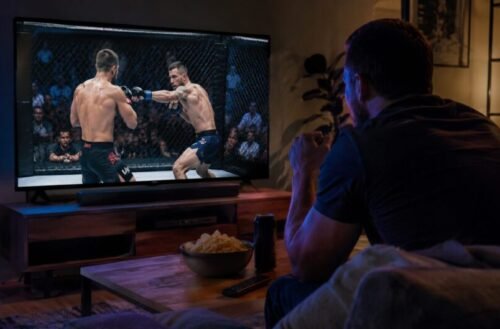
MMA fan leans towards a television while watching two fighters exchange strikes inside the cage during a live event.

Every MMA education begins with watching the action and gradually learning to recognise the decisions beneath it.

There is no substitute for watching elite fighters solve problems under pressure. A striker may adjust when their preferred range disappears. A wrestler may use the threat of a takedown to create openings on the feet. A champion may abandon the original game plan and find another route to victory as fatigue, damage and momentum reshape the fight.

For newcomers, however, the sheer number of promotions, events and fighters can make knowing where to begin difficult. Some contests are remembered for breathtaking action, others for technical brilliance, dramatic rivalries or moments that changed the sport forever.

🧭 A Guided MMA Education

This guide is not intended to rank the greatest fights of all time or settle arguments about the greatest fighter ever. It is a viewing guide: a collection of essential bouts chosen because each reveals something important about Mixed Martial Arts.

Some demonstrate range management, pressure or positional control. Others show adaptation, resilience, creative striking or the danger of a single mistake during a transition. Together, they offer a practical education in how MMA works while capturing the drama and unpredictability that make the sport so compelling.

By the end, you should not only recognise more of the sport’s defining fighters and moments. You should also begin to see why the action unfolds as it does, and what separates a memorable fight from a genuinely instructive one.

🔥 Essential Viewing

Some fights transcend individual divisions, championships or eras. They become part of MMA’s shared language, revealing the technique, adaptability, resilience and unpredictability that define the sport. Not every contest below is technically perfect, but each offers an essential lesson for the new viewer.

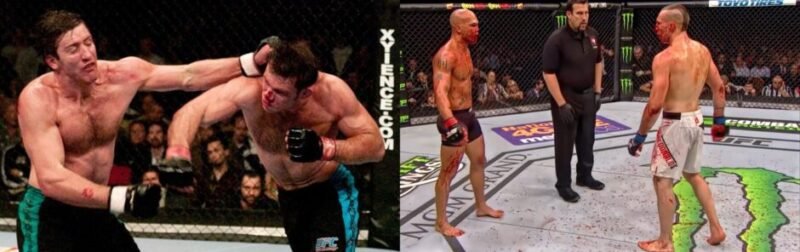
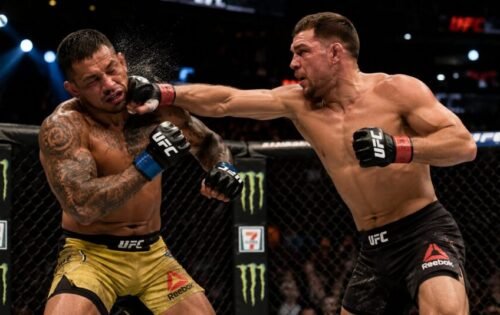
Forrest Griffin and Stephan Bonnar exchange heavy strikes alongside Robbie Lawler and Rory MacDonald battling during one of MMA's most celebrated championship fights.

From Griffin and Bonnar’s sport-changing brawl to Lawler and MacDonald’s brutal championship war, these fights show how pressure, courage and attrition can turn elite competition into MMA history.

Click on the links below to read more.

The light-heavyweight final of The Ultimate Fighter saw two exhausted newcomers trade punches for three relentless rounds. Griffin won by unanimous decision, although both men received UFC contracts. Its raw intensity captured a new television audience and helped transform the UFC’s fortunes, while showing how pace, fatigue and determination can turn a technically imperfect fight into something unforgettable.

Ken Shamrock appeared to possess every physical advantage, but Royce Gracie quickly took his back and forced the submission. Lasting less than a minute, the fight demonstrated how positioning and submission knowledge could overcome strength, aggression and appearance. It remains an ideal introduction to the importance of control and how quickly a single positional mistake can end a fight.

Zhang Weili and Joanna Jędrzejczyk contested the strawweight title across five rounds of exceptional striking. Zhang’s power met Joanna’s accuracy, combinations and movement, with neither woman able to establish lasting control. Zhang retained the championship by split decision in a fight that rewards close attention to range, volume and the difference between landing more often and landing with greater impact.

After dominating a succession of former champions, Jon Jones encountered an opponent capable of matching his reach and athleticism. Gustafsson defended takedowns, boxed effectively at range and forced Jones to adapt under sustained pressure. Jones recovered to win by unanimous decision, demonstrating how elite fighters solve unfamiliar problems when their usual physical and tactical advantages begin to disappear.

Diego Sanchez began with a furious striking assault, while Clay Guida responded through wrestling, pressure and relentless scrambles. Sanchez eventually won by split decision after three chaotic rounds in which neither fighter accepted a settled position. It is an exhilarating demonstration of transitions, showing how striking, wrestling and grappling can flow together when both fighters continually force the contest into its next phase.

Dan Severn controlled much of their UFC 4 final through his size and elite wrestling, but Gracie remained composed beneath him before securing a triangle choke. The fight teaches newcomers that the competitor on top is not automatically safe or dominant. Gracie’s victory demonstrated how the guard can remain an attacking position when the fighter underneath controls posture, creates reactions and waits for the correct opening.

Robbie Lawler and Rory MacDonald combined tactical adjustment with extraordinary toughness during their welterweight title rematch. MacDonald’s combinations and kicks repeatedly troubled the champion, while Lawler’s pressure gradually pulled him into a punishing battle. Lawler forced the stoppage in the fifth round, showing how damage, fatigue and momentum can reshape a technically balanced contest over championship distance.

Gilbert Melendez controlled much of the fight through sharper boxing and accurate counters, but Diego Sanchez continued advancing and searching for a breakthrough. His aggression transformed the final round into a frantic battle in which he nearly overturned the result. Melendez won the decision, but the fight highlights the difference between effective offence and forward movement while showing how sustained pressure can alter the rhythm of a contest.

Justin Gaethje attacked with punishing leg kicks and constant forward pressure, while Dustin Poirier answered with faster, more accurate boxing combinations. Both accumulated damage before Poirier secured the fourth-round stoppage. Watch how Gaethje attacks Poirier’s stance and mobility, while Poirier uses timing and combination punching to punish the openings created by that aggression.

Dan Henderson dominated the opening stages with his right hand, but Shogun Rua survived, recovered and took control as Henderson tired. Henderson held on to win the decision after five exhausting rounds. Few fights better demonstrate how energy management affects technique, decision-making and positional control, or how quickly a commanding advantage can disappear when fatigue begins to change the contest.

🧠 What These Fights Teach

Together, these fights show how position, range, pressure, adaptation, composure and energy management can decide a contest, whether through technical control, sudden opportunity or sheer resilience.

👑 Great Champions

Great champions do more than collect title defences. They impose their strengths upon elite opponents, adapt when their preferred approach fails and continue making intelligent decisions under championship pressure. The following fights capture some of MMA’s finest champions at their most commanding, resourceful or complete.

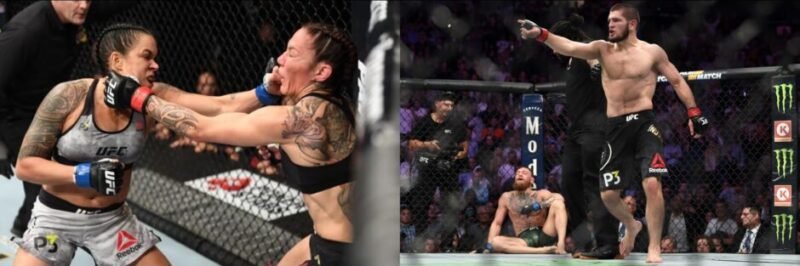
Khabib Nurmagomedov controls Conor McGregor on the ground while Amanda Nunes lands powerful strikes against Cris Cyborg during two iconic championship performances.

From Khabib Nurmagomedov’s suffocating dominance to Amanda Nunes’ explosive knockout of Cris Cyborg, these performances show how truly great champions impose their strengths and define an era.

Click on the links below to read more.

This meeting between reigning welterweight and lightweight champions matched BJ Penn’s exceptional boxing and grappling against the athleticism and tactical discipline of Georges St-Pierre. GSP steadily broke him down through pressure, takedowns and ground control until Penn’s corner stopped the fight after the fourth round. Watch how St-Pierre removes Penn’s preferred space, forces him to defend repeatedly and builds control through accumulated physical and tactical pressure.

Rich Franklin entered as the established middleweight champion, but Anderson Silva dismantled him with frightening efficiency. Silva controlled the Muay Thai clinch, disrupted Franklin’s posture and delivered a succession of knees before ending the fight in the opening round. The performance shows how positional control at close range can make devastating strikes possible.

John Dodson’s speed and power created serious problems during the opening rounds, forcing Demetrious Johnson to recover and reconsider his approach. Johnson gradually took control through movement, clinch work, takedowns and superior conditioning before winning the decision. The fight captures the value of adaptation, showing a champion collecting information, surviving danger and steadily shifting the contest towards more favourable terms.

Cris Cyborg had built an aura of near invincibility through years of aggressive knockout victories. Amanda Nunes met that pressure with composure, recognised the openings created by Cyborg’s aggression and knocked her out in 51 seconds. The finish shows how a fighter can turn an opponent’s greatest strength into a vulnerability through timing and controlled counter-attacking.

Chad Mendes returned from their first meeting as a far more complete challenger, capable of threatening José Aldo through wrestling, speed and powerful combinations. Aldo was forced to adapt across five competitive rounds, responding with sharper counters, takedown defence and championship composure. The fight shows how elite champions maintain their identity while making enough tactical adjustments to defeat an opponent built specifically to challenge them.

Antônio Rodrigo Nogueira was renowned for surviving punishment and submitting opponents from his guard, yet Fedor Emelianenko willingly entered it. Fedor combined takedowns with explosive ground-and-pound while remaining disciplined enough to avoid Nogueira’s submission attacks. The performance demonstrates that entering an opponent’s strongest position can still be effective when posture, timing and positional awareness remain under control.

Paulo Costa entered undefeated and was expected to overwhelm Israel Adesanya with pressure and power. Adesanya instead controlled the distance, damaged Costa with leg kicks and punished every reckless advance before securing the second-round stoppage. It remains one of his cleanest championship performances, demonstrating how timing, accuracy and distance management can systematically dismantle a physically imposing challenger.

Francis Ngannou entered with devastating knockout power, but Stipe Miocic refused to contest the fight on those terms. He survived the early danger, used wrestling and positional control to exhaust Ngannou, then dominated the later rounds. Miocic’s victory is a masterclass in risk management, showing how patience, conditioning and a disciplined game plan can neutralise overwhelming physical power.

Facing the UFC’s leading pound-for-pound fighter, Islam Makhachev encountered an opponent capable of resisting his usual control and forcing constant adjustments. Makhachev mixed takedowns, back control and measured striking to earn a close unanimous decision after five rounds. He would settle any remaining debate in their rematch, stopping Volkanovski decisively with a first-round head kick.

🧠 What These Champions Teach

These performances show that championship greatness is built on more than talent: it requires control, adaptation, risk management and the ability to impose a preferred fight against elite resistance.

💥 Incredible Knockouts

A great knockout is more than an explosive finish. It may result from timing, preparation, creativity or the ability to recognise an opening before the opponent understands the danger. These fights show how MMA’s wider striking environment can produce moments unavailable in more specialised combat sports.

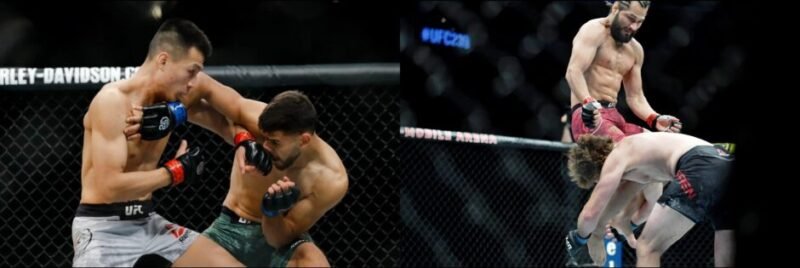
Yair Rodriguez lands his dramatic last-second upward elbow against Chan Sung Jung alongside Jorge Masvidal's flying knee knockout of Ben Askren seconds after the opening bell.

From Yair Rodriguez’s last-second knockout to Jorge Masvidal’s record-breaking flying knee, these unforgettable finishes show that a fight can change in a single instant, no matter what has happened beforehand.

Click on the links below to read more.

After two competitive rounds, Edson Barboza caught Terry Etim with a perfectly timed spinning wheel kick that ended the fight instantly. The speed and accuracy made it one of the UFC’s most spectacular knockouts. It remains a striking example of how an unconventional technique can succeed when distance, timing and setup align.

With only seconds remaining in the fifth round, Chan Sung Jung advanced in search of one final exchange. Yair Rodriguez slipped beneath the attack and produced an upward elbow that knocked him out at the final second. The finish shows how creativity and awareness can turn a seemingly ordinary transition into an opportunity no conventional defence anticipates.

Alistair Overeem was one of heavyweight MMA’s most accomplished strikers, but Francis Ngannou erased his experience with a single left uppercut. The force of the finish instantly established Ngannou as the division’s most frightening puncher and propelled him towards his first title challenge. Few knockouts have demonstrated heavyweight power quite so dramatically.

Ben Askren immediately attacked for the takedown, exactly as Jorge Masvidal had expected. Masvidal sprinted across the cage and met him with a flying knee, recording a five-second knockout. Although it looked spontaneous, the finish came from opponent study, rehearsal and total commitment to exploiting a predictable opening.

Mirko Cro Cop entered the UFC with a reputation built partly upon his devastating left high kick. Gabriel Gonzaga shocked the sport by knocking him out with the same technique. Beyond the dramatic irony, the finish shows how quickly a fighter’s preferred range and rhythm can be disrupted when an opponent creates an unexpected angle.

Known primarily for his wrestling, Kamaru Usman showed how far his striking had developed by knocking out Jorge Masvidal with a perfectly timed right hand. Masvidal had survived their first encounter and entered the rematch with a full training camp, but Usman produced a decisive second-round finish that transformed how opponents viewed his threat on the feet.

Kamaru Usman appeared to be closing out another successful title defence when Leon Edwards created one final opening in the fifth round. Edwards disguised a left high kick behind his punches and landed as Usman moved towards the anticipated escape. The knockout demonstrates the value of maintaining technical discipline and tactical awareness even when the fight appears almost lost.

🧠 What These Knockouts Teach

These finishes reveal that spectacular violence is often built upon timing, preparation, deception and the ability to recognise a brief opening before it disappears.

🥋 Iconic Submissions

Submissions may end a fight suddenly, but the finish is usually the final stage of a longer sequence involving position, control and reaction. Some are constructed methodically, while others appear during chaotic transitions. These contests reveal how quickly elite grapplers can turn a small opening into victory.

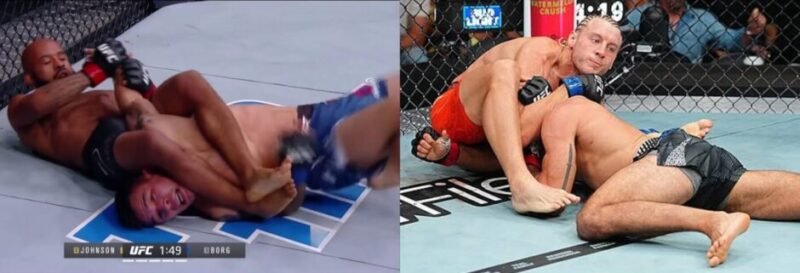
Demetrious Johnson applies his famous flying armbar against Ray Borg alongside Paddy Pimblett securing a rear-naked choke against Benoît Saint Denis.

From Demetrious Johnson’s spectacular suplex-to-armbar to Paddy Pimblett’s composed rear-naked choke, these submissions show that intelligence, timing and technique can end a fight just as decisively as any knockout.

Click on the links below to read more.

While controlling Ray Borg from behind, Demetrious Johnson launched him with a suplex and caught his arm before they reached the canvas, transitioning directly into an armbar. Nicknamed the Mighty Wiz Bar, the finish connected wrestling and submission grappling in one fluid movement. Watch how Johnson anticipates Borg’s position during the transition rather than waiting for both fighters to settle.

Chael Sonnen used wrestling and ground-and-pound to control Anderson Silva for most of their middleweight title fight. With defeat approaching in the fifth round, Silva secured a triangle armbar from his back and forced the submission. The comeback demonstrates why top position does not guarantee safety when the fighter underneath can control posture, create an angle and attack from guard.

After being hurt by Antônio Rodrigo Nogueira, Frank Mir recovered during a scramble, escaped a guillotine and attacked with a kimura. Nogueira attempted to roll free, but Mir followed the movement and completed the submission. The sequence shows how composure and positional awareness can reverse control several times within seconds.

After accepting the fight on short notice, Nate Diaz survived Conor McGregor’s fast start and began finding him with punches as the second round progressed. A hurt and tiring McGregor attempted a takedown, allowing Diaz to take his back and secure the rear-naked choke. It was not an elaborate grappling performance, but the shock of McGregor’s first UFC defeat made it one of MMA’s most memorable submission victories.

Dustin Poirier began strongly with his boxing, but Charles Oliveira gradually imposed pressure through clinch work, body attacks and ground control. In the third round, Oliveira climbed onto his back and secured a standing rear-naked choke. The finish captures Oliveira’s danger during transitions, where defending one attack can expose the position needed for another.

When Benoît Saint Denis attacked early, Paddy Pimblett caught him in a modified D’Arce choke and rendered him unconscious after only 52 seconds. The unusual angle and speed of the finish made it immediately memorable. It demonstrates how a fighter can recognise a developing submission opportunity before either competitor has established a conventional position.

🧠 What These Submissions Teach

These finishes show that submissions are rarely isolated techniques. They emerge through position, timing, control and the ability to anticipate an opponent’s reaction during a transition.

😲 Biggest Upsets

MMA punishes certainty. A dominant champion can appear untouchable until an overlooked challenger exposes a weakness, survives the expected onslaught or refuses to follow the anticipated script. These fights show why reputation and past achievement offer no protection once the cage door closes.

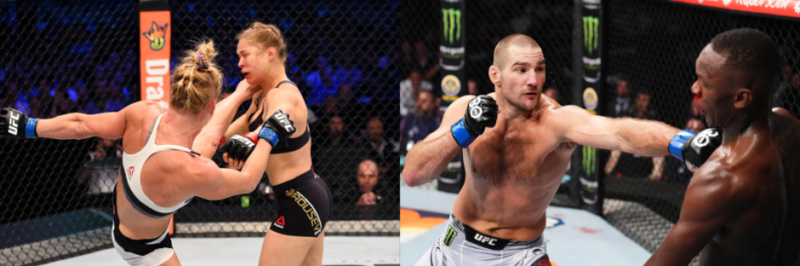
Holly Holm lands the decisive head kick against Ronda Rousey alongside Sean Strickland outstriking Israel Adesanya during one of the biggest championship upsets in MMA history.

From Holly Holm’s stunning dethroning of Ronda Rousey to Sean Strickland’s disciplined masterclass against Israel Adesanya, these fights prove that reputations alone never win inside the cage.

Click on the links below to read more.

Few expected Matt Serra to seriously threaten Georges St-Pierre, but Serra hurt him with a right hand and immediately pressed the advantage. He continued attacking until the fight was stopped in the opening round, capturing the welterweight championship in one of MMA’s greatest shocks. The result shows how quickly composure can collapse once a fighter is hurt and how important it is to recognise when an opponent has not fully recovered.

Ronda Rousey entered as an undefeated champion who had overwhelmed most opponents within minutes. Holly Holm refused to remain directly in front of her, using footwork, straight punches and angles to frustrate Rousey’s pressure before landing a second-round head kick. The performance is a lesson in denying an opponent their preferred range and forcing them to repeatedly restart their attack.

Amanda Nunes appeared firmly established as the dominant force in women’s MMA, but Julianna Peña survived the early danger and forced her into increasingly uncomfortable exchanges. Peña’s pressure and persistent jab disrupted the champion before she secured a rear-naked choke in the second round. The upset shows how pace, confidence and tactical disruption can unravel a more accomplished fighter once the contest moves away from their preferred rhythm.

Rather than relying upon one dramatic moment, Sean Strickland defeated Israel Adesanya through five rounds of disciplined pressure. He defended calmly, maintained a simple boxing attack and denied Adesanya the space needed to establish his usual rhythm. The unanimous decision was remarkable because Strickland did not merely catch the champion. He repeatedly imposed the same difficult problem and prevented Adesanya from finding an effective answer.

🧠 What These Upsets Teach

These fights show that an upset is rarely just luck. It can emerge through composure, disciplined pressure, range denial and the ability to expose a weakness that reputation had concealed.

🧠 Technical Masterclasses

Not every essential fight becomes a desperate war. Some are memorable because they reveal the intelligence behind elite MMA: distance management, timing, positioning and the ability to remove an opponent’s strongest weapons. These performances reward close attention to the decisions made between the obvious moments.

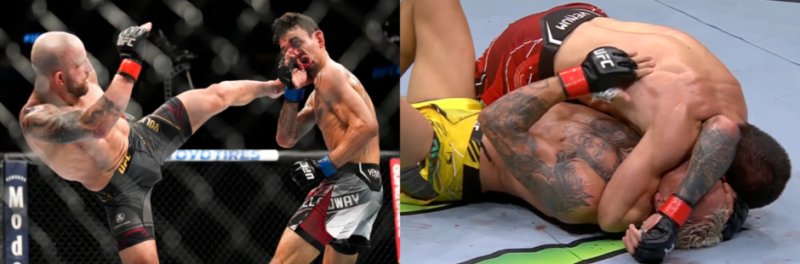
Alexander Volkanovski outmanoeuvres Max Holloway with precise striking while Islam Makhachev controls Charles Oliveira during two of MMA's finest technical championship performances.

From Volkanovski’s tactical dismantling of Holloway to Makhachev’s composed victory over Oliveira, these fights showcase technical excellence at the highest level of MMA.

Click on the links below to read more.

Dominick Cruz and TJ Dillashaw contested five rounds built around movement, angles and constant adjustment. Cruz used unpredictable footwork and well-timed takedowns, while Dillashaw switched stances and attacked from range. Cruz won by split decision, but the real value lies in watching both fighters continually alter their positioning and timing in response to the other.

Jon Fitch entered on a long winning streak and was renowned for his wrestling and durability, but Georges St-Pierre controlled every phase of the contest. He combined precise striking, takedowns and ground control while preventing Fitch from establishing his own game. The performance demonstrates how a complete fighter can connect each phase of combat while denying an opponent any stable route into the fight.

After two competitive previous meetings, Alexander Volkanovski removed any remaining uncertainty in their third fight. He controlled the distance, repeatedly beat Max Holloway to the target and escaped before meaningful counters could return. His speed was obvious, but the real lesson lies in anticipation, positioning and disciplined shot selection against an opponent he understood exceptionally well.

Charles Oliveira’s submission threat had overwhelmed a succession of elite lightweights, but Islam Makhachev remained composed wherever the fight moved. He applied pressure, controlled the grappling exchanges and dropped Oliveira with a counter before transitioning directly into an arm-triangle choke. The performance shows how preparation, positional discipline and control of transitions can neutralise even the most dangerous finisher.

🧠 What These Performances Teach

These fights show that technical superiority often comes from controlling choices, denying strengths and making consistently better decisions across every phase of the contest.

🌸 PRIDE Essentials

PRIDE offered a viewing experience unlike anything in the UFC. Fights took place in a ring, the opening round lasted ten minutes and the rules permitted attacks rarely seen in modern MMA. Combined with theatrical entrances and vast Japanese arenas, this gave PRIDE contests their own rhythm, character and sense of occasion.

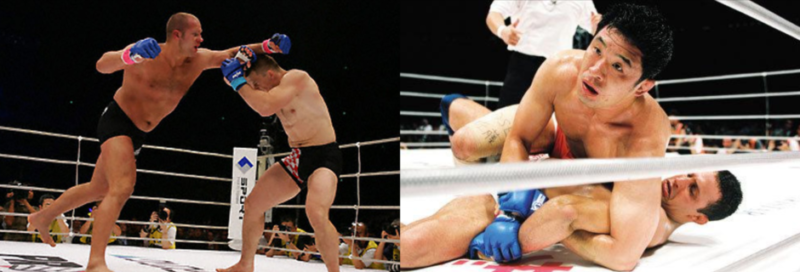
Fedor Emelianenko exchanges strikes with Mirko Cro Cop while Kazushi Sakuraba battles Royce Gracie during two of PRIDE FC's most iconic and influential fights.

From Fedor Emelianenko’s legendary clash with Mirko Cro Cop to Kazushi Sakuraba’s marathon victory over Royce Gracie, these PRIDE classics helped shape modern MMA and remain essential viewing for every fan.

Click on the links below to read more.

Mirko Cro Cop was one of MMA’s most feared strikers, but Fedor Emelianenko refused to give him the distance needed to unleash his kicks. Fedor pressured him around the ring, competed confidently on the feet and mixed in takedowns before winning the decision. The fight shows how controlled aggression and range denial can neutralise a dangerous specialist without avoiding their strengths entirely.

Shogun Rua and Antônio Rogério Nogueira combined sharp boxing with takedowns, sweeps and frantic ground exchanges throughout their PRIDE Grand Prix encounter. Shogun won the decision after repeatedly pushing the pace, but both men demonstrated how seamlessly striking and grappling could merge. Watch how each exchange continues through transitions rather than resetting whenever the range changes.

Quinton Jackson attempted to contain Wanderlei Silva through wrestling and physical pressure, but Silva’s Muay Thai clinch became increasingly dangerous. Once Silva secured the position needed to deliver repeated knees, the fight ended with one of PRIDE’s most recognisable knockouts. The rematch demonstrates how winning the battle for posture and control in the clinch can create decisive striking opportunities.

Contested under special rules without a conventional time limit, Kazushi Sakuraba and Royce Gracie fought for 90 minutes. Sakuraba attacked the legs, manipulated Gracie’s gi and used creative grappling to gradually exhaust him before Gracie’s corner stopped the contest. It is demanding viewing, but provides a remarkable lesson in adaptation, attrition and solving an unfamiliar opponent over an extended fight.

🧠 What These PRIDE Fights Teach

These contests show how rules, environment and pacing reshape strategy, while reinforcing the importance of range control, transitions, clinch position and long-term adaptation.

⚔️ Rivalries Worth Following

Some fighters cannot be fully understood through a single performance. Rivalries force competitors to adapt, expose weaknesses and return with new solutions against opponents who already understand their strengths. Watching the contests together reveals how tactics, confidence and momentum can change across repeated meetings.

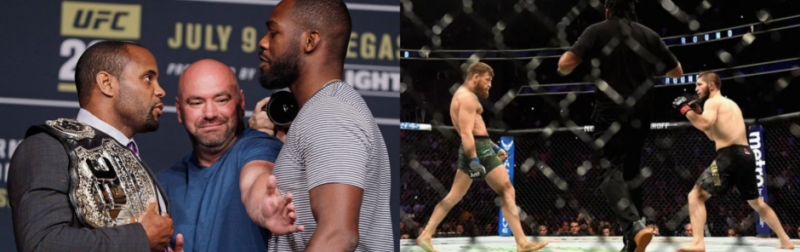
Jon Jones faces Daniel Cormier during their heated championship rivalry while Khabib Nurmagomedov battles Conor McGregor in one of the most anticipated fights in MMA history.

From Jones and Cormier’s deeply personal feud to Khabib and McGregor’s global showdown, these rivalries proved that the stories outside the cage can make the battles inside it even more compelling.

Click on the links below to read more.

Randy Couture upset Chuck Liddell in their first fight by closing the distance, applying pressure and repeatedly forcing him into wrestling exchanges. Liddell returned with improved takedown defence and won both rematches by knockout. Their trilogy shows how a fighter can rebuild an entire strategy around denying the position that caused the original defeat.

Matt Hughes submitted a young Georges St-Pierre in their first meeting, capitalising when the challenger appeared overawed by the occasion. GSP returned with greater confidence to stop Hughes and capture the welterweight championship, then submitted him in their third fight. The rivalry traces St-Pierre’s development from gifted prospect to complete champion while showing how technical growth and composure can transform a match-up.

Gray Maynard won their first encounter and came close to finishing Frankie Edgar during the opening round of their championship rematch. Edgar recovered to secure a draw, then survived another difficult start before stopping Maynard in their third fight. Across the trilogy, the key lesson is adaptation under pressure: Edgar repeatedly found ways to survive the same danger and gradually create better answers.

Nate Diaz accepted their first fight at short notice, survived Conor McGregor’s early attacks and submitted him in the second round. McGregor returned with a more measured strategy, using low kicks, improved pacing and greater control of distance to win a closely contested decision. Together, the fights show how endurance, weight, preparation and emotional restraint can reshape a familiar contest.

The hostility between Jon Jones and Daniel Cormier produced one of MMA’s most personal rivalries. Jones won their first encounter by unanimous decision, matching the Olympic wrestler in the clinch and taking him down. Jones stopped Cormier in their rematch, but the result was overturned after a failed drug test. Their rivalry helped define the UFC light-heavyweight division, although controversy ensures its legacy remains bitterly disputed.

The rivalry between Khabib Nurmagomedov and Conor McGregor became deeply personal long before they entered the cage. When they finally met, Khabib absorbed the early pressure, imposed his wrestling and gradually exhausted McGregor before submitting him in the fourth round. The chaos surrounding the contest often overshadowed the performance, but the fight itself provided a decisive answer between MMA’s biggest star and its undefeated lightweight champion.

The rivalry between Israel Adesanya and Alex Pereira crossed from kickboxing into MMA, with Pereira repeatedly finding ways to defeat an opponent who often appeared to be controlling their contests. After losing their first MMA meeting by late stoppage, Adesanya returned to knock Pereira out and regain the middleweight championship. Their rivalry demonstrates how small tactical adjustments, timing and psychological pressure can alter a match-up shaped by years of shared history.

🧠 What These Rivalries Teach

These series show that repeated opponents force deeper adaptation, exposing how preparation, confidence, pacing and tactical adjustment can completely change the outcome of the same match-up.

📌 Final Thoughts

No watchlist can capture every great fighter, rivalry or unforgettable finish in a sport as varied as Mixed Martial Arts. New classics will continue to emerge, while long-time fans will always argue over which contests deserve inclusion. That debate is part of the enjoyment.

The fights in this guide offer more than entertainment. Together, they reveal the importance of timing, positioning, pressure, adaptation, composure and resilience. They show champions imposing their strengths, underdogs overturning expectations and exhausted fighters finding one final answer when every obvious route to victory appears closed.

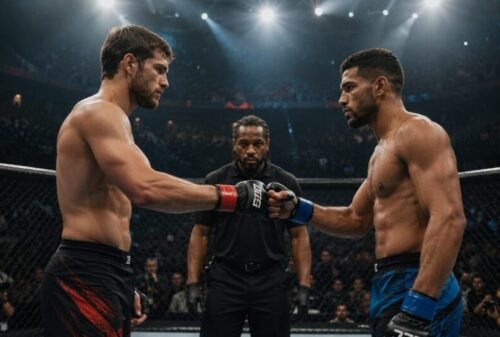
Two MMA fighters touch gloves beneath bright arena lights as the referee stands between them inside a crowded cage.

Every opening bell offers another lesson, another defining moment and the possibility that a new classic is about to begin.

Most importantly, they give new viewers a foundation. The concepts explored in Changing Levels: Understanding MMA become clearer when seen against elite opposition, where every mistake is punished and every adjustment can change the direction of the contest.

Once you begin recognising those decisions beneath the action, MMA no longer looks like organised chaos. Every exchange becomes a battle for distance, control and opportunity, and every great fight offers another lesson in what happens when skill, strategy and pressure collide.

🥊 Thinking About Training?

Watching MMA may leave you wondering what it feels like to learn these skills yourself. Step into the Octagon: Getting Started in MMA explains how to choose a gym, prepare for your first class and begin training safely.

➡️ Read: Step into the Octagon — Getting Started in MMA

If you have enjoyed this post please share or feel free to comment below 🙂

Our Other Posts

Leave a Reply

Your email address will not be published. Required fields are marked *

This site uses Akismet to reduce spam. Learn how your comment data is processed.

error: Content is protected !!

Join the Super Soldier Project Mailing List Today!!