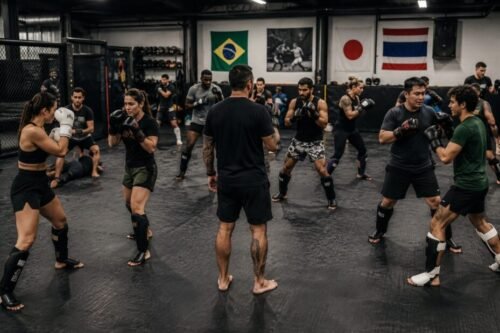
Thinking about trying MMA but not sure what to expect? From choosing the right gym and surviving your first class to sparring, equipment, training, and competition, this guide covers everything you need to know before stepping onto the mats.
Table of Contents
🥋 Introduction
Mixed Martial Arts attracts people for many different reasons. Some want to improve their fitness, others are interested in self-defence, competition or testing themselves in an unfamiliar environment. For many, it begins more simply: they watch the sport and wonder what training is actually like.
The reality is often very different from what people expect.
From the outside, MMA can appear chaotic and unforgiving. In a well-run gym, however, training follows a structured process. Beginners develop striking, grappling, conditioning and decision-making gradually, building technical foundations before working against increasing levels of resistance. They are not expected to understand everything on day one or thrown immediately into full-contact fighting.
MMA training is far more organised and progressive than it may appear from outside the gym.
This article is not about the history of MMA or the tactics used inside the cage. It is a practical guide to starting your own training journey. We will look at how to choose the right gym, what happens in a typical class, the equipment you need, the realities of sparring, and the benefits and challenges that come with regular practice.
Whether you are simply curious or seriously considering joining a gym, the aim is straightforward: to give you a realistic picture of what beginning MMA actually involves.
🎯 Why Do People Start MMA?
People arrive at MMA from very different backgrounds. Some already train in boxing, Brazilian Jiu-Jitsu or another martial art and want to broaden their skills. Others have never thrown a punch or attempted a takedown.
Understanding why you want to train is more important than many beginners realise. Your reasons will influence the type of gym that suits you, how often you train and what you hope to achieve over time. Someone focused on fitness and confidence may thrive in a welcoming recreational gym, while an aspiring competitor will usually need an active fight team and a more demanding training schedule.
Curiosity about the sport, improved fitness and practical self-defence can all lead someone onto the MMA mats.
🥊 Common Reasons People Start MMA
- Improve fitness and overall conditioning.
- Learn practical self-defence skills.
- Challenge themselves by learning a complex new discipline.
- Experience the sport they enjoy watching.
- Develop greater confidence, resilience and discipline.
- Work towards amateur or professional competition.
🏠 Choosing the Right MMA Gym
The gym you choose will shape your experience more than almost any other decision. Good coaching, suitable training partners and a structured environment can make the early stages challenging but enjoyable. The wrong gym can leave beginners feeling overwhelmed, discouraged or injured before they have had the chance to develop.
Not every MMA gym serves the same audience. Some are built around competitive fighters, while others focus mainly on recreational members training alongside work, study or family commitments. Neither approach is inherently better, but one may suit your goals far more than the other.
A competitive fight team and a recreational training environment can both be excellent, provided the culture matches your goals.
Click on the links below to read more.
🥋 Different Gym Cultures
Walk into ten MMA gyms and you may find ten different atmospheres.
Some are highly competitive, with professional and amateur fighters preparing for upcoming bouts. Others are relaxed, community-focused clubs where most members train a few times each week for fitness, technical development and enjoyment.
Many gyms offer both, separating beginner, recreational and competition sessions. You do not need to decide your long-term ambitions immediately. The priority is finding an environment where you feel comfortable learning.
✅ What to Look For
A well-run gym is usually easy to recognise:
- Coaches explain techniques clearly and pay attention to beginners.
- Sessions are organised and appropriate for the experience level.
- Training partners work with one another rather than trying to dominate.
- Sparring intensity is controlled and matched to ability.
- Safety, hygiene and mutual respect are treated seriously.
- More experienced members help newer students develop.
Mistakes should be treated as part of the learning process, not as an excuse for ridicule.
🚩 Potential Red Flags
Be cautious if:
- Beginners are expected to spar hard immediately.
- Coaches show little interest in new members.
- Sessions feel disorganised or lack clear instruction.
- Experienced students regularly use excessive force against less capable partners.
- Equipment or training areas are poorly maintained.
- The atmosphere is driven by ego, intimidation or proving toughness.
- Injuries and concussion symptoms are dismissed or normalised.
No gym is perfect, but if the environment repeatedly feels unsafe or unprofessional, trust your judgement.
📝 Try Before You Commit
Most gyms offer a trial class or introductory session. Use it to assess more than the technical instruction.
Are beginners welcomed? Do partners communicate and adjust their intensity? Does the coach notice when someone is struggling? Does the atmosphere encourage learning rather than competition between teammates?
A good gym should challenge you, but it should also be somewhere you are willing to return to consistently. Finding that balance is one of the most important steps in building a lasting relationship with MMA.
🥋 What Training MMA Actually Looks Like
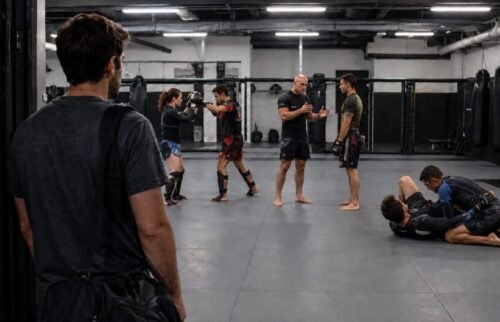
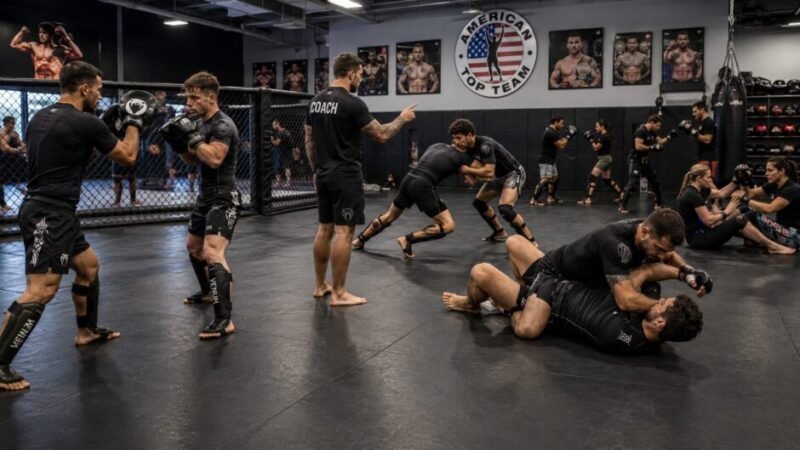
From the outside, an MMA session can appear fast and unpredictable. In reality, good training is highly structured. Beginners develop individual skills first, then gradually learn how to connect them under increasing levels of resistance.
Early training is less about learning to fight and more about building reliable foundations. Each class adds another piece to the puzzle, helping unfamiliar movements become more natural through repetition, feedback and controlled practice.
Good MMA training develops individual skills through structured drilling before combining them under resistance.
Click on the links below to read more.
🧱 The Structure Behind the Chaos
Most gyms divide training into three broad areas:
- Striking: Punches, kicks, defence, footwork and distance management.
- Grappling: Takedowns, positional control, escapes and submissions.
- Integrated MMA: Combining striking, wrestling and ground fighting through transitions.
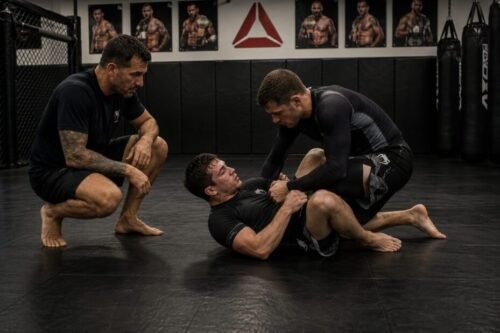
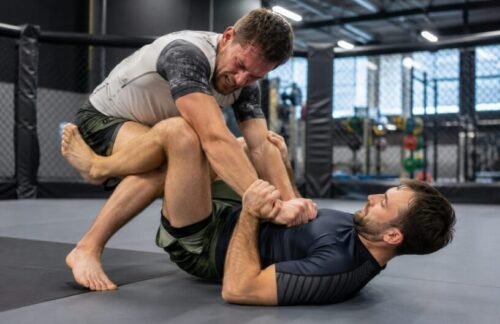
These areas are often taught separately at first. One session may focus on stance and simple combinations, while another develops takedowns, escapes or positional control on the ground.
As your understanding improves, the disciplines begin to merge. You learn how strikes create takedown opportunities, how clinch positions lead to trips and how ground exchanges develop from failed attacks or defensive scrambles.
🔁 How a Typical Session Runs
Although every gym has its own approach, most classes follow a similar structure:
- Warm-up: Mobility, movement drills and preparation for the demands of the session.
- Technical instruction: The coach introduces or refines a particular skill.
- Partner drilling: Students repeat the movement with limited resistance.
- Progressive resistance: The partner begins reacting, defending or countering more realistically.
- Positional or technical sparring: Students apply the lesson in a controlled live situation.
- Conditioning or cooldown: Some sessions finish with fitness work, mobility or a review of the techniques covered.
The purpose is not simply to leave you exhausted. It is to teach you to maintain sound technique while managing fatigue, pressure and resistance.
🎯 What You’re Actually Learning
One of the biggest surprises for beginners is how little emphasis is placed on winning during the early stages.
In striking, the focus is usually on stance, balance, movement, defence, distance and simple combinations. In grappling, beginners learn how to maintain position, escape safely, control their weight and remain calm when placed under pressure.
These fundamentals may feel less exciting than spectacular knockouts or submissions, but they make everything else possible. Advanced techniques are difficult to apply without the balance, awareness and control developed through the basics.
⚠️ Your First Few Sessions
During your first few sessions:
- You will probably tire more quickly than expected.
- Techniques may disappear from memory as soon as the demonstration ends.
- Your timing and coordination may feel awkward.
- You will spend more time reacting than anticipating.
- Unfamiliar positions may initially feel confusing or uncomfortable.
None of this means you are unsuited to MMA. Every experienced practitioner began by struggling with the same basic movements and decisions.
Progress comes from becoming slightly more familiar, efficient and composed each time you train.
🧠 Learning Through Resistance
A defining feature of MMA is that techniques are eventually tested against partners who are actively trying to prevent them.
Resistance is introduced gradually. Beginners may start with cooperative drilling before partners add movement, defence and counterattacks. This creates immediate feedback: techniques either work, fail or reveal where they need adjustment.
That cycle of learning, testing and refining is one of MMA’s greatest strengths. It prevents false confidence and teaches practitioners to adapt rather than rely upon movements that only succeed against a compliant partner.
👊 Your First Few Weeks
The first few weeks can feel like information overload. You are learning unfamiliar terminology, positions and movements across several disciplines, often while your fitness and coordination are being tested in new ways.
It is normal to feel as though everyone else understands what is happening while you are struggling to keep up. They were once in exactly the same position.
The first few weeks can feel exhausting and confusing, but clear coaching gradually turns difficulty into understanding.
Click on the links below to read more.
🧱 Focus on Learning, Not Winning
Your job is not to submit experienced grapplers, outstrike seasoned kickboxers or prove that you belong in the room.
Focus instead on understanding the fundamentals, following instructions and developing good habits. The beginners who progress most reliably are usually those who listen carefully, ask sensible questions and accept that mistakes are part of learning.
🎯 Control Before Intensity
New students often compensate for limited experience by using excessive strength, speed or aggression. This makes techniques harder to learn and increases the risk of injuring themselves or their training partners.
Work at a pace you can control. Good coaches would rather see a technique performed slowly and correctly than quickly and without understanding.
Learning to stay relaxed is a skill in itself. It helps conserve energy, improves decision-making and makes you a safer, more useful training partner.
📈 Recognising Progress
Early improvement is often subtle.
You may begin to:
- Recognise positions that previously felt unfamiliar.
- Remember more of a technique after the demonstration.
- Move with greater balance and control.
- Remain calmer when placed under pressure.
- Recover more quickly between rounds.
- Notice mistakes before your coach points them out.
You probably will not feel like a fighter after your first month. Progress is measured through growing familiarity and competence rather than dramatic transformation.
💬 Give Yourself Time
Everyone develops at a different rate. Previous martial arts experience, fitness, coordination and training frequency all influence progress, but comparison with people who have trained for months or years is rarely useful.
The aim is not to become the best person in the room. It is to leave each session with a slightly better understanding than when you arrived.
🎒 Equipment and Preparing for Class
You do not need to spend heavily before trying MMA. Most beginners can attend their first sessions in basic training clothes, then add specialist equipment as they begin training regularly.
Many gyms have gloves, pads or other kit available to borrow, allowing newcomers to try the sport before committing to a full set of equipment.
Beginners can build their kit gradually, starting with the protective equipment required by their gym.
Click on the links below to read more.
👕 What Should You Wear?
For your first class, choose clean, comfortable clothing that allows you to move freely.
A fitted T-shirt or rash guard and shorts without zips, buttons or open pockets are usually suitable. Loose clothing can become tangled during grappling, while hard fastenings may scratch you or your training partners.
Bring flip-flops or sliders for moving around off the mats. Most gyms require footwear in changing areas and bare feet on the training surface.
There is no need to arrive dressed like a professional fighter. Practicality and hygiene matter far more than appearance.
🥊 Essential Equipment
Once you begin training regularly, you’ll usually need a few core items.
- Hand wraps to support your wrists and protect your hands.
- MMA gloves for drilling and technical sparring.
- Boxing gloves for pad work and striking sessions.
- Shin guards for kickboxing and sparring.
- A mouthguard for any form of contact training.
- A groin guard for male practitioners during sparring or competition.
Some gyms also use headguards for particular drills or sessions, although policies and opinions vary. A headguard may reduce cuts and superficial injuries, but it does not remove the risk of concussion.
Always ask the coach what is required before buying equipment, as glove sizes, styles and safety standards differ between gyms.
🧼 Hygiene Matters
Good hygiene is part of being a responsible training partner.
- Wash your kit after every session.
- Keep fingernails and toenails trimmed.
- Cover cuts and abrasions securely.
- Avoid training with contagious illness or suspected skin infection.
- Keep outdoor footwear away from the mats.
- Clean gloves, shin guards and other protective equipment regularly.
MMA involves close contact and shared surfaces, so neglecting hygiene can quickly affect the entire gym.
📝 Before Your First Class
A simple checklist can make the first session easier:
- Contact the gym and confirm that the class is suitable for beginners.
- Ask what clothing and equipment you need.
- Arrive early enough to introduce yourself to the coach.
- Mention any injuries, medical conditions or movement restrictions.
- Bring water, clean training clothes and suitable footwear for off the mats.
- Expect to learn rather than prove yourself.
💰 Buy Gradually
Avoid buying an entire kit bag before you know whether you enjoy the training.
After a few sessions, you will have a clearer idea of what you need, and your coach can recommend equipment suited to the way the gym trains. Buying gradually also reduces the chance of wasting money on poor-quality or unsuitable gear.
Your equipment should develop alongside your commitment. There is no prize for owning the most kit.
🤝 Coaches, Training Partners & Gym Etiquette
You cannot develop MMA skills alone. Your progress depends upon good coaching, reliable training partners and a gym culture built around trust, control and mutual improvement.
When everyone approaches training with the right attitude, beginners learn faster, experienced members sharpen their skills and the entire room becomes safer.
Productive training depends on coaching, communication and partners who help one another improve safely.
Click on the links below to read more.
🧑🏫 The Role of a Good Coach
A coach does far more than demonstrate techniques.
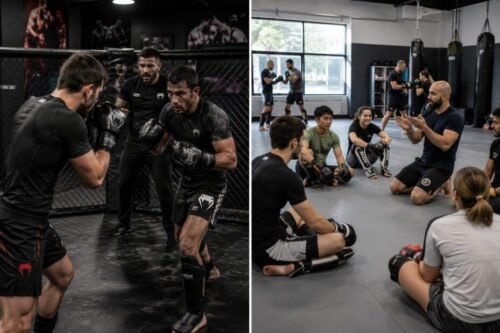
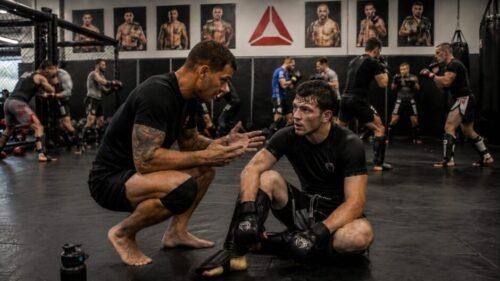
They structure sessions, correct mistakes, manage intensity and pair students according to size, experience and temperament. They should know when to challenge a beginner and when to slow the pace, simplify the task or return to the fundamentals.
Listen carefully during demonstrations and ask questions when something is unclear. Improvement rarely comes from collecting flashy techniques. It comes from understanding the basics and refining them through consistent practice.
A good coach should also take injuries, concussion symptoms and unsafe behaviour seriously. Any culture that treats avoidable harm as proof of toughness should be approached with caution.
🤼 Your Training Partners
Your training partners are not opponents to be defeated.
Every drill, sparring round and grappling exchange should allow both people to learn. That requires communication, controlled resistance and enough awareness to recognise when a partner is uncomfortable or outmatched.
More experienced members will often adjust their pace, offer guidance and give beginners enough space to practise correctly. As your own experience develops, you will be expected to do the same for others.
A productive round does not require one person to dominate. Both partners should leave it more capable than when they began.
🫱 Gym Etiquette
Every gym has its own customs, but several expectations are nearly universal:
- Arrive on time and ready to train.
- Listen while coaches are explaining techniques.
- Treat every partner with respect.
- Match your strength and intensity to the task.
- Tap early and release submissions immediately.
- Communicate if you are injured, inexperienced or uncomfortable.
- Keep yourself and your equipment clean.
- Do not coach over the instructor or give advice you are unqualified to offer.
- Leave ego and uncontrolled aggression outside the gym.
These rules are simple, but they make technical training possible.
🤝 More Than Just a Gym
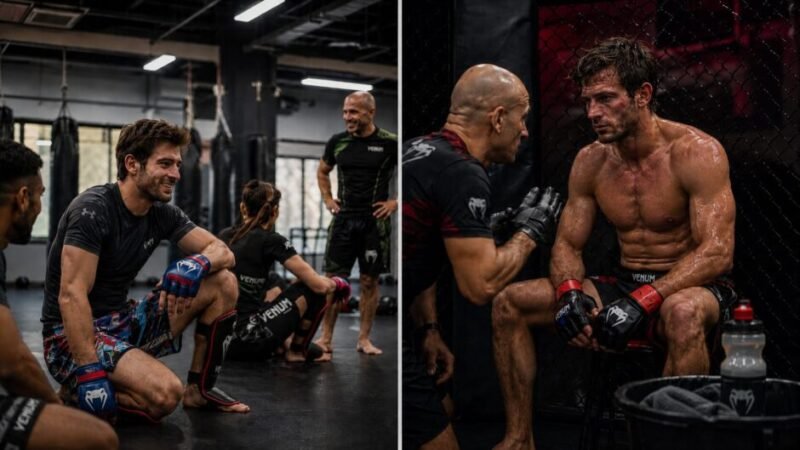
One of the most rewarding aspects of MMA is the community that develops around regular training.
People of different ages, professions and backgrounds work together towards the same broad goal: becoming more capable. Over time, unfamiliar faces become trusted partners, and the shared experience of difficult sessions often creates strong friendships.
A healthy gym challenges its members without turning every interaction into a contest. Everyone should remember that the person across from them is helping them improve and will probably be training with them again tomorrow.
🥊 Sparring — What It Really Means
For many beginners, sparring is the most intimidating part of Mixed Martial Arts. It is also one of the most misunderstood.
Watching professional fights can create the impression that sparring is simply a smaller version of competition. In reality, good sparring is a learning tool. Its purpose is to help practitioners apply techniques against resistance while developing timing, judgement and composure.
Good sparring develops timing and decision-making without turning every round into a fight.
Click on the links below to read more.
🧱 Not All Sparring Is the Same
The word sparring covers several forms of live training:
- Positional sparring: Both partners begin in a specific situation and work towards a limited objective.
- Technical sparring: Light, controlled exchanges focused on timing, movement and applying recently learned skills.
- Open sparring: A wider range of techniques and situations is permitted, but intensity should still match experience and purpose.
- Hard sparring: Higher-intensity rounds used selectively by experienced fighters, usually during competition preparation.
More intensity does not automatically produce more learning. Technical and positional rounds often allow practitioners to work more deliberately, take sensible risks and correct mistakes without unnecessary damage.
⏳ When Do Beginners Start?
Beginners should not be thrown immediately into unrestricted sparring.
Most coaches introduce live resistance gradually, once a student understands enough to protect themselves, follow the rules and respond without panicking. Grappling rounds may begin earlier than striking sparring because the risks and pace can be controlled differently, although every gym has its own approach.
The timing should depend on your readiness, not pressure to prove that you are tough.
🎯 What You Should Be Trying to Achieve
The objective is not to win every round.
A productive session might involve:
- Maintaining your stance under pressure.
- Defending a takedown correctly.
- Escaping a difficult position.
- Controlling your breathing.
- Applying one technique from the lesson.
- Recognising when to disengage or reset.
Sparring exposes weaknesses and gives you a place to test solutions. It should leave you with useful information, not simply a sense that you survived.
🧠 Head Contact and Long-Term Risk
Any form of striking to the head carries a risk of concussion. Repeated impacts may also have cumulative effects, even when no single blow appears severe.
Headguards can reduce cuts and some superficial injuries, but they do not prevent the brain from moving inside the skull. They should never be treated as permission to spar recklessly.
Recreational practitioners do not need regular hard head contact to benefit from MMA. Technical sparring, body-only rounds, restricted drills and carefully controlled contact can develop timing and decision-making while reducing unnecessary exposure.
Stop training and seek appropriate medical assessment if you experience symptoms such as headache, dizziness, nausea, confusion, unusual fatigue, balance problems or sensitivity to light after a blow to the head. Returning too quickly after a suspected concussion can increase the risk of further harm.
⚠️ Don’t Confuse Training With Fighting
Training should be difficult, but it should not feel like surviving a real fight every time you step onto the mats.
When every round becomes a contest of ego and excessive force, technique deteriorates and injuries become more likely. Good partners communicate, adjust their intensity and understand the purpose of the session.
A well-run gym prepares people to improve consistently. It does not treat avoidable damage as evidence of commitment.
❌ Common Beginner Mistakes
Mistakes are an unavoidable part of learning MMA. The problem is not getting things wrong, but repeating habits that slow progress, frustrate training partners or increase the risk of injury.
Most beginner errors come from impatience. New students often want to move faster, train harder or prove themselves before they have developed the control and understanding to do so.
Excessive effort wastes energy and often allows a relaxed, technically sound partner to remain in control.
Click on the links below to read more.
🧱 Using Strength Instead of Technique
Beginners often tense up and rely on strength, speed or aggression when they are unsure what to do.
This wastes energy, makes movements less precise and forces training partners to protect themselves rather than help you learn. Strength is useful, but it should support correct technique rather than replace it.
Try to remain relaxed enough to recognise what is happening and apply the movement deliberately.
🎯 Treating Every Round Like a Competition
Sparring and drilling are opportunities to practise, not tests of your status in the gym.
Trying to dominate every exchange encourages poor decisions and makes people reluctant to train with you. Some of your most valuable rounds will involve being controlled, caught or repeatedly placed in difficult positions because those experiences expose what needs work.
Measure progress by the problems you are beginning to understand, not by how many rounds you believe you won.
👂 Ignoring Feedback
Small corrections can feel inconvenient, particularly when a movement already seems natural. However, comfortable habits are not always effective ones.
Listen to coaches, ask for clarification when necessary and remain open to feedback from experienced partners. Fixing a mistake early is far easier than trying to remove it after months of repetition.
❤️🩹 Training Through Genuine Injury
Normal training discomfort and injury are not the same thing.
Sore muscles, fatigue and minor stiffness are common. Sharp pain, instability, restricted movement or worsening symptoms should not be ignored. Continuing to train through an injury can turn a manageable problem into a lengthy setback.
Tell your coach when something is wrong and adjust, stop or seek appropriate medical advice when necessary.
📈 Expecting Progress to Be Linear
Improvement rarely arrives at a steady rate.
Some sessions feel productive, while others expose weaknesses you thought you had solved. As your understanding develops, you may become more aware of mistakes, which can make progress feel slower than it actually is.
Avoid judging your development by one difficult class or a comparison with another student. Long-term improvement comes from regular attendance, thoughtful practice and the willingness to keep correcting the same details.
❤️🩹 Staying Healthy — Injury Prevention & Recovery
Mixed Martial Arts places significant demands on the body. Sore muscles, bruises and occasional minor injuries are part of regular training, but frequent or serious injury should not be treated as inevitable.
The aim is not to prove how much punishment you can tolerate. It is to train consistently enough to improve over the long term.
Mobility, recovery and sensible pacing help practitioners train consistently rather than merely train hard.
Click on the links below to read more.
🛡️ Reducing the Risk of Injury
No contact sport is risk-free, but sensible habits reduce unnecessary exposure:
- Learn techniques under control before adding speed or resistance.
- Match your intensity to your experience and the purpose of the session.
- Communicate clearly with coaches and training partners.
- Tap early rather than attempting to escape a fully secured submission.
- Stop if you feel sharp pain, instability or symptoms following a head impact.
- Avoid training when illness, exhaustion or injury prevents you from protecting yourself properly.
Many avoidable injuries occur when fatigue, ego or poor judgement overrides technical control.
🌙 Recovery Is Part of Training
Your body adapts between sessions, not simply during them.
Adequate sleep, hydration, balanced nutrition and sufficient rest all influence how well you perform and recover. Mobility work, light movement and appropriate strength training may also help you manage the demands placed on your joints and muscles.
Recovery does not always mean doing nothing. It means choosing activity that supports your next productive session rather than adding more fatigue.
⚖️ Consistency Beats Intensity
Enthusiasm often encourages beginners to train as frequently as possible, but repeatedly pushing through fatigue reduces technical quality and increases the risk of injury.
For many newcomers, two or three well-managed sessions each week provide enough exposure to improve while allowing the body time to recover. Training frequency can then increase gradually as fitness, experience and recovery capacity develop.
The aim is to choose a workload you can manage safely, rather than accumulating fatigue faster than your body can adapt.
🩺 Know When to Step Back
Normal soreness should gradually improve. Pain that persists, worsens or affects everyday movement deserves greater attention.
Do not rely on teammates to diagnose an injury, and do not allow gym culture to pressure you into returning before you are ready. Modify training, speak to your coach and seek appropriate professional advice when necessary.
Looking after your body is not separate from becoming a better martial artist. It is what allows you to continue learning.
⚖️ The Benefits — Why MMA Works
Progress may feel gradual, but the combined effects become increasingly noticeable over time.
MMA develops conditioning, coordination, technical skill and confidence through purposeful physical training.
Click on the links below to read more.
💪 Broad, Purposeful Fitness
MMA challenges several physical qualities at once:
- Cardiovascular fitness.
- Strength and muscular endurance.
- Balance and coordination.
- Mobility and agility.
- Reaction speed and body awareness.
Unlike conventional exercise performed purely for conditioning, these qualities develop while solving practical movement problems. You are learning to move efficiently, maintain position and apply technique while tired.
MMA provides broad athletic development, although specialised goals such as maximum strength, muscle growth, endurance competition or rehabilitation may still require additional training.
🧠 Practical Skills and Honest Feedback
Techniques are gradually tested against resisting partners, revealing what you can apply reliably and where your weaknesses remain.
A movement that works during cooperative drilling may fail when timing, pressure and resistance are introduced. This feedback encourages practitioners to adjust their positioning, improve their technique and abandon assumptions that do not survive live practice.
Progress is demonstrated through growing competence rather than simply memorising movements or collecting techniques.
🧭 Confidence Through Experience
MMA can build confidence, but not because training makes someone invulnerable.
Confidence develops through repeated exposure to manageable difficulty. You learn to remain calmer in uncomfortable positions, think while fatigued and continue working when the original plan fails.
Because that confidence is based on tested experience, it often feels quieter and more realistic than confidence built on theory alone.
🔄 Adaptability and Problem-Solving
MMA rarely allows one solution to work indefinitely.
Distance changes, positions shift and training partners respond differently. Practitioners must recognise what is happening, choose an appropriate response and adjust when it fails.
This constant problem-solving is one of the sport’s defining qualities. It keeps training mentally engaging while developing patience, awareness and decision-making under pressure.
🤝 Discipline and Community
Progress depends upon regular attendance, controlled effort and cooperation with other people.
Training partners rely on one another to practise safely, while coaches expect students to listen, communicate and manage their intensity. Over time, this creates accountability and often a strong sense of community.
The broader lessons should not be exaggerated, but habits such as consistency, humility and remaining composed through difficulty can extend beyond the gym.
For many practitioners, these gradual changes become more valuable than the original reason they started training.
⚠️ The Challenges — What MMA Demands
For all its benefits, Mixed Martial Arts is not an easy activity to maintain. It requires time, patience and a willingness to spend long periods feeling uncomfortable while developing skills that may take years to become reliable.
Understanding those demands helps beginners build realistic expectations and decide whether MMA fits their goals and lifestyle.
Sustainable progress requires balancing training with work, family responsibilities, fatigue and recovery.
Click on the links below to read more.
💷 The Cost of Training
Getting started does not require a large investment, but the costs increase once training becomes regular.
Typical expenses include:
- Gym membership.
- Gloves, shin guards, wraps and a mouthguard.
- Replacement of worn or damaged equipment.
- Laundry, travel and other practical costs.
- Medicals, entry fees and additional travel for competitors.
For most hobbyists, membership and basic protective equipment remain the main expenses. Asking about contracts, cancellation terms and required kit before joining can prevent unexpected costs.
🥵 Physical Wear and Tear
Even sensible MMA training places considerable demands on the body.
Muscular soreness, bruises, minor abrasions and occasional strains can occur. Contact training also carries a risk of injury, including damage to joints and the effects of blows to the head.
Good coaching, controlled partners and sensible recovery reduce these risks, but they cannot remove them completely. Anyone considering MMA should be comfortable accepting a degree of physical contact and managing their training responsibly.
⚖️ Finding the Right Balance
For most practitioners, MMA is one part of a larger life. Training must fit alongside work, relationships, family responsibilities and recovery rather than competing with them.
A sustainable routine is usually more effective than trying to organise everything around the gym. The right balance allows you to train seriously without neglecting the rest of your life.
🏆 Hobbyist or Competitor?
One of the biggest misconceptions about MMA is that everyone who joins a gym eventually wants to step into the cage.
Most practitioners never compete. They train because they enjoy the fitness, technical challenge, community and sense of progression. For them, regular training is the destination rather than preparation for a fight.
Others develop an interest in competition after gaining experience. Neither path is more legitimate than the other.
MMA can remain an enjoyable hobby or become a demanding competitive pursuit, with neither path more legitimate than the other.
Click on the links below to read more.
🥋 Different Goals, Same Mats
A typical MMA gym may include professional fighters, amateur competitors and recreational members training a few times each week.
Some people want to test themselves in competition. Others are interested in learning skills, improving their fitness or enjoying a demanding hobby alongside work and family life.
These different goals can coexist successfully when the gym respects each member’s ambitions and adjusts training accordingly.
🎯 Competition Is a Choice
A responsible coach should never pressure someone into competing before they are ready or when they have no interest in doing so.
You can train recreationally for years without entering a cage and still develop considerable skill. Equally, deciding to compete can provide a clear goal and a new level of challenge when supported by sufficient experience and preparation.
The decision should be based on your own ambitions, health and circumstances rather than pressure from teammates or a desire to prove yourself.
⚖️ Be Honest About the Difference
Recreational training and competitive MMA are not identical commitments.
A hobbyist can usually adjust training around the rest of life, avoid regular hard sparring and progress at a sustainable pace. A competitor must accept greater demands, including harder preparation, stricter recovery, increased injury exposure and the possibility of making weight.
Both approaches require discipline, but competition asks significantly more of the athlete.
There is no correct endpoint. The right path is the one that matches what you genuinely want from MMA.
🥇 If You Decide to Compete
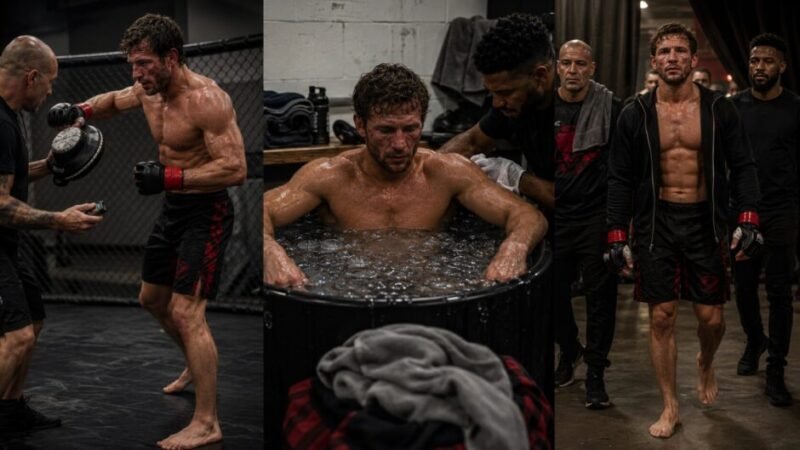
Choosing to compete changes the purpose and intensity of training. Regular classes remain important, but preparation becomes more structured, demanding and specific to the realities of an upcoming bout.
Competition should be approached as a gradual progression, not as something to rush into before the necessary skills, fitness and composure have been developed.
Competition involves far more than fight night, requiring preparation, recovery, weight management and the composure to make the walk.
Click on the links below to read more.
🧱 The Competition Pathway
There is no single route into competitive MMA, but most athletes follow a broadly similar progression:
- Build foundations through regular striking, wrestling, grappling and integrated MMA classes.
- Gain experience through controlled sparring and more demanding live rounds.
- Take part in interclubs, grappling competitions or other supervised events where appropriate.
- Begin preparing for amateur MMA under the guidance of an experienced coach.
- Progress towards professional competition only after developing sufficient skill, experience and maturity.
The exact pathway varies between gyms, governing bodies and individual athletes. What matters is that each stage prepares the fighter for the next rather than simply increasing the danger.
🥊 What Is a Fight Camp?
A fight camp is a dedicated period of preparation leading into a scheduled bout.
Training becomes more focused and demanding, with greater attention given to:
- The opponent’s likely strengths and habits.
- Technical and tactical preparation.
- Sparring and competition-specific conditioning.
- Recovery, nutrition and injury management.
- Making weight safely where required.
- Mental preparation and managing the pressure of competition.
A camp may last several weeks, depending on the athlete, experience level and notice given for the fight.
Most recreational practitioners will never need one. For competitors, however, it becomes a carefully managed process designed to produce the best possible performance on a particular date.
⚖️ Weight Cutting and Health
Some competitors reduce body weight before a bout to enter a lighter division. Poorly managed weight cutting can impair performance and create serious health risks through dehydration, electrolyte disturbance and inadequate recovery.
Beginners should never attempt aggressive weight cuts without experienced coaching and appropriate professional support. Competing close to a natural, sustainable weight is usually safer and allows greater focus on developing skill.
Making weight is not evidence of toughness. It is a practical part of competition that must be managed responsibly.
🧠 Readiness Means More Than Skill
Being technically capable is only one part of being ready to compete.
A fighter must also be able to:
- Remain composed under sustained pressure.
- Defend themselves intelligently when tired.
- Follow a game plan while adapting when necessary.
- Accept the physical and psychological risks involved.
- Train consistently without neglecting recovery.
- Manage the effect of preparation on work, family and other responsibilities.
A good coach should assess all of these factors before recommending competition.
⏳ There Is No Rush
The key message is readiness, not every criterion.
A first fight should be the result of proper preparation, not impatience or a desire to prove toughness.
Readiness should be assessed honestly by both the athlete and an experienced coach, taking into account technical ability, fitness, composure, defensive awareness and the demands of competition.
Entering the cage before those foundations are in place creates unnecessary risk. Competition should be approached when you are genuinely prepared, not simply when you are eager.
👥 Who MMA Is For
Mixed Martial Arts attracts people of different ages, professions, fitness levels and sporting backgrounds. You do not need to fit a particular mould to enjoy it.
What matters far more is your attitude towards learning, your willingness to train consistently and whether the demands of the sport suit your goals and lifestyle.
MMA does not require a particular look or background; patience, consistency and willingness to learn matter far more.
Click on the links below to read more.
✅ MMA May Be a Good Fit If You…
MMA often appeals to people who enjoy:
- Learning practical, hands-on skills.
- Combining physical training with technical problem-solving.
- Working towards long-term goals.
- Testing themselves in a structured environment.
- Developing fitness with a clear sense of purpose.
- Training closely with others as part of a supportive community.
Previous experience and natural athletic ability can help, but they are rarely decisive. Patience, consistency and a willingness to accept correction usually matter more.
🚧 When Another Martial Art Might Suit You Better
MMA offers broad exposure to striking, wrestling and grappling, but that breadth will not suit everyone.
Someone mainly interested in striking may prefer boxing or Muay Thai. Those drawn to ground fighting may find Brazilian Jiu-Jitsu, judo or wrestling more rewarding. Others may prefer traditional martial arts because of their emphasis on culture, forms, philosophy or a lower-contact training environment.
Choosing a specialist discipline is not settling for less. It may simply provide a clearer route towards the part of martial arts that interests you most.
⚖️ Consider the Physical Demands
MMA involves close contact, awkward positions, impact and repeated physical effort. Even recreational training requires a reasonable tolerance for discomfort and a willingness to manage recovery sensibly.
Anyone with significant medical concerns, previous injuries or uncertainty about whether contact training is appropriate should speak with a suitable healthcare professional and discuss any limitations with the coach before beginning.
A good gym should be willing to adapt drills where possible, but not every session can be made suitable for every individual.
🎯 The Best Choice Is the One You Will Keep Doing
No martial art delivers results unless you continue turning up.
The most successful choice is rarely determined by reputation, popularity or which style appears most effective in professional competition. It is the one that matches your goals, fits your circumstances and keeps you motivated to train consistently.
A well-run MMA gym may provide exactly that. If it does not, another discipline may take you further.
📌 Final Thoughts
Beginning Mixed Martial Arts can feel like a significant step, but every experienced practitioner started in the same position: unfamiliar with the techniques and unsure what to expect.
The first few weeks may be physically and mentally demanding. You will make mistakes, struggle with unfamiliar movements and discover weaknesses in your fitness, coordination and composure. None of that is failure. It is the normal starting point of learning a complex skill.
Beginning MMA means turning curiosity into practice and gradually becoming more capable through repeated, purposeful training.
Progress comes gradually. Positions become easier to recognise, movements feel less awkward and situations that once seemed overwhelming begin to feel manageable. The change is rarely dramatic from one session to the next, but consistent training steadily builds competence.
Whether you train for fitness, practical skills, competition or simply the enjoyment of learning, the principles remain the same: choose a well-run gym, listen to your coaches, train safely and focus on long-term improvement rather than quick results.
Mixed Martial Arts is not about becoming unbeatable. It is about becoming more capable, composed and adaptable through regular practice.
Want to understand how striking, wrestling and grappling work together inside the cage? Continue with Changing Levels: Understanding MMA and learn to recognise the tactics, transitions and decisions beneath the action.
If you have enjoyed this post please share or feel free to comment below 
Our Other Posts


Shifting Sands: The Power of Sandbag Training
Welcome to our guide to Sandbag Training! Discover how this versatile, no-nonsense tool can revolutionise

From Russia With Love – Kettlebell Workout
Simple. Brutal. Effective. From Russia With Love uses classic kettlebell conditioning to build endurance, work

Black Ledger – The Deathstroke Workout
Welcome to Black Ledger – The Deathstroke Workout. Inspired by DC’s ultimate anti-hero, Deathstroke, this