Stylised grunge collage inspired by Fight Club, featuring Tyler Durden front and centre, with Jack at left, Marla Singer at right, pink soap in the foreground and a basement brawl below.

The Philosophy of Fight Club

What can a fictional anarchist teach us about freedom, identity and the meaning of life? From Nietzsche and Existentialism to Stoicism and Eastern philosophy, we examine the ideas behind Tyler Durden’s rebellion, considering both the uncomfortable truths he exposes and the dangerous contradictions within his worldview.

๐Ÿค• Beyond the Bruises

What happens when a man who seemingly has everything discovers that none of it means anything? And what happens when someone offers him an entirely different way to live?

More than a quarter-century after its cinematic release, Fight Club remains a provocative exploration of masculinity, consumerism, conformity and personal identity. Beneath its violence, dark humour and anarchic philosophy lies a story that challenges our understanding of freedom, purpose and what it means to live authentically.

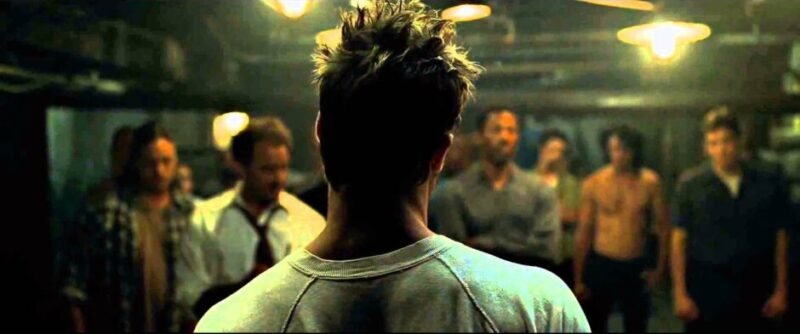
Tyler Durden addresses a gathering of men inside a dimly lit underground Fight Club basement, illuminated by industrial ceiling lights.

Initially divisive, David Fincher’s 1999 film Fight Club has since become a cult classic, attracting generations of devoted fans. Its story follows a disillusioned office worker whose encounter with the enigmatic Tyler Durden draws him into a secret underground fighting club.

At its centre stands Tyler Durden, a charismatic rebel whose unconventional ideas range from genuinely insightful to deeply disturbing. His challenges to materialism, social expectations and established authority deserve serious consideration, even when his proposed solutions become considerably harder to defend.

Rather than simply admiring or condemning Tyler, we’ll explore his philosophy, examine its contradictions and consider why this extraordinary story continues to provoke debate.

๐Ÿคซ The First Rule of Fight Club Isโ€ฆ

Well, we’re about to break it.

Published in 1996, Chuck Palahniuk’s Fight Club was adapted into David Fincher’s cult classic film in 1999, starring Edward Norton, Brad Pitt and Helena Bonham Carter.

๐ŸŒ™ I Can't Get No Sleep โ€” The Story

Our protagonist is an unnamed, neurotic insomniac, commonly called the Narrator, or informally Jack.

Employed by an automobile manufacturer, he spends his working life calculating the financial consequences of defective vehicles. Outside work, he attempts to fill his emotional emptiness with possessions, meticulously furnishing his apartment with purchases from the IKEA catalogue.

His carefully constructed existence provides everything except happiness.

Desperate for relief from chronic insomnia, Jack begins attending support groups for illnesses he doesn’t have. There, he discovers an unexpected sense of emotional release, until another impostor, Marla Singer, threatens his fragile refuge.

Then he meets Tyler Durden.

Tyler Durden wearing a red leather jacket and tinted sunglasses in Fight Club (1999).

Confident, fearless and fiercely independent, Tyler Durden represents almost everything Jack believes himself incapable of becoming.

๐Ÿงผ Tyler Durden โ€” The Seduction of Rebellion

Confident, fearless, resourceful and fiercely independent, Tyler represents almost everything Jack believes himself incapable of becoming.

He rejects consumerism, questions authority, embraces discomfort and refuses to measure personal worth through wealth, possessions or social approval. Together, they establish Fight Club, an underground gathering where disillusioned men engage in bare-knuckle combat, discovering camaraderie, challenge and a renewed sense of purpose.

Tyler offers Jack something his comfortable existence never could: the exhilarating possibility of reclaiming control over his own life. Yet his philosophy reaches far beyond rejecting material possessions or questioning social conventions. Tyler demands a more radical confrontation with the identities, fears and expectations that govern our existence.

His ideas are frequently compelling, sometimes contradictory and occasionally outrageous. That’s precisely what makes them worth examining.

Spoiler note: We’ll explore the story’s major revelations later. For now, let’s examine the philosophy.

Jack becomes increasingly fascinated by Tyler Durden's confidence, independence and rejection of conventional expectations.

Tyler introduces Jack to a radically different way of thinking, challenging the assumptions governing his conventional existence.

๐Ÿง  The Tao of Tyler Durden

Part philosopher, part provocateur, part anarchist, Tyler Durden challenges accepted wisdom with an infectious disregard for convention.

His arguments invite comparisons with Stoicism, Existentialism, Nietzsche and Eastern philosophy, touching upon individual freedom, masculine identity, mortality and the nature of the self. These aren’t necessarily philosophies Tyler consciously follows, nor do their teachings always support his conclusions.

Nevertheless, they offer useful perspectives through which to explore his ideas, their contradictions and the uncomfortable questions they raise.

From the comforts of consumer culture to the raw intensity of Fight Club, Jack confronts two radically different visions of identity, purpose and personal freedom.

๐Ÿ—๏ธ Click on the links below for a look into Tyler's mindset.

๐Ÿ’ณ The Consumer Trap

Jack has meticulously furnished his apartment with IKEA purchases, yet his immaculate surroundings provide little personal fulfilment. His possessions have become more than objects; they’re an attempt to construct an identity.

Tyler Durden sees consumerism as a trap. Work, earn, buy, repeat, while advertising and social expectations increasingly dictate our ambitions and understanding of success.

Modern consumer culture doesn’t merely sell products. It sells lifestyles, status and idealised versions of ourselves, encouraging us to measure personal worth through what we acquire rather than how we live.

Tyler challenges this dependence on material possessions, questioning whether we can genuinely call ourselves free when so much of our identity rests upon things we own.

๐Ÿชท The Freedom of Letting Go

Tyler’s rejection of material dependence bears some resemblance to the Buddhist principle of non-attachment, which encourages freedom from craving and excessive dependence upon impermanent things.

The distinction, however, is important. Buddhist non-attachment concerns our relationship with desires and possessions, not their deliberate destruction.

Tyler’s philosophy is considerably more radical. He sees losing everything as an opportunity to demolish the artificial identities we’ve constructed and begin again, liberated from the expectations of our former lives.

Losing what we own can reveal how much of our security and identity rests upon circumstances beyond our control. Yet Tyler’s uncompromising rejection of material attachment raises a contradiction of its own: has he escaped dependence altogether, or merely replaced his attachment to possessions with an attachment to his ideology?

We might abandon the things that define us, only to become equally imprisoned by our determination to live without them.

๐Ÿ‘ The Individual Versus the Herd

Tyler Durden rejects society’s prescribed path to success: education, career, marriage and material prosperity. His objection isn’t necessarily that these ambitions are worthless, but that pursuing them without question can leave us living lives we never consciously chose.

His outlook recalls Friedrich Nietzsche’s portrayal of the ‘last man’, content with comfort, security and modest pleasures but lacking the ambition to aspire towards something greater.

Tyler’s challenge is compelling. Yet rebellion alone offers no guarantee of independence. Defining ourselves purely in opposition to society’s expectations can leave those same expectations dictating our choices, just as surely as following them unquestioningly.

๐ŸŽญ The Masks We Wear

Beyond conformity lies a deeper question: how much of our identity have we consciously chosen?

Tyler encourages Jack to abandon the roles, expectations and insecurities that have come to define him. This invites comparison with Jean-Paul Sartre’s concept of bad faith, in which individuals evade their freedom and responsibility by treating their circumstances or social roles as fixed definitions of who they must be.

For Sartre, authenticity isn’t simply discovering a hidden, predetermined self. Our choices and actions help define the people we become.

Tyler offers Jack an exhilarating alternative to conventional existence, but his influence introduces a complication. If we abandon an inherited identity only to embrace someone else’s vision of freedom, how much have we actually chosen?

๐Ÿงจ A Generation Without a Cause

Tyler Durden sees a generation of men promised extraordinary futures, only to find themselves trapped in monotonous jobs, consumer culture and lives lacking any greater sense of purpose.

His criticism extends beyond materialism. Tyler describes men who have inherited society’s expectations of success but lack the defining struggles or shared ambitions that gave previous generations a sense of direction. His generation’s crisis is as much about meaning and identity as it is about masculinity.

This disillusionment helps explain Tyler’s appeal. He offers an alternative to comfortable mediocrity, challenging men to question the ambitions they’ve inherited and consider what might make their lives genuinely meaningful. Yet rejecting conventional expectations leaves an equally important challenge: discovering what deserves to replace them.

โš”๏ธ Emasculation โ€” The Search for Masculine Identity

The film confronts paternal absence and uncertain masculine identity through a conversation in which Tyler recounts his father’s conventional roadmap: college, employment and eventually marriage. Jack recognises the experience, having grown up with a father who repeatedly abandoned his family to begin another. Neither appears to have found much meaningful guidance in the expectations they inherited.

Tyler takes his argument further, questioning whether a generation of men raised by women can find the masculine identity it lacks through another romantic relationship. It’s one of his more controversial propositions, but it raises questions worth exploring. What happens when boys grow up without positive male role models, and where should they look for guidance, purpose and examples of manhood worth aspiring to? His concern about absent fathers deserves consideration, although recognising the importance of male guidance doesn’t mean women are incapable of raising confident, capable men.

Interestingly, the film complicates Tyler’s argument before Fight Club even begins. Jack initially finds emotional release not through violence, but through crying and receiving comfort in another man’s arms at a support group. His experience suggests that vulnerability and masculine strength need not be opposing qualities. Perhaps the greater challenge is finding ways for men to develop courage, independence and self-respect without sacrificing emotional connection.

๐Ÿค Brotherhood โ€” The Need to Belong

Fight Club provides something Jack and its other members have struggled to find elsewhere: camaraderie, shared adversity and a community in which conventional social status carries little importance.

Men who previously felt isolated discover solidarity through experiences that test their courage and commitment. Their bruises become evidence of participation in something that feels more meaningful than their ordinary routines, while the friendships and shared identity offer a powerful sense of recognition.

There’s genuine value in that experience. Brotherhood can foster loyalty, confidence and mutual responsibility, particularly among men who feel disconnected from their communities. Understanding that appeal is essential to understanding Fight Club itself, even as the movement Tyler builds around it eventually takes a more troubling direction.

๐ŸŽญ Destroying the Ego’s Illusions

Tyler Durden has little interest in conventional self-improvement. He advocates something considerably more radical: self-destruction as a path to liberation.

Our pride, reputation, achievements and insecurities can become psychological prisons. We become so invested in protecting our identities that we resist anything threatening our carefully constructed sense of self. Tyler challenges Jack to dismantle these illusions, not merely to improve himself, but to abandon the assumptions defining who he believes he must be.

His philosophy invites comparison with Nietzsche’s concept of self-overcoming, although Nietzsche’s emphasis on transformation and creating new values differs considerably from Tyler’s fascination with destruction. Both challenge established identities, but their visions of what should emerge are not necessarily compatible.

โš–๏ธ The Tyranny of the Ideal Self

Tyler also rejects society’s obsession with perfection. The ideal physique, successful career, flawless reputation and carefully cultivated personality become standards against which we continually measure ourselves.

Yet his argument contains a fascinating contradiction. While encouraging Jack to abandon society’s expectations, Tyler himself embodies an almost impossibly confident, fearless and uncompromising ideal of manhood. Has he genuinely rejected the pursuit of perfection, or merely replaced society’s ideal with one of his own?

Jack risks exchanging one manufactured identity for another, potentially becoming just as constrained by Tyler’s expectations as he was by society’s. The deeper question is whether dismantling an unwanted identity can bring genuine liberation when we’re still captivated by an ideal of who we ought to become.

๐Ÿ”ฅ Discomfort โ€” The Price of Growth

Tyler Durden believes our obsession with comfort and security has weakened our willingness to confront life’s difficulties. He sees adversity as an opportunity to strip away illusions, challenge our limitations and discover what we’re capable of enduring.

In the infamous chemical-burn scene, Tyler forces Jack to experience excruciating pain rather than escape from it. His lesson is uncompromising: accept reality and stop seeking refuge from life’s unpleasant experiences.

Nietzsche’s Amor Fati, or love of fate, calls for affirming life, including its hardships. Tyler, by contrast, deliberately inflicts suffering on Jack and insists that he embrace it.

Tyler’s methods expose a contradiction. He demands that Jack surrender the illusion of control while exercising extraordinary control over Jack himself. What Tyler presents as liberation might equally be interpreted as domination.

โฐ Carpe Diem โ€” Seize the Day

Tyler also challenges our tendency to postpone living until circumstances are perfect. Jack has spent years pursuing financial security and material comfort, yet seems barely present in his own existence.

This recalls Carpe Diem, the ancient Latin injunction to seize the day rather than assume tomorrow is guaranteed.

Tyler’s argument has genuine appeal. We can become so preoccupied with preparing for the future that we neglect the experiences and opportunities available to us now. Yet living fully in the present needn’t mean disregarding tomorrow or abandoning responsibility for our actions.

๐Ÿ’€ Memento Mori โ€” Remember You Must Die

Tyler’s fascination with mortality takes this argument further. He believes confronting death can free us from trivial concerns, fear and the expectations governing our lives.

Stoic reflections on mortality offer a philosophical parallel, encouraging us to recognise life’s limits and reconsider what genuinely matters. Tyler, however, transforms contemplation into confrontation.

When he threatens convenience-store clerk Raymond K. Hessel, Tyler uses the terror of imminent death to force another man to reconsider his abandoned ambitions. Raymond survives, but whether the experience genuinely transforms his life remains unknown.

The underlying challenge is nevertheless powerful. If we fully appreciated how little time we possess, would we continue living as we do today? Tyler’s methods are disturbing, but the question he raises deserves consideration. Awareness of mortality can inspire us to live more deliberately without requiring us to embrace his extreme interpretation of that lesson.

๐Ÿ›๏ธ Questioning Authority โ€” Who Holds the Power?

Tyler Durden distrusts institutions that shape our ambitions while presenting their authority as natural or unavoidable. Corporations, financial systems and social hierarchies become targets of his criticism, particularly when people adopt their values without questioning whose interests they serve.

His defiance shares certain principles with anarchist thought, particularly its opposition to coercive hierarchies. However, anarchism isn’t synonymous with disorder or destruction. Many anarchist traditions advocate voluntary cooperation, mutual aid and forms of organisation that reject domination.

Rejecting unquestioned authority is straightforward; deciding when an institution deserves our allegiance, and on what grounds, is considerably harder.

๐Ÿ’ฅ Chaos โ€” Destruction as Liberation

Tyler regards disruption as a necessary break from a society he believes encourages passivity and dependence. Rather than reforming institutions he considers fundamentally corrupt, he questions whether meaningful freedom requires dismantling them altogether.

There’s something compelling about his refusal to regard established systems as permanent or beyond challenge. History offers countless examples of social progress emerging from resistance to accepted authority, although resistance need not involve destruction.

But demolishing an existing order doesn’t automatically produce a better alternative. Tyler’s enthusiasm for tearing down society raises questions about what should replace it, and whether liberation can emerge from chaos without some meaningful vision of what comes afterwards.

That distinction becomes increasingly important as Fight Club develops from a personal rebellion into something considerably more ambitious.

โš”๏ธ Confrontation โ€” Discovering Who We Are

Tyler Durden believes physical confrontation strips away the pretences of modern existence, exposing something more fundamental about human nature.

Within Fight Club, professional status, wealth and social standing become irrelevant. Men confront fear, pain and vulnerability directly, discovering camaraderie and a sense of vitality absent from their everyday lives.

For Tyler, fighting represents more than an outlet for frustration. It’s an opportunity to test our courage, discover our limitations and experience something beyond the comforts and conventions of ordinary existence.

But does physical confrontation reveal our authentic character, or simply expose how we behave under extreme circumstances?

๐Ÿ”ฅ Aggression โ€” Instinct or Destruction?

Tyler’s philosophy also challenges our relationship with aggression. Anger is a natural human emotion, while aggression generally involves behaviour intended to cause harm. Assertiveness, determination and the courage to stand our ground are distinct qualities that need not involve violence.

Tyler regards fighting as a form of liberation, allowing men to confront emotions and impulses they struggle to express elsewhere. Yet the emotional release his followers experience doesn’t necessarily resolve the frustrations that brought them together.

Confronting difficult impulses may reveal more about us than denying them, but understanding aggression and surrendering to it are very different things. Whether that confrontation develops greater self-awareness and self-control, or merely provides another escape from unresolved problems, remains uncertain.

โ˜ ๏ธ Project Mayhem

When Freedom Becomes Control

โš ๏ธ SPOILER WARNING: From here onwards, we’ll discuss major revelations from Fight Club.

What begins as an underground gathering of disillusioned men evolves into Project Mayhem, an organised movement determined to dismantle the institutions Tyler believes have enslaved modern society.

His ambitions have grown beyond personal liberation. Tyler Durden wants a revolution, and his followers are increasingly prepared to sacrifice their individuality to achieve it.

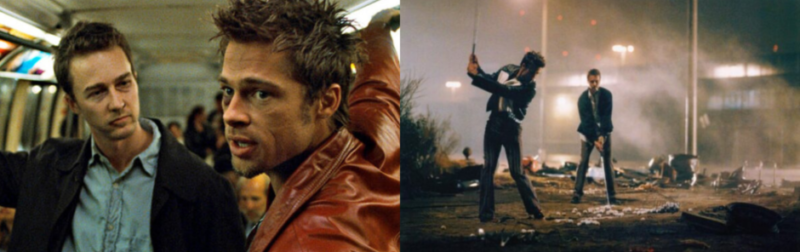
Split image from Fight Club showing Tyler Durden outside the Paper Street house with fellow members, alongside the Narrator during a Project Mayhem operation surrounded by masked recruits.

What begins as rebellion hardens into hierarchy. Under Tyler’s leadership, Fight Club becomes Project Mayhem, a movement in which individuality gives way to ritual, obedience and control.

๐Ÿ—๏ธ Click on the links below for a look into Tyler's mindset.

Under Tyler’s leadership, members surrender their names, adopt rigid rules and follow orders without question. The men who originally rebelled against conformity have become conformists themselves, exchanging one system of control for another.

Yet their devotion reveals something important about Tyler’s appeal. He offers purpose, belonging and a common cause to men who previously felt insignificant. Their obedience isn’t necessarily born from fear; it also reflects their conviction that they’re participating in something greater than themselves.

But was this authoritarianism a corruption of Tyler’s original philosophy, or was it present from the beginning? Even his earliest lessons involve forcing others to confront experiences on his terms. The promise of liberation has always existed alongside his desire to control how others achieve it.

In the film, Tyler’s campaign culminates in a plan to destroy credit-card company buildings and erase debt records, supposedly liberating society from financial dependence.

His criticism of institutional power remains worth examining, but his methods raise questions about the consequences of revolutionary action. Destroying an existing system doesn’t guarantee a fairer replacement, particularly when those affected have no meaningful say in the decision.

Tyler condemns authority while establishing himself as an unquestionable leader. He celebrates independent thought while demanding absolute loyalty, creating a movement that increasingly resembles the hierarchies he despises.

Project Mayhem doesn’t necessarily invalidate Tyler’s original criticisms of society. Instead, it exposes the danger of assuming that recognising oppression gives someone the wisdom, or the right, to dictate how everyone else should be liberated.

Tyler Durden. Fight Club.

โ€œHow much can you possibly know about yourself if youโ€™ve never been in a fight?โ€œย (Tyler Durden).

๐Ÿชž Breaking from Tyler

Beyond the Two Extremes

๐Ÿง  The Man in the Mirror

The story’s greatest revelation changes everything: Tyler Durden isn’t another man. He’s another identity of Jack himself.

Tyler embodies the confidence, courage and independence Jack desperately desires, alongside darker impulses he struggles to acknowledge. Their conflict is no longer simply between opposing philosophies, but between competing aspects of the same individual.

Indeed, Tyler emerges from the very dissatisfaction, insecurities and contradictions that define Jack’s existence. The man who rejects artificial identities is himself an idealised identity, created to escape the limitations of another.

Does Jack need to destroy Tyler to reclaim his freedom, or somehow reconcile the conflicting qualities Tyler represents?

Tyler Durden and Jack arguing inside a car during a tense nighttime journey in Fight Club (1999).

Tyler demands that Jack surrender control, revealing the troubling contradiction between his promise of liberation and his desire to dominate.

โš–๏ธ Dialectical Synthesis โ€” Two Extremes, One Identity

Jack’s transformation lends itself to a simplified dialectical interpretation, in which conflicting ideas produce the possibility of a new understanding.

  • Thesis โ€” Conformity: Jack’s original existence is dominated by consumerism, apathy and social expectations.
  • Antithesis โ€” Rebellion: Tyler represents independence, courage and radical freedom, but also fanaticism and destruction.
  • Possible Synthesis โ€” Self-Mastery: Jack begins recognising that he needn’t surrender to either extreme, potentially developing an identity informed by both experiences.

This isn’t necessarily about finding a comfortable compromise. It’s about confronting internal contradictions and deciding what kind of person we wish to become.

Yet the film doesn’t establish that Jack achieves this synthesis. His confrontation with Tyler may represent the beginning of self-mastery rather than its successful completion.

๐Ÿฅ€ The Human Connection

Robert Paulson’s death exposes the human cost of Project Mayhem, while Marla Singer challenges Jack to confront a reality beyond his competing identities. Her own difficulties and demands cannot simply be absorbed into Tyler’s grand philosophy or Jack’s personal crisis.

As Jack attempts to reclaim control, his connection with Marla suggests the possibility of genuine intimacy and responsibility rather than another escape into fantasy.

But the ending remains ambiguous. In the film, Project Mayhem’s destruction unfolds despite Jack’s resistance. Palahniuk’s novel concludes differently: the explosives fail, and Jack survives his suicide attempt, awakening in a psychiatric hospital. Yet members of Project Mayhem remain among the staff, awaiting Tyler’s return. His apparent liberation has neither dismantled the movement nor extinguished its devotion to Tyler.

Jack may have rejected Tyler’s authority, but has he truly escaped the need to become someone other than himself?

Perhaps his greatest act of rebellion is not destroying everything Tyler represents, but finally beginning to question the identity he once believed would set him free.

๐Ÿงจ The Last Rule of Fight Club

Tyler Durden is a difficult man to dismiss. His courage, independence and contempt for hollow consumerism challenge us to reconsider the values we’ve inherited and the lives we’ve constructed around them. His questions about conformity, masculine identity, freedom and the search for meaning remain as provocative today as when Fight Club first appeared.

Yet Tyler’s contradictions are equally revealing. The rebel against conformity creates a movement built upon obedience, while the man promising liberation increasingly demands control. Even his rejection of manufactured identities conceals a profound irony: he is himself an idealised identity. These contradictions don’t necessarily invalidate his criticisms of society, but they make his proposed solutions considerably harder to accept.

Jack and Marla Singer holding hands while watching buildings collapse through a large window in the final scene of Fight Club.

As Tyler’s revolution unfolds, Jack and Marla face its consequences together, suggesting the possibility of genuine human connection amid the destruction.

Perhaps that’s what makes Fight Club so enduring. It doesn’t offer a simple philosophy to embrace or reject, nor does Tyler fit comfortably into the role of hero or villain. His convictions are compelling precisely because they contain uncomfortable truths alongside dangerous assumptions. The challenge is deciding which ideas withstand scrutiny, particularly when their most persuasive advocate proves so deeply contradictory.

Tyler encourages us to question the values and institutions governing our lives, yet becomes increasingly intolerant of anyone questioning his own vision. There is no reason to grant his philosophy the exemption he denies everyone else’s.

The first rule of Fight Club? We’ve already broken it. Now it’s your turn. What do you make of Tyler Durden? Which of his arguments deserve serious consideration, and which collapse under their own contradictions? Join the discussion below.

If you have enjoyed this post please share or feel free to comment below ๐Ÿ™‚

๐Ÿ”— Our Other Posts

3 thoughts on “The Philosophy of Fight Club”

  1. Great post and I think you captured this book perfectly.
    I was 18 when the movie was released and it felt like an initiation or rite of passage which has led me on a very interesting and rewarding journey called Life.
    Thanks for the post!

  2. Excellent discussion of the philosophy and issues apparently at the core of the film and the book. I hadn’t thought about it ultimately leading to a moderate course and the rejection of extremism. Perhaps Aristotle is alive and well in the story after all.

Leave a Reply

Your email address will not be published. Required fields are marked *

This site uses Akismet to reduce spam. Learn how your comment data is processed.

error: Content is protected !!

Join the Super Soldier Project Mailing List Today!!