⚔️ Reconstructed Arts & Revival Systems

Not all martial arts survive the passage of time. This guide explores Europe’s reconstructed fighting systems, examining how historians, martial artists, and researchers are bringing lost combat traditions back to life.

Table of Contents

🔥 Introduction

Most martial arts survive through direct transmission from teacher to student. Historical European Martial Arts (HEMA) are different.

Many of Europe’s combat systems disappeared as warfare changed, duelling declined, and firearms replaced traditional weapons. What remained were manuals, illustrations, treatises, and scattered historical records.

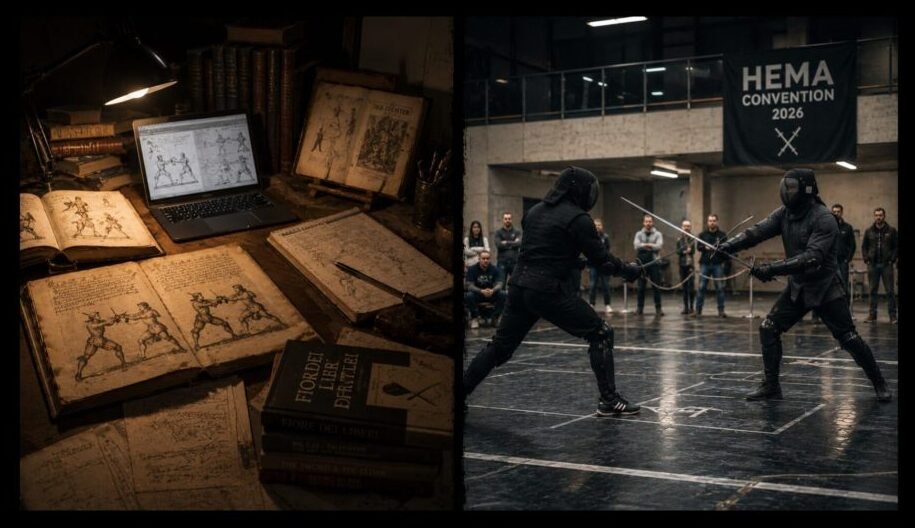
Ancient fencing manuals, treatises, and historical manuscripts lie open inside a dim archive, illuminated by sunlight filtering through dust-filled air.

Many European martial arts survived only through the manuals, illustrations, and records left behind by earlier generations.

These arts did not vanish because they were ineffective. They disappeared because the world around them changed. New weapons, evolving military tactics, modern legal systems, and the rise of combat sports gradually removed the environments in which many traditional fighting systems once thrived. As their practical role diminished, many traditions simply stopped being taught.

Modern practitioners now attempt to reconstruct these lost arts through historical research, experimentation, pressure testing, and live training. The result is not a single martial art, but a growing movement dedicated to rediscovering Europe’s martial heritage and understanding how people fought in the past.

📜 The Sources of Reconstruction

Modern reconstruction relies upon surviving historical evidence. Unlike living martial traditions that pass knowledge directly from teacher to student, many European systems must be rebuilt from the records left behind by earlier generations.

To do this, researchers study martial manuals, technical treatises, artwork, historical accounts, and archaeological evidence. Many of these sources were produced by fencing masters and combat instructors, providing valuable insight into how combat was taught and practised during their time.

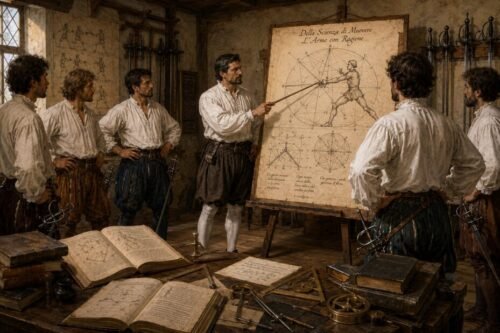
A Renaissance fencing master instructs students in swordsmanship, using demonstrations and geometric concepts to teach positioning, timing, distance, and angles.

Long before modern coaching methods emerged, Europe’s fencing masters were developing systematic approaches to teaching combat, laying the foundations for many concepts still used by fighters today.

Click links below to read more.

Among the most influential figures are Johannes Liechtenauer, Fiore dei Liberi, Hans Talhoffer, Joachim Meyer, Ridolfo Capo Ferro, and Camillo Agrippa.

Their surviving works provide detailed insight into how combat was taught during the Medieval and Renaissance periods. Without these manuals, much of Europe’s martial heritage would have been lost forever.

Historical manuals rarely explain everything. Many assume the reader already understands basic movement, footwork, terminology, training methods, and broader cultural context.

As a result, modern practitioners must fill gaps through experimentation, comparison with other sources, and practical testing. This process inevitably involves interpretation, which helps explain why different schools sometimes reach different conclusions when studying the same material.

For much of the twentieth century, Historical European Martial Arts (HEMA) remained largely forgotten. Interest began to grow during the late twentieth and early twenty-first centuries as historians, martial artists, and researchers started translating, studying, and testing surviving manuals.

What began as a niche pursuit gradually developed into an international movement. Today, HEMA clubs can be found throughout Europe, North America, Australia, and beyond, with practitioners using modern training methods to explore and revive historical combat systems.

One of the most debated questions in martial arts is whether a lost fighting system can ever truly be brought back to life.

Some practitioners argue that reconstruction can never fully replicate the original art. Important details may have been lost, historical sources may be incomplete, and no modern practitioner can perfectly recreate the cultural and physical environment in which the system originally existed.

Others argue that careful research, practical experimentation, pressure testing, and comparison with surviving combat traditions can recover a surprising amount of historical knowledge.

The truth likely lies somewhere between these positions. Modern reconstructions may never be identical to their historical predecessors, but they can still provide valuable insight into how those systems functioned and why they were effective.

Rather than recreating the past perfectly, most reconstruction movements seek to understand it as accurately as possible.

One intriguing question sits at the heart of every reconstruction project:

What might these martial arts look like if they had never disappeared?

Had Europe’s historical combat systems survived through continuous transmission, they would almost certainly have evolved. Just as Boxing, Wrestling, Judo, and Muay Thai changed over time, historical European arts would likely have adapted to new training methods, sporting formats, legal environments, and cultural influences.

The systems practised today might look very different from their Medieval or Renaissance ancestors. New techniques may have emerged, others may have been discarded, and competition formats could have reshaped entire traditions.

Because these arts were interrupted, we can never know for certain. Modern reconstruction therefore attempts to answer a different question: not what these systems might have become, but what was lost when their evolution was interrupted.

🤺 The Foundations of HEMA

Much of the modern reconstruction movement rests upon a relatively small number of martial traditions whose manuals survived the passage of time. While hundreds of historical sources exist, a handful have proven especially influential in shaping modern HEMA practice and research.

These traditions provide some of the clearest surviving windows into how Europeans trained, fought, and thought about combat during the Medieval and Renaissance periods. They also demonstrate the remarkable diversity that existed within European martial culture long before the modern era.

🇩🇪 Kunst des Fechtens

The German tradition known as Kunst des Fechtens (“The Art of Fighting”) forms one of the largest and most influential bodies of material within HEMA. Associated with masters such as Johannes Liechtenauer, Hans Talhoffer, and Joachim Meyer, the surviving manuals reveal a sophisticated martial system that extended far beyond the longsword for which it is best known today.

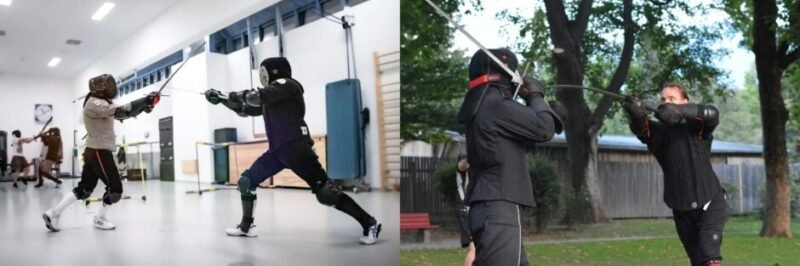
Practitioners demonstrating techniques from Kunst des Fechtens, including longsword fencing, grappling, and close-quarters combat based on medieval German martial traditions.

The German tradition remains one of the most actively reconstructed and widely practised systems within the modern HEMA movement.

Modern practitioners studying these sources quickly discover that the German masters approached combat as an interconnected whole. Wrestling, dagger fighting, messer fencing, polearms, mounted combat, and longsword were all viewed as part of the same broader martial framework. Rather than teaching isolated techniques, the manuals emphasise timing, initiative, distance, structure, and the ability to adapt to changing circumstances.

For modern HEMA practitioners, the German sources provide one of the richest collections of surviving martial material anywhere in the world. Entire clubs, tournaments, and research groups continue to build their training around these manuals, making Kunst des Fechtens one of the cornerstones of the reconstruction movement.

🇮🇹 Italian Longsword

The Italian tradition occupies an equally important place within HEMA, particularly through the work of Fiore dei Liberi and later Renaissance fencing masters.

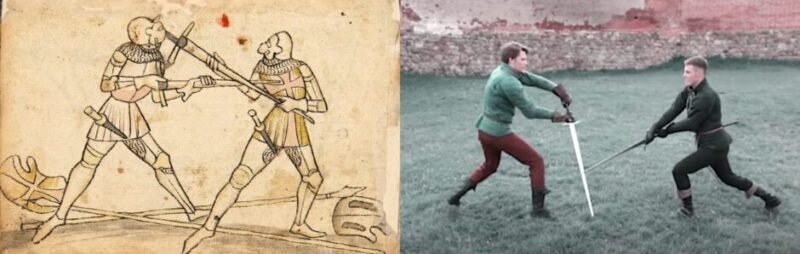
Split image showing a medieval illustration from Fiore dei Liberi's Fior di Battaglia alongside modern HEMA practitioners training comparable grappling, dagger, or weapon techniques.

Today, HEMA practitioners continue to study, reconstruct, and apply the martial principles preserved within Fiore’s Fior di Battaglia.

Where the German sources often emphasise initiative and tactical pressure, the Italian manuals are frequently admired for their fluidity and seamless transitions between combat ranges. Fiore’s Fior di Battaglia presents a martial system in which striking, grappling, dagger work, and weapon combat flow naturally into one another as circumstances change.

For reconstructionists, Fiore’s work is especially valuable because it offers an unusually comprehensive view of a complete martial art. Rather than focusing upon a single weapon or context, the manual explores combat across multiple situations, providing modern practitioners with insight into how a medieval martial artist may have approached fighting as a whole.

As a result, Fiore remains one of the most studied figures within HEMA and continues to influence how many practitioners approach both training and interpretation.

🇪🇸 🇮🇹 Rapier & Duelling Systems

The rapier traditions of Spain and Italy represent a later stage in Europe’s martial development and provide a fascinating contrast to the battlefield-oriented systems that preceded them.

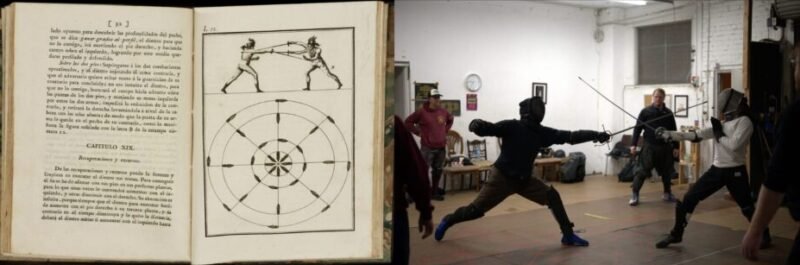
Split image showing a historical rapier duelling illustration alongside modern HEMA practitioners training rapier fencing techniques in a contemporary salle.

The rapier traditions of Italy and Spain remain among the most actively studied and reconstructed disciplines within modern HEMA.

These sources emerged during a period when personal defence, civilian carry, honour disputes, and formal duelling played an increasingly important role in daily life. As a result, they place extraordinary emphasis on timing, distance management, positioning, judgement, and tactical decision-making.

For modern HEMA practitioners, rapier systems demonstrate how European martial arts evolved alongside changing social conditions. The focus shifted away from armoured battlefields and toward individual encounters, producing some of the most refined and intellectually sophisticated combat systems ever documented.

Their survival allows modern researchers to explore an entirely different side of Europe’s martial heritage, one shaped not by war, but by duelling culture, civilian self-defence, and personal combat.

⚔️ The Renaissance Revolution

When Combat Became a Science

One of the most important contributions of Europe’s fencing masters was not a particular weapon or technique, but a new way of thinking about combat itself.

During the Renaissance, Europe experienced profound intellectual change. Advances in mathematics, geometry, engineering, navigation, and scientific inquiry encouraged scholars and practitioners to analyse the world in increasingly systematic ways. Combat was no exception.

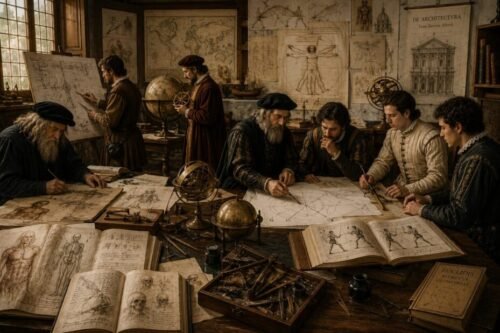
A bustling Renaissance workshop filled with maps, globes, navigation instruments, engineering sketches, anatomical studies, mathematical diagrams, fencing manuals, and scholars engaged in study and discussion.

The Renaissance transformed how Europeans understood the world, encouraging the application of observation, mathematics, and systematic thinking to fields ranging from science and engineering to combat.

Masters such as Camillo Agrippa, Ridolfo Capo Ferro, and the practitioners of La Verdadera Destreza sought to move beyond tradition and intuition, applying logic, structure, and observation to the study of fighting.

Click links below to read more.

Rather than viewing combat as a collection of techniques, many Renaissance masters began treating it as a problem that could be analysed and understood through underlying principles. Questions of distance, timing, leverage, positioning, and movement were examined with a level of detail rarely seen in earlier martial traditions.

Geometry became particularly influential. Some fencing systems used lines, circles, angles, and measurements to explain how fighters should move, attack, defend, and control space. Combat was increasingly viewed not simply as an art, but as a discipline that could be studied, refined, and improved through reasoned analysis.

Many of the concepts developed during this period remain fundamental to combat sports and martial arts today. Renaissance fencing masters recognised that victory often depended less upon strength and more upon positioning, timing, and efficient movement.

The ability to create angles, control distance, manage initiative, and move efficiently became central themes throughout European fencing. These principles allowed practitioners to maximise opportunities while minimising risk, creating a tactical approach to combat that extended far beyond swordsmanship alone.

The weapons may have changed, but many of the ideas explored by Renaissance masters remain familiar to modern fighters. Boxers create angles and control range. Wrestlers seek positional dominance. MMA fighters constantly manage timing, distance, initiative, and tactical decision-making.

Even outside Europe, these concepts found influence. Bruce Lee famously studied Western fencing and incorporated ideas such as interception, timing, direct attack, and footwork into the development of Jeet Kune Do. His emphasis on efficiency and adaptability echoed principles that European masters had been exploring centuries earlier.

In this sense, the legacy of Europe’s fencing traditions extends far beyond the sword. Their greatest contribution may have been the development of a systematic approach to understanding combat itself.

Rather than relying solely upon tradition or experience, Renaissance masters sought to identify the underlying principles that governed fighting. In doing so, they helped establish a framework for analysing movement, strategy, and performance that continues to influence martial artists, coaches, and fighters today.

Their weapons belong to the past. Their ideas remain surprisingly modern.

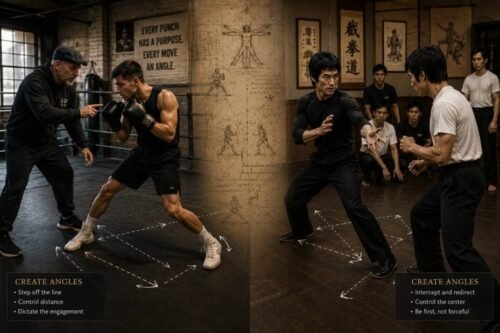
Split image showing a boxing coach teaching footwork and angle creation in a modern gym alongside Bruce Lee instructing students in Jeet Kune Do, highlighting shared principles of timing, movement, positioning, and tactical decision-making.

Although the weapons changed, many of the principles explored by Renaissance fencing masters, timing, distance, angles, initiative, and efficient movement, remain central to modern combat sports and martial arts, from boxing to Jeet Kune Do.

🏺 Beyond HEMA

Other Revival Movements

While HEMA remains the most visible reconstruction movement, it is not the only attempt to revive lost martial traditions. Similar efforts have emerged elsewhere, applying the same principles of research, interpretation, and practical testing to historical combat systems.

🇬🇷 Modern Pankration — Reconstructing an Ancient Combat Sport

Ancient Pankration disappeared centuries ago, leaving behind no unbroken lineage of instructors or practitioners. As a result, modern attempts to revive the art rely upon historical texts, archaeological evidence, artwork, and comparisons with surviving combat sports.

Modern pankration competitors compete in a tournament as one athlete delivers a gastrizein-style kick to an opponent, demonstrating techniques inspired by the ancient Greek combat sport.

Drawing upon Greece’s martial heritage, Modern Pankration has re-emerged as an established martial art and combat sport for the modern era.

The challenge facing modern practitioners is determining how much of the original system can be recovered with confidence. Different organisations often interpret the evidence in different ways, leading to variations in rules, techniques, and training methods. While Modern Pankration cannot claim to be an exact recreation of its ancient predecessor, it represents one of the most ambitious attempts to revive a lost combat sport and reconnect with Greece’s martial heritage.

🇮🇹 Nova Scrimia — Preserving Italy's Martial Heritage

Nova Scrimia emerged from efforts to preserve and revitalise Italy’s diverse martial traditions. Drawing upon historical manuals, regional fighting methods, and surviving weapon systems, it seeks to prevent important aspects of Italy’s martial culture from disappearing entirely.

Unlike some reconstruction projects that focus primarily on historical accuracy, Nova Scrimia also explores how traditional principles can remain relevant in the modern world. Its approach highlights an important question within the reconstruction movement: should historical martial arts be preserved exactly as they were, or adapted to meet contemporary needs?

🇮🇹 Gladiatura Moderna — Bringing History Back to Life

Gladiatura Moderna represents another approach to reconstruction, combining historical research with practical experimentation to explore how Roman combat systems may have functioned in practice. Practitioners study surviving evidence, recreate equipment, and test historical theories to better understand the weapons, training methods, and fighting styles of the ancient world.

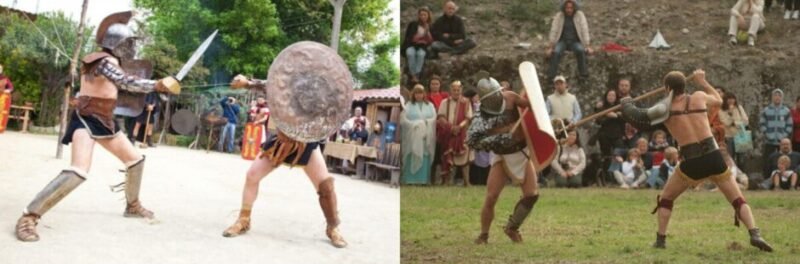
Modern martial artists train historical European combat techniques using reconstructed weapons and protective equipment during a Gladiatura Moderna training session.

Practitioners of Gladiatura Moderna use historical research, recreated equipment, and practical experimentation to explore how Roman combat systems may have functioned in the ancient world.

Unlike some revival movements that focus on rebuilding a complete martial art, Gladiatura Moderna often serves an educational and interpretive role. By placing historical combat back into physical practice, researchers and practitioners hope to gain deeper insight into how Roman fighters trained, moved, and fought.

🗡️ Additional Reconstructed Weapon Systems

Although the longsword often receives the most attention, historical European combat involved a far wider range of weapons. Modern reconstruction efforts therefore extend beyond swords to explore the diverse fighting traditions once found across the continent.

Click on the links below to read more.

Many Europeans carried smaller weapons for personal protection and daily use. Modern practitioners reconstruct systems involving daggers, messers, stilettos, sword-and-dagger combinations, and the sophisticated rapier traditions of Italy and Spain.

Battlefields demanded specialised tools. Sabres, broadswords, claymores, polearms, halberds, spears, and cavalry weapons all formed important parts of Europe’s martial history and remain popular subjects for reconstruction.

Not all martial systems were built around military arms. Traditions such as Singlestick in Britain, La Canne in France, and various stick-fighting systems across Europe demonstrate how ordinary objects could be adapted for self-defence and training.

Reconstruction efforts continue to uncover and preserve weapon systems from across the continent, including:

🇬🇧 Britain: Backsword, Singlestick, Sword and Buckler.

🏴 Scotland: Claymore, Broadsword, Targe and Sword.

🇩🇪 Germany: Messer fencing, dagger systems, and staff weapons.

🇮🇹 Italy: Sword-and-dagger traditions and civilian fencing systems.

🇪🇸 Spain: Rapier traditions and cloak-and-blade methods.

🇵🇱 Poland: Szabla and cavalry sabre traditions.

🇭🇺 Hungary: Military sabre systems and cutting weapons.

🇨🇭 Switzerland: Halberd and polearm traditions.

🇳🇴 🇸🇪 🇩🇰 🇮🇸 🇫🇮 Nordic Traditions: Axe, spear, and sword traditions.

Together, these systems reveal the extraordinary diversity of Europe’s martial heritage. Far from being limited to longsword fencing, modern reconstruction efforts explore everything from civilian self-defence and duelling weapons to battlefield arms and military fighting methods.

Many of these systems remain active areas of research, with new translations, interpretations, and training methods continuing to expand our understanding of Europe’s historical weapon arts.

⏳ The Longsword Myth

Popular culture often treats the longsword as the defining weapon of European martial arts. In reality, most historical practitioners were far more likely to encounter daggers, polearms, staffs, civilian sidearms, or everyday tools than a knightly longsword.

The longsword remains popular partly because the surviving manuals are exceptionally detailed, not because it was the only weapon Europeans used.

⚙️ How Reconstruction Works

Reconstructing a martial art involves far more than reading historical manuals. Modern practitioners combine research, interpretation, training, and testing to transform historical evidence into functional martial practice.

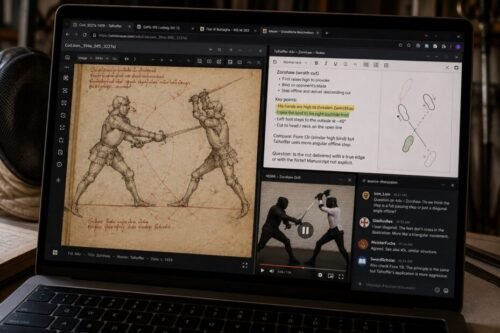
Close-up of a laptop displaying digitised fencing manuals, translation notes, research discussions, and HEMA training footage used to study historical martial arts.

Modern reconstruction relies upon careful study of surviving manuals, historical evidence, translations, and shared research.

Most reconstruction projects rely on a combination of:

  • Historical research.
  • Technical interpretation.
  • Partner drilling.
  • Controlled sparring.
  • Competitive testing.

This process allows theories from historical sources to be examined under live conditions rather than remaining purely academic.

🏺 Experimental Archaeology for Fighters

In many ways, HEMA resembles experimental archaeology. Rather than simply reading about historical combat, practitioners attempt to physically recreate techniques, equipment, and training methods to better understand how they functioned in practice.

Historical manuals rarely provide every detail. As a result, practitioners must interpret the material, test their ideas through training, and compare results with both historical evidence and practical experience.

⚔️ Pressure Testing and Competition

Modern HEMA competitions provide practitioners with opportunities to pressure-test techniques against resisting opponents. While tournament environments differ from historical combat, they help identify what works consistently under stress, fatigue, and resistance.

For many practitioners, competition serves as an important tool for refining interpretations and exposing weaknesses that may not appear during cooperative training.

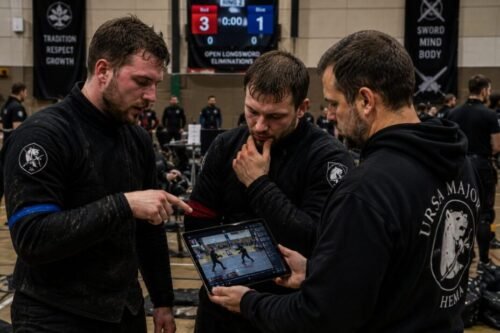
HEMA practitioners review footage of a recent tournament bout on a tablet, discussing techniques, timing, positioning, and tactical decisions while analysing the exchange.

Competition, analysis, and practical experimentation help practitioners refine interpretations and better understand how historical techniques function under pressure.

⚖️ The Sportification Question

As HEMA competition continues to grow, practitioners debate the balance between historical accuracy and sporting success.

Some argue that tournaments help reveal effective techniques under realistic conditions and encourage higher standards of performance. Others caution that competitive rule sets can gradually push systems away from their historical roots, rewarding tactics that succeed under tournament conditions rather than those intended by the original sources.

The discussion remains ongoing and reflects one of the central challenges facing all reconstructed martial arts.

💬 Discussion

⚠️ Reality vs Representation

HEMA and other reconstructed arts are often misunderstood from both directions.

Some enthusiasts overstate historical certainty. Others dismiss the entire field as little more than roleplay. The reality sits somewhere in between.

These systems involve:

  • Serious physical training.
  • Historical research.
  • Live sparring.
  • Technical experimentation.

However, reconstruction always involves interpretation. No practitioner can claim absolute certainty about exactly how a historical master intended every technique to be performed. The goal is not perfect certainty, but the most accurate understanding possible based on the evidence that survives.

⏳ What Happens When the Sources Are Missing?

Not every martial art left behind detailed manuals or technical descriptions. Some traditions survive only through brief references, artwork, legal records, or archaeological evidence.

As a result, certain systems can be reconstructed in considerable detail, while others remain largely speculative. The amount and quality of surviving evidence often determines how confidently modern practitioners can interpret a historical martial art.

🧠 Closing Perspective

Reconstructed martial arts occupy a unique position within the martial world.

They are not purely historical study. Nor are they simple attempts to recreate the past. Instead, they represent an ongoing effort to understand, test, and preserve systems that might otherwise have vanished completely.

Unlike museum exhibits, reconstructed martial arts remain living disciplines. New translations, discoveries, interpretations, and training methods continue to influence how practitioners understand historical systems. In that sense, reconstruction is never truly finished.

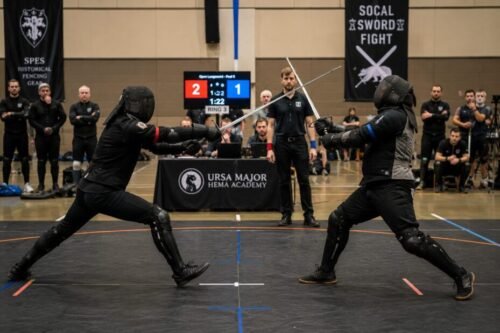
Two HEMA practitioners engage in a competitive longsword bout during a modern tournament, applying reconstructed historical techniques in a live environment.

HEMA remains a living discipline, where historical research and practical experience combine to keep Europe’s martial heritage alive.

Ultimately, these arts ask a fascinating question:

How much of a lost fighting system can be recovered when history, research, and practical training are brought together?

While the answer may never be known with complete certainty, the search itself continues to preserve Europe’s martial heritage and reveal new insights into how people fought, trained, and survived throughout history.

If you have enjoyed this post please share or feel free to comment below 🙂

Leave a Reply

Your email address will not be published. Required fields are marked *

This site uses Akismet to reduce spam. Learn how your comment data is processed.

error: Content is protected !!

Join the Super Soldier Project Mailing List Today!!