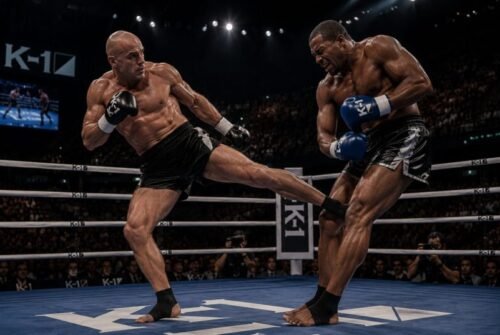
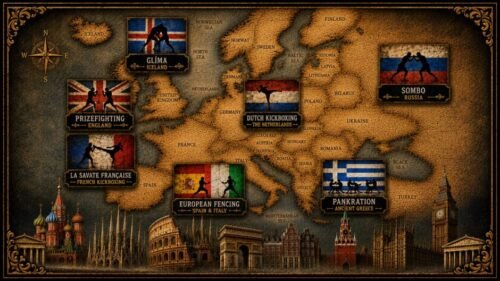
🏔️ Northern Europe — Wrestling, Fencing & Combat Sports

From the wrestling traditions of Iceland and Switzerland to the fencing schools of Germany and the kickboxing gyms of the Netherlands, Northern Europe developed martial arts built on balance, control, technical skill, and pressure-tested performance.

Table of Contents

🔥 Introduction

Northern Europe has produced some of Europe’s most enduring wrestling traditions, influential combat sports, and important historical fighting systems.

The region is home to traditional arts such as Glima, Schwingen, and Ringen, as well as the German fencing traditions that helped shape European martial culture. In more recent times, Northern Europe has also produced modern systems such as Dutch Kickboxing, whose influence extends throughout combat sports and MMA.

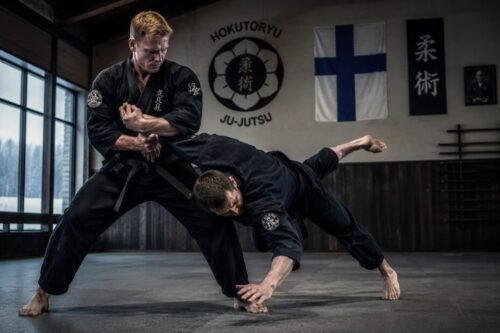
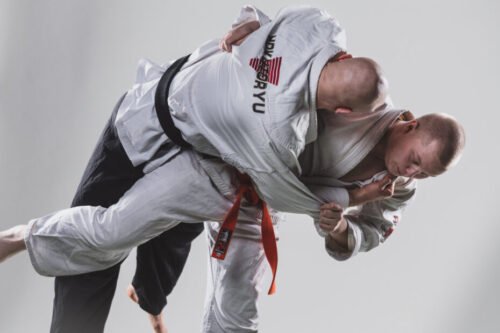
Two Hokutoryu Ju-Jutsu practitioners demonstrating techniques, representing Northern Europe's blend of traditional martial heritage and modern combat systems.

From ancient wrestling traditions and medieval combat systems to modern hybrid martial arts, Northern Europe has produced a diverse and influential martial heritage.

Some of these arts survived through continuous practice, while others were reconstructed from historical sources. Together they reveal a martial heritage built on competition, technical skill, physical development, and practical fighting ability.

From wrestling fields and fencing halls to modern combat gyms, Northern Europe’s martial traditions continue to leave their mark on the martial arts world.

🤼 Wrestling Traditions

Across Northern Europe, wrestling formed the foundation of many martial traditions. These systems emphasised balance, leverage, throws, and physical control, developing through local competitions, festivals, and community sporting culture. While each style evolved differently, all shared a focus on controlling an opponent through skill, positioning, and timing.

🇮🇸 Glima

Glima is a traditional Icelandic wrestling style rooted in Scandinavian wrestling culture. It emphasises maintaining posture while off-balancing an opponent through controlled movement and grip work. Unlike many wrestling styles, Glima prioritises clean technique and continuous motion rather than brute force.

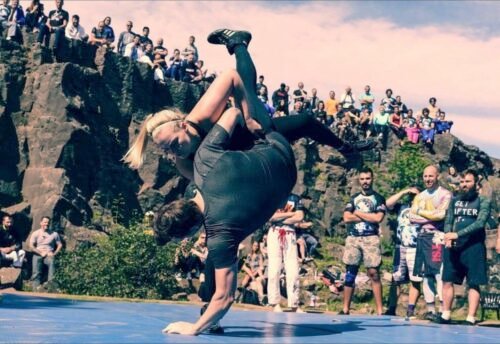
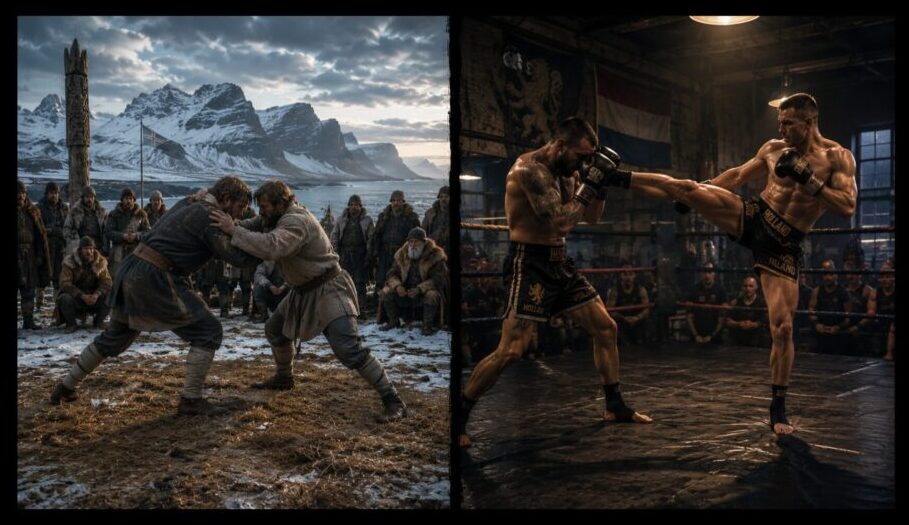
Two competitors engaged in a Glíma wrestling match, demonstrating the balance, footwork, and throwing techniques characteristic of Iceland's traditional wrestling style.

The wrestling skills valued by Viking-age warriors survive today through Glíma, Iceland’s enduring national wrestling style.

Glima places a strong emphasis on movement, timing, and balance. Rather than driving directly into opponents, practitioners seek to create openings through footwork, subtle changes of direction, and precise manipulation of posture.

Key themes include:

  • Continuous Movement: Remaining mobile and fluid rather than becoming static or locked in place.
  • Balance Disruption: Creating instability before attempting throws or takedowns.
  • Postural Control: Maintaining an upright stance while compromising an opponent’s structure.
  • Grip Fighting: Using established grips to control movement and create opportunities.
  • Technical Efficiency: Relying on leverage, timing, and positioning rather than raw strength.
  • Clean Throws: Executing decisive techniques with control and precision.

One of Glima’s defining characteristics is its emphasis on sportsmanship and technical execution. Success often depends less on overpowering an opponent and more on maintaining superior balance, movement, and control throughout the exchange.

🇨🇭 Schwingen

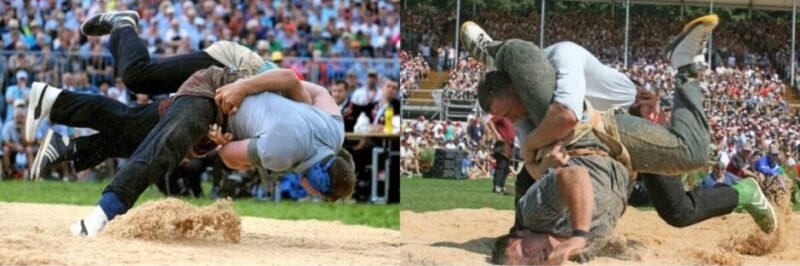
Schwingen is a Swiss wrestling style where competitors wear specialised shorts to establish grips. The objective is to throw the opponent cleanly onto their back. It combines strength, technique, and timing, and remains widely practised in competition today.

More than a sport, Schwingen remains an important part of Swiss cultural identity and martial heritage.

Schwingen places a premium on controlling the clinch and creating throwing opportunities through superior positioning. While physical strength is important, successful competitors rely equally on timing, leverage, and the ability to exploit subtle shifts in balance.

Key themes include:

  • Grip Control: Establishing strong holds to dictate movement and create openings.
  • Throwing Technique: Using leverage and body positioning to execute clean, decisive throws.
  • Clinch Dominance: Controlling the engagement while limiting an opponent’s options.
  • Balance Manipulation: Creating instability before committing to an attack.
  • Explosive Power: Generating force quickly when opportunities arise.
  • Competitive Testing: Refining skills through regular competition against resisting opponents.

One of Schwingen’s defining characteristics is its emphasis on achieving clear, decisive victories through effective throwing rather than prolonged grappling exchanges. This combination of technical skill, athleticism, and live competition has helped preserve the art as one of Europe’s most successful traditional wrestling systems.

🇩🇪 Ringen

Ringen is a medieval German wrestling system found throughout historical martial manuals. It includes throws, joint manipulation, takedowns, and close-range control. Originally used alongside weapons training, it remains relevant today through reconstruction efforts and modern grappling crossover.

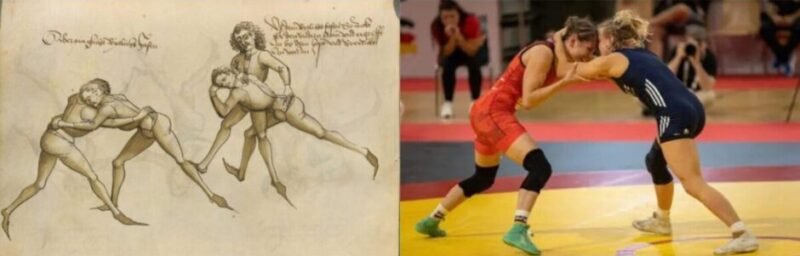
Two practitioners demonstrating Ringen techniques, including grappling, throws, and joint locks from the traditional German wrestling system.

Preserved in medieval fight manuals, Ringen remains one of the best-documented wrestling systems in European martial history.

Unlike many folk wrestling traditions, Ringen was often taught as part of a complete martial curriculum. Practitioners learned to grapple both as a standalone skill and as a solution for situations where armed combat collapsed into close-range struggles.

Key themes include:

  • Throws and Takedowns: Bringing opponents to the ground through leverage and timing.
  • Joint Manipulation: Controlling or disabling opponents through locks and holds.
  • Close-Range Control: Dominating clinch positions and preventing counterattacks.
  • Weapon Integration: Applying grappling principles alongside sword, dagger, and other weapon systems.
  • Mechanical Efficiency: Using positioning and leverage rather than strength alone.
  • Martial Application: Emphasising techniques intended for practical combat rather than sporting competition.

Because it formed part of a broader medieval fighting system, Ringen occupies a unique position within European martial arts. Its principles continue to influence HEMA practitioners and remain relevant to modern grappling arts today.

⏳ Wrestling Across Northern Europe

Long before organised combat sports emerged, wrestling was one of Northern Europe’s most widespread martial activities.

From Glima in Iceland and Schwingen in Switzerland to Ringen in the German states, regional styles developed their own methods while sharing many common principles:

  • Balance disruption.
  • Positional control.
  • Throwing ability.
  • Physical conditioning.

Other traditions existed throughout Scandinavia, including various Swedish and Norwegian wrestling practices that emphasised similar concepts of leverage, balance, and control.

Together, these wrestling arts formed an important foundation for Northern Europe’s martial culture, influencing later combat sports, military training, and historical fighting systems.

⚔️ Historical Combat Systems

Northern Europe also produced influential weapon traditions, particularly through the German fencing schools and wider medieval martial culture. These systems combined armed and unarmed combat, treating wrestling, swordsmanship, and close-quarters fighting as interconnected skills rather than separate disciplines.

🇩🇪 Kunst des Fechtens

The German school of fencing encompassed far more than sword fighting. Historical manuals included striking, grappling, dagger work, polearms, and wrestling techniques designed for both civilian and military contexts.

Rather than treating combat as separate disciplines, practitioners were expected to transition seamlessly between armed and unarmed methods depending on the situation.

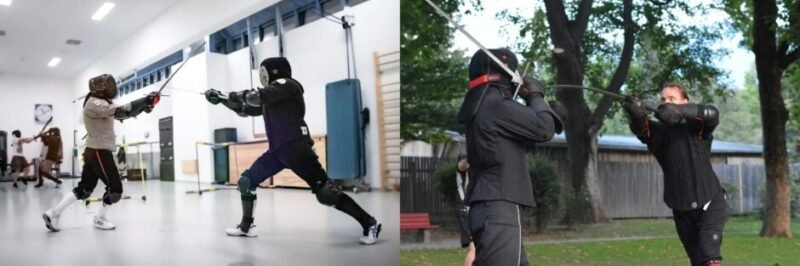
Practitioners demonstrating techniques from Kunst des Fechtens, including longsword fencing, grappling, and close-quarters combat based on medieval German martial traditions.

Kunst des Fechtens reflects the holistic approach of medieval European martial arts, where striking, wrestling, and weapons training formed part of a single system.

Kunst des Fechtens viewed combat as a complete martial system rather than a collection of separate skills. Practitioners were expected to understand distance, timing, positioning, and control across a variety of weapons and ranges.

Key themes include:

  • Adaptability: Transitioning smoothly between weapons, grappling, and close-range fighting.
  • Initiative: Taking control of the engagement and forcing opponents to react.
  • Timing and Distance: Understanding when to attack, defend, or reposition.
  • Mechanical Efficiency: Generating effective results through leverage, structure, and positioning.
  • Versatility: Developing competence across multiple weapons and combat scenarios.
  • Integrated Combat: Treating armed and unarmed fighting as interconnected skills.

Rather than specialising in a single weapon or method, practitioners sought to develop a broad understanding of combat principles that could be applied across many different situations. This holistic approach remains one of the defining characteristics of the German martial tradition.

⏳ The German Martial Manuals

The German fencing tradition produced some of Europe’s most important martial texts, particularly those associated with the Liechtenauer lineage.

These manuals preserved instruction covering:

  • Longsword.
  • Messer.
  • Dagger.
  • Polearms.
  • Wrestling.

Unlike many modern martial arts, these disciplines were not viewed as separate subjects. Historical practitioners were often expected to move seamlessly between weapons and grappling as circumstances demanded.

Today, these manuals form a major part of the HEMA movement and provide invaluable insight into how combat was taught during the Medieval and Renaissance periods.

🥊 Modern Combat Sports

Northern Europe also produced influential weapon traditions, particularly through the German fencing schools and wider medieval martial culture. These systems combined armed and unarmed combat, treating wrestling, swordsmanship, and close-quarters fighting as interconnected skills rather than separate disciplines.

🇳🇱 Dutch Kickboxing

Dutch Kickboxing blends Western Boxing, Muay Thai, and Kyokushin Karate. The result is a style known for fast combinations, relentless pressure, heavy conditioning, and aggressive pacing.

It remains one of the most successful striking systems in modern combat sports.

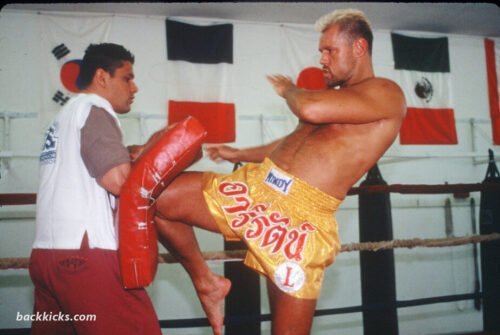
Rob Kaman training knee strikes on focus pads with a coach, demonstrating the powerful striking techniques that helped define Dutch kickboxing.

Rob Kaman’s devastating knees, low kicks, and technical precision helped establish Dutch kickboxing as one of the world’s premier striking styles.

Dutch kickboxing emphasises overwhelming opponents through sustained offensive pressure. Rather than relying on single techniques, practitioners are trained to chain punches, kicks, knees, and combinations together while maintaining a relentless pace.

Key themes include:

  • Combination Striking: Linking punches and kicks into continuous attacking sequences.
  • Forward Pressure: Forcing opponents onto the defensive and dictating the pace of the fight.
  • Heavy Conditioning: Developing the endurance required to maintain a high work rate.
  • Low Kicks: Using leg attacks to reduce mobility and wear opponents down.
  • Adaptability: Blending techniques from multiple striking traditions.
  • Competitive Testing: Refining skills through sparring and high-level competition.

Dutch kickboxing’s success stems from its ability to combine technical striking with intensity, conditioning, and pressure. The result is a style that remains highly effective in both kickboxing and mixed martial arts competition.

⏳ The Dutch Formula

Dutch kickboxing emerged through a blend of Western Boxing, Kyokushin Karate, and Muay Thai, combining the strengths of each into a unified striking system.

Its success was built upon several key principles:

  • Aggressive combinations.
  • Relentless pressure.
  • Heavy conditioning.
  • Continuous offensive output.

This formula produced some of the most successful strikers in modern combat sports and heavily influenced the development of modern MMA striking. Many of the combination-based attacks, pressure-fighting tactics, and training methods seen in MMA today can trace part of their lineage back to Dutch kickboxing gyms.

🥋 Modern Hybrid Systems

As the twentieth century progressed, many martial artists began looking beyond the boundaries of individual styles. Instead of preserving a single tradition, they borrowed techniques from multiple systems, combining what they believed worked best.

The result was a new generation of hybrid martial arts designed around practicality and adaptability. Systems such as German Ju-Jutsu and Hokutoryu Ju-Jutsu emerged from this movement, foreshadowing the cross-training philosophy that would later become commonplace in modern MMA.

🇩🇪 Deutsches Ju-Jutsu

Developed in the late twentieth century, German Ju-Jutsu combines techniques from Judo, Karate, Aikido, and Jujutsu into a practical self-defence system. The emphasis is placed on adaptability and real-world application rather than sporting competition alone.

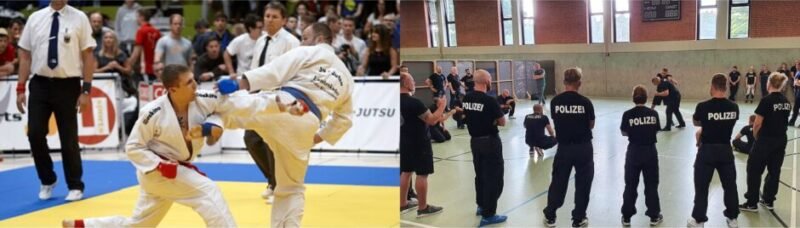
Practitioners demonstrating Deutsches Ju-Jutsu techniques, combining strikes, throws, joint locks, and grappling in a practical self-defence setting.

Widely taught within German law enforcement and self-defence circles, Deutsches Ju-Jutsu emphasises control, adaptability, and practical application.

German Ju-Jutsu was designed to provide practitioners with a broad toolkit capable of addressing a variety of situations. Rather than specialising in a single range or method of combat, training encourages students to select the most appropriate response based on the circumstances they face.

Key themes include:

  • Adaptability: Applying different techniques according to the situation rather than following fixed responses.
  • Striking and Grappling Integration: Combining punches, kicks, throws, locks, and control techniques.
  • Self-Defence Application: Addressing common threats and real-world confrontations.
  • Control and Restraint: Managing opponents without necessarily causing unnecessary injury.
  • Situational Awareness: Recognising threats and responding appropriately.
  • Practical Training: Using partner drills and scenario-based exercises to develop usable skills.

German Ju-Jutsu is widely practised by civilians, security personnel, and law-enforcement agencies. Its flexible approach reflects the system’s original goal: creating a modern martial art capable of adapting to the diverse challenges of contemporary self-defence.

🇫🇮 Hokutoryu Ju-Jutsu

Originating in Finland, Hokutoryu Ju-Jutsu combines striking, grappling, throws, and self-defence techniques into a structured modern system. Its curriculum emphasises practical effectiveness while maintaining a strong educational framework.

Practitioners demonstrating Hokutoryu Ju-Jutsu techniques, combining strikes, throws, joint locks, and self-defence applications during training.

Developed in Finland, Hokutoryu Ju-Jutsu reflects the growing European trend towards hybrid martial arts that combine techniques from multiple combat disciplines.

Hokutoryu Ju-Jutsu seeks to provide a well-rounded approach to self-defence by developing competence across multiple ranges of combat. Practitioners learn to assess situations, apply appropriate techniques, and maintain control while minimising unnecessary force.

Key themes include:

  • Integrated Skills: Combining striking, grappling, throws, and defensive tactics into a unified system.
  • Control and Restraint: Emphasising safe and proportionate responses where possible.
  • Technical Efficiency: Using leverage, timing, and positioning rather than relying on strength alone.
  • Self-Defence Awareness: Developing the ability to recognise and respond to common threats.
  • Progressive Learning: Building skills through a structured curriculum and gradual development.
  • Practical Application: Focusing on techniques that can be adapted to real-world situations.

Unlike combat sports that focus primarily on competition, Hokutoryu Ju-Jutsu places greater emphasis on personal protection, conflict management, and practical self-defence. Its balanced approach has helped make it one of the most widely practised modern martial arts systems in Finland.

💬 Discussion

⚠️ Reality vs Representation

Northern Europe’s martial traditions are often viewed through the lens of mythology, folklore, and popular culture. Yet behind the legends lies a much simpler reality: effective combat was built through training, repetition, competition, and practical experience.

Whether on the wrestling field, fencing floor, or in the modern kickboxing gym, success depended on skill, conditioning, and the ability to perform under pressure rather than heroic tales or warrior myths.

❄️ Northern Europe's Combat Legacy

While Southern Europe refined fencing and Eastern Europe developed systems such as Sambo, Northern Europe made lasting contributions to wrestling, historical martial arts, and modern combat sports.

From Glima and Schwingen to Kunst des Fechtens and Dutch Kickboxing, the region’s influence can still be seen throughout HEMA, combat sports, self-defence systems, and MMA. Its traditions continue to demonstrate the enduring value of balance, control, technical skill, and pressure-tested training.

🧠 Closing Perspective

Northern Europe’s martial traditions developed across different countries, cultures, and time periods, yet many share a common emphasis on balance, control, positioning, and practical application.

Whether expressed through wrestling, historical fencing, kickboxing, or modern self-defence systems, these arts sought efficient ways to overcome opponents through superior technique rather than brute force alone.

A Dutch kickboxer delivering a low kick during competition, representing the technical skill and enduring martial traditions of Northern Europe.

From wrestling fields and fencing halls to modern combat sports, Northern Europe’s martial arts have consistently emphasised efficiency, control, and adaptability.

Together, they highlight Northern Europe’s enduring contribution to European martial arts and the continued importance of fundamentals, pressure testing, and technical proficiency in combat.

If you have enjoyed this post please share or feel free to comment below 🙂

Leave a Reply

Your email address will not be published. Required fields are marked *

This site uses Akismet to reduce spam. Learn how your comment data is processed.

error: Content is protected !!

Join the Super Soldier Project Mailing List Today!!