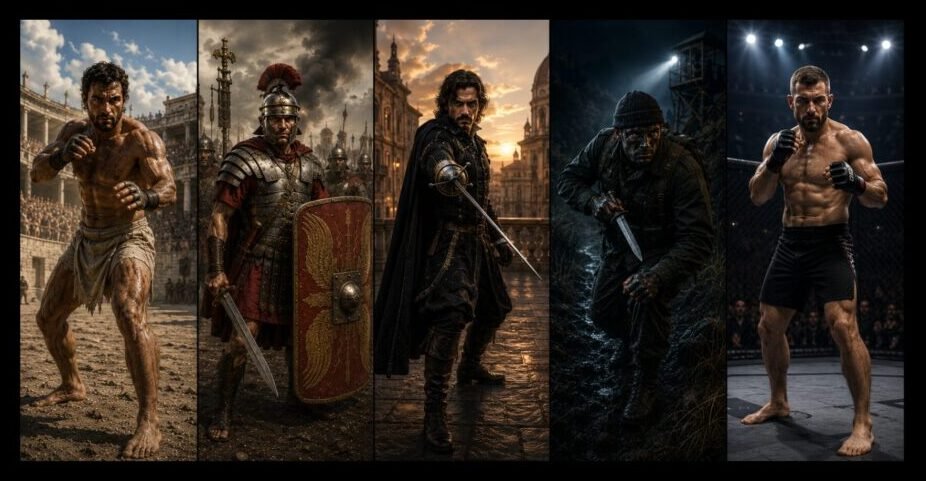
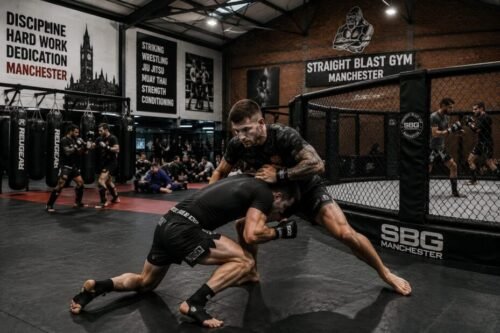
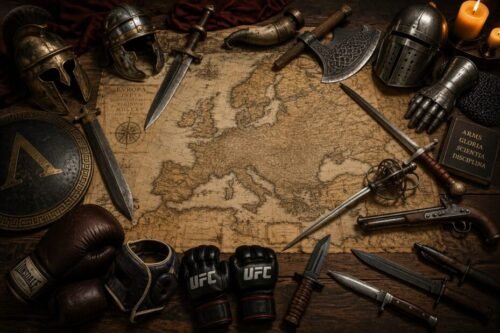
From Greek phalanxes and Roman legions to medieval knights, Renaissance duelists, modern soldiers, and MMA fighters, this guide traces the evolution of European combat and the forces that shaped it across the centuries.
Table of Contents
π₯ Introduction
The history of European combat is a story of adaptation.
As weapons changed, fighting methods evolved. As armour improved, new tactics emerged to overcome it. As firearms transformed warfare, many traditional martial systems declined while others found new life through sport, self-defence, military training, and historical reconstruction.
Over time, European combat followed two closely connected paths. One evolved on the battlefield, shaped by war, technology, and the realities of survival. The other developed through competition, producing wrestling styles, combat sports, fencing traditions, and athletic contests that tested fighting skill in a controlled environment.
Across centuries of conflict, European fighters developed new weapons, tactics, and martial systems to meet the demands of their time.
These paths often influenced one another. Military systems borrowed from sporting traditions, while combat sports preserved skills that had once been used in war. Although they sometimes diverged, they remained part of the same evolutionary story.
From Greek phalanxes and Olympic wrestlers to Roman legions and gladiators, Viking shield walls and medieval knights, Renaissance duelists, modern soldiers, and MMA fighters, each generation developed solutions to the challenges of its time.
β³ Why So Many European Martial Arts?
Unlike highly centralised empires, Europe spent much of its history divided into competing kingdoms, city-states, principalities, and tribal regions. Constant warfare, shifting borders, trade networks, mercenary service, and cultural exchange encouraged the development of a wide variety of fighting systems.
At the same time, soldiers, merchants, fencing masters, and travellers carried ideas across the continent, creating a continual process of adaptation and cross-pollination. The result was not a single European martial art, but a vast and evolving ecosystem of combat traditions.
ποΈ Ancient Greece
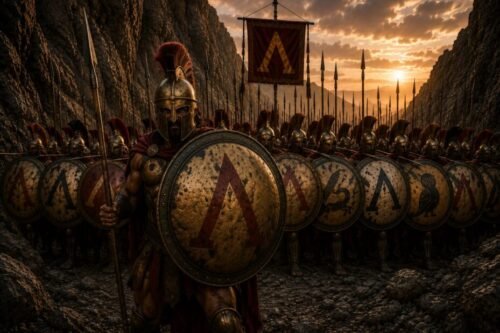
Many of Europe’s earliest documented martial traditions emerged in Ancient Greece, where warfare, athletics, and physical culture were closely linked. Greek city-states relied heavily upon citizen-soldiers fighting in disciplined formations known as the phalanx, a dense wall of spears and shields that demanded coordination, endurance, and collective action.
The phalanx represented one of the most influential battlefield formations of the ancient world. At Thermopylae, disciplined hoplite warfare became legendary.
Click links below to read more.
βοΈ Warfare
Greek warfare centred around the citizen-soldier. Unlike many later professional armies, the defence of a city-state often depended upon ordinary citizens taking up arms when required. Success relied less upon individual heroics and more upon discipline, organisation, and the ability to fight as part of a cohesive formation.
The phalanx became one of the most influential battlefield systems of the ancient world. Rows of heavily armed infantry advanced behind overlapping shields and projecting spears, creating a formidable wall of men that rewarded teamwork and punished disorder.
π₯ Combat Sports
At the same time, the Greeks developed some of Europe’s earliest organised combat sports. These included:
- Pale (Wrestling).
- Pygmachia (Boxing).
- Pankration.
Contested at festivals such as the Olympic Games, these events provided a structured environment for testing fighting ability, physical conditioning, and competitive skill.
Wrestling developed balance, leverage, and control. Boxing refined striking and endurance. Pankration combined striking and grappling into a single integrated system that many regard as the spiritual ancestor of modern mixed combat sports.
β³ Sparta and the Warrior Ideal
No Greek city-state became more closely associated with martial excellence than Sparta. Spartan society placed extraordinary emphasis on military preparation, discipline, and physical conditioning through the famous Agoge training system.
Although popular culture often exaggerates Spartan combat superiority, their legacy highlights an important truth that appears repeatedly throughout martial history: successful fighters and military systems are usually built upon training, discipline, conditioning, and cohesion rather than courage alone.
π― The Greek Legacy
The Greek contribution to European combat was twofold.
On the battlefield, Greece demonstrated the effectiveness of disciplined formations and collective action. In the sporting arena, it established organised combat competition as a means of testing skill, fitness, and fighting ability.
These two traditions, warfare and competition, would continue to evolve side by side throughout European martial history.
π¦ Rome
The Roman Empire transformed warfare through discipline, organisation, and professional military training. Following reforms such as those introduced by Gaius Marius, Roman armies evolved into highly effective fighting forces built around standardised equipment, rigorous training, and battlefield cohesion.
At the same time, Rome developed one of history’s most famous combat cultures through the gladiatorial games, creating a second arena in which martial skill could be displayed, tested, and celebrated.
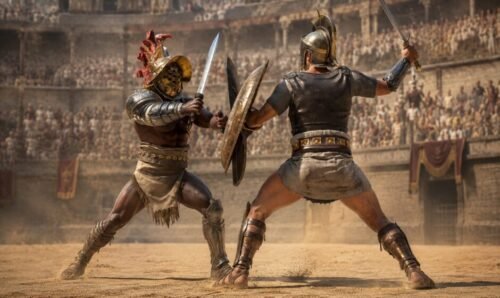
Roman gladiators transformed combat into spectacle. Their specialised training preserved and refined many aspects of armed fighting within a highly structured environment.
Click links below to read more.
βοΈ The Legion
Unlike the Greek phalanx, which relied heavily on a dense wall of spears, Roman soldiers fought as part of flexible formations capable of adapting to changing battlefield conditions.
Legionaries trained extensively with weapons such as the Gladius, Scutum, and Pilum, allowing Rome to project military power across much of Europe. Training emphasised discipline, endurance, aggression, and the efficient application of simple techniques under pressure.
The Roman legion demonstrated an important principle that would reappear throughout European military history: organised groups of trained fighters often proved more effective than individual warriors acting alone. Success depended upon coordination, leadership, and collective action as much as personal bravery.
π The Gladiator Arena
Away from the battlefield, Rome developed a very different form of combat culture through the gladiatorial games.
Gladiators were not simply untrained prisoners thrown into combat. Many underwent extensive instruction in specialised schools where they learned weapon handling, footwork, conditioning, and tactical awareness.
Different gladiator types fought with different combinations of weapons and armour, creating a variety of fighting styles and strategic matchups. While the realities of gladiatorial combat differed significantly from warfare, the arena provided another environment in which martial skill could be tested before large audiences.
In many respects, the gladiator became one of Europe’s earliest combat athletes, training full-time to entertain, compete, and survive.
πͺ The Viking Age
Following the decline of Roman authority, new warrior cultures emerged across Europe. Among the most influential were the Norse peoples, commonly known as the Vikings. Operating across Scandinavia, the British Isles, and beyond, Viking warfare revolved around practical weapons, mobility, and the realities of raiding, exploration, and regional conflict.
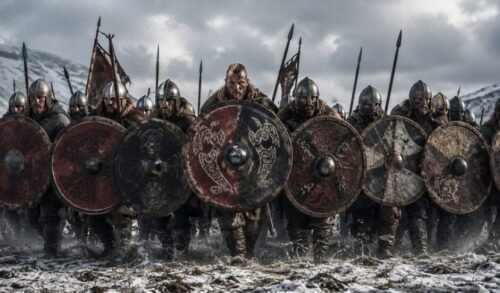
The shield wall emphasised unity, discipline, and collective defence. Success depended upon maintaining formation under intense pressure and close-quarters combat.
Click links below to read more.
π‘οΈ Warfare in the North
Combat during the Viking Age centred around:
- Spears.
- Axes.
- Swords.
- Shields.
- Wrestling.
Despite their fearsome reputation, Viking warfare was often built upon discipline and cooperation rather than individual heroics. Warriors frequently fought in formations known as shield walls, where overlapping shields created a defensive barrier that allowed fighters to advance, defend, and attack as a unified force.
Like the Greek phalanx and Roman legion before it, the shield wall demonstrated the power of collective action on the battlefield. Success often depended upon maintaining formation and supporting the warriors beside you.
π± The Spear Was King
Popular culture tends to focus on Viking swords and axes. In reality, the spear was by far the most common battlefield weapon.
Cheaper to produce, easier to use, and highly effective in formation, the spear remained one of the most practical weapons in European warfare for centuries. While swords carried prestige, most warriors would have trusted their lives to a spear.
π€Ό Martial Skill Beyond the Shield Wall
While battlefield success relied heavily upon teamwork, Viking warriors also needed the ability to fight independently when formations broke down.
Historical sources suggest that wrestling played an important role within Norse culture. Styles such as Glima preserve aspects of this tradition and demonstrate how grappling remained a valuable skill alongside weapon use.
Once combat became fragmented and chaotic, individual attributes such as strength, balance, endurance, weapon retention, and close-range fighting ability became increasingly important.
π‘οΈ The Medieval World
Following the Viking Age, European warfare became increasingly shaped by the feudal system, the rise of heavily armoured warriors, and the growing importance of specialised military classes. Knights, men-at-arms, mercenaries, and professional soldiers developed increasingly sophisticated approaches to combat as weapons, armour, and battlefield tactics continued to evolve.
Medieval warfare demanded mastery of weapons, armour, wrestling, and battlefield tactics. Surviving manuals reveal increasingly sophisticated martial systems.
Click links below to read more.
βοΈ Battlefield Evolution
Combat during the medieval period revolved around:
- Swords.
- Spears.
- Polearms.
- Shields.
- Wrestling.
- Horsemanship.
For much of the medieval era, warfare was dominated by heavily armed and armoured warriors. The battlefield rewarded discipline, courage, mobility, and the ability to fight effectively both on foot and horseback.
The horse became one of the most important military technologies of the age. Mounted warriors possessed significant advantages in mobility, reach, shock power, and battlefield flexibility. From knights and mounted men-at-arms to various cavalry formations, horsemanship became a defining feature of European warfare for centuries.
π‘οΈ The Arms Race of Armour
As armour became more effective, combat systems evolved alongside it.
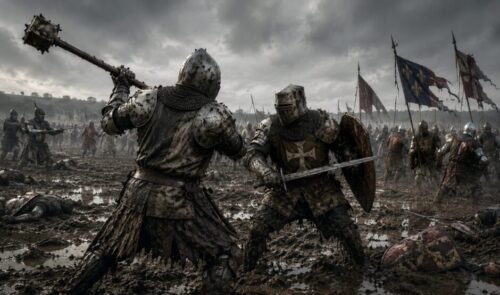
Against heavily protected opponents, simply striking with a sword was often insufficient. Fighters increasingly relied upon polearms, maces, war hammers, axes, grappling, and techniques designed to exploit weaknesses in armour.
Combat became a continual cycle of adaptation. As protection improved, new methods emerged to overcome it. As new weapons appeared, new tactics followed. This process drove the development of some of the most sophisticated martial systems in European history.
π€Ό The Growth of Martial Skill
Contrary to popular belief, medieval combat was not simply a matter of swinging weapons wildly.
Surviving evidence reveals increasingly structured approaches to timing, positioning, footwork, wrestling, weapon handling, and tactical decision-making. Fighters trained to control opponents, break balance, exploit openings, and apply force efficiently rather than relying on strength alone.
Many of the concepts later recorded in Europe’s famous fencing manuals were already developing during this period, laying the foundations for the martial traditions that would flourish during the Renaissance.
βοΈ The Warrior Classes
Throughout the medieval period, a variety of warrior groups contributed to the evolution of European combat.
These included:
- Knights.
- Men-at-arms.
- Mercenaries.
- Professional soldiers.
- Military orders.
Each brought their own battlefield experiences, training methods, and tactical requirements, helping drive the continual development of weapons, armour, and fighting systems across Europe.
π― The Medieval Legacy
The medieval world demonstrated that combat evolves in response to technology.
As armour improved, fighters developed new methods to defeat it. As warfare became more specialised, martial training became increasingly sophisticated.
By the end of the medieval period, Europe had developed a rich martial culture built upon weapons, wrestling, horsemanship, and battlefield experience. These foundations would soon be recorded, analysed, and preserved in some of the most influential martial manuals ever written.
π The Age of Manuals
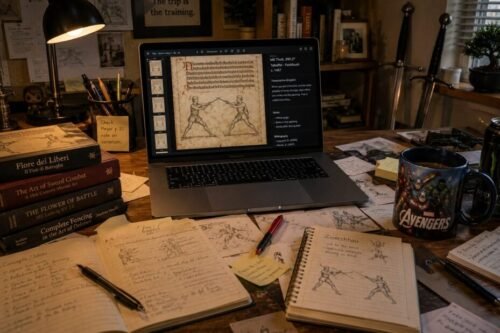
As Europe emerged from the medieval period, martial knowledge increasingly moved from oral tradition and battlefield experience into written form. Fencing masters, soldiers, and professional instructors began documenting their methods, creating manuals that preserved techniques, principles, and training systems for future generations.
As Europe urbanised, personal defence and duelling encouraged the development of refined fencing systems focused on timing, precision, and technique.
Click links below to read more.
βοΈ Recording the Martial Arts
For the first time, complex martial systems could be systematically recorded, studied, and taught across different regions and generations. This period produced some of the most influential figures in European martial history, including:
- Fiore dei Liberi.
- Johannes Liechtenauer.
- Hans Talhoffer.
- Joachim Meyer.
Their works covered far more than sword fighting alone. Surviving manuals contain instruction on wrestling, dagger combat, longsword, polearms, mounted combat, self-defence, and battlefield applications.
Rather than treating combat as separate disciplines, many masters viewed fighting as an interconnected system where skills could transfer across different weapons and situations.
π A Marketplace of Ideas
Europe’s soldiers rarely remained confined to a single kingdom or region. Mercenaries travelled across borders carrying weapons skills, training methods, and battlefield experience with them.
This constant movement encouraged the exchange of ideas between different cultures and helped spread martial knowledge throughout Europe. Many fighting systems evolved through adaptation, borrowing, and refinement rather than developing in complete isolation.
At the same time, Europe experienced an unprecedented growth in martial literature. Hundreds of manuals were produced covering longsword, wrestling, dagger fighting, polearms, duelling weapons, and military combat, creating one of the richest surviving martial records anywhere in the world.
π― Why the Manuals Matter
Most martial traditions throughout history disappeared without leaving detailed records behind.
The survival of works by masters such as Fiore, Liechtenauer, Talhoffer, and Meyer provides an unusually detailed glimpse into how Europeans trained, fought, and thought about combat centuries ago.
Without these manuals, much of Europe’s martial heritage would likely have been lost forever.
π The Renaissance & Duelling Era
Other Revival Movements
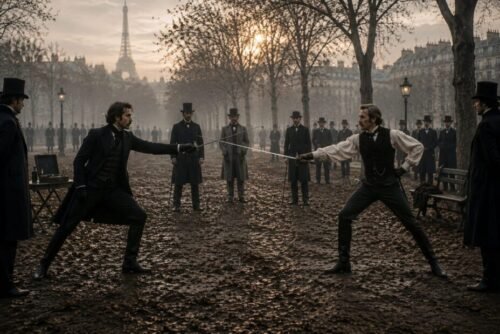
As Europe became increasingly urbanised, combat gradually shifted away from the battlefield and into civilian life. Personal defence, honour disputes, law enforcement, and formal duelling became increasingly important, creating demand for new weapons and more specialised fighting systems.
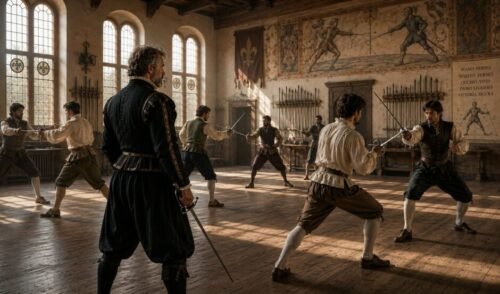
Duelling became an important part of European martial culture, preserving personal combat traditions long after battlefield warfare had changed.
Click links below to read more.
βοΈ From Battlefield to Street
Unlike medieval warfare, which often involved armour, formations, and military objectives, Renaissance combat increasingly focused on the individual.
As cities expanded and civilian carry became more common, people required systems suited to personal defence, honour disputes, and formal duels rather than battlefield survival. This change encouraged the development of lighter weapons and more specialised fighting methods.
Combat was becoming less about surviving a war and more about prevailing in a personal encounter.
π€Ί The Rise of the Fencing Masters
This period saw the growth of some of Europe’s most influential martial traditions, including:
- Italian Fencing.
- Spanish Destreza.
- French Fencing.
- Rapier Systems.
Masters developed increasingly sophisticated approaches to timing, distance management, footwork, deception, and tactical decision-making. Success depended less upon brute force and more upon precision, control, and efficiency.
Many principles still found in modern fencing and combat sports can trace their roots to this period.
π© The Civilianisation of Combat
As Europe became increasingly urbanised, combat moved away from military battlefields and into civilian environments.
Duelling, self-defence, law enforcement, and personal protection became increasingly important concerns. Martial systems adapted accordingly, producing some of the most technically refined fighting traditions in European history.
The focus shifted from surviving mass warfare to managing individual confrontations, often under highly formalised social rules.
β³ Pike & Shot β The Forgotten Transition
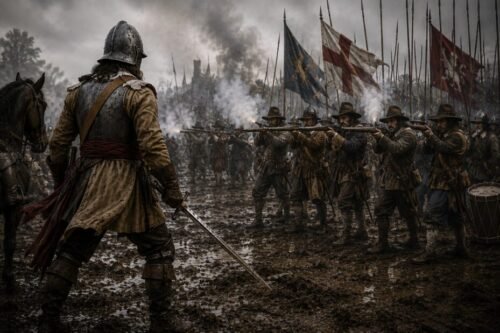
Between the medieval and gunpowder eras, Europe passed through a transitional period often known as Pike & Shot warfare. Armies increasingly combined long pikes with early firearms, creating powerful formations such as the Swiss Pikemen, German Landsknechts, and the famous Spanish Tercios.
This period marked the gradual decline of the armoured knight and the rise of professional infantry armies. Swords and armour remained important, but the battlefield was beginning to change as gunpowder transformed the nature of warfare.
π« The Gunpowder Revolution
The introduction of gunpowder fundamentally changed European warfare. As firearms became increasingly effective and widespread, many traditional battlefield weapons gradually lost the military role they had occupied for centuries. Armour declined, tactics evolved, and combat systems were forced to adapt to a rapidly changing battlefield.
Gunpowder transformed warfare. As firearms became dominant, armour gradually disappeared from the battlefield and combat systems adapted to a new era.
Click on the links below to read more.
π₯ Firearms Change the Battlefield
The transition was gradual rather than immediate. Swords, spears, cavalry sabres, and other traditional weapons remained in use for centuries alongside firearms. However, gunpowder steadily shifted the balance of power away from heavily armoured warriors and towards disciplined formations equipped with muskets and artillery.
As firearms became increasingly dominant, many martial traditions faced a challenge. Systems that had developed around swords, shields, and armoured combat were no longer as relevant to the realities of modern warfare. Some adapted to new military requirements, while others gradually declined.
βοΈ Bayonet Warfare β The Soldier's New Spear
The introduction of the bayonet transformed the musket from a purely ranged weapon into a close-combat tool.
Rather than carrying separate firearms and polearms, soldiers could now convert their muskets into spear-like weapons capable of both ranged and close-range combat.
Bayonet training emphasised:
- Aggressive forward movement.
- Simple thrusting attacks.
- Weapon retention.
- Unit cohesion.
In many ways, the bayonet represented a return to one of Europe’s oldest battlefield concepts: disciplined formations using thrusting weapons to dominate close combat.
π° Close Combat Survives
Popular imagination often portrays gunpowder warfare as purely ranged combat. The reality was often far more brutal.
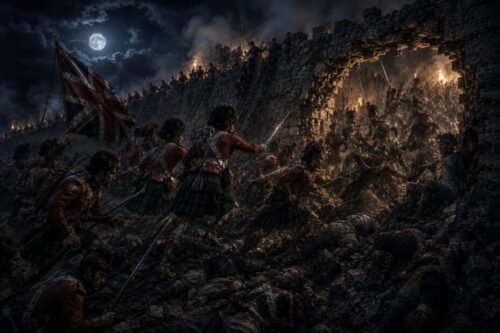
During conflicts such as the Napoleonic Wars, soldiers frequently fought hand-to-hand during assaults on fortifications, breaches, and urban strongholds. Even in the age of muskets, close combat remained a harsh reality whenever formations broke down or opposing forces collided at close range.
The famous infantry square demonstrated that discipline, organisation, and collective action remained just as important as they had been in the days of Roman legions and Viking shield walls.
π Industrial Warfare
The Industrial Revolution transformed warfare on a scale never seen before. Mass production, railways, telegraphs, rapid-fire weapons, artillery, and machine guns changed how wars were fought and how armies operated. Victory increasingly depended upon logistics, organisation, and industrial capacity rather than the skill of individual warriors.
Even in the age of firearms, brutal hand-to-hand combat remained common during assaults, sieges, and close-quarters fighting.
Click on the links below to read more.
βοΈ Battlefield Evolution
For much of history, individual martial skill played a significant role on the battlefield. A skilled swordsman, cavalryman, or warrior could influence the outcome of a fight through training, experience, and personal ability.
Industrial warfare gradually changed that reality. As weapons became more powerful and armies grew larger, success increasingly depended upon firepower, communication, logistics, and organisation. Swords disappeared from military service, armour vanished from the battlefield, and many traditional martial systems lost the practical role they had held for centuries.
The battlefield was becoming increasingly technological.
π₯ When Warriors Became Athletes
As battlefield applications declined, organised competition increasingly became the primary testing ground for fighting skill.
Boxing, Catch Wrestling, Savate, Schwingen, and numerous regional wrestling traditions preserved many of the qualities that had always mattered in combat: timing, conditioning, courage, adaptability, and the ability to perform under pressure against a resisting opponent.
The setting had changed from battlefield to arena, but the process remained familiar. Fighters still trained, competed, and tested themselves against one another. The purpose had changed, but the pursuit of combat excellence endured.
π Fighting Goes Global
This period also helped spread European combat sports far beyond their countries of origin. Expanding trade routes, migration, and colonial empires carried fighting systems across the world.
British soldiers, sailors, and settlers helped export Boxing and Catch Wrestling throughout the Empire, while French influence contributed to the spread of fencing traditions and Savate. Combat was no longer confined to local regions; it was becoming increasingly international.
β³ Two Paths Emerge
For thousands of years, battlefield combat and competitive fighting had evolved side by side.
By the nineteenth century, however, they began to diverge. For the first time in European history, the battlefield and the arena were no longer developing in response to the same pressures.
One path focused on increasingly technological warfare, shaped by industrialisation, modern weapons, and military doctrine. The other focused on organised sporting competition, athletic performance, and the testing of individual fighting skill.
Although the two worlds would grow further apart during the twentieth century, they would eventually reconnect through military combatives, hybrid systems, and modern MMA.
π― The Industrial Legacy
By the early twentieth century, the warrior was gradually being replaced by the athlete.
For the first time in European history, the battlefield and the arena were no longer shaped by the same demands. One pursued military effectiveness. The other pursued competitive excellence.
Together, these parallel paths would lay the foundations for modern combat sports, military combatives, and eventually MMA itself.
πͺ The Age of Military Combatives & Hybrid Systems
The twentieth century transformed both warfare and martial arts. While modern technology increasingly reduced the role of traditional battlefield combat, advances in travel, communication, and international exchange exposed European martial artists to a wider range of fighting systems than ever before.
Modern military combatives emphasised simple, effective techniques designed for battlefield survival and close-quarters encounters.
Click on the links below to read more.
βοΈ Modern Warfare & Military Combatives
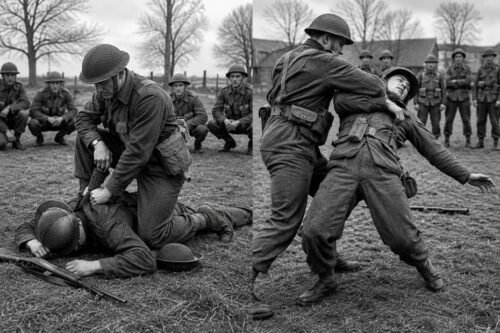
The First and Second World Wars demonstrated that close combat had not disappeared. Trench raids, urban fighting, sentry removal, prisoner handling, and special operations all created situations where soldiers could find themselves fighting at arm’s length despite advances in military technology.
Rather than preserving traditional martial arts, military instructors increasingly focused on simple, effective techniques that could be learned rapidly and applied under battlefield conditions. This led to the development of systems such as Defendu, later military combatives programmes, and specialised close-quarters combat training.
At the same time, the Soviet Union invested heavily in both combat sports and military fighting systems. The development of Sambo, extensive wrestling programmes, and state-supported athlete development helped establish Eastern Europe as one of the world’s leading combat regions. The influence of these programmes remains visible today in combat sports, military training, and MMA.
π New Influences Arrive
The post-war period also saw increasing exposure to martial arts from outside Europe. Japanese arts such as Judo, Jujutsu, and Karate spread rapidly throughout the continent, influencing self-defence training, combat sports, and military combatives.
Institutions such as the Budokwai in London, founded in 1918, played an important role in introducing Japanese martial traditions to European practitioners. As travel and communication improved, martial artists gained unprecedented access to systems that had previously remained confined to specific countries and cultures.
For the first time, large numbers of European practitioners could study, compare, and experiment with a truly global range of martial arts.
π₯ The Hybrid Approach
As these influences mixed, martial artists became less concerned with preserving stylistic purity and more interested in finding effective solutions wherever they could be found.
This period saw the emergence of systems such as:
- Bartitsu.
- German Ju-Jutsu.
- Hokutoryu Ju-Jutsu.
- Modern self-defence systems.
Rather than preserving a single historical style, these systems combined striking, grappling, weapon defence, and situational training into broader approaches designed to address a wider range of challenges.
In many ways, hybrid systems represented a return to an older martial philosophy. Rather than focusing on a single discipline, they combined striking, grappling, weapon defence, and situational training into broader approaches designed to address a wider range of challenges.
Drawing upon influences from Europe, Asia, and beyond, practitioners became increasingly concerned with what worked rather than where it came from.
By the late twentieth century, the boundaries that had once separated martial arts were becoming increasingly blurred. Military combatives borrowed from combat sports. Self-defence systems borrowed from military training. Traditional arts borrowed from one another. Fighters increasingly cross-trained rather than remaining within a single discipline.
The stage was now set for the next major development in the evolution of combat: Mixed Martial Arts.
π₯ MMA β The Great Convergence
Modern Mixed Martial Arts (MMA) represents the convergence of many combat traditions that evolved across different cultures and time periods. Rather than favouring a single style, MMA rewards effectiveness, adaptability, and the ability to integrate multiple skill sets into a complete fighting system.
Modern MMA represents the continuing evolution of combat sports, bringing together techniques from multiple martial traditions into a single competitive environment.
Click on the links below to read more.
βοΈ The End of the Specialist?
For much of European martial history, practitioners often trained within a single discipline. Boxers boxed. Wrestlers wrestled. Fencers fenced. Even as combat sports evolved, most competitors specialised within a single ruleset and competitive environment.
The rise of MMA challenged this approach by placing fighters from different backgrounds into the same competitive arena. The results were revealing. Pure specialists could still succeed, but only to a point. Over time, the most successful competitors became those who could strike, grapple, wrestle, defend submissions, and transition smoothly between different phases of combat.
π Europe's Contribution
Europe played a major role in the development of modern MMA, contributing many of the combat sports and martial systems that now form part of a complete fighter’s toolkit.
Key contributions include:
- Boxing.
- Catch Wrestling.
- Sambo.
- Dutch Kickboxing.
- Folk Wrestling traditions.
- Judo influences through European competition.
- Pankration’s integrated philosophy.
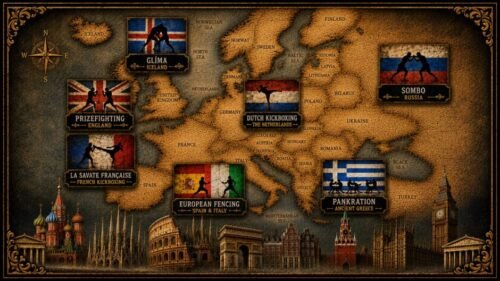
Together, these systems provided many of the striking, grappling, takedown, submission, and conditioning methods that continue to shape modern MMA. From British boxing gyms and Dutch kickboxing academies to Russian Sambo schools and European wrestling traditions, the continent has become one of the sport’s most influential regions.
π Has Combat Come Full Circle?
In many respects, MMA represents the logical outcome of the evolutionary process traced throughout this article.
For centuries, European combat continually adapted to changing circumstances. Battlefield systems borrowed from one another. Combat sports refined techniques through competition. Military combatives focused on practicality and efficiency. Hybrid systems blurred the boundaries between styles.
MMA brought many of these developments together within a single competitive format.
More than two thousand years before the creation of MMA, the Greeks developed Pankration, a combat sport that combined striking and grappling into a single contest. Modern MMA is not the same art, nor is it a direct descendant. Yet both pursue a remarkably similar goal: developing well-rounded fighters capable of adapting to a wide range of combat situations.
βοΈ Reconstruction & Revival
While MMA represented the convergence of many living combat traditions, not all European martial arts survived continuously into the modern era. As warfare changed and older combat systems lost their practical role, many disappeared entirely or survived only in fragments.
In recent decades, however, growing interest in martial history has sparked efforts to recover, reconstruct, and preserve Europe’s lost fighting arts.
Historical European Martial Arts practitioners combine research, translation, and practical experimentation to reconstruct combat systems that were once thought lost.
π The Revival Movement
Using surviving manuals, historical records, artwork, and archaeological evidence, practitioners have attempted to rebuild systems that might otherwise have been lost to history.
The most visible example is the Historical European Martial Arts (HEMA) movement, which uses surviving sources to recreate traditions such as Kunst des Fechtens, Italian Longsword, and various rapier systems.
π§ Closing Perspective
European combat has never stood still.
Over thousands of years, warriors, soldiers, athletes, duelists, and martial artists continuously adapted to changing circumstances. New weapons appeared. Armour evolved. Empires rose and fell. Firearms transformed warfare. Combat moved from battlefields to duelling halls, sporting arenas, military training grounds, and eventually into MMA cages and HEMA clubs.
Throughout that journey, European combat followed multiple paths. Some systems evolved to meet the demands of war. Others found new life through competition, sport, and athletic performance. At times these paths diverged. At other times they influenced one another, borrowing ideas and methods across generations.
Yet despite the changes, certain principles endured.
From ancient battlefields to modern gyms, European combat has continually evolved. Weapons changed, tactics adapted, and martial traditions transformed, but the pursuit of effective fighting methods endured.
Wrestling remained relevant from Ancient Greece to modern MMA. Pressure testing survived through combat sports long after many battlefield systems disappeared. Timing, distance management, physical conditioning, adaptability, and the ability to perform under pressure continued to separate effective fighters from ineffective ones regardless of the era.
Perhaps this is the most important lesson of European martial history. Successful combat systems were rarely the strongest, most elaborate, or most fashionable. They were the systems that adapted most effectively to the realities of their time.
From Greek wrestling grounds and Roman training fields to Viking shield walls, medieval battlefields, Renaissance duelling halls, boxing rings, Sambo academies, MMA gyms, and HEMA tournaments, each generation inherited old ideas, discarded others, and developed new solutions to familiar problems.
The weapons, battlefields, and training methods changed dramatically over the centuries, but one requirement remained constant: the need to adapt.