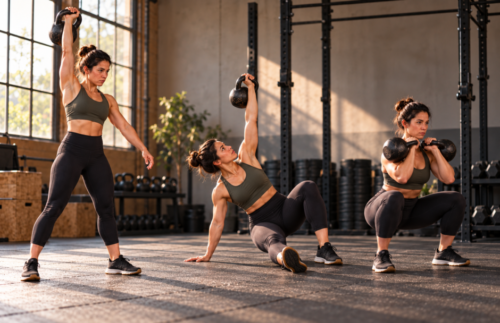
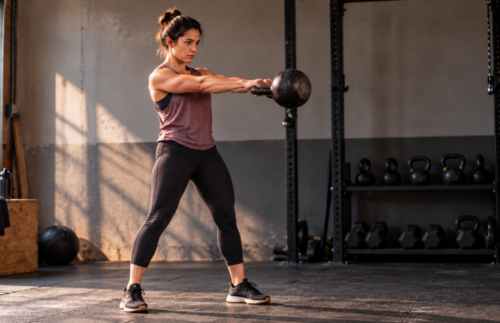
New to kettlebells? You don’t need a rack full of weights or a catalogue of complicated exercises. This beginner’s guide covers everything you need to get started, from choosing your first kettlebell to learning the fundamental movements and building your training from the ground up.
📑 Table of Contents
📝 Introduction
Kettlebells are simple pieces of equipment, but the way they are used can differ considerably from conventional resistance training. Their shape allows you to lift, carry, swing and accelerate weight, combining strength work with power, coordination and conditioning in ways that are difficult to reproduce with many other single implements.
For somebody new to kettlebell training, however, there is no need to learn everything at once. Start with one suitable bell, a handful of fundamental movements and enough patience to develop good technique. Once those foundations are established, kettlebell training can become as simple or as sophisticated as you want to make it.
💣 The Cannonball with a Handle
At its simplest, a kettlebell is a weighted ball with a handle attached to the top. That unusual shape is also what distinguishes it mechanically from a dumbbell.
With a dumbbell, the load generally remains close to the hand. With a kettlebell, the centre of mass sits outside the grip, allowing the bell to hang beneath the hand, travel around it and move dynamically through space. This makes kettlebells particularly well suited to two broad categories of exercise: ballistics and grinds.
Ballistic movements such as swings, cleans and snatches use acceleration, momentum and rapid force production, while grinds such as presses, squats and Turkish get-ups rely more heavily on deliberate tension, control and slower force application. A beginner does not need to master all of these immediately, but understanding that kettlebells can be both moved explosively and lifted under control provides a useful framework for everything that follows.
🧩 Anatomy of a Kettlebell
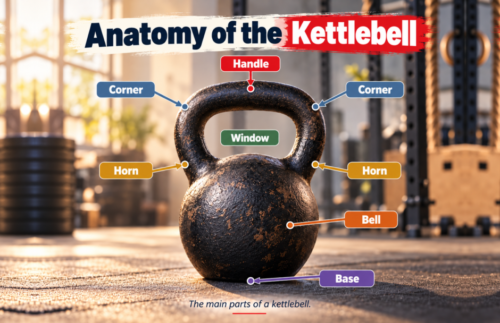
A kettlebell is simple in construction, but knowing the names of its main parts becomes useful once you start learning more technical movements.
The basic anatomy consists of:
Handle: the section you grip.
Corners: the curved areas where the handle begins to transition into the horns.
Horns: the sides connecting the handle to the body of the bell.
Window: the space between the handle and the bell.
Bell or body: the main weighted section.
Base: the flat underside that allows the kettlebell to stand securely.
These features are more than just labels. As your technique develops, the corners, horns and window become useful reference points when discussing hand position, cleans, snatches, rack work and other movements.
For a beginner, though, the main priority is simply choosing a kettlebell that feels comfortable to hold, well finished and stable when placed on the floor.
⚖️ Choosing Your First Kettlebell
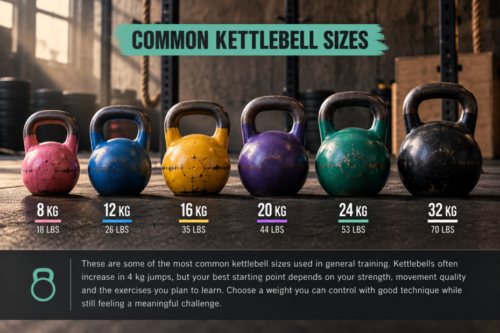
Kettlebells come in a wide range of weights, so there is no single starting size that suits everybody. Your training history, current strength, movement quality and the exercises you intend to perform all matter.
Someone completely new to resistance training may need a lighter bell than an experienced lifter, but even strong people should avoid choosing a kettlebell purely by comparing it with what they can lift using barbells or dumbbells. Ballistic movements introduce speed, timing and momentum, which changes the demands significantly.
A better approach is to choose a bell you can deadlift and goblet squat with good control while still feeling meaningful resistance. From there, use technique to guide progression. Ballistic exercises may require a different load while you are learning them, and the correct choice is not automatically the lightest bell available. A weight that is too light can sometimes encourage you to muscle the movement with the arms rather than learn to generate force properly through the hips.
The aim is to find a kettlebell that is heavy enough to provide useful feedback, but light enough that you can still control the movement and repeat good technique.
💣 Cast Iron or Competition Kettlebells?
Most beginners will encounter two main designs.
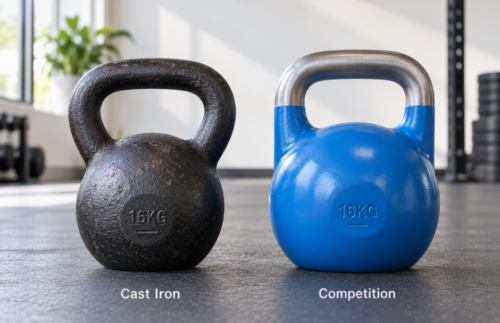
Traditional cast-iron kettlebells generally become physically larger as the weight increases. They are widely available and work perfectly well for general strength, conditioning and home training.
Competition kettlebells usually retain the same external dimensions regardless of weight. This gives the athlete a more consistent grip, rack position and movement pattern as loading changes, which is particularly useful in kettlebell sport.
Neither design is automatically better for a beginner. What matters more is basic build quality. Look for a smooth handle without rough seams or sharp finishing, enough window space to grip comfortably and a stable base.
Cast-iron and competition kettlebells can weigh the same while differing considerably in shape, dimensions and handle design.
1️⃣ One Bell Is Enough
You do not need to buy a matching pair immediately.
A single kettlebell is enough to learn the major movement patterns and perform a huge amount of effective training. It also introduces unilateral loading naturally, requiring you to control weight on one side of the body during carries, presses and rack work.
Double-kettlebell training can come later if your goals require it. For now, one suitable bell used well is far more valuable than a collection of bells you cannot yet control.
🏗️ Build the Foundations First
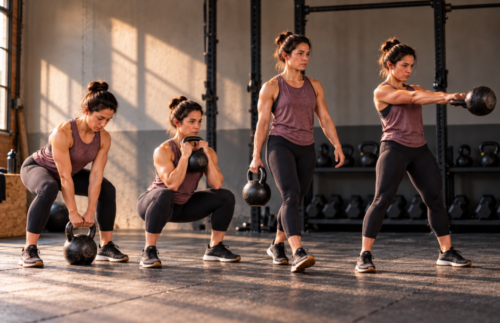
Kettlebell training becomes much easier to learn when the basic movement patterns are established before speed and complexity are added. A simple progression is deadlift → goblet squat → loaded carry → two-hand swing.
Deadlift, squat, carry, then swing. Build the movement patterns first before adding speed and complexity.
Deadlift
The kettlebell deadlift teaches the hip hinge, how to create tension through the trunk and how to lift the bell from the floor while maintaining a strong position. That hinge becomes the foundation for the swing and many later ballistic movements.
Goblet Squat
Holding the kettlebell close to the chest introduces loaded squatting while keeping the weight relatively easy to control. It also familiarises you with supporting the bell in front of the body before progressing to more demanding rack positions.
Loaded Carries
Suitcase and farmer carries introduce grip, posture and trunk control without requiring complicated technique. Pick the bell up well, walk under control and put it down with the same attention.
Two-Hand Swing
Once the hinge is established, speed can be introduced through the two-hand swing. The hips accelerate the kettlebell while the arms guide it rather than attempting to lift it.
The important principle is that the bell moves because force has been transferred into it, not because the arms are trying to lift it upwards. You do not have to begin with swings. Learn the hinge first, then add speed.
🧭 Your First Session
Your first kettlebell session does not need to be complicated. A simple sequence of deadlifts, goblet squats, suitcase carries and hinge practice is enough to begin learning how the bell feels and how your body responds to the different loading positions.
Once the hinge is consistent, the two-hand swing can be introduced as your first ballistic movement. There is no need to chase volume or cram several new exercises into the same session; at this stage, the objective is to practise a small number of movements well enough that they become familiar.
📈 What Comes Next?
Once those foundations feel comfortable, your movement library can gradually expand. The clean provides an efficient route into the rack position, opening the door to pressing, squatting and more complex combinations, while movements such as the snatch, Turkish get-up and double-kettlebell exercises can be introduced later as your strength, control and technical confidence develop..
Once the foundations are secure, kettlebell training can progress into more technical movements such as snatches, Turkish get-ups and double-kettlebell work.
The progression does not need to be rushed. Build a small number of movements to a good standard first, then add complexity when it serves a purpose rather than simply because another exercise exists.
⚠️ Give the Bell Some Respect
A kettlebell is still a heavy object being moved through space, sometimes at considerable speed. That does not make kettlebell training inherently dangerous, but it does mean the environment, equipment and quality of movement matter.
Train with enough room around you, keep the floor clear and make sure the handle and your grip are secure. As fatigue builds, stop the set when technique noticeably changes, grip becomes uncertain or the bell path becomes unpredictable. Continuing simply because a timer is still running usually turns conditioning into damage control.
Progress should also remain deliberate. Increase weight, volume, speed or technical complexity only when the movement you are already performing stays consistent.
We cover kettlebell safety in much more detail elsewhere in this series, including equipment checks, hand care, overhead control, aborting failed reps and learning how to park the bell safely.
🧭 Keep It Simple
Kettlebell training can eventually include cleans, snatches, Turkish get-ups, complexes, double-kettlebell work and countless variations, but none of that is necessary to begin training effectively.
You do not need a rack full of bells, matching pairs, specialist accessories or a catalogue of advanced exercises. One suitable kettlebell and a small number of well-practised movements can take you a long way.
Build confidence before complexity and technique before load. Once the fundamentals are secure, everything that follows has a stronger foundation.
If you have enjoyed this post please share or feel free to comment below 🙂