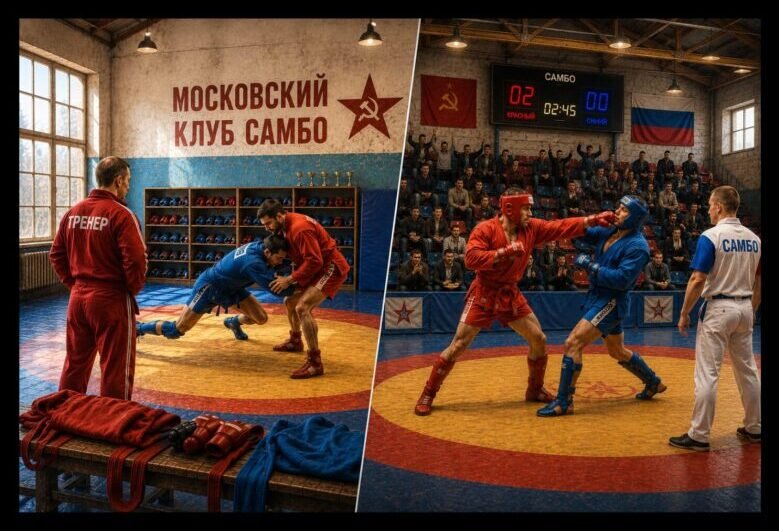
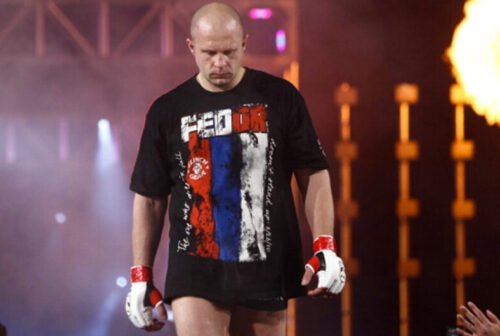
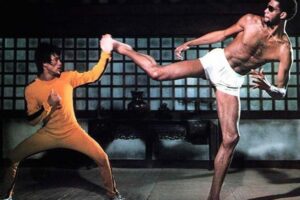
Montage of Combat Sambo athletes striking, grappling, and throwing against a Russian-inspired background representing the martial art's Soviet origins.

Combat Sambo – The Beast from the East

From the rugged training halls of the Soviet Union to the cages of modern MMA, Combat Sambo blends raw aggression, tactical grappling, and battlefield-tested techniques into a relentless system of dominance.

Table of Contents

🥊 Introduction

Sambo (Russian: са́мбо) is a Russian martial art and combat system developed during the Soviet era to improve hand-to-hand combat effectiveness for the Red Army and security forces. The term “Sambo” is an acronym for Samozashchita Bez Oruzhiya (Russian: самозащита без оружия), meaning “self-defence without weapons.”

Built around efficiency, adaptability, and practical combat application, Sambo combines striking, grappling, throws, takedowns, and submissions into a highly versatile fighting system. Drawing influence from Judo, wrestling, regional folk styles, and military combatives, it evolved into one of the most influential martial arts of the twentieth century.

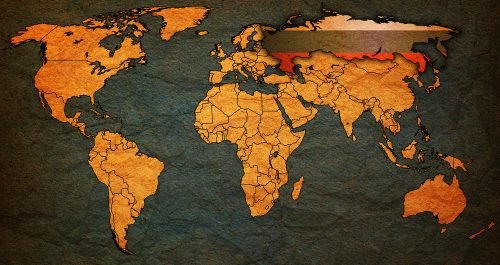
Map of Russia highlighted in the colours of the Russian flag, representing the birthplace of Sambo.

Developed in the Soviet Union, Sambo combines influences from wrestling, Judo, military combatives, and regional folk fighting styles.

Today, Sambo exists as both a combat sport and a fighting system, practised by athletes, military personnel, law enforcement officers, and martial artists around the world. Its success in combat sports and MMA has helped establish a reputation for producing disciplined, technically skilled fighters capable of performing under pressure.

☭ Brief History of Sambo

During the Russo-Japanese War (1904–1905), Russian forces suffered significant setbacks in close-quarters combat against the Japanese military. The conflict exposed weaknesses in Russia’s hand-to-hand combat training and highlighted the need for a more effective system of military unarmed combat.

Following the Bolshevik Revolution in 1917, the Soviet government began searching for ways to modernise and standardise Red Army combat training. Military instructors, security officials, and martial artists studied a wide range of fighting systems, seeking to combine the most effective techniques into a practical discipline suited for warfare, self-defence, and physical conditioning.

From this environment, Sambo gradually emerged.

Russian and Japanese soldiers during the Russo-Japanese War, a conflict that exposed weaknesses in Russian military preparedness and close-quarters combat training.

The Russo-Japanese War exposed weaknesses in Russian close-quarters combat training. Efforts to address these shortcomings would later contribute to the development of Sambo.

Rather than preserving a single martial tradition, Sambo was developed by selecting and refining techniques from a wide range of combat systems. Its creators focused on what worked in practice, combining effective methods into a unified fighting discipline. Its development drew heavily from Judo, wrestling, traditional folk combat styles, and military fighting methods from across the Soviet Union and beyond.

By the 1930s, Sambo had evolved into a structured combat system used by the military, law enforcement, and sporting organisations, laying the foundations for what would later become both Sport Sambo and Combat Sambo.

👤 The Founders of Sambo

Three men were instrumental in creating Sambo: Vasili Oshchepkov, Victor Spiridonov, and Anatoly Kharlampiev.

Click on links below to read more.

Vasili Oshchepkov was one of the first Russians to study Judo in Japan under Jigoro Kano at the famous Kodokan. At a time when very few foreigners were accepted into Japanese martial arts circles, Oshchepkov earned a black belt and developed a deep understanding of throwing, grappling, and groundwork.

After returning to Russia, he began teaching hand-to-hand combat and integrating Judo techniques into Soviet military training. His influence on Sambo was immense, particularly in the areas of throws, takedowns, positional control, and ground fighting. Oshchepkov believed combat systems should be practical, adaptable, and continually refined through live application.

Victor Spiridonov was a veteran of World War I who suffered serious injuries during combat. Because of these physical limitations, he developed a more economical approach to fighting that relied on leverage, timing, and efficiency rather than strength alone.

His system, known as Samoz, emphasised joint locks, off-balancing, and using an opponent’s momentum against them. Spiridonov’s methods focused on control, survival, and achieving maximum effect with minimal effort, adding an important tactical dimension to Sambo’s development.

Often referred to as the father of modern Sambo, Anatoly Kharlampiev played a major role in organising and formalising the art into a coherent system. He travelled extensively throughout the Soviet Union studying regional wrestling styles and traditional combat systems, collecting techniques from numerous republics and ethnic fighting traditions.

Kharlampiev helped transform Sambo from a loose collection of military combat methods into a recognised sport and national martial art. His efforts were instrumental in Sambo receiving official recognition in 1938, helping secure its future throughout the Soviet Union and beyond.

Portraits of Victor Spiridonov, Vasili Oshchepkov, and Anatoly Kharlampiev, the key figures responsible for the development of Sambo.

The founders of Combat Sambo (left to right – Victor Spiridonov, Vasili Oshchepkov and Anatoly Kharlampiev.

☠️ The Great Purge

Sambo’s development nearly suffered a fatal setback during Stalin’s Great Purge of the late 1930s.

Due to his links with Japan and his background in Judo, Vasili Oshchepkov was accused of espionage, arrested, and died in prison in 1938. His death threatened the future of Sambo at a time when Soviet authorities were deeply suspicious of foreign influence.

The art survived largely through the efforts of Anatoly Kharlampiev, who emphasised Sambo’s Soviet identity and helped secure official recognition. Following Stalin’s death, Oshchepkov was posthumously exonerated and is now recognised as one of the principal architects of Sambo.

Monument in Moscow dedicated to Vasili Oshchepkov and Anatoly Kharlampiev, two of the principal architects of Sambo.

This monument honours Vasili Oshchepkov and Anatoly Kharlampiev, whose contributions helped shape Sambo into a recognised martial art and combat sport.

🌍 Recognition and Growth

Following official recognition by the Soviet sports authorities in 1938, Sambo spread rapidly throughout the USSR and became closely associated with military training, law enforcement, and competitive sport. During the second half of the twentieth century it began expanding internationally, receiving recognition from FILA in 1966 and holding its first World Championships in 1972.

The creation of FIAS in 1984 helped organise the sport internationally, while growing success in combat sports and MMA introduced Sambo to a wider audience. In 2018, Sambo received full recognition from the International Olympic Committee, although it has yet to be included as an Olympic sport.

Today, Sambo is practised across Europe, Asia, the Americas, and beyond, and is widely regarded as one of the most influential grappling and combat systems of the modern era.

🌐 Influences

Sambo is a highly syncretic martial art, combining techniques from numerous fighting systems into a single practical combat discipline. Rather than preserving tradition for its own sake, Sambo’s founders focused on identifying what worked under pressure and integrating those methods into an adaptable system suited for military combat, self-defence, and competition.

Its development drew heavily from grappling arts, folk wrestling systems, military combatives, and striking disciplines from across the Soviet Union, Europe, and Asia.

🤼 Grappling Influences

Click on links below to read more.

One of Sambo’s strongest technical influences came from Judo, largely through the work of Vasili Oshchepkov. Judo contributed major elements of Sambo’s throwing system, groundwork, submissions, and training methodology. Many of Sambo’s core throws and positional concepts can still be traced directly to early Kodokan Judo.

Greco-Roman wrestling contributed powerful clinch work, upper-body control, and explosive hip throws, while freestyle wrestling added leg attacks, trips, and dynamic takedown entries. Together, these styles helped shape Sambo’s aggressive and versatile grappling approach.

Various jacket wrestling systems practised throughout the Caucasus and Central Asia heavily influenced Sambo’s gripping mechanics and throwing techniques. Competitors learned to manipulate an opponent’s clothing for control, balance disruption, and takedowns, shaping the development of the distinctive Sambo jacket, known as the Kurtka.

Sambo also absorbed techniques from numerous regional wrestling traditions across the Soviet republics. Georgian wrestling contributed powerful throws and aggressive jacket-gripping exchanges, while Ossetian wrestling was valued for its toughness and practical combat application. Traditional Armenian styles such as Kokh, along with various Azeri, Turkic, and Russian folk wrestling systems, added further elements of belt-gripping, off-balancing, trips, clinch fighting, and lower-body attacks.

Together, these regional traditions helped create the broad technical foundation that became one of Sambo’s defining characteristics.

Wrestling systems from Mongolia and China, including Shuai Jiao, also influenced Sambo’s throwing mechanics and standing grappling exchanges. These arts emphasised balance disruption, explosive takedowns, and continuous control from the clinch, reinforcing Sambo’s preference for dynamic throwing and positional dominance.

👊 Striking Influences

Click on links below to read more.

Both Oshchepkov and Spiridonov were familiar with the striking methods found within older Japanese martial arts systems. These attacks targeted vulnerable areas and complemented Sambo’s close-quarters combat philosophy.

Western boxing heavily influenced Sambo’s punching techniques, defensive movement, timing, and striking fundamentals. Boxing’s emphasis on efficient hand striking became an important component of Combat Sambo.

French Savate, which had been practised within the Russian Empire before the Revolution, likely contributed elements of kicking and lower-body striking to Sambo’s striking arsenal.

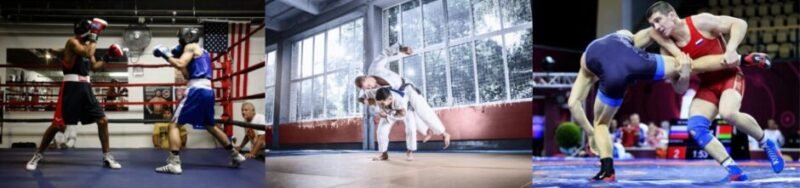
Collage featuring boxing, Judo, and traditional wrestling styles that influenced the development of Sambo.

Sambo combines influences from Judo, wrestling, boxing, and regional folk combat styles into a single fighting system.

Rather than copying any single martial art wholesale, Sambo evolved by selecting effective techniques from multiple systems and adapting them into a cohesive combat framework. This emphasis on practicality, pressure testing, and adaptability became one of the defining characteristics of the art.

🧩 What Makes Sambo Different?

Most martial arts can trace their lineage back to one or two primary influences. Sambo is different. Rather than evolving from a single tradition, it was deliberately assembled from numerous combat systems with the goal of creating the most effective fighting method possible.

Several characteristics help distinguish Sambo from other grappling arts:

  • Kurtka Jacket Wrestling: Extensive use of jacket grips for throws, control, and off-balancing.
  • Aggressive Leg Locks: Sambo is particularly known for its lower-body submission game, including ankle locks, kneebars, and leg attacks that were uncommon in many traditional grappling systems.
  • Explosive Throws: Influences from wrestling and Judo combine to create a fast-paced throwing style that rewards aggression and forward pressure.
  • Combat Sambo Striking: Unlike most grappling arts, Combat Sambo integrates punches, kicks, knees, and elbows alongside throws and submissions.
  • Relentless Transitions: Sambo practitioners are trained to move fluidly between striking, clinching, takedowns, groundwork, and submissions without pausing between ranges.

The result is a combat system that combines the throwing ability of Judo, the pressure of wrestling, the submission threat of leg locks, and the adaptability of mixed combat. This blend helps explain why Sambo has become one of the most successful foundations for modern MMA competition.

🥋 Types of Sambo Practised

Today, several variations of Sambo are practised, each shaped by different goals ranging from military combat and self-defence to competitive sport. The two most widely recognised forms are Combat Sambo and Sport Sambo.

⚔️ Combat Sambo

Combat Sambo (Russian: Боевое Самбо) was originally developed for military use and remains the more aggressive and combat-oriented branch of the art. Designed for soldiers, special forces, and law enforcement personnel, it combines striking and grappling into a highly adaptable close-quarters fighting system that closely resembles modern MMA.

Unlike Sport Sambo, Combat Sambo integrates punches, kicks, knees, elbows, throws, takedowns, submissions, and positional control within a single ruleset. Practitioners are trained to transition seamlessly between striking, clinch fighting, takedowns, and ground control.

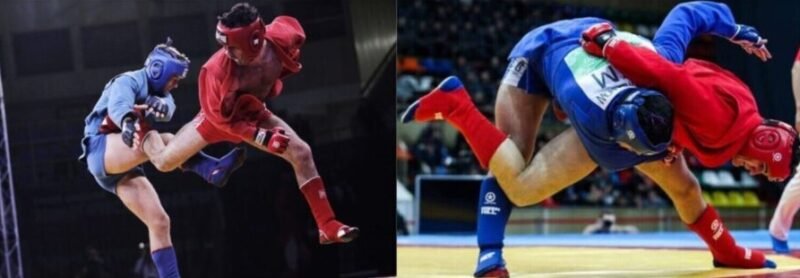
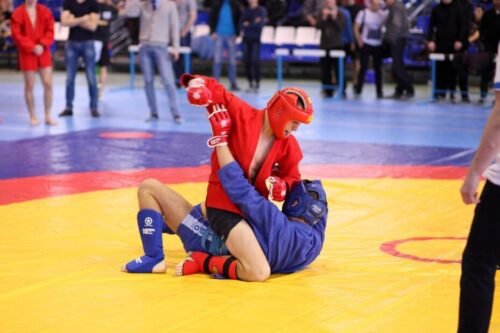
Two Combat Sambo competitors exchanging punches during a match while wearing protective headgear and gloves.

Unlike Sport Sambo, Combat Sambo incorporates punches, kicks, knees, and elbows alongside throws, takedowns, and submissions.

Chokes, joint locks, and leg locks form a major part of the submission game, while some military and non-sport applications may also include weapon defence, disarming techniques, and close-quarters combat concepts. This blend of striking, grappling, and transitional fighting has made Combat Sambo one of the most successful martial arts backgrounds in modern MMA.

🤼 Sport Sambo

Sport Sambo (Russian: Борьба Самбо) is the competitive civilian form of the art and focuses primarily on grappling, throws, takedowns, and submissions. While it shares similarities with Judo and wrestling, it possesses a distinctive rule set, pace, and tactical approach.

The sport rewards explosive throws, aggressive attacks, and continuous forward pressure. Competitors use the Kurtka jacket to establish grips, disrupt balance, and set up takedowns, creating a highly technical standing grappling game.

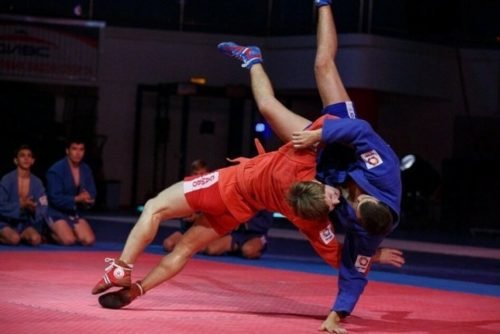
A Sport Sambo competitor executing a powerful suplex during a match, demonstrating the throws and wrestling techniques that define the sport.

Sport Sambo is a competitive sport focusing on throws and grappling without strikes, emphasizing technical skill and compliance with sportive rules for safe, athletic competition.

Unlike Combat Sambo, striking is not permitted and chokeholds are generally prohibited under standard competition rules. However, Sambo’s permissive approach to leg locks and lower-body submissions gives it a distinctive identity within the grappling world and helps separate it from many traditional grappling arts.

Today, Sport Sambo is practised internationally and serves as both a respected combat sport and a common pathway into Combat Sambo.

🔀 Other Variations

Several specialised forms of Sambo have also emerged over time, adapting the art for different sporting, civilian, and operational environments.

🥋 Freestyle Sambo

Developed by the American Sambo Association, Freestyle Sambo broadens the rule set by allowing techniques such as chokeholds that are restricted in traditional Sport Sambo.

🛡️ Self-Defence Sambo

A civilian-focused variation that emphasises practical responses to common threats, including grabs, strikes, and weapon attacks.

🪖 Special Sambo

Special Sambo is a military-oriented variation developed for elite Russian units and special operations forces. Its role within military and security training is explored later in this article.

🏖️ Beach Sambo

A standing-only variation contested on sand, placing heavy emphasis on throws, takedowns, balance disruption, and explosive movement.

🧠 Sambo's Combat Philosophy

At its core, Sambo is built around initiative, pressure, and control. Rather than reacting to an opponent, the goal is to impose a pace, force mistakes, and dictate where the fight takes place.

The objective is simple: gain control, maintain initiative, and prevent the opponent from settling into a comfortable rhythm.

Sambo practitioners are encouraged to move fluidly between striking, clinching, takedowns, and groundwork rather than treating them as separate phases of combat. If one attack fails, another follows immediately. Throws lead into pins, pins lead into submissions, and strikes create opportunities for takedowns.

This emphasis on constant transition creates a proactive style of fighting. Rather than waiting for perfect opportunities, Sambists seek to create them through pressure, positional dominance, and relentless forward momentum.

👊 Integration of Striking and Grappling

One of Combat Sambo’s defining characteristics is its seamless integration of striking and grappling.

Strikes are used to create reactions, disrupt balance, and open pathways to takedowns or submissions. Punches, elbows, knees, and kicks are not viewed as separate tools, but as part of a wider offensive system.

Likewise, grappling positions can create opportunities for striking. Throws may leave opponents vulnerable on impact, while clinch control and dominant positions allow practitioners to continue attacking during transitions.

This ability to blend striking and grappling into a continuous offensive sequence helps explain why Combat Sambo has adapted so successfully to modern MMA competition.

🥋 Key Techniques

🤼 Throws and Takedowns

Throws are central to Sambo’s approach to combat. Practitioners use explosive hip throws, sweeps, trips, sacrifice throws, and wrestling-style takedowns to bring opponents to the ground while maintaining positional advantage and control.

Rather than simply scoring points, throws are often used to disrupt balance, break posture, and create immediate opportunities for follow-up attacks. The influence of both wrestling and Judo can be clearly seen throughout Sambo’s throwing arsenal.

Two Combat Sambo practitioners exchanging strikes before engaging in grappling range.

Strikes are often used to create openings for clinch entries, takedowns, and submissions.

🔒 Joint Locks and Submissions

Submissions play a major role in Sambo’s grappling system, allowing practitioners to control, incapacitate, or finish opponents once dominant positions have been established. Techniques target both the upper and lower body, with arm bars, shoulder locks, kneebars, ankle locks, and various compression locks all forming part of the art’s technical arsenal.

Unlike systems that rely heavily on static positional control, Sambo often applies submissions aggressively during transitions, scrambles, and moments of instability. Practitioners are trained to recognise openings quickly and attack before opponents have an opportunity to recover their position.

🦵 Why Is Sambo Famous for Leg Locks?

While many grappling systems historically focused on upper-body submissions, Sambo practitioners developed a sophisticated arsenal of ankle locks, kneebars, heel controls, and other lower-body attacks.

This emphasis gave Sambists a unique tactical advantage and helped influence modern submission grappling and MMA, where leg locks have become increasingly important. Today, Sambo remains one of the martial arts most closely associated with aggressive and highly developed lower-body submission fighting.

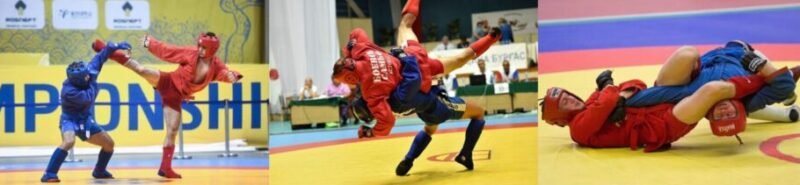
Combat Sambo competitors transitioning from striking range into a takedown exchange.

In Sambo, a solid strategy is to use strikes to weaken the opponent and break their defenses, setting up a takedown. Once the takedown is secured, the practitioner can finish with a pin or submission.

📍 Pins and Positional Control

Pins are used to immobilise opponents, restrict movement, and establish dominance during ground exchanges. Maintaining pressure and positional control allows practitioners to limit an opponent’s options while creating opportunities for strikes, submissions, or further advancement.

This emphasis on control reflects Sambo’s broader philosophy of dictating the fight and forcing opponents to react.

👊 Striking

Combat Sambo integrates punches, kicks, elbows, and knees into both standing and transitional exchanges. Striking is used not only to inflict damage, but also to disrupt balance, break defensive structure, and create openings for throws, clinch entries, or submissions.

The ability to blend striking seamlessly with grappling is one of the defining features that separates Combat Sambo from purely grappling-based systems.

🏋️ Training in Sambo

Combat Sambo training combines striking, grappling, conditioning, and live resistance into a demanding system designed to prepare practitioners for both competition and self-defence.

Training typically begins with the fundamentals of movement, striking, throws, takedowns, and submissions before progressing into more advanced combinations and live combat scenarios. Techniques are drilled repeatedly to develop timing, coordination, and technical proficiency under pressure.

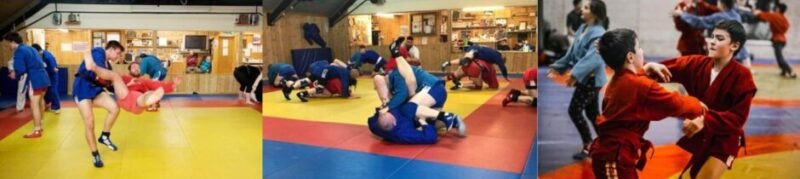
Young Sambo practitioners training throws, grappling, and movement drills under instructor supervision.

Early exposure to wrestling and Sambo has helped produce generations of highly skilled grapplers and combat athletes.

Live sparring is a central component of Sambo training. Practitioners regularly test their skills against resisting opponents in both standing and ground exchanges, helping bridge the gap between technical knowledge and practical application.

The result is a training environment that emphasises realism, adaptability, and the ability to perform effectively against active resistance.

Click on links below to read more.

While training methods vary between clubs, most Sambo classes follow a broadly similar structure. Sessions often begin with mobility work, conditioning drills, and breakfall practice before moving into technical instruction. Practitioners then spend time drilling throws, takedowns, grip fighting, positional control, and submissions, gradually increasing resistance as techniques become more familiar.

Many classes also include situational sparring, allowing students to focus on specific positions or scenarios before progressing to live wrestling or Combat Sambo sparring. Depending on whether the emphasis is Sport Sambo or Combat Sambo, sessions may also incorporate striking drills, defensive tactics, and combat-oriented training exercises.

This combination of technical drilling, live resistance, and physical conditioning helps develop the adaptability, timing, and pressure-tested skills for which Sambo is known.

Physical conditioning is a major component of Sambo training and reflects the art’s military and competitive roots. Success in Sambo requires a combination of strength, endurance, explosiveness, mobility, and resilience, allowing practitioners to maintain performance during fast-paced and physically demanding exchanges.

Training commonly includes strength and power development, cardiovascular conditioning, grip training, agility drills, mobility work, and explosive movement exercises. These qualities support the demands of throwing, clinch fighting, takedowns, groundwork, and repeated sparring rounds while helping practitioners remain effective under fatigue and physical stress.

In Russia and many former Soviet states, Sambo training often begins at a young age, with athletes growing up immersed in a highly competitive wrestling and combat sports culture. This long-term development system has produced generations of successful Sambists and helped establish Sambo as one of the most effective foundations for high-level grappling and MMA competition.

Combat Sambo competitions are known for their fast pace, aggressive exchanges, and broad technical rule set, allowing fighters to combine striking, grappling, takedowns, and submissions within the same match. Unlike many combat sports that separate striking from grappling, Combat Sambo encourages constant transitions between the two, creating a style of competition that closely resembles modern MMA.

Competitors wear a specialised jacket known as a Kurtka, along with shorts, wrestling shoes, and protective equipment. The Kurtka plays a major tactical role, allowing fighters to establish grips, control balance, and set up throws during clinch exchanges.

Victory may be achieved through knockout, technical knockout, submission, points victory, or opponent disqualification. Matches reward effective striking, successful throws, positional dominance, and offensive initiative, with high-impact throws particularly valued within the scoring system.

Combat Sambo encourages continuous engagement and offensive pressure. Fighters who stall, repeatedly avoid action, or use illegal techniques may receive penalties, point deductions, or disqualification.

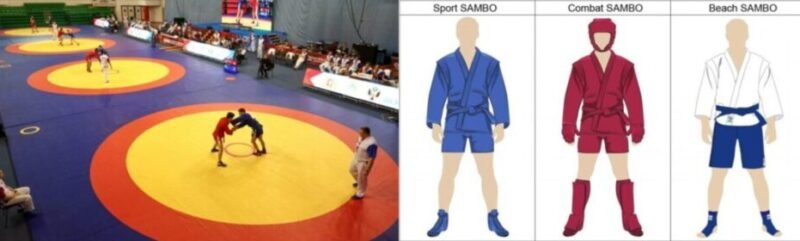
Sambo competition mat alongside Sport Sambo and Combat Sambo uniforms, including protective equipment used for striking.

(Left) Sambo matches take place on a specialised mat designed for throwing and grappling exchanges. (Right) The Sambo uniform varies by discipline, with Combat Sambo incorporating protective equipment to accommodate striking.

🚨 Street Effectiveness

Combat Sambo was designed with practical violence in mind, making it one of the most functional and pressure-tested combat systems to emerge from the twentieth century. Its blend of striking, grappling, takedowns, and submissions gives practitioners answers to many of the situations commonly encountered during physical confrontations.

Combat Sambo practitioners engaged in a close-range exchange involving striking and grappling techniques.

Combat Sambo’s emphasis on striking, clinch fighting, takedowns, and submissions makes it highly effective in chaotic close-range confrontations.

Click on links below to read more.

Combat Sambo incorporates punches, kicks, elbows, and knees, allowing practitioners to engage effectively at striking range. Unlike systems that focus solely on grappling, Sambists can strike to create openings, disrupt an opponent’s balance, and set up takedowns or clinch entries.

Many real-world altercations quickly collapse into grabbing, clinching, and wrestling for control. This is an area where Sambo excels.

Its emphasis on throws, trips, takedowns, and off-balancing techniques allows practitioners to dictate positioning and potentially end confrontations by putting opponents on the ground.

If a confrontation reaches the ground, Sambo provides a strong arsenal of positional control and submission techniques. Joint locks, particularly leg attacks, give practitioners multiple options for controlling or incapacitating an opponent.

One of Sambo’s greatest strengths is its training methodology. Regular sparring, live resistance, and competition expose practitioners to unpredictable situations and resisting opponents. This develops timing, composure, and the ability to function under pressure.

Like all martial arts, Combat Sambo has limitations.

Real-world violence may involve multiple attackers, weapons, environmental hazards, or legal consequences that differ significantly from training or competition. Technical skill alone cannot replace awareness, avoidance, de-escalation, and sound judgement.

⚖️ Final Evaluation — Sambo for Self-Defence

Within its range, Combat Sambo is one of the most complete and effective martial arts for self-defence. Its blend of striking, clinch fighting, takedowns, submissions, and positional control gives practitioners tools across most phases of a physical confrontation.

Its greatest strength is its ability to transition under pressure. A Sambist can strike into the clinch, throw from the clinch, control on the ground, and attack submissions during scrambles. This makes Sambo highly adaptable in chaotic situations where distance, balance, and control are constantly changing.

However, Sambo is not a magic answer to violence. Civilian self-defence also requires awareness, de-escalation, legal judgement, weapon awareness, escape tactics, and environmental control. Combat Sambo provides an excellent fighting base, but real-world self-protection demands more than fighting skill alone.

✅ Pros

  • Excellent blend of striking, grappling, throws, and submissions.
  • Strong clinch fighting and takedown ability.
  • Highly pressure-tested through sparring and competition.
  • Effective leg locks and lower-body submission attacks.
  • Develops aggression, toughness, conditioning, and composure.
  • Translates extremely well into MMA and full-contact fighting.
  • Useful for controlling, throwing, or disabling an attacker at close range.

❌ Cons

  • Authentic instruction can be hard to find outside Russia, Eastern Europe, and specialist clubs.
  • Sport Sambo lacks striking and chokes under standard rules.
  • Combat Sambo availability is far more limited than Judo, BJJ, Wrestling, Boxing, or MMA.
  • Heavy throwing and submission training carries injury risk.
  • Some military and self-defence claims can be exaggerated by poor instructors.
  • Limited focus on civilian legal aftermath, de-escalation, and avoidance unless specifically taught.
  • Weapon defence should be treated cautiously and pressure-tested realistically.

🛡️ Military and Security Use

One of the reasons Sambo gained such a strong reputation for practicality is its long association with military, law-enforcement, and security organisations. While it has developed into a successful combat sport, many of its techniques and training methods were originally shaped by the demands of real-world conflict, control, and close-quarters combat.

🪖 Military Applications

Sambo has long been associated with Russian military forces, particularly the various special operations units collectively referred to as Spetsnaz. Although popular media often portrays Sambo as the sole martial art of Russian special forces, the reality is more nuanced. Modern personnel typically train in a combination of boxing, wrestling, military combatives, firearms skills, and close-quarters combat systems.

Even so, Sambo has historically formed one of the most influential foundations of Russian hand-to-hand combat training. Its emphasis on throws, takedowns, submissions, clinch control, and fighting under pressure aligns closely with the demands of military personnel operating in unpredictable and high-stress environments.

Combat Sambo in particular was developed with military applications in mind, combining striking and grappling into a practical close-quarters fighting system. This connection has helped cement Sambo’s reputation as one of the defining combat arts of the Soviet and Russian military tradition.

Military or security personnel demonstrating Sambo-based restraint and control techniques.

Sambo’s emphasis on control, restraint, and close-quarters combat has made it popular within military and security circles.

🚔 Law Enforcement and Security

Beyond the military, Sambo has also seen widespread use within law enforcement, security, and protective-service roles. Practitioners are trained to establish control quickly through clinch work, throws, sweeps, restraints, and positional dominance, making the system particularly effective in confined environments where threats emerge at close range.

Bodyguards and security personnel often operate in situations where controlling an aggressive individual is more important than causing damage. Sambo’s emphasis on balance disruption, takedowns, restraint techniques, and positional control provides practical tools for managing confrontations while maintaining command of a situation.

This practical focus has helped establish Sambo as one of the most respected combat systems within Russian military, law-enforcement, and security culture.

🇷🇺 Sambo Today

Once largely confined to the Soviet Union and its sphere of influence, Sambo is now practised throughout the world. The art continues to evolve as both a competitive combat sport and a practical fighting system, attracting practitioners from wrestling, Judo, Brazilian Jiu-Jitsu, and MMA backgrounds.

Today, strong Sambo communities can be found across Eastern Europe, Central Asia, Mongolia, Japan, the United States, the United Kingdom, and parts of South America and the Middle East. While Russia and the former Soviet republics remain the sport’s traditional heartland, its international reach has expanded considerably over the past few decades.

Governing international bodies for Sambo in the US and UK. USA Sambo and British Sombo Federation.

Much of this growth has been driven by the success of Sambists in modern MMA, helping expose the art to a wider audience and reinforcing its reputation as one of the most effective combat systems of the modern era.

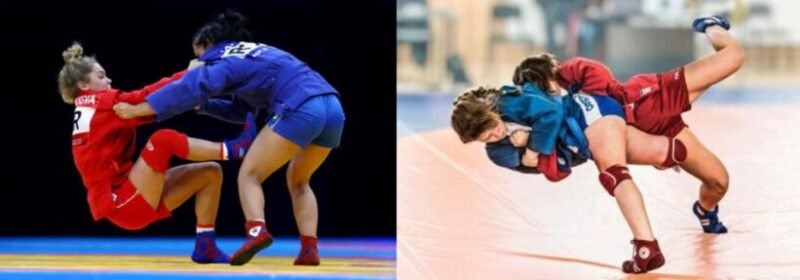
Female Sambo competitors engaged in a match during an international tournament.

Recent times have seen even greater recognition and support for female athletes, further contributing to the sport’s development worldwide.

🏔️ Dagestan and the Rise of Modern Grappling Culture

Few regions have had a greater influence on modern combat sports than Dagestan and the wider Caucasus.

Wrestling and grappling have deep cultural roots throughout the region, where combat sports are often viewed as both a source of personal development and a pathway to sporting success. Many athletes begin training at a young age and grow up immersed in highly competitive wrestling environments.

This culture has produced a remarkable number of elite fighters, including Khabib Nurmagomedov and Islam Makhachev, whose success helped bring global attention to Sambo and the broader grappling traditions of the Caucasus.

The relentless takedowns, clinch control, positional dominance, and suffocating pressure commonly associated with modern Dagestani fighters have become some of the most recognisable characteristics of Sambo-influenced MMA.

🏆 Famous Practitioners and Their Contributions

👑 Fedor Emelianenko

Widely regarded as one of the greatest heavyweight fighters in MMA history, Fedor Emelianenko remains one of Combat Sambo’s most iconic representatives. Nicknamed The Last Emperor, he achieved major success in both MMA and Combat Sambo, winning multiple World Combat Sambo Championships alongside a legendary run in PRIDE Fighting Championships.

Fedor Emelianenko, legendary Combat Sambo champion and MMA heavyweight, during competition.

Fedor’s calm demeanour, explosive throws, powerful striking, submission ability, and tactical adaptability showcased many of the qualities associated with Combat Sambo. His success helped introduce Sambo to mainstream MMA audiences and demonstrated that the art could compete successfully at the highest levels of combat sports.

🦅 Khabib Nurmagomedov

Before becoming UFC Lightweight Champion and retiring undefeated at 29–0, Khabib Nurmagomedov was already a two-time Combat Sambo World Champion. His relentless pressure, chain wrestling, clinch control, takedowns, and suffocating top game became hallmarks of both his fighting style and the modern Dagestani approach to combat sports.

Khabib Nurmagomedov, former UFC Lightweight Champion and Combat Sambo World Champion, during competition.

Khabib’s dominance helped expose a new generation of fans to Sambo and reinforced its reputation as one of the most effective foundations for elite MMA competition.

🥇 Islam Makhachev

Islam Makhachev emerged as the next major Sambist to dominate the UFC lightweight division, continuing the legacy established by Khabib and the wider Dagestani combat system. A highly accomplished Combat Sambo competitor before entering MMA, he combines technical striking, takedowns, clinch control, and elite positional grappling into an exceptionally efficient fighting style.

Islam Makhachev, UFC champion and Combat Sambo practitioner, competing during a professional MMA bout.

His success has further strengthened Sambo’s reputation within modern MMA and demonstrated the continued effectiveness of its blend of wrestling, submissions, and transitional fighting.

Together, fighters such as Fedor, Khabib, and Islam helped transform Sambo from a relatively niche Soviet martial art into one of the most respected and influential combat backgrounds in modern mixed martial arts.

🥊 Why Sambo Produces Successful MMA Fighters

Few martial arts have adapted to MMA as successfully as Combat Sambo.

The reason lies in the way the system was originally developed. Unlike arts that focus primarily on a single range of combat, Combat Sambo combines striking, clinch fighting, takedowns, submissions, and ground control within a single training framework. As a result, many of the skills required for MMA are already present before a fighter ever enters a cage.

Sambo also encourages seamless transitions between these phases. Fighters learn to move from striking to wrestling, from takedowns to positional control, and from scrambles to submissions without treating them as separate disciplines.

Another major advantage is the emphasis placed on live resistance. Regular sparring, competition, and pressure-tested techniques help practitioners develop timing, composure, and decision-making against resisting opponents, all of which are critical in MMA competition.

Perhaps most importantly, Sambo teaches fighters to dictate where a fight takes place. Whether standing, clinching, or grappling on the ground, Sambists are typically comfortable imposing their preferred style of combat and forcing opponents to react.

These qualities have helped produce some of the most successful competitors in modern MMA and explain why Sambo remains one of the most respected combat backgrounds in the sport today.

🏁 Conclusion

Sambo emerged from a uniquely Soviet effort to create a practical and effective system of hand-to-hand combat. Drawing from Judo, wrestling, regional folk styles, and military combatives, it evolved into a martial art built around practical effectiveness, technical versatility, and performance under pressure.

Over time, Sambo expanded far beyond its military origins. It developed into both a respected international combat sport and one of the most successful foundations for modern MMA, producing generations of fighters known for their toughness, technical ability, and relentless competitive style.

A Sambist executing a powerful suplex during competition, demonstrating the explosive throwing techniques associated with the martial art.

From Soviet military origins to modern MMA success, Sambo has secured its place among the most influential martial arts of the twentieth and twenty-first centuries.

What separates Sambo from many martial arts is not any single technique, but the way it blends multiple aspects of combat into a unified system. Throws, strikes, takedowns, submissions, and positional control are treated as interconnected tools rather than isolated skills, allowing practitioners to adapt to rapidly changing situations and maintain control across multiple ranges of combat.

Today, Sambo is practised around the world by athletes, competitors, military personnel, and martial artists seeking a proven and practical approach to combat. From Soviet training halls to World Championship mats and UFC title fights, it has earned its reputation as one of the most influential martial arts of the modern era.

If you have enjoyed this post please share or feel free to comment below 🙂

Related Posts

Our Other Posts

Leave a Reply

Your email address will not be published. Required fields are marked *

This site uses Akismet to reduce spam. Learn how your comment data is processed.

error: Content is protected !!

Join the Super Soldier Project Mailing List Today!!