









Athlete walking away from empty gym surrounded by discarded equipment showing failed training attempt and lack of structure

The Failure Trap – Why Most Fitness Goals Fail

Most fitness goals don’t fail because of effort — they fail because they were never built to survive real life. This post kicks off a 4-part series on building fitness goals that actually hold. We start by breaking down why most goals fail — not from lack of effort, but from poor structure.

Table of Contents

📖 Introduction

Every year begins the same way. A burst of motivation. Fresh gear. New plans. A belief that this time will be different.
The intention is genuine. People want to feel stronger, healthier, and more capable in their own bodies.

But good intentions alone don’t carry a plan very far. Most fitness goals collapse long before they reach the finish line — not because the person failed, but because the goal itself was poorly designed. Within a few weeks, normal life begins to interfere. Work becomes busy. Sleep suffers. Motivation fades. Training sessions start to slip, routines break down, and the plan quietly disappears.

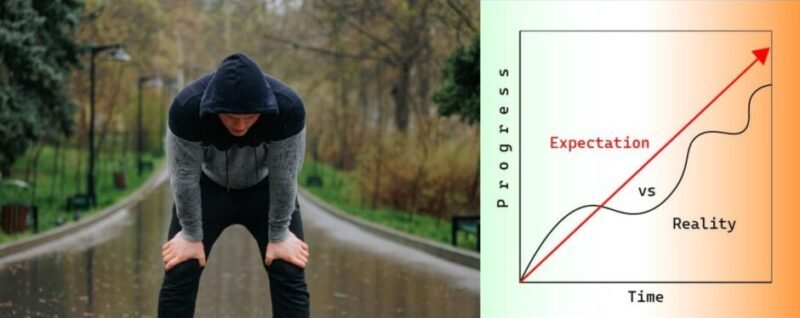
Exhausted runner struggling early with expectation vs reality fitness chart comparison

You start harder than your current capacity allows. Within minutes, the gap between expectation and reality shows — and the plan begins to break.

Many people assume the problem is discipline. In reality, the issue is structural. The goal was built around a surge of motivation rather than a system that can survive real life. And real life always pushes back.

🧭 What This Series Will Do

The aim of this series is to show how to build fitness goals that hold up under pressure — goals that survive work stress, bad sleep, busy schedules, and low motivation. Because those are the real enemies of progress.

This is Part 1 of a 4-part series focused on building a goal-setting framework that works in real life — from identifying failure points, to building identity, assessing your starting point, and structuring a plan that holds.

You’ll learn how to:

  • Build a performance-driven training identity.
  • Install habits that survive stress and busy schedules.
  • Choose performance goals that actually drive progress.
  • Track improvement without becoming obsessive.
  • Adjust your plan without losing direction.

The aim isn’t motivation or hype. It’s a practical system that keeps working long after the initial enthusiasm fades.

🧩 Internal Patterns

When goals fail, people often blame circumstances — work schedules, stress, or lack of time. In reality, the collapse usually begins much earlier, inside the way the goal was designed. Certain patterns appear again and again.

Young man collapsed on gym floor holding dumbbell showing overtraining and lack of structure leading to fatigue

You push too hard, too soon, then hit a wall. Without structure, effort spikes and collapses instead of building anything.

Outcome-only goals — “Lose 10kg.” “Get fitter.” “Run a marathon.” These focus on the result but ignore the daily behaviours required to reach it. Without a process, the goal becomes a wish rather than a plan.

Unrealistic timelines — Expectations shaped by marketing, social media, or memories of a younger version of yourself. Years of drift cannot be reversed in a four-week transformation window.

All-or-nothing perfectionism — One missed session becomes self-sabotage. A small disruption turns into “I’ll restart Monday.” Progress becomes fragile because it depends on perfection.

No tracking or weekly structure — Without measurement nothing adapts. Without a routine every session becomes a negotiation.

Identity mismatch — If someone still sees themselves as inconsistent, unfit, or “not a gym person,” behaviour eventually follows that identity. Actions rarely outperform self-perception for long.

In short, many people aim for a destination while still thinking and living like the person who never gets there. Goals often fail in the mind before they fail in the diary.

⚠️ The Comfort Zone Problem

Part of the reason these patterns appear is simple: the brain prefers comfort.
Routine. Familiarity. Low effort.

Training consistently asks for the opposite — effort, discipline, and time carved out of an already busy schedule. The moment discomfort appears, the mind begins negotiating:

“You’ve worked hard this week.”
“Go tomorrow.”
“One missed session won’t matter.”

Man relaxing on couch next to gym bag procrastinating instead of training showing comfort zone behaviour

The intention is there, but comfort wins. The session gets delayed, then skipped, and the pattern repeats.

Individually those thoughts seem harmless. Repeated often enough, they quietly dismantle consistency.

Progress doesn’t require punishment or extreme effort, but it does require stepping outside the comfort zone often enough for the body to adapt.

🌍 Real-World Constraints

Even the best internal intentions eventually collide with external pressure. The world does not reorganise itself to support a new fitness goal. Instead, existing demands begin competing with it.

Real life doesn’t clear space for your training. Work runs late, energy drops, and time disappears — this is what your plan has to survive.

Time — Work obligations, commuting, family responsibilities, and unexpected interruptions. The calendar dictates behaviour far more than motivation does.

Stress and recovery limits — High stress disrupts sleep. Poor sleep drains energy. Training layered on top of inadequate recovery quickly leads to stagnation and resentment. Training volume that exceeds your ability to recover will eventually force regression, regardless of intent.

Age and training age — Biology matters, but so does experience. A beginner cannot adopt the workload of someone who has trained consistently for years — yet many try.

Health and injury history — Old injuries, chronic issues, and medical constraints shape what is possible. Ignoring them usually leads to setbacks rather than progress.

Environment and access — Equipment, space, weather, and travel influence consistency more than most people realise. Convenience is a powerful ally; friction is a reliable barrier.

Social pressure — Partners, friends, and colleagues all influence behaviour. When the people around you are not aligned with your goals, behavioural friction increases.

Taken together, these constraints define the conditions your goal has to survive. A plan that doesn’t match your lifestyle will always fail, no matter how effective it looks on paper. These are not excuses. They are variables — and goals that ignore them are fragile by design.

Fitness does not happen in a vacuum. It has to survive the world it lives in.

📚 Knowledge Gaps

A large portion of failure is simply not knowing what to do. Fitness advice is endless, contradictory, and often designed to sell something rather than help.

Two issues dominate.

Two men in gym looking frustrated and overwhelmed, unsure what to do, showing lack of training direction and knowledge

Without a clear plan, training becomes guesswork. Effort builds frustration, not progress, and motivation drops quickly.

Random workouts

Many people train hard but without a clear strategy. They jump between programmes, change exercises constantly, and chase variety instead of progression.

The body adapts to consistent stress applied over time. Without progression — gradually increasing workload, improving technique, or repeating movements long enough for adaptation — effort gets spent without producing real improvement.

Most people don’t fail because they chose the wrong programme. They fail because they don’t follow any programme long enough for it to work.

Many people train consistently but see little change because their nutrition doesn’t support their goal. Fat loss, muscle gain, and performance all depend on energy balance and recovery — not just effort in the gym.

Training can drive adaptation, but it cannot override consistently poor intake.

Poor technique leading to injury

Fitness is also a skill. Strength exercises, running mechanics, and conditioning drills all depend on movement patterns that improve with practice.

When technique is ignored, people load movements their joints and tissues are not prepared for. Pain interrupts progress, and fear of reinjury keeps them from continuing.

Learning good mechanics early allows safer progression, heavier loads, and years of improvement.

Information overload is not the same as understanding. Many approaches fail because they are too complex too early. Detail without consistency creates friction, not progress.

Many people are overwhelmed not because they lack motivation, but because they lack clarity.

🧠 Emotional / Psychological Triggers

The biggest disruptors are rarely physical. They are emotional reflexes triggered by everyday life.

Woman hesitating to enter gym due to intimidation and man comfort eating showing emotional triggers affecting fitness consistency

You don’t stop because you can’t train — you stop because stress, doubt, and discomfort change the decision in the moment.

Stress eating — Food often becomes a coping mechanism during stressful periods. After a difficult day, the brain naturally looks for comfort and reward. One evening of emotional eating can override a week of good decisions if the pattern repeats often enough.

Gym intimidation — Many people enter the gym hyper-aware of judgement. The space feels designed for people who already know what they are doing, which turns uncertainty into avoidance. In reality, most people are focused on their own workouts — but the anxiety is enough to keep beginners away or limit how often they show up.

Boredom — is often mistaken for lack of motivation. In practice, it’s a breakdown in engagement. When training becomes repetitive without purpose or progression, attention drops, sessions get skipped, and consistency fades.

Shame after setbacks — A missed workout or poor week can trigger guilt and self-criticism. Instead of adjusting and continuing, people assume they’ve already failed. Small disruptions turn into a shame spiral where quitting feels easier than restarting.

People often assume progress is linear. In reality, it is messy, emotional, and repeatedly tested.

Training the body without learning how to respond to stress, discomfort, and inconsistency leaves the goal vulnerable the moment life pushes back.

⚙️ Structure That Wins

Once you understand why goals fail, the solution becomes much clearer. Progress holds when the system — not your mood — drives the behaviour.

Young woman on running track unzipping gym bag preparing to train showing structured routine and readiness

When training is planned and prepared for, there’s no decision to make — you show up and start.

A stable fitness framework tends to develop in this order:

Identity Habits Strength Results

Most people try to build this sequence backwards.

They start with the result they want — weight loss, visible abs, better fitness — and hope motivation will somehow carry them there. When progress slows, the goal collapses because nothing underneath it is stable.

The process works better when the foundations come first.

Identity — This is the decision about the kind of person you are becoming. Someone who trains consistently, even when motivation fluctuates.
If a person still sees themselves as someone who “tries to get fit,” their behaviour remains fragile. When identity shifts to “I’m someone who trains,” consistency becomes normal rather than exceptional.

Habits — Once identity is clear, behaviour follows. Training sessions, basic nutrition habits, sleep, and recovery routines become regular parts of the week.
These habits don’t need to be perfect. They simply need to be repeatable enough to survive busy schedules, stress, and imperfect days.
Habits are the engine that drives progress.

Strength and capability — Over time, those habits begin to produce measurable change. Strength improves. Endurance increases. Technique becomes more efficient.
This is where progress becomes visible in performance. Numbers go up, times come down, and the body gradually adapts to the training stress.
Feedback becomes useful here — performance tells you whether the system is working.

Results — Finally, the visible outcomes appear. Body composition changes. Fitness improves. Confidence grows.
This is the stage most people want to start with, but it only appears consistently after the three foundations above are in place.
Results are not the starting point. They are the consequence.

🔄 Systems Beat Motivation

Motivation will always fluctuate. Stress, fatigue, and routine pressures will eventually erode it.

Systems survive those fluctuations. When training sessions are scheduled, habits are established, and progress is measured, behaviour continues even when enthusiasm disappears. The structure carries the goal forward.

This is why experienced athletes rely far less on motivation than beginners often assume. Their progress is built on routine.

Consistency beats intensity.

🏁 Build Goals That Survive Real Life

Most fitness goals fail not because people lack effort, but because the goal was never designed to survive real life.
Work becomes busy. Stress rises. Sleep suffers. Motivation dips. When a plan depends on perfect conditions, it collapses quickly.

Progress comes from designing goals that can withstand disruption — goals built on habits, structure, and realistic expectations rather than bursts of enthusiasm.

The real measure of a plan is not how it performs on your best days, but how it survives the difficult ones.

If a goal cannot exist in your real world, it will not exist at all.

Two men training with push ups and jogging showing simple sustainable fitness routines and consistent effort

Nothing extreme — just work that can be repeated. Progress comes from what you can sustain, not what you push through once.

🎯 Key Takeaways — What Actually Holds

  • Goals fail at the design stage, not the effort stage.
  • Motivation is unreliable. Structure is what sustains progress.
  • Internal patterns — like perfectionism and lack of structure — quietly undermine consistency.
  • External constraints are not obstacles to ignore, but variables to plan around.
  • Random training produces random results. Progress requires direction and repetition.
  • Emotional responses — stress, boredom, shame — are often the real breaking points.
  • Sustainable progress follows a sequence: Identity → Habits → Strength → Results.
  • The goal is not intensity. The goal is repeatability under real-world conditions.

🧠 Next Post - The Athlete Mindset

Understanding why goals fail is only the first step. Fixing it requires a shift deeper than planning — it requires a change in how you see yourself.

In the next post, we build the foundation that everything else depends on: identity. Not motivation. Not discipline. Identity. Because until training becomes part of who you are, every plan remains temporary.

If you have enjoyed this post please share or feel free to comment below 🙂

Related Posts

Our Other Posts

Leave a Reply

Your email address will not be published. Required fields are marked *

This site uses Akismet to reduce spam. Learn how your comment data is processed.

error: Content is protected !!

Join the Super Soldier Project Mailing List Today!!