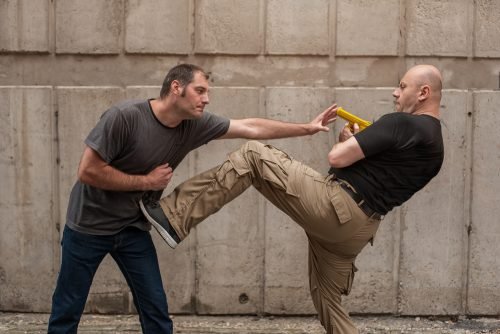
Krav Maga didn’t develop as a traditional martial art. It developed as a filter, keeping what could be applied under pressure in training, and discarding what could not.
Table of Contents
🔥 Introduction
Krav Maga didn’t develop in isolation. It was shaped by experience, then refined by selectively drawing from other systems.
In the previous sections, we looked at how the system emerged and how it functions under pressure. This section focuses on where its movements and ideas come from—what was taken, what was changed, and what was left behind.
🧱 The Approach
Krav Maga is often described as a hybrid system, but that description doesn’t quite fit.
It doesn’t blend arts in a balanced or structured way. It doesn’t attempt to preserve their philosophy, technical depth, or stylistic identity. Instead, it reduces them.
The guiding idea is simple: if something holds up under pressure, it stays. If it breaks down, it goes.
That approach comes directly from Imi Lichtenfeld’s early experience. He wasn’t trying to build a complete system or refine a tradition. He was dealing with immediate problems in unstable conditions, where time was limited and mistakes had consequences.
That mindset carried forward as Krav Maga developed. The system didn’t grow by adding layers. It evolved by removing what wasn’t reliable. This is the same approach that shaped its development in the origins section.
🥊 Striking
The striking base comes primarily from boxing and karate, but only at a functional level.
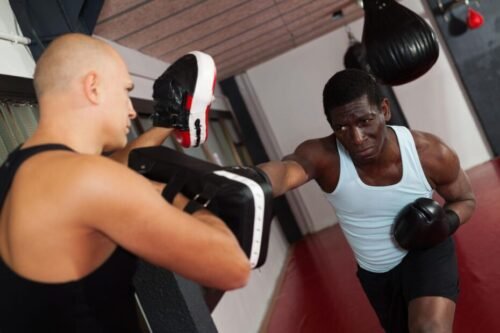
From boxing, Krav Maga keeps direct punches and a basic understanding of guard, positioning, and balance. From karate, it takes simple kicking mechanics and linear attacks. What remains is not a blend of styles, but a reduced set of movements that can be applied quickly under pressure.
Krav Maga adopted direct striking mechanics from systems such as boxing and karate, reducing them to movements that could be applied quickly and reliably under pressure.
What’s noticeable is what’s missing.
There is little emphasis on rhythm, combination work, or stylistic movement. Strikes are shortened and simplified so they can be delivered at close range, often from natural or compromised positions rather than formal stances. The objective isn’t to build an exchange or outscore an opponent. It’s to interrupt the attack, create a reaction, and open a path to disengage.
🤼 Grappling
The grappling influence comes mainly from wrestling and judo, again in a reduced and functional form.
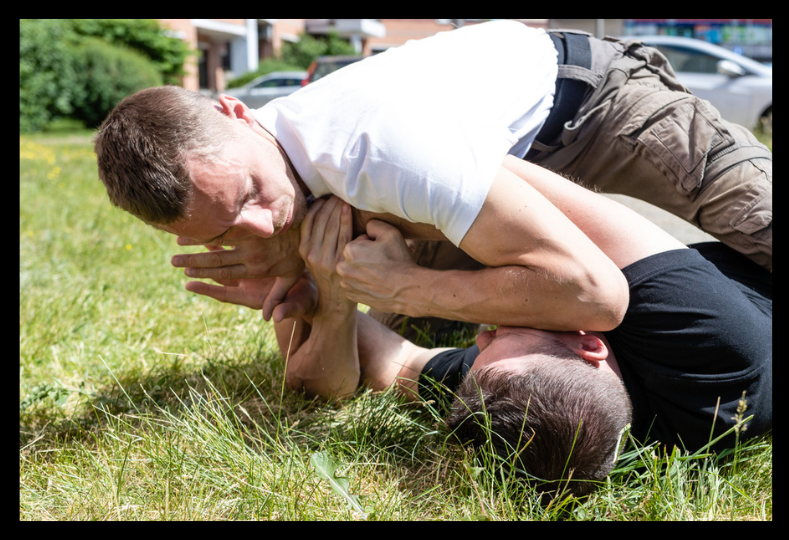
Krav Maga uses grappling to solve immediate problems—breaking grips, regaining balance, disrupting an attacker’s structure, or creating enough space to move. Control is treated as temporary rather than positional. The goal isn’t to establish dominance through prolonged holds or transitions, but to break contact and return to a position where movement is possible.
Grappling in Krav Maga is treated as transitional rather than positional, used to regain movement, interrupt control, or create space under pressure.
This is where it clearly diverges from systems such as Brazilian Jiu-Jitsu. Extended groundwork, positional control, and submission chains are not central to the system. Time spent on the ground is treated as a risk, particularly in environments where multiple attackers or weapons may be involved.
The emphasis is on resolving the situation quickly, rather than controlling it over time.
🗡️ Real-World Experience
The most important influence on Krav Maga isn’t a martial art. It’s experience.
Street confrontations in Bratislava.
Early training within the Haganah.
Development under unstable, and often violent conditions.
Alongside this, early systems such as Kapap contributed to the training environment, focusing on practical combat under limited resources and time constraints.
These conditions shaped the system’s priorities.
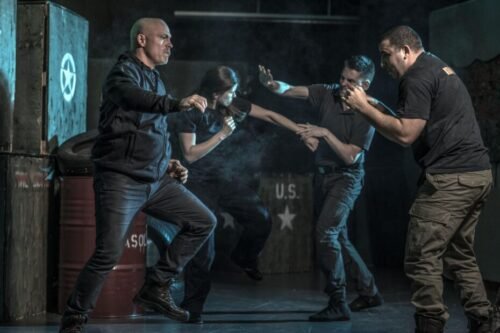
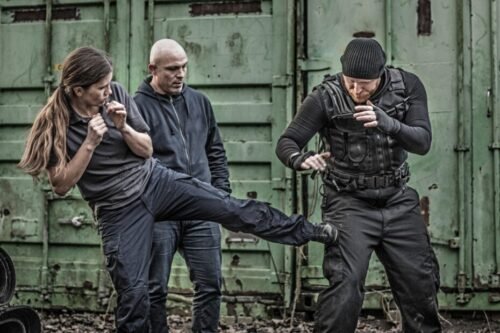
Scenario training exposes students to pressure, movement, and uncertainty, reinforcing the practical problem-solving approach that became central to Krav Maga.
There was no expectation of fairness, no guarantee of space, and no assumption of a clean exchange. Encounters were unpredictable, often chaotic, and already in motion by the time they were recognised.
This removed the idea of ideal conditions entirely. Techniques had to work when timing was off, positioning was poor, and the situation was already escalating. That is why simplicity is emphasised—not as a teaching tool, but as a necessity under pressure.
🔄 Later Development
As Krav Maga expanded—particularly under Eli Avikzar—elements from other systems were explored and tested.
These included Muay Thai, Brazilian Jiu-Jitsu, Savate, and Aikido, among others. However, the approach did not change.
Techniques were not adopted wholesale. They were tested under the same criteria: could they be applied quickly, under pressure, without requiring ideal conditions?
Anything that relied on precision timing, extended engagement, or complex sequencing was usually stripped back or discarded. The goal was never to deepen the system technically, but to ensure that what remained could be used reliably.
As a result, Krav Maga did not become more complex as it evolved. It remained selective.
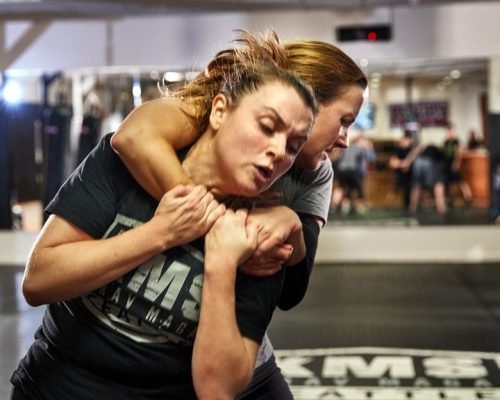
As Krav Maga evolved, techniques from other systems were tested and adapted, but only if they remained simple, direct, and functional under pressure.
⚖️ What This Created
Because of how it developed, Krav Maga does not operate like a traditional martial art.
It does not rely on a deep technical tree in the same way structured systems do. There is no emphasis on formal patterns, extended combinations, or stylistic expression. Instead, it offers a framework built from reduced components of other systems, organised around usability rather than completeness.
That makes it accessible. It also means it depends heavily on how it’s trained.
Without pressure, the system becomes theoretical—recognisable movements without reliable application. With pressure, those same movements become practical, because they are tied to decision-making under stress.
The outcome is not defined by the techniques alone, but by whether they can be applied when conditions are unstable.
📌 Final Reflection
Krav Maga wasn’t built by refining a single discipline. It developed by cutting across disciplines and keeping only what survived contact with reality. That approach carries through every part of the system.
In practice, that means focusing on what can be applied immediately, rather than what can be developed over time.
Krav Maga training often places techniques into realistic civilian scenarios, reinforcing the system’s emphasis on adaptability, pressure, and responding effectively when conditions are unpredictable.
The result is not a complete martial art in the traditional sense, and not a sport system designed for controlled competition. It is a stripped-down approach to dealing with violence under pressure—built around simplicity, adaptability, and the ability to respond when conditions aren’t ideal. Understanding those influences explains both its strengths and its limitations.