Chinese Martial Arts: The Grandparent of Systems

From Shaolin to Sanda, Chinese martial arts cover everything from traditional systems to modern combat sport. This section breaks down the key styles and explains how they differ in purpose, training, and application.

Table of Contents

🇨🇳 China

China has one of the deepest martial traditions in the world—not a single unified style, but a vast network of systems shaped by warfare, regional culture, civilian self-defence, and long-term training traditions.

These arts are commonly grouped by region (north vs south), training method (internal vs external), and purpose (combat, health, or performance). Despite this variety, most systems share an emphasis on structure, timing, conditioning, and adaptable movement, forming the foundation of what is broadly known as Kung Fu.

🗺️  Kicks of the North, Fists of the South

A common saying in Kung Fu is “Nán Quán Běi Tuǐ” (Southern Fists, Northern Legs).

  • Northern Styles (like Long Fist) often feature high kicks, deep stances, and long-range movements, suited for the open plains of Northern China.
  • Southern Styles (like Wing Chun or Hung Gar) tend to favor stable footwork, tight combinations, and heavy hand strikes, reflecting the cramped streets and boat-based life of Southern China.

🇨🇳 Key Chinese Martial Arts (Major Systems)

China produced hundreds of martial systems, ranging from external striking styles to internal arts, grappling systems, and combat sports. Below are some of the most influential and widely recognised.

🛕 Shaolin Kung Fu

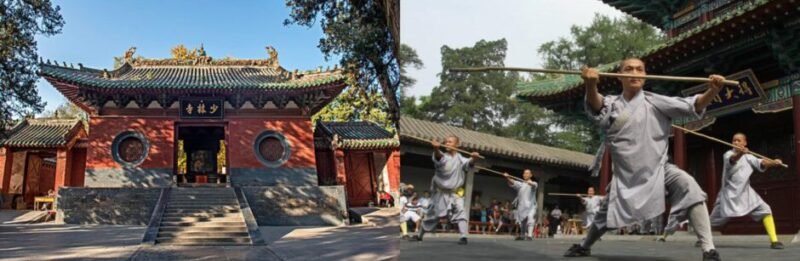
Shaolin Kung Fu is one of the most iconic Chinese martial traditions, associated with the Shaolin Temple (Henan Province) and a history stretching back over 1,500 years. It is known for its athletic expression, broad technical range, and strong cultural influence worldwide.

The famous Shaolin Temple in the Henan province of China. Henan province is revered as the historical, spiritual and cultural epicenter of Kung Fu.

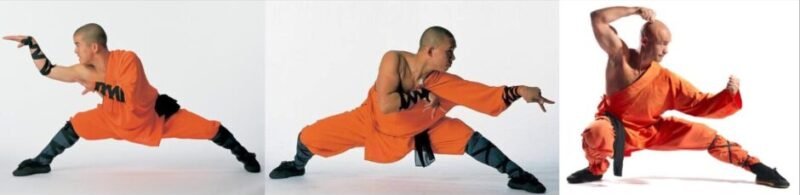
Shaolin Kung Fu includes a wide blend of skills, including striking, kicking, throws, joint locking, and traditional conditioning. Many schools also incorporate animal-inspired principles, with an emphasis on full-body movement, speed, and precision.

A defining feature of Shaolin training is its connection to mind-body discipline, including meditation and long-term character development. In modern times, Shaolin has also become a major influence on global martial arts culture through film, television, and popular media.

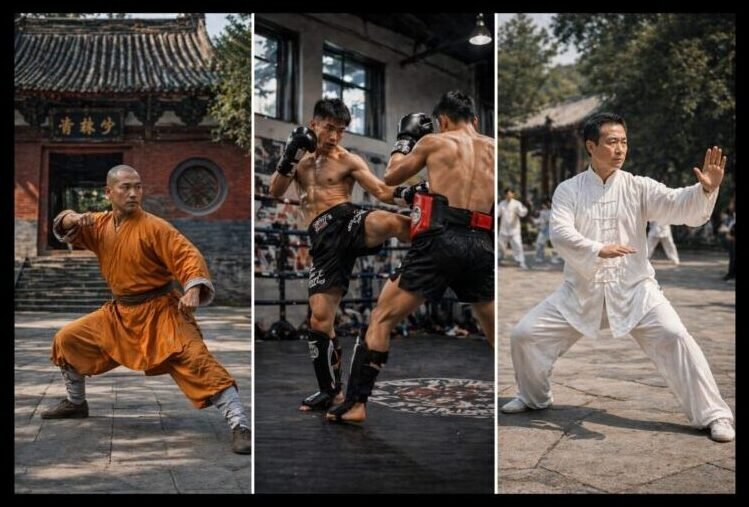
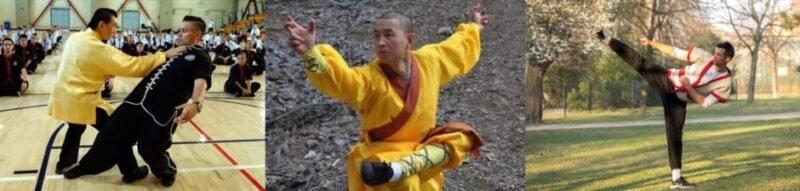
Shaolin Kung Fu is one of the oldest and most well-known styles of Kung Fu.  Its techniques are based on the movements and principles of Chinese animal styles.

🧱 Wing Chun

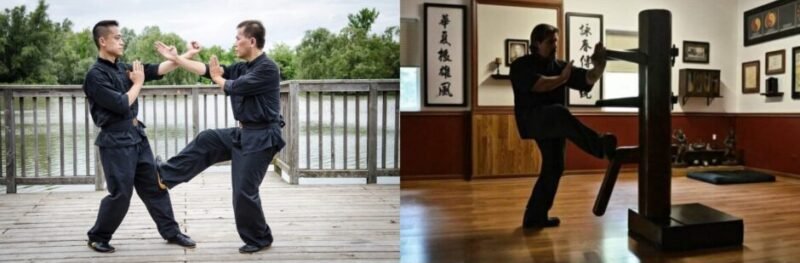
Wing Chun is a close-range striking system built around efficiency, timing, and centreline control. It became globally famous through Hong Kong cinema and the lineage of Ip Man.

Wing Chun prioritises fast, direct attacks and simultaneous defence. Key themes include:

  • Centreline theory: Controlling the direct line between you and the opponent.
  • Trapping and interception: Shutting down attacks as they begin.
  • Low kicks: Disrupting base and mobility without overcommitting.
  • Sticky hands (Chi Sao): Sensitivity training to develop reflexes and contact control.
  • Chain punching: Rapid pressure strikes designed to overwhelm.

Wing Chun’s strength is its tight economy of movement. Its weakness, in some schools, is insufficient sparring or pressure-testing — so quality varies heavily by instructor.

Wing Chun emphasises close range combat, rapid strikes, and simultaneous attack and defence.

💥 Bajiquan (Eight Extremities Fist)

Bajiquan is a direct, aggressive Chinese martial art built for close-range impact, famous for explosive power and brutal short-range strikes.

Originating in Hebei Province, Bajiquan is known for “short power” — sudden bursts of force delivered from tight range. It commonly features:

  • Elbow strikes: A signature weapon of the system.
  • Shoulder strikes: Used for smashing through structure at clinch range.
  • Compact entries: Closing distance aggressively rather than playing at range.
  • Throws and sweeps: Used to disrupt balance and finish decisively.

Many schools also include Qi Gong, breathing work, and internal training to build stability and whole-body power.

🌀 Baguazhang (Eight Trigrams Palm)

Baguazhang is an internal Chinese martial art known for circular footwork, constant angling, and evasive movement. It specialises in repositioning around an opponent rather than meeting force head-on.

Baguazhang is closely linked to the Bagua (Eight Trigrams) concept from the I Ching, and it often carries strong Daoist philosophical influence. Training typically includes:

  • Circle walking: The core method for building footwork, structure, and fluidity.
  • Partner drills: Used to develop timing, redirection, and control.
  • Striking and grappling: Including joint locks, throws, and close-range entries.

Baguazhang is also associated with internal training ideas such as Qi development, though the quality and emphasis vary between schools.

☯️ Tai Chi Chuan

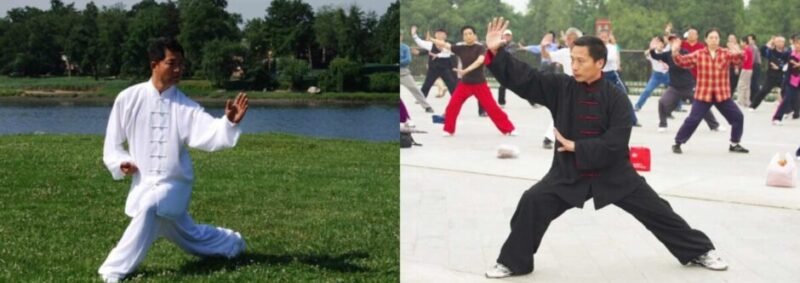
Tai Chi Chuan is one of the best-known internal martial arts, recognised for slow, controlled forms and its reputation for health and longevity. While often trained as wellness practice today, it originated as a functional martial system.

Tai Chi is built around relaxation, balance, and whole-body coordination, using continuous movement linked with breathing and mental focus. It exists in multiple lineages and styles, but most share these priorities:

  • Soft structure: Staying relaxed while maintaining alignment and control.
  • Sensitivity and timing: Using feel and positioning rather than brute force.
  • Low-impact conditioning: Suitable for all ages and fitness levels.

It is widely practised for health benefits such as improved mobility, balance, and stress reduction.

Tai Chi is characterized by slow and gentle movements that promote physical and mental relaxation, balance and coordination.

🗡️ Xingyiquan (Form-Intention Fist)

Xingyiquan is an internal Chinese martial art built around direct, linear power, explosive entry, and whole-body force generation. It’s often grouped alongside Tai Chi Chuan and Baguazhang as one of the major internal systems.

Xingyiquan is commonly linked to the Five Elements framework and the strategic logic of the Yi Jing (Book of Changes). Its movement is typically forward-driving and aggressive, built for fast engagement.
Training often includes:

  • Explosive striking: Straight-line attacks designed to break structure.
  • Throws and disruption: Simple, direct grappling integrated into entry.
  • Standing practice: Building alignment, strength, and internal stability.
  • Qi Gong and breathing work: Used to support mechanics and endurance.

Xingyi tends to appeal to fighters who prefer efficiency and directness over complex movement.

🤼 Shuai Jiao (Chinese Wrestling)

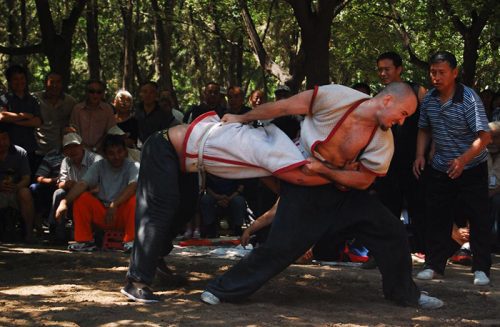
Shuai Jiao is China’s traditional wrestling system, built around throws, takedowns, and standing grappling. It’s one of the oldest recorded Chinese fighting methods, with roots reaching back to the Han Dynasty (206 BCE–220 CE).

Shuai Jiao is physically demanding and heavily based on balance-breaking and control. Techniques commonly include:

  • Hip throws: High control, high impact takedowns.
  • Shoulder throws: Classic wrestling-style projections.
  • Sweeps and trips: Fast takedowns without needing huge strength.
  • Standing dominance: A focus on remaining upright rather than ground fighting.

It has a long history of both military use and sport competition, and remains a serious grappling base for modern cross-training.

Shuai Jiao. Chinese fighting arts. Chinese Martial arts. Far East Asian Martial Arts. martial arts disciplines. Fighting arts of the world. best martial arts for self defence. Health and fitness. healthy lifestyle. Stress management. Benefits of exercise.

Shuai Jiao, a contender for the title of ‘first martial art’ given its ancient history.  This fighting art is heavy on the grappling with throws, takedowns and much wrestling.

Kung Fu vs Wushu

(Traditional vs Modern Chinese Martial Arts)

People use Kung Fu and Wushu interchangeably in the West, but they often refer to different things depending on context. Kung Fu – A broad traditional category covering striking, grappling, weapons, forms, and internal practices such as Qi Gong. It is not a single style, but a spectrum of systems developed over centuries. Wushu – A modern, standardised sport system developed in the 20th century, focused on performance (Taolu) and competition fighting (Sanda).

Simple takeaway:
Kung Fu = traditional systems
Wushu = modern sport framework

🇨🇳 Wushu (Modern Framework)

Wushu refers to the modern, organised framework used to train and present Chinese martial arts today. Rather than a single style, it provides a standardised structure through which techniques are taught, tested, and performed.

In practice, Wushu is divided into two distinct paths:

  • Taolu — forms and performance.
  • Sanda — full-contact combat.

This split reflects two different approaches: developing movement and attributes, and applying techniques under pressure.

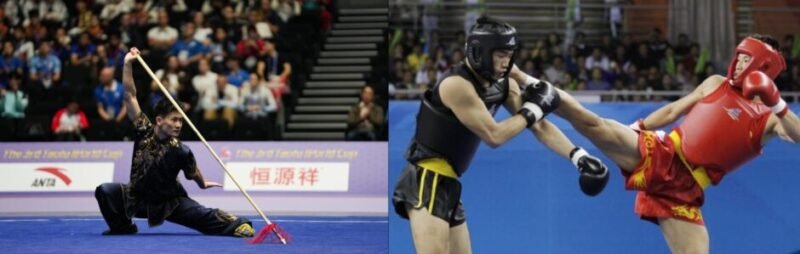
Wushu can be categorised into Taolu (practice of forms – similar to Japanese ‘Kata’ in Karate) and Sanda/Sanshou (full contact sparring).

🥋 Taolu (Forms & Performance)

Taolu consists of pre-arranged solo routines, designed to showcase and refine the movements found in Chinese martial arts.

Training focuses on:

  • Speed, balance, and coordination.
  • Flexibility and mobility.
  • Explosive power and control.

Routines may be:

  • Empty-hand forms.
  • Weapons-based (staff, sword, spear, broadsword).

Unlike combat systems, Taolu is not intended for direct application. Instead, it develops the physical attributes and movement patterns that underpin martial performance.

In modern Wushu, Taolu has evolved into a highly athletic discipline, often incorporating acrobatics and dynamic transitions, with competition judged on precision, difficulty, and execution.

Best for: Movement development, flexibility, and technical precision.

🥊 Sanda (Sanshou)

Shuai Jiao is China’s traditional wrestling system, built around throws, takedowns, and standing grappling. It’s one of the oldest recorded Chinese fighting methods, with roots reaching back to the Han Dynasty (206 BCE–220 CE).

It combines:

  • Striking: Boxing-style punches and kicks
  • Throws and takedowns: Wrestling/Judo-style trips and slams
  • Clinch work: Brief control to set up takedowns or disengage

Unlike traditional systems, Sanda operates under a ruleset and competitive format, making it one of the most reliable pathways for developing functional fighting ability within Chinese martial arts.

Best for: Full-contact fighting, pressure testing, and modern combat sport application.

🏟️ The Lei Tai (The Raised Platform)

Sanda’s emphasis on throws and ring-outs comes directly from the Lei Tai—an elevated platform used for challenge matches with no ropes or barriers. Victory could come not just from strikes, but by forcing an opponent off the platform.

This rule set survives today. Modern Sanda fighters are trained to unbalance, catch kicks, and drive opponents out of the fighting area—ending exchanges decisively rather than trading blows.

🐉 Other Kung Fu Styles

Gōng Fu (Kung Fu) is a broad term referring to Chinese fighting systems, developed across centuries through regional, family, and temple-based traditions. Historically, these systems were often closely guarded, passed down within lineages and rarely taught outside trusted circles—particularly to outsiders—until the 20th century, when wider dissemination began.

Beyond the well-known systems, Kung Fu remains a vast and fragmented landscape, with styles differing in emphasis—striking, grappling, internal development, or weapons work—but all rooted in the same underlying tradition.

There are hundreds of Kung Fu styles and sub-styles — too many to list properly — but these are some of the most recognised names:

  • Praying Mantis Kung Fu.
  • White Crane Kung Fu.
  • Hung Gar Kung Fu.
  • Choy Li Fut.
  • Five Animals Kung Fu.
  • Dragon Style Kung Fu.
  • Monkey Style Kung Fu.
  • Drunken Fist Kung Fu.
  • Iron Palm Kung Fu.
  • Northern Shaolin Kung Fu.
  • Southern Shaolin Kung Fu.
  • Eagle Claw Kung Fu.

There are hundreds, maybe thousands of Kung Fu styles and sub-styles that have developed in China over the centuries.

☯️ Philosophy, Balance, and the Long View

Chinese martial arts didn’t grow in isolation—they developed alongside philosophy, medicine, and long-standing ideas about how the body should move and exist within the world. Taoism emphasised flow, balance, and alignment with nature, shaping systems that favour efficiency over force. Buddhism, particularly through the Shaolin tradition, reinforced discipline, repetition, and the idea of training as a path to self-mastery. Confucian values added structure—respect for teachers, hierarchy, and long-term commitment to learning.

The result is a martial culture that often looks inward as much as outward. Even in systems built for combat, there’s an underlying emphasis on refinement, control, and development over time—less about winning quickly, more about building something that lasts.

If you have enjoyed this post please share or feel free to comment below 🙂

Leave a Reply

Your email address will not be published. Required fields are marked *

This site uses Akismet to reduce spam. Learn how your comment data is processed.

error: Content is protected !!

Join the Super Soldier Project Mailing List Today!!