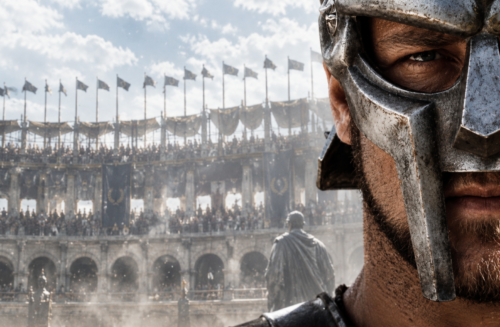
Gladiators were not thrown into the arena unprepared. In this post, we examine the world behind the spectacle — the training, structure, and systems that produced fighters capable of performing under extreme conditions.
📑 Table of Contents
🔥 Introduction
Blood, sand, steel and a roaring crowd. This is the world of the gladiator as we remember it: brutal combat in the arena, where victory brought glory and defeat could mean death. But the spectacle was only the final act. Behind it stood an entire system designed to create men capable of surviving there.
Gladiators were not simply thrown into combat unprepared. They were selected, assessed, trained, and managed within structured environments designed to produce fighters capable of performing under extreme conditions. What survives of their world through archaeology, medical writing, and historical accounts reveals something more organised than chaotic: a controlled system built around discipline, repetition, and performance.
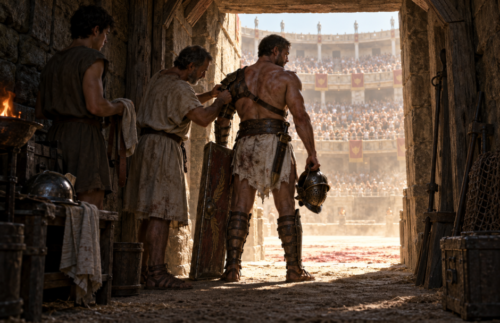
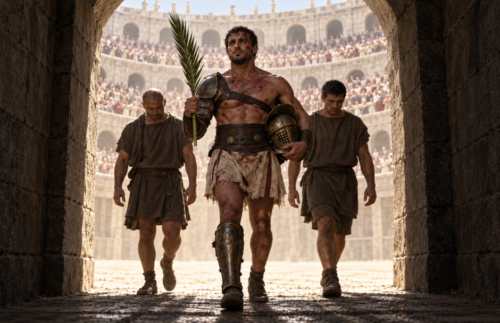
The arena was only the final act. Behind the spectacle, gladiators were equipped, checked and prepared before stepping onto the sand.
⚔️ Origins
In the Roman Empire, gladiatorial games served multiple functions. For emperors and wealthy patrons, they were displays of power, wealth, and control. Staging games required considerable resources, including trained fighters, animals, infrastructure, and the organisation needed to bring them together. The scale of the spectacle itself became a public demonstration of status and authority.
The games were also embedded in civic life. They could mark military victories, honour the dead, accompany festivals, and provide mass entertainment. Amphitheatres hosted animal hunts, executions, and staged combats alongside gladiatorial contests, bringing large crowds together in environments where violence was ritualised and carefully presented.
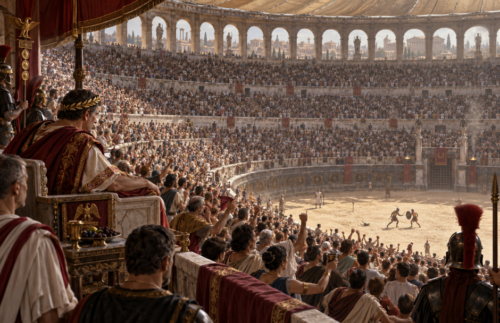
Rome’s arenas did more than entertain. By captivating the people, emperors transformed public spectacle into an instrument of power and control.
The phrase “bread and circuses” reflects another aspect of Roman public life. Food and spectacle could help secure popular favour and distract from wider political or economic concerns. The arena was therefore more than a place of violence. It was entertainment, ceremony, commerce, and political theatre combined.
Rome did not simply stage violence. It turned violence into spectacle, and spectacle into power.
🏛️ Gladiator Schools (Ludus)
Gladiators were trained within specialised schools known as ludi (singular: ludus), which operated throughout the Roman Empire. Some were small and provincial, while others, particularly those in Rome, were large, organised institutions capable of housing and training significant numbers of fighters.
Within these schools, gladiators belonged to a familia gladiatoria under the authority of a lanista. The lanista managed recruitment, training arrangements, contracts, and the commercial interests of the school. His role was both practical and financial. A trained gladiator represented an investment, and keeping that fighter healthy enough to perform mattered.
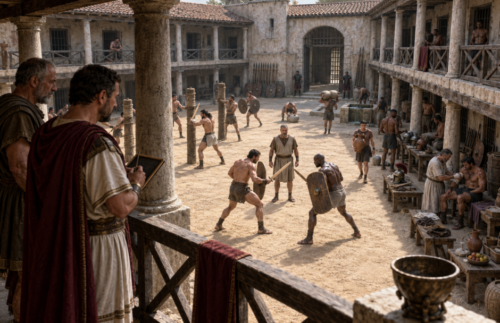
Inside the ludus, discipline, repetition and constant supervision prepared valuable fighters for the demands of the arena.
Conditions and resources inevitably differed between schools. Wealthier institutions could provide experienced trainers, better facilities, food, and medical attention, while smaller provincial schools operated with less. There was no single training programme followed throughout the empire.
The underlying system, however, was recognisable. Gladiators lived and trained within a controlled environment built around routine, repeated practice, discipline, and preparation for the arena.
🧠 Trainers and Assessment
New recruits did not immediately begin full combat training. They first had to be assessed. The lanista, alongside trainers and medical staff, could evaluate physical condition, build, ability, and potential. Not every recruit was suited to every fighting style, so these early judgements helped determine how a man would be developed.
Instruction was delivered by specialist trainers known as doctores, often men with considerable experience of gladiatorial combat. Training could be specific to a particular class of fighter, with instructors teaching the weapons, defensive movements, footwork, and tactics associated with that role.
Inside the ludus, discipline, repetition and constant supervision prepared valuable fighters for the demands of the arena.
This mattered because gladiators were not being trained as interchangeable fighters. A heavily armoured man fighting behind a large shield needed the strength and endurance to absorb pressure, hold his ground, and fight effectively under considerable weight. A lighter gladiator might instead depend on speed, reach, footwork, and mobility, staying out of danger and exploiting openings rather than meeting force with force.
Training was therefore role specific. Strength, endurance, speed, timing, movement, and technique were developed according to what the individual gladiator would eventually be expected to do in the arena.
⚔️ Initial Training
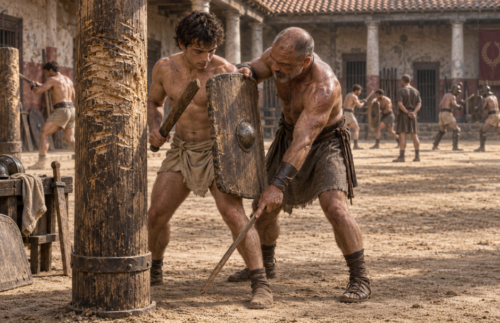
Training began with control rather than outright intensity. A new recruit was not immediately thrown into combat. He first had to learn how to stand, move, keep his balance, hold a shield, and handle a weapon correctly. These were the foundations upon which everything else would be built.
Wooden weapons allowed techniques to be drilled repeatedly without the dangers of sharpened steel. One of the most familiar was the rudis, a wooden sword associated with gladiatorial training. At first, movements would be slow and deliberate as instructors corrected mistakes. Strikes, blocks, footwork, and changes of position were practised until the recruit could perform them cleanly and consistently.
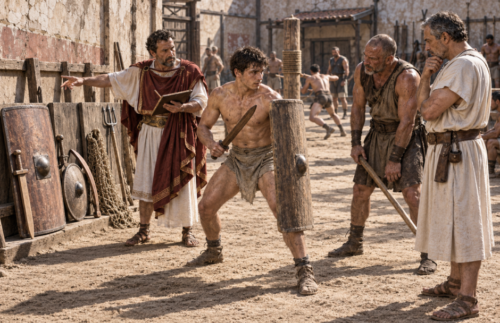
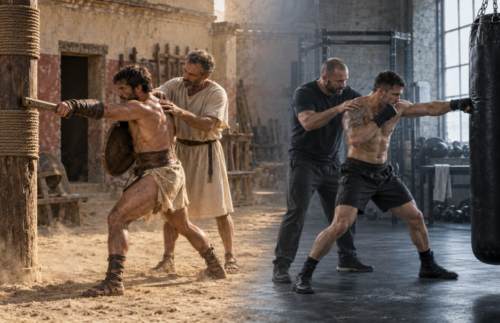
Before speed and intensity came control. Recruits drilled stance, footwork and weapon handling under the exacting eye of a doctore.
Then came repetition. The same movements were drilled again and again, gradually becoming faster, harder, and more demanding. Individual techniques became combinations. Footwork was linked to attack and defence. What initially required conscious thought began to become reliable movement, available even as fatigue and pressure started to interfere with concentration.
As competence grew, so did the demands of training. Drills became more specific, resistance increased, and recruits had to apply their skills against an opponent rather than simply rehearse them in isolation. Physical conditioning now supported technical training, building the strength and stamina needed to keep moving, defending, and fighting as fatigue accumulated.
By the time a recruit was considered ready for the arena, he had progressed from learning individual movements to performing them under pressure. Physical condition mattered, but so did discipline, technical control, and the ability to execute what had been learned when another trained fighter was actively trying to stop him.
🛡️ Fighting Styles, Armour and Roles
Gladiator combat was structured around distinct fighting styles. Weapons and armour were not simply decorative. They influenced how each gladiator moved, attacked, defended, and conserved energy.
Heavily equipped types such as the murmillo or secutor fought with substantial shields and close range weapons. Their equipment offered protection, but it also imposed a physical cost. Training had to develop the endurance and efficiency needed to operate under load while maintaining defensive structure and applying controlled pressure.
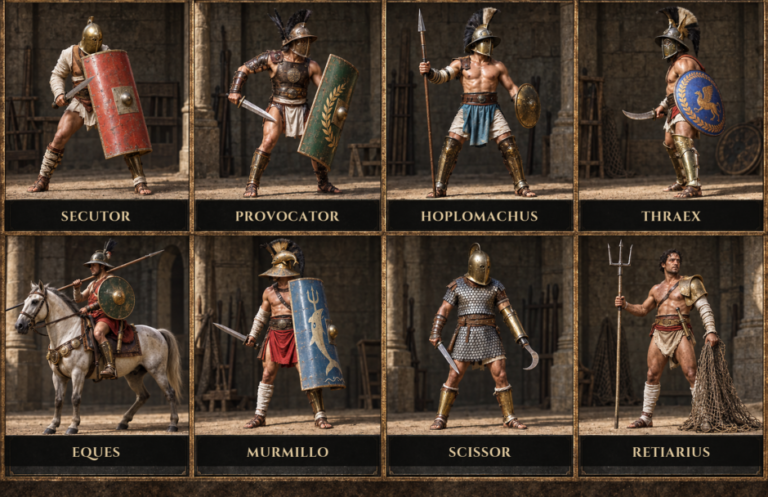
Eight types of Roman gladiator shown with their characteristic weapons and armour: Secutor, Provocator, Hoplomachus, Thraex, Eques, Murmillo, Scissor and Retiarius.
The retiarius presented a very different problem. Lightly protected and armed with a net and trident, he relied more heavily on reach, movement, timing, and control of distance. Standing directly in front of a heavily armed opponent and exchanging blows would surrender many of his advantages.
Training therefore reflected the fighter’s role. The objective was not to produce one ideal gladiator, but to prepare each man for the tactical demands created by his equipment and likely opponent.
Matchmaking exploited these contrasting styles. Certain types were deliberately paired to create contests built around strength versus speed, protection versus mobility, and pressure versus distance. The spectacle worked because each fighter brought different advantages to the arena, but the contest still had to be credible enough to produce a competitive fight.
☠️ Learning How To Die
Gladiator training extended beyond physical preparation. A fighter also had to learn how to conduct himself under extreme pressure, including the possibility of failure and death.
Roman audiences placed considerable value on courage, discipline, and composure. A defeated gladiator who had fought well could retain the respect of the crowd, while panic or an obvious refusal to face the consequences could undermine it. How a man behaved at the end of a contest therefore mattered.
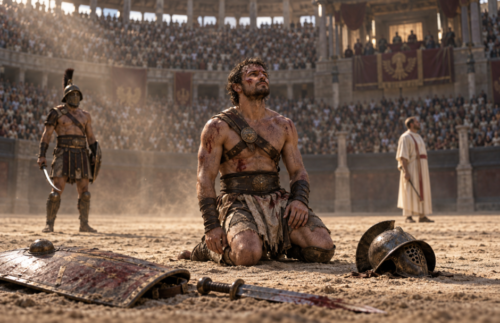
Defeat did not end a gladiator’s performance. With his fate in another person’s hands, courage and composure could determine how he was remembered.
For the gladiator, this demanded an unusual form of mental conditioning. He trained knowing that serious injury was possible and that losing a contest might place his life in another person’s hands. Fear could not simply be removed, but behaviour in its presence could be controlled.
Learning to fight was therefore only part of the process. The gladiator also had to learn what to do when the fighting stopped, the contest was lost, and control of the outcome belonged to someone else. In the arena, how a man faced defeat was part of the spectacle. How he faced death could define him.
⚖️ The Reality Of The Arena
Gladiatorial combat was dangerous, but not every defeat ended in death. Death gave the arena much of its tension, but trained gladiators were valuable, and killing every man who lost would have been expensive and wasteful.
Training a fighter required time, food, accommodation, instruction, and medical care. Experienced gladiators were valuable assets. A defeated fighter could therefore seek mercy, leaving the final decision to the presiding authority, with the reaction of the crowd potentially influencing the outcome.
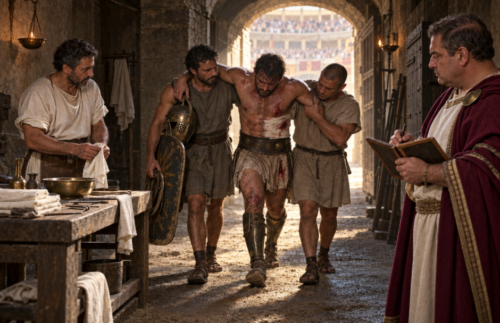
Mercy did not end the business of the arena. A valuable fighter could be treated, rehabilitated and prepared to fight again.
This did not make gladiatorial combat safe. Fighters suffered serious wounds, and death remained an accepted possibility. Some contests were more lethal than others, and circumstances changed across different periods and events. The arena combined genuine danger with economic calculation.
Skill and conduct also mattered. A gladiator who had fought courageously and entertained the crowd had a stronger claim to mercy than one perceived to have performed poorly. Survival could therefore depend on more than simply winning.
When death was demanded, the conclusion itself formed part of the arena’s ritual. The fight did not simply descend into uncontrolled killing. Defeat was acknowledged, judgement was passed, and the contest was brought to a deliberate end. Even death had its place in the choreography of the arena.
🏆 Status, Reputation and Survival
What happened in the arena determined more than victory or defeat. Performance could shape a gladiator’s value, reputation, and prospects within the system. Those who demonstrated skill, composure, and consistency could become valuable assets. A proven fighter could draw crowds, enhance the reputation of a ludus, and generate considerable interest. Preserving such a fighter made practical sense, and success could bring better treatment, rewards, medical attention, and greater investment in his continued development.
Reputation extended beyond the training ground. The crowd played a role in shaping a gladiator’s identity and, at times, his fate. Fighters who displayed courage, resilience, or exceptional skill could develop public followings. Their names could become known, their victories recorded, and their images reproduced.
The crowd might celebrate his victories and remember his name, but fame did not place a gladiator beyond the authority of the ludus.
This created an unusual contradiction. Many gladiators occupied a low or marginal social position, yet an individual fighter could still become admired, desired, or celebrated. A man denied conventional social status could nevertheless acquire fame through the arena.
For most, such prominence remained out of reach. Many gladiators passed through the system without lasting recognition. But the possibility existed. Performance, discipline, and reputation could elevate a fighter beyond basic survival and make him increasingly valuable to those who controlled his career.
🏚️ Living Conditions and Daily Life
Life inside the ludus was highly structured. Gladiators could be housed in barracks or small cells, with movement and daily routine controlled by the institution. Training, eating, rest, treatment, and preparation for future contests shaped much of everyday life.
Conditions varied according to the school, location, and status of the fighter. A successful gladiator in a wealthy institution might experience circumstances very different from those of an inexperienced recruit in a poorer provincial school. The ludus could be both a training establishment and a place of confinement.
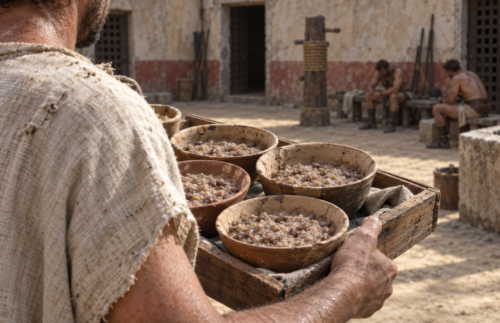
A gladiator’s diet was functional. Archaeological and written evidence points particularly towards barley, legumes, and other plant based foods as important staples. Such foods were inexpensive, available in quantity, and capable of supplying the energy required for sustained training.
What’s for dinner? Barley and beans again. Plain, filling and practical, these staples helped fuel the relentless demands of gladiator training.
Gladiators may also have carried more body fat than the highly defined physiques associated with them in modern art and film. One proposed advantage is that subcutaneous fat offered some protection against shallow cuts, potentially allowing dramatic wounds without immediate damage to deeper structures. Whatever the exact reasoning, the priority was not modern aesthetic leanness. The fighter needed to train, recover, and remain durable.
Gladiators came from different backgrounds. Some were enslaved, some prisoners, and others entered voluntarily. Their individual circumstances were not identical, but life within the school placed all of them inside a system built around discipline, control, and preparation.
⚰️ Death and Theatre
When a contest ended in death, the aftermath could become part of the spectacle. The arena had its own personnel, procedures, and theatrical conventions for dealing with the fallen.
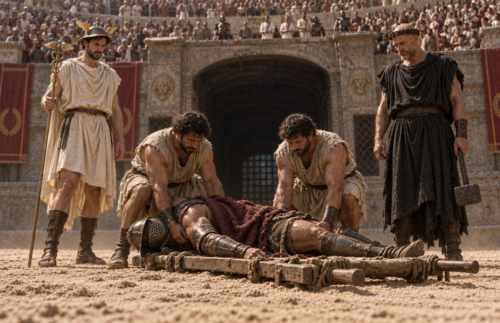
Roman writers, inscriptions, mosaics, and other surviving evidence give us glimpses of the people who worked behind the spectacle. Literary accounts describe arena attendants dressed as figures associated with death, including Dis Pater and Mercury, while inscriptions record specialist arena personnel responsible for dealing with the dead and wounded. Bodies were examined and removed through designated exits, making death itself part of the organised operation of the amphitheatre.
The contest was over, but the spectacle continued. In this reconstruction, Mercury and Dis Pater observe as arena attendants prepare the fallen gladiator for his final removal.
Some ancient descriptions are more gruesome. They refer to heated metal being used to test an apparently dead fighter for a response and to a hammer blow used to finish or confirm death. These details have been repeated widely, but the evidence is fragmentary and its interpretation debated. They should not be treated as a standard procedure followed after every gladiatorial bout.
What is clearer is the broader point. Death did not simply end the spectacle. The handling and removal of the body took place within the organised machinery of the arena, where ritual, theatre, and practical necessity frequently overlapped. Even in death, the gladiator remained part of the performance.
⛪ The End of Gladitorial Combat
Gladiatorial games did not disappear overnight. They declined gradually as the political, economic, and cultural conditions of the Roman Empire changed.
Large spectacles were expensive. Political instability and financial pressure made the traditional games increasingly difficult to maintain on the scale seen during earlier centuries. At the same time, the cultural environment of the empire was changing.
The growth of Christianity contributed to increasing criticism of public bloodshed, although the relationship between Christianisation and the disappearance of gladiatorial combat was not simple or immediate. Roman entertainment did not transform at a single moment, and different spectacles declined at different rates.
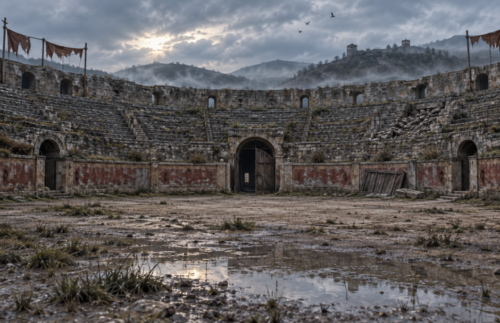
After the crowds had gone and the age of the gladiator had come to an end, amphitheatres across the former Roman Empire were abandoned as the world that built them receded. Some still stand today. Others fell into ruin, were stripped for stone, or vanished beneath the centuries.
By the early 5th century, gladiatorial combat had largely disappeared from the Western Empire. Emperor Honorius is often credited with ending the games, traditionally following the death of the monk Telemachus while attempting to stop a gladiatorial contest in Rome. The story is difficult to verify in its familiar form, however, and there is no clear evidence of a single empire-wide decree that abruptly ended gladiatorial combat. Its disappearance is better understood as the culmination of a much longer decline.
Other spectacles continued. Chariot racing remained enormously popular, while theatrical performances, animal spectacles, and other forms of public entertainment survived. The amphitheatres did not all fall silent at once, but the professional gladiator gradually ceased to occupy the place he once had in Roman public life.
🏛️ Legacy
Rome made gladiators outcasts, then turned them into stars. They could be controlled, marginalised, and expendable while simultaneously becoming objects of fascination and admiration. Few figures exposed the contradictions of Roman society quite so clearly.
The popular image focuses on the arena, but the fight itself was only the visible end of a much larger process. Behind it stood selection, instruction, repetition, specialisation, physical preparation, recovery, and the constant management of men whose ability to perform had economic value.
That is perhaps the most useful way to understand the gladiator. He was not simply a man handed a weapon and told to fight. He was the product of a system designed to create a particular kind of performer: technically prepared, physically conditioned, and capable of functioning under extraordinary pressure.
The legacy of Rome’s gladiatorial combat still echoes through history, its emphasis on preparation, conditioning, technique and performance under pressure finding modern expression in boxing, wrestling, MMA and other combat sports.
Modern training no longer carries anything approaching the same stakes, but the underlying principles are familiar. Fighters still drill techniques until they become automatic, athletes progressively increase training demands, strength programmes build physical capacity around specific performance goals, and coaches manage fatigue and recovery so that athletes can perform when it matters. Discipline, progression, repetition, specialisation, recovery, and performance under fatigue remain fundamental parts of athletic preparation.
Two thousand years later, the arena is gone, but the question remains: how much of the gladiator’s training still works?