Korean Martial Arts: Legacy of the Hwarang

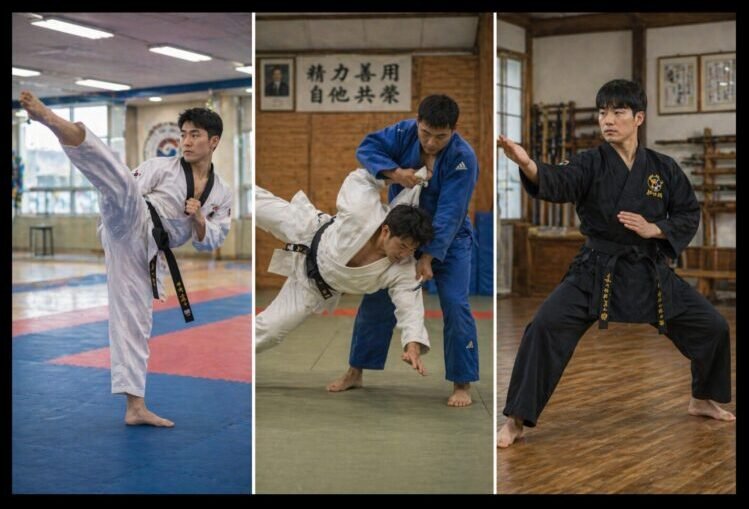
Korean martial arts blend tradition with modern structure. In this section, we explore systems built on dynamic kicking, fluid movement, and disciplined training — from Taekkyon to Taekwondo, Hapkido, and Tang Soo Do.

Table of Contents

🇰🇷 Korea

Korean martial arts represent a blend of indigenous practices and external influences, shaped by periods of cultural exchange and modern reconstruction. While some systems trace their roots to older traditions, many were formalised and developed in the 20th century, particularly following Japanese occupation and the Korean War. They are defined by their emphasis on dynamic kicking, speed, and athletic movement, alongside structured progression and disciplined training methods. Many systems reflect Korea’s modern development—blending traditional influences with standardised curricula and global sport pathways. Today, Korean martial arts are practised for competition, self-defence, fitness, and personal development, with a strong reputation for technical structure and accessibility.

⚔️ Rebuilding a Martial Identity

Many Korean martial arts, including Taekwondo, Tang Soo Do, and Hapkido, were formalised in the 20th century following periods of suppression during the Japanese occupation (1910–1945) and the disruption of the Korean War. During this time, native practices declined, while Japanese systems such as Karate and Judo were introduced and widely taught.

After liberation, Korean instructors began to rebuild a national martial identity. Rather than restoring a single continuous tradition, they developed new systems by combining surviving indigenous practices (such as Taekkyon) with elements drawn from Japanese and Chinese martial arts.

The result was not a direct continuation of the past, but a structured reconstruction—designed for modern training, education, and national identity. This is why many Korean systems share clear technical similarities, while still presenting themselves as distinct arts.

🦶 Taekkyon

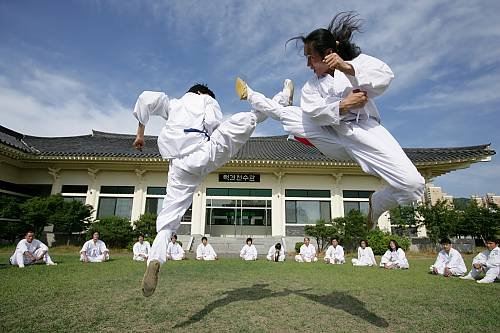
Taekkyon is a traditional Korean martial art known for its fluid, rhythmic movement and distinctive footwork, with origins often traced back to the Goguryeo Kingdom. It emphasises continuous motion, using positioning and timing to disrupt balance rather than relying on direct force.

Unlike more rigid systems, Taekkyon prioritises flow and adaptability, blending evasive movement with sweeps, kicks, and off-balancing techniques. Today, it is preserved as part of Korea’s cultural heritage, valued for its unique movement style and historical significance.

Key themes include:

  • Footwork: Rhythmic, shifting movement to control space.
  • Balance disruption: Sweeps, trips, and off-balancing techniques.
  • Evasion: Avoiding force rather than meeting it directly.
  • Flow: Continuous transitions between movement and attack.
  • Cultural role: Recognised traditional heritage system.

Best for: Footwork, balance disruption, and evasive movement.

Taekkyon.Far East Asian Martial Arts.Asian Martial Arts.

Taekkyon utilizes a wide variety of techniques including kicks, hands, knee, elbow strikes, pressure point attacks, throws, joint locks, headbutt and grapples.

🥋 Taekwondo

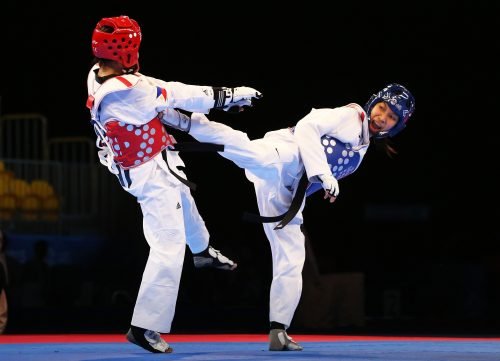
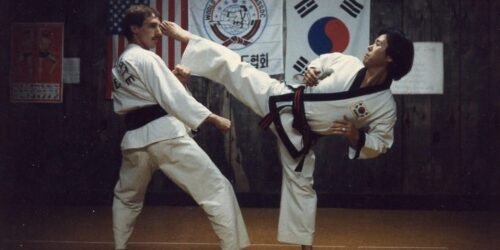
Taekwondo is Korea’s most widely practised martial art, built around high-speed kicking and structured striking combinations. Developed in the mid-20th century, it blends traditional Korean influences with elements adapted into a modern, standardised system.
It is strongly associated with global sport, particularly its Olympic format, where speed, precision, and scoring techniques dominate. Alongside competition, Taekwondo maintains a structured approach to discipline, progression, and technical development.

Key themes include:

  • Kicking: High, fast, and powerful techniques.
  • Striking: Basic punches and combinations.
  • Sparring: Sport-focused competition formats.
  • Forms (poomsae): Structured technical patterns.
  • Global reach: Practised in 190+ countries.

Best for: Dynamic kicking, speed, and competitive striking.

Taekwondo. Martial arts. Fitness. Fight Club. Martial Arts of the World. Korean Martial Arts.Far East Asian Martial Arts.Asian Martial Arts.

Taekwondo – “the way of the hand and foot.’  Although it is a martial art more famous for its use of flashy high spinning kicks.

🦵 The Kicking Blueprint

Korean martial arts are defined by their emphasis on kicking—but this is not just stylistic. Systems like Taekwondo prioritise speed, distance control, and scoring efficiency, favouring fast techniques delivered from range.

This created a distinct technical identity: high kicks, spinning attacks, and rapid combinations designed to overwhelm while maintaining mobility.

🌀 Hapkido

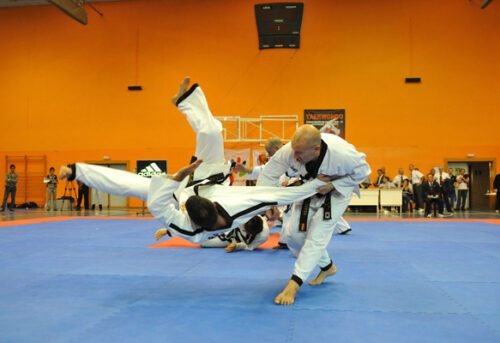
Hapkido is a self-defence-focused system built around joint manipulation, throws, and controlled striking, designed for efficient real-world application. Developed in the 20th century, it incorporates influences from systems such as Daitō-ryū Aiki-jūjutsu and Judo.

The system emphasises circular motion and redirection, using an opponent’s force against them rather than meeting strength head-on. This creates a versatile approach combining grappling, control, and striking within a single framework.

Key themes include:

  • Joint locks: Limb control and submission techniques.
  • Throws: Off-balancing and redirection.
  • Striking: Supporting techniques to create openings.
  • Circular movement: Using momentum rather than resisting force.
  • Application: Practical self-defence focus.

Best for: Joint locks, control, and practical self-defence.

Hapkido.Far East Asian Martial Arts.Asian Martial Arts.

Hapkido – “the way of coordinated power.”

📜 Tang Soo Do

Tang Soo Do is a traditional Korean striking system focused on kicks, punches, and structured forms, developed in the mid-20th century by Hwang Kee. It draws influence from both Korean traditions and Chinese martial systems, alongside overlap with early Karate development.

Unlike sport-focused systems, Tang Soo Do maintains a strong emphasis on traditional structure, discipline, and technical development, preserving classical training methods and progression.

Key themes include:

  • Striking: Kicks, punches, and open-hand techniques.
  • Forms (hyung): Structured patterns for skill development.
  • Breathing: Coordination of movement and power.
  • Discipline: Strong focus on etiquette and progression.
  • Structure: Traditional training approach.

Best for: Traditional striking, forms, and structured discipline.

Tang Soo Do. Korean Martial arts. Far East Asian Martial Arts. martial arts disciplines. Fighting arts of the world. best martial arts for self defence. Health and fitness. healthy lifestyle. Stress management. Benefits of exercise.

Tang Soo Do blends traditional Korean striking with influences from Chinese and Japanese systems. It emphasises disciplined forms, powerful kicking, and structured progression through ranks.

🤼 Ssireum (Korean Wrestling)

Ssireum is Korea’s traditional wrestling system, centred on balance-breaking and throws using a cloth belt (satba) worn around the waist and thigh. The objective is to bring the opponent to the ground, typically by forcing them to lose balance and touch the sand.

Practiced historically during festivals, Ssireum remains a visible part of Korean culture and competition. Unlike many modern grappling systems, it emphasises upright wrestling, grip control, and explosive throws rather than prolonged ground fighting. Its continued presence in organised sport reflects a rare continuity between traditional practice and modern competition.

Key themes include:

  • Throws: Trips, lifts, and rotational takedowns.
  • Grip fighting: Control through the satba belt.
  • Balance and posture: Maintaining stability while off-balancing the opponent.
  • Explosive power: Fast, decisive engagements.
  • Competition: Sand-based matches rooted in tradition.

Best for: Balance disruption, throws, and upright grappling.

⚔️🏇 The Hwarang-Do

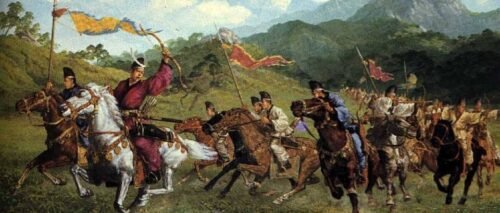
The roots of Korean martial culture are often linked to the Hwarang, an elite warrior group of the Silla Dynasty. They were trained not only in combat, but also in philosophy, discipline, and cultural education, reflecting a well-rounded warrior ideal.

Their training included swordsmanship, archery, and hand-to-hand combat, forming a foundation for military capability during a period of unification and conflict.

While modern Korean martial arts developed much later, the legacy of the Hwarang remains as a cultural reference point—representing discipline, loyalty, and the integration of physical and mental development within Korean martial identity.

The Hwarang-Do. Korean Martial arts. Far East Asian Martial Arts. martial arts disciplines. Fighting arts of the world. best martial arts for self defence. Health and fitness. healthy lifestyle. Stress management. Benefits of exercise.

The Hwarang were elite young warrior-scholars who served as protectors of ancient Korea. Today, they represent the ideal of discipline, honour, and character in Korean martial arts.

If you have enjoyed this post please share or feel free to comment below 🙂

Leave a Reply

Your email address will not be published. Required fields are marked *

This site uses Akismet to reduce spam. Learn how your comment data is processed.

error: Content is protected !!

Join the Super Soldier Project Mailing List Today!!