Weapons & Regional Systems — Forged by Environment

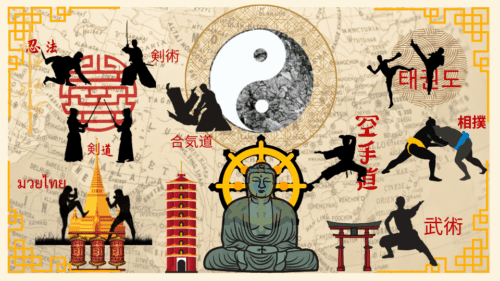
Beyond China and Japan lies a wider martial world shaped by blades, wrestling, regional warfare, and hybrid combat systems. This section explores how different cultures built practical solutions to the same problem — how to fight, control, and survive.

Table of Contents

📖 Introduction

Beyond the major systems of China and Japan lies a diverse range of martial traditions shaped by local environments, warfare, and cultural priorities. These arts do not follow a single pattern, but each reflects a specific approach to combat—whether through weapons, grappling, or hybrid methods.

From the blade-focused systems of the Philippines to the wrestling traditions of Mongolia, these disciplines highlight how different regions solved the same problem in different ways. Taken together, they expand the picture of what martial arts can be beyond conventional categories.

🇵🇭 Philippines

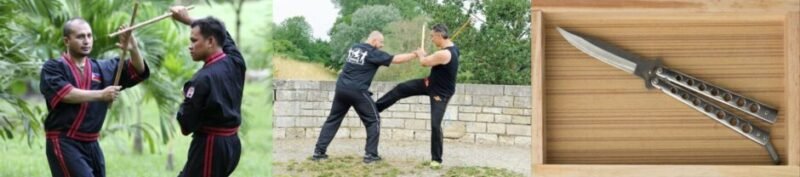
Filipino Martial Arts (FMA)—including Arnis, Eskrima, and Kali—are built around a weapons-first approach, where sticks, blades, and improvised tools form the foundation of training. Rather than fixed styles, they operate as a system of principles based on timing, angles, and flow.

A defining feature of FMA is transferability—the same movement patterns apply across weapons and empty-hand combat. This makes the system highly adaptable and widely used in modern combatives, military training, and self-defence, while maintaining strong cultural roots.

🦯🗡️ Arnis / Eskrima / Kali (Filipino Martial Arts Core System)

Arnis, Eskrima, and Kali refer to the core systems of Filipino Martial Arts, built around weapons-first training using sticks, blades, and improvised tools. While the names vary by region and lineage, they share the same underlying principles and methodology.

🔪 Blades, Adaptation, and Survival

Filipino Martial Arts developed in an environment where blades were part of everyday life, shaping systems built around speed, timing, and immediate application. Combat was often close, fast, and unpredictable, reinforcing a need for efficiency over formality.

During the Spanish colonial period, restrictions on weapons forced practitioners to adapt—sticks became a way to train blade mechanics without drawing attention. This preserved the core principles while making the systems more accessible and transferable.

The result is a martial culture defined by adaptability and practicality, where techniques are not fixed, but applied across contexts. Whether using a weapon or empty hand, the focus remains the same: control angles, manage distance, and respond effectively under pressure.

The system is defined by its emphasis on angles, timing, and flow, with techniques designed to transfer seamlessly between weapons and empty-hand combat. This creates a highly adaptable framework used in both traditional practice and modern combatives.

Key themes include:

  • Weapons-first: Training begins with sticks and blades.
  • Angles: Attacks and defence based on directional patterns.
  • Flow: Continuous movement and transitions.
  • Transferability: Same principles apply across weapon and empty-hand.
  • Application: Used in military, self-defence, and combatives systems.

Best for: Weapons training, timing, and adaptable combat across ranges.

FMA – Filipino Martial Arts (Also known as Escrima/Arnis/Kali – All of these names are recognised and interchangeable). Involves seamless transitions between weapons and unarmed combat. 

🐍  Defanging the Snake

In Filipino Martial Arts (FMA), the term “Defanging the Snake” isn’t just a metaphor—it is a core tactical priority. The concept is simple: if you are attacked by a venomous snake, you don’t fight the body; you remove the fangs. In combat, the “fang” is the weapon or the hand holding it. Rather than trying to block a heavy strike or move to a “killing blow” immediately, FMA practitioners strike the opponent’s weapon hand or limb first. By destroying the hand’s ability to hold a stick or blade, you effectively end the fight before it even truly begins.

🥊 Yaw-Yan (Sayaw ng Kamatayan)

Yaw-Yan, meaning “Sayaw ng Kamatayan” (Dance of Death), is a Filipino striking system developed by Napoleon A. Fernandez in the 1970s. It builds on traditional FMA concepts but applies them within a modern stand-up fighting framework.

While often compared to Muay Thai, Yaw-Yan places greater emphasis on long-range striking and aggressive forward pressure, favouring powerful kicks and continuous combinations over extended clinch work.

Key themes include:

  • Kicking: Strong hip-driven strikes with a downward cutting angle.
  • Range: Preference for long-range engagement.
  • Strategy: Aggressive combinations and forward pressure.
  • Application: Stand-up combat and modern competition.
  • Context: Prominent in Philippine MMA and kickboxing circuits.

Best for: Power kicking, long-range striking, and aggressive stand-up fighting.

Yaw Yan is a ‘hardstyle’ Filipino kickboxing style known for its dynamic and versatile techniques, blending strikes, kicks, takedowns, and ground fighting techniques into a comprehensive and effective fighting system.

🇲🇾 Malaysia

Malaysian martial arts are closely linked to the wider Silat tradition, with systems such as Silat Melayu reflecting a more structured and culturally embedded expression of the art.

🥋 Silat Melayu

Silat Melayu is a traditional system from the Malay Peninsula, known for controlled movement, efficient technique, and strong cultural integration. It shares core Silat principles but often places greater emphasis on structure and refinement.

Beyond combat, it is closely tied to cultural, spiritual, and philosophical practice, functioning as both a martial system and a discipline for personal development.

Key themes include:

  • Striking: Kicks, punches, and open-hand techniques.
  • Grappling: Off-balancing and control.
  • Weapons: Blades and traditional tools.
  • Movement: Efficient, controlled, and close-range focused.
  • Role: Martial discipline and cultural tradition.

Best for: Fluid movement, close-range control, and traditional self-defence.

Silat Melayu. Far East Asian Martial Arts. martial arts disciplines. Fighting arts of the world. best martial arts for self defence. Health and fitness. healthy lifestyle. Stress management. Benefits of exercise.

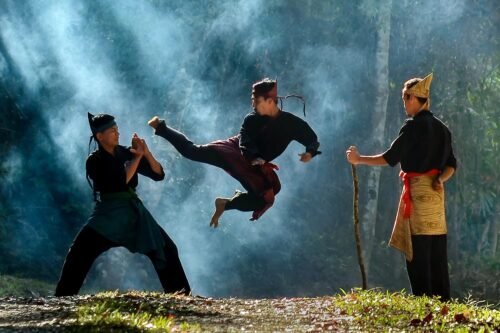
Silat Melayu: Close-range, evasive, and efficient, built on timing and deception.

🌿 Silat Regions — Landscape, Movement, and Hidden Angles

Silat developed across islands, jungles, and dense terrain, where footing was unstable and encounters were rarely clean or predictable. Movement reflects this—low stances, shifting angles, and constant adjustment rather than fixed positioning.

Many systems also emphasise concealment and deception, with techniques hidden within fluid, almost dance-like movement. What appears controlled or passive can quickly transition into decisive action.

Across regions, styles may differ significantly, but they share a common approach: indirect, adaptive, and shaped by the environment they come from.

🇮🇩 Indonesia

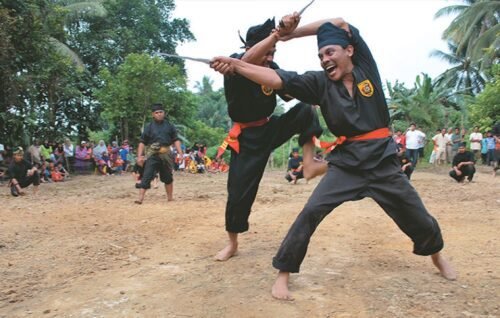
Indonesian martial arts are best represented by Silat (Pencak Silat)—a broad family of systems built around angles, deception, and close-range control. Rather than a single style, Silat operates as a regional ecosystem, with significant variation between schools and lineages.

Across this variation, most systems prioritise fluid movement, off-balancing, and disruption, often integrating weapons awareness from the outset. Training may focus on combat, performance, or cultural preservation, but the underlying approach remains adaptive and unpredictable.

🥋 Pencak Silat

Pencak Silat is the core Indonesian martial framework, combining striking, grappling, and weapon awareness into a system defined by movement and positioning rather than fixed technique. It varies widely by region, but consistently emphasises timing, angling, and control.

Pencak Silat. Far East Asian Martial Arts. Far East Asian Martial Arts.

Pencak Silat combines elements of striking, grappling, and weapons techniques with fluid movements and transitions between techniques, and deceptive movements.

Unlike more direct systems, Silat often uses deception and indirect entry, creating openings through misdirection before applying decisive techniques at close range.

Key themes include:

  • Movement: Fluid transitions between striking, grappling, and control.
  • Angles: Attacking from off-line positions rather than head-on.
  • Deception: Feints, misdirection, and disguised entries.
  • Range: Close-quarters disruption and control.
  • Weapons: Integrated awareness of blades and improvised tools.
  • Role: Combat system, cultural practice, and performance art.

Best for: Fluid movement, close-range control, and adaptable combat.

🐯 The Predator’s Low Stance 

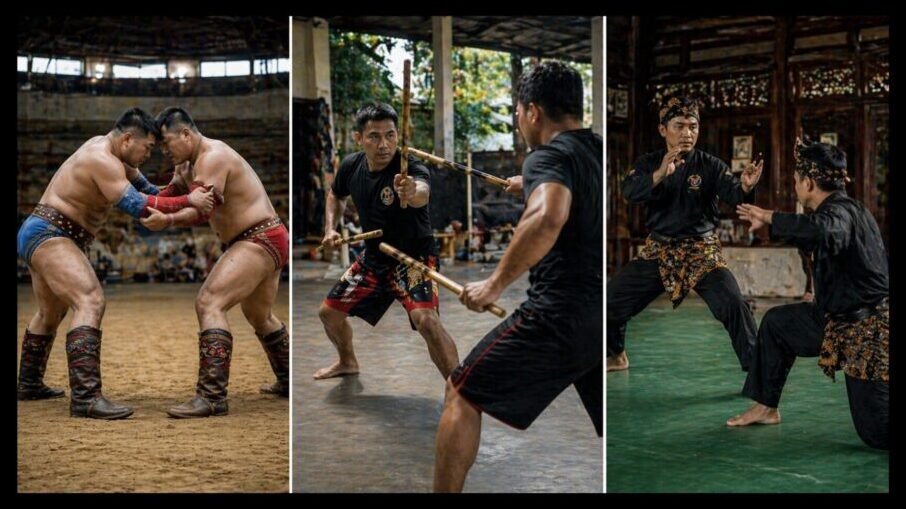
One of the most striking features of Silat Harimau (Tiger Style) is its extremely low-to-the-ground fighting stance. This wasn’t developed for aesthetics, but for survival in the specific environment of the Malay Archipelago. A low center of gravity provides a stable base on slippery or soft jungle terrain where a higher stance would lead to a loss of balance. Furthermore, staying low allows a practitioner to strike at an opponent’s low line (the legs and ankles), which is notoriously difficult to defend against, while also using the ground as a tool for stealth and rapid, predatory movement.

🥊 Tarung Derajat

Tarung Derajat is a modern Indonesian combat sport developed in the 1970s by Haji Achmad Dradjat (AA Boxer), built for full-contact competition rather than traditional practice. It blends striking, throws, and clinch work into a direct, aggressive format.

Where Silat emphasises fluidity and deception, Tarung Derajat focuses on pressure, durability, and straightforward application, making it Indonesia’s primary fight-sport expression.

Key themes include:

  • Striking: Punches, kicks, and combinations.
  • Grappling: Throws and clinch-based control.
  • Strategy: Forward pressure and aggressive engagement.
  • Competition: Ring-based format with knockdowns and control scoring.
  • Focus: Conditioning, resilience, and sustained output.

Best for: Full-contact fighting, pressure, and conditioning.

🇻🇳 Vietnam

Vietnamese martial arts represent a hybrid martial culture, shaped by indigenous systems and strong external influence—particularly from Chinese martial arts, alongside later integration of modern combat disciplines.

Rather than a single unified system, they operate across a spectrum—combining striking, grappling, weapons training, and internal development within structured frameworks. Some prioritise combat efficiency and application, while others emphasise discipline, philosophy, and long-term development.

The result is a martial landscape defined by balance—hard and soft, internal and external, traditional and modern.

🥋 Vovinam (Việt Võ Đạo)

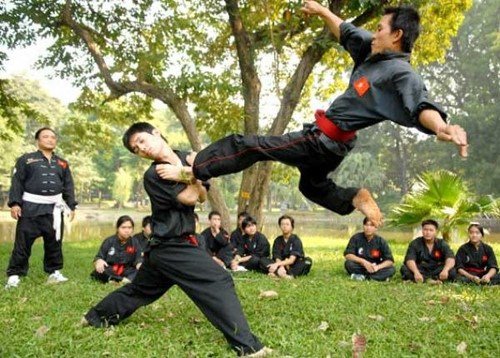
Vovinam is a modern Vietnamese martial art founded in 1938 by Nguyễn Lộc, designed to create a complete system capable of adapting across multiple combat ranges. It blends traditional Vietnamese methods with influences from Chinese systems, Judo, wrestling, and Western boxing, creating a broad and adaptable technical base.

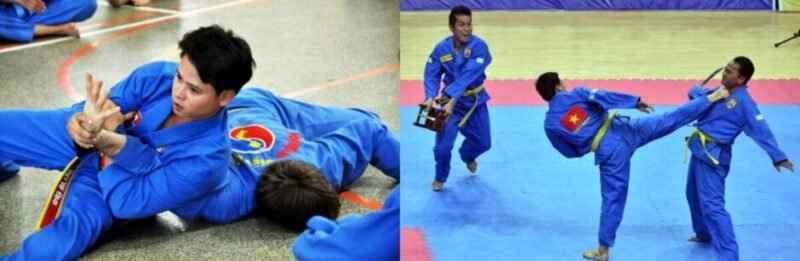
Vovinam is a Vietnamese martial art that encompasses a diverse range of techniques, including strikes, throws, grappling, and weapon usage, emphasizing self-defense, flexibility, and the development of physical and mental strength.

A defining feature of Vovinam is its emphasis on dynamic, often acrobatic movement, including jumping attacks and scissor-style takedowns that require timing, coordination, and commitment.

Key themes include:

  • Striking: Punches, kicks, elbows, and combinations.
  • Grappling: Sweeps, throws, joint locks, and clinch work.
  • Dynamic techniques: Flying kicks and leg-scissor takedowns.
  • Weapons: Introduced at advanced levels.
  • Training: Forms (quyền), partner drills, sparring, and self-defence.
  • Structure: Belt system reflecting technical skill and discipline.

In practice, Vovinam aims to develop a complete martial athlete, balancing physical ability with control, discipline, and adaptability.

Best for: Well-rounded combat, dynamic movement, and structured progression.

📜 Võ Bình Định

Võ Bình Định refers to a network of traditional martial systems from Bình Định province, historically one of Vietnam’s most important martial regions. Rather than a single style, it encompasses multiple lineages developed across villages and schools, many shaped by periods of conflict and military demand.

Vo Binh Dinh. Vietnamese Martial Arts. Far East Asian Martial Arts. martial arts disciplines. Fighting arts of the world. best martial arts for self defence. Health and fitness. healthy lifestyle. Stress management. Benefits of exercise.

Binh Dinh province in Vietnam is renowned for its rich martial arts heritage, particularly for being the birthplace of the traditional Vietnamese martial art of Vovinam.

Its development is closely linked to the Tây Sơn Dynasty, where martial skill played a decisive role in military success, giving these systems a strong battlefield influence.

Key themes include:

  • Structure: Multiple lineages within a regional framework.
  • Core pillars: Breath control, empty-hand combat, weapons, and willpower.
  • Techniques: Striking, grappling, sweeps, and close-range engagement.
  • Weapons: Staffs, swords, and traditional battlefield arms.
  • Specialisation: Regional variation with distinct technical emphasis.

Today, Bình Định remains a major hub for Vietnamese martial arts, preserving both technical depth and historical continuity.

Best for: Traditional combat systems, weapons training, and regional depth.

🏯 Bình Định — A Stronghold of Vietnamese Martial Arts

Central Vietnam—particularly Bình Định Province—is widely regarded as a core region of traditional Vietnamese martial arts (Võ cổ truyền). The area developed a reputation for structured systems combining striking, grappling, and weapons training, often linked to military and regional defence.

Training emphasises strong stances, direct power, and disciplined forms, alongside practical application. Weapons such as staffs, swords, and polearms remain a key part of the curriculum, reflecting the system’s battlefield origins.

While Vietnamese martial arts vary across the country, Bình Định stands out as a centre of preservation and development—where traditional methods continue to be taught, refined, and passed down.

⚖️ Nhất Nam

Nhất Nam is a traditional system built around principle-driven movement, emphasising leverage, timing, and efficiency over brute force. It is designed to allow smaller practitioners to manage and overcome larger opponents through positioning and control.

The system blends internal development with practical application, using breath control and body awareness to support movement and technique.

Key themes include:

  • Principles: Technique, leverage, and timing over strength.
  • Internal work: Breathing, balance, and control.
  • Movement: Flexible, mobile, and often acrobatic.
  • Application: Joint manipulation, off-balancing, and counters.
  • Weapons: Integrated alongside empty-hand training.

It occupies a space similar to internal systems such as Tai Chi, but with a stronger emphasis on applied combat.

Best for: Internal development, flexibility, and principle-based combat.

☯️ Cương Nhu

Cương Nhu is a modern Vietnamese-American system founded in 1965 by Ngô Đồng, built on the principle of “hard–soft” integration—combining direct, forceful techniques with fluid redirection and control.

It draws from multiple systems, creating a curriculum that progresses from foundational striking into more advanced grappling and internal movement.

Key themes include:

  • Hard elements: Direct strikes, kicks, and structured movement.
  • Soft elements: Redirection, joint locks, and control.
  • Influences: Karate, Judo, Aikido, Wing Chun, and Tai Chi.
  • Training: Forms, drills, grappling, and progressive sparring.
  • Approach: Integration of force and flow depending on context.

The system is designed to produce balanced practitioners, capable of adapting between direct force and fluid control.

Best for: Hybrid training, balanced development, and structured progression.
🤼 Đấu Vật (Vietnamese Traditional Wrestling)

Đấu Vật is a traditional Vietnamese wrestling system focused on throws, balance, and positional control, with strong roots in rural culture and festival competition.

Unlike striking systems, it is built entirely around grappling exchanges, where control of posture and centre of gravity determines success.

Key themes include:

  • Objective: Throw or destabilise the opponent.
  • Techniques: Trips, sweeps, body locks, and lifts.
  • Rules: No striking permitted.
  • Skills: Balance, timing, grip strength, and positioning.

A defining feature of Đấu Vật is its strong festival tradition, particularly during Tết (Lunar New Year). Events are marked by:

  • Wrestling drums: Used to gather crowds and signal matches.
  • Pre-bout ritual dances: Performed as a sign of respect and preparation.
  • Regional variation: Differences in ceremony, rules, and style across locations.

Notable events, such as those in Làng Sinh (Thừa Thiên Huế), highlight the enduring role of Đấu Vật as both sport and cultural spectacle.

Best for: Grappling, balance disruption, and traditional competition.

🇻🇳🇫🇷 Qwan Ki Do

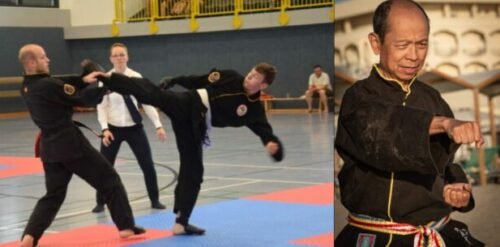
Qwan Ki Do is a modern Vietnamese martial art founded in 1981 by Phạm Xuân Tong in France, developed within the Vietnamese diaspora as a structured system combining Vietnamese, Chinese, and Japanese influences.

Qwan Ki Do was founded by Pham Xuân Tong (right), a Vietnamese-French martial artist, with the aim of preserving and promoting traditional Vietnamese martial arts.

It places strong emphasis on technical precision, coordination, and controlled application, making it more systematised than many traditional arts.

Key themes include:

  • Striking: Punches, kicks, and combinations.
  • Grappling: Throws, sweeps, and joint locks.
  • Training: Forms (quyền), drills, and controlled sparring.
  • Weapons: Included in advanced curriculum.
  • Focus: Discipline, structure, and long-term progression.

This diaspora origin gives Qwan Ki Do a more formalised and standardised structure compared to many regionally evolved Vietnamese systems.

Best for: Structured training, well-rounded development, and traditional-modern balance.

🇲🇳 Mongolia

Mongolian martial traditions originate from the era of the Mongol Empire, where combat skills were essential for warfare, survival, and movement across vast terrain.

Core disciplines include wrestling (Bökh), archery, and mounted combat, all built around strength, endurance, and practical effectiveness. These systems were never isolated—they functioned as a combined skill set designed for real-world use.

🏇🏹 The Warrior Culture of the Steppe

On the open steppe, mobility and endurance mattered more than rigid technique. Under Chinggis Khan, warriors were expected to ride, shoot, and fight as a single system—archery from horseback, rapid manoeuvre, and close-range grappling when engagements closed.

Training wasn’t separated into styles. It was part of daily life, with wrestling, riding, and archery forming the foundation of both survival and warfare.

These principles still exist today, most visibly preserved through cultural traditions such as the Naadam Festival.

🤼 Bökh (Mongolian Wrestling)

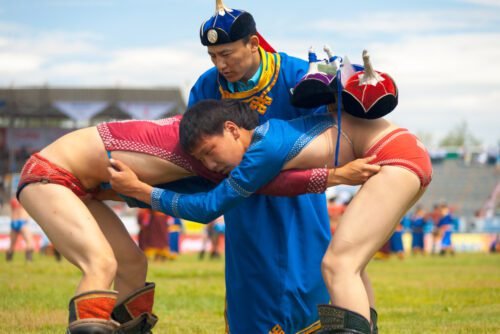
Bökh is Mongolia’s traditional wrestling system and one of its oldest surviving combat arts. It focuses on balance-breaking, throws, and physical dominance, with the objective of forcing the opponent to touch the ground with any part of the body other than the feet.

Mongolian Wrestling.Far East Asian Martial Arts.Asian Martial Arts.

Bokh – Mongolian wrestling.

Unlike many modern grappling systems, Bökh is deeply tied to cultural identity and national tradition, forming a central part of Mongolian festivals and competition. It develops raw strength, posture, and resilience, and has influenced the success of Mongolian athletes in wrestling, judo, and MMA.

Key themes include:

  • Throws: Trips, sweeps, lifts, and off-balancing.
  • Grip fighting: Jacket and body control.
  • Strength development: Emphasis on raw power and endurance.
  • Balance and posture: Staying upright under pressure.
  • Competition: Central to the Naadam Festival.

Best for: Balance disruption, strength, and dominant grappling.

🏹 Mongolian Archery

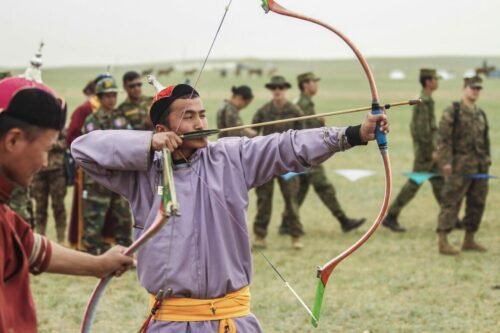
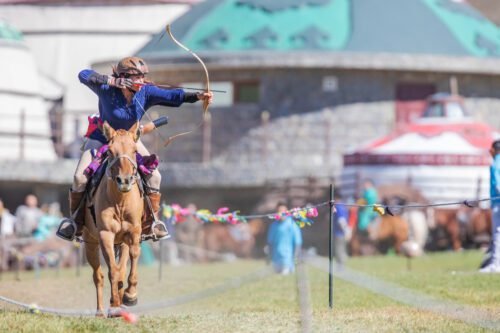
Mongolian archery is built around the traditional composite bow, developed during the era of Chinggis Khan. Constructed from wood and horn with recurved tips, it is lightweight, powerful, and designed for effective long-range shooting—particularly from horseback in open terrain.

Mongolian Archery.Far East Asian Martial Arts.Asian Martial Arts.

Mongolian Archery.

Unlike static target-based systems, Mongolian archery is rooted in mobility and battlefield function, where accuracy under movement was critical. Regional styles, such as those of the Buryat and Khalkha, reflect variations in technique, but all emphasise precision, control, and adaptability.

Key themes include:

  • Composite bow: Recurved design built for power and portability.
  • Static shooting: Accuracy at fixed distances.
  • Mounted archery: Shooting from horseback at speed.
  • Dynamic drills: Targets engaged on approach and exit (e.g. leather balls on poles).
  • Cultural role: Central to Naadam Festival and traditional practice.

Best for: Precision, range, and mounted shooting skill.

Mongolian Horseback Archery.Far East Asian Martial Arts.Asian Martial Arts.

Bajutsu – Mongolian Horseback combat.

🎪 Naadam Festival

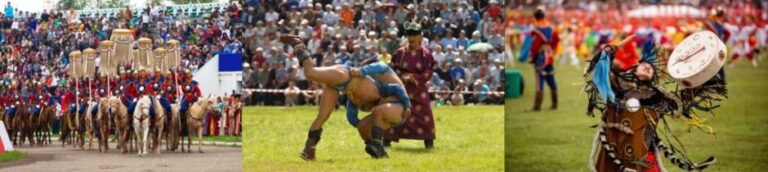
The Naadam Festival, held annually in July, is Mongolia’s national celebration of the “Three Manly Games”—each one directly reflecting the country’s martial roots.

  • Wrestling (Bökh): Tests strength, balance, and dominance through throws and control.
  • Horse Racing: Long-distance endurance races across open terrain.
  • Archery: Precision shooting rooted in battlefield skill.

More than competition, Naadam preserves the same qualities that once defined Mongolian warfare—strength, endurance, and precision—expressed through tradition, ceremony, and national identity.

The Mongolian Naadam Festival centres on the “Three Manly Games”—wrestling, horse racing, and archery—reflecting the strength and traditions of Mongolia’s nomadic culture, alongside music and cultural performances.

If you have enjoyed this post please share or feel free to comment below 🙂

Leave a Reply

Your email address will not be published. Required fields are marked *

This site uses Akismet to reduce spam. Learn how your comment data is processed.

error: Content is protected !!

Join the Super Soldier Project Mailing List Today!!