Barbells, kettlebells, sandbags, sleds, ropes, bands and more. The functional training toolbox is huge, but you don’t need everything in it. In Part Two of this series, we explore what different training tools actually do and how to choose the right one for the job.
๐ Table of Contents
๐งฐ Introduction
Choose the Tool for the Job
Functional training has accumulated an impressive collection of equipment over the years. Kettlebells, sandbags, sleds, suspension trainers, medicine balls, battle ropes, resistance bands, tyres, clubs and maces now sit alongside the barbells and dumbbells that have been building strong bodies for generations. Walk into a well-equipped functional gym and it can resemble a cross between a traditional weights room, an athletics facility and somebodyโs extremely well-organised garage.
That variety is part of the appeal. Different tools allow us to load, carry, throw, drag, swing, push and pull in different ways. They create different forms of resistance, allow force to be applied through different ranges and velocities, and give us considerable freedom when designing training.
But as we established in the first part of this series, the equipment itself is not what makes training functional. A kettlebell is still just a lump of iron with a handle until you give it a job.
๐จ The Right Tool for the Right Job
Every training tool has strengths and limitations. A barbell allows substantial loads to be increased with considerable precision. A medicine ball can be thrown and released explosively. A sandbag provides an awkward load that shifts and resists perfect positioning. A sled allows force to be applied while moving through space, while resistance bands can provide useful resistance almost anywhere.
None is universally superior. The mistake is deciding that because a particular piece of equipment is available, every training problem needs to be solved with it. Exercise selection should follow the goal, not the contents of the equipment rack.
If a barbell is the simplest and most effective option, use it. If a kettlebell better suits the movement or training effect, use the kettlebell. If dragging a heavily loaded sled provides exactly the stimulus required, load it up. Sometimes the most appropriate piece of training equipment is simply your own body.
In this part of the series, weโll open the functional training toolbox and examine what the major implements actually offer, where they excel, where their limitations lie and how they can contribute to building a stronger, better-conditioned and more capable body. You do not need all of them. You need to understand which tool to reach for when the job demands it.
๐คธ Bodyweight
The Original Training Tool
Before kettlebells, suspension trainers, sleds or steel maces enter the conversation, there is one piece of training equipment almost everyone already possesses: their own body.
Bodyweight training can develop strength, muscular endurance, coordination, balance and movement control without requiring a gym or specialist equipment. It is portable, highly adaptable and can provide anything from an accessible starting point for beginners to demanding strength and conditioning work for experienced trainees.
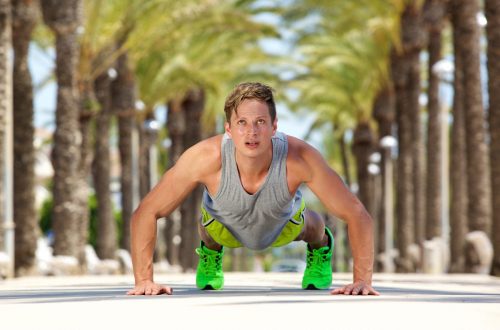
Bodyweight exercises. Push ups.
Squats, lunges, push-ups, pull-ups, dips, step-ups, crawls, jumps and numerous other movements can all be progressed or regressed to suit different levels of ability.
๐ More Than Just Adding Reps
The obvious limitation is that you cannot simply add another plate to your body in the same way you can load a barbell. That does not mean progression is limited to performing more and more repetitions.
Bodyweight exercises can be manipulated through leverage, range of motion, tempo, pauses, unilateral variations, volume and movement complexity. A wall push-up, standard push-up, feet-elevated push-up and one-arm push-up variation all belong to the same broad movement family while presenting very different strength demands.
Lower-body work can progress from supported squats and step-ups towards split squats, deeper ranges, jumping variations or more demanding single-leg movements. Eventually, however, external resistance may become the simplest and most effective way to continue increasing strength. That is not a limitation to be fought against; it is simply the point where another tool becomes more useful.
๐ Train Almost Anywhere
Perhaps bodyweight trainingโs greatest advantage is accessibility. A hotel room, park, garden, workplace or small patch of floor can provide enough space for a productive session, while adding something as simple as a pull-up bar, rings or suspension trainer expands the available exercise library considerably.
That makes bodyweight training particularly valuable for travel, outdoor training and situations where access to equipment is limited. It also reinforces an important principle of functional fitness: physical capability should not depend entirely on access to a perfectly equipped gym.
Learn to control and use your own body well, then add equipment where it provides a clear advantage.
๐๏ธ Free Weights
The Original Training Tool
Functional training became so closely associated with unconventional equipment that the most obvious tools were sometimes overlooked. Barbells and dumbbells remain two of the most effective pieces of training equipment ever created, while kettlebells add their own distinctive advantages.
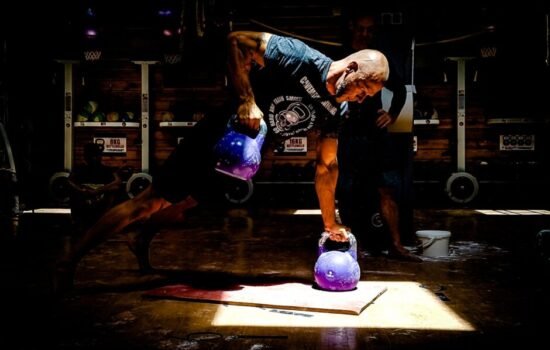
Kettlebell renegade rows.
Together, free weights allow resistance to be progressively increased, exercises to be measured and repeated consistently, and virtually every major movement pattern to be loaded. Whether the goal is strength, muscle development, power or general physical capacity, they provide a foundation that is difficult to replace.
๐ For more detail, open the sections below.
๐๏ธ Barbells
The great advantage of the barbell is its ability to handle substantial and precisely adjustable loads.
Squats, deadlifts, presses, rows and Olympic lifting variations can all be progressively loaded over long periods, making the barbell particularly effective for building strength and, when used appropriately, power.
Progress is also relatively easy to quantify. If you can perform the same movement with better technique, more repetitions or a heavier load than you could several months earlier, you have a clear measure of improvement.
Barbells are not perfect for everything. They require appropriate equipment, space and technique, and because both limbs are connected to the same implement they offer less independent movement than dumbbells. Some exercises and individuals will simply be better served by another tool.
But if the objective involves becoming stronger, dismissing barbell training because it looks too traditional makes little sense.
๐ช Dumbbells
Dumbbells sacrifice some of the maximal loading potential of the barbell in exchange for greater freedom of movement.
Each side can work independently, making dumbbells particularly useful for unilateral training, exposing side-to-side differences and allowing positions that may be difficult or impossible with a fixed bar. They can be pressed, pulled, carried, squatted and lunged with, while also providing straightforward resistance for isolation and accessory work.
They are also highly scalable. The same pair of dumbbells can be used by a beginner learning basic movement patterns, an athlete performing demanding strength work or an experienced lifter targeting specific muscles and weak points.
Simple equipment can still offer enormous range.
๐ฃ Kettlebells
Few implements are more closely associated with modern functional training than the kettlebell, and there are good reasons for its popularity.
Its compact shape and offset centre of mass make it particularly well suited to ballistic movements, loaded carries, unilateral exercises and transitions between positions. Swings allow repeated explosive hip extension, while cleans and snatches move the bell dynamically into the rack or overhead position. Goblet squats provide an accessible way to load the squat pattern, while presses, rows and carries cover more conventional strength work.
The Turkish get-up offers something different again, requiring the trainee to control a load through a sequence of positions while transitioning from the floor to standing and back down.
Kettlebells also work extremely well for strength-endurance and conditioning, particularly when ballistic and strength movements are linked into complexes or repeated for sustained sets.
What they do not possess are magical fat-burning properties. Claims that kettlebell training somehow burns calories at a rate other resistance methods cannot match are usually more marketing than physiology. Their real advantage is far more useful: they are exceptionally versatile pieces of equipment.
๐งฑ Build Strength Before Chasing Novelty
Barbells, dumbbells and kettlebells overlap considerably, but each offers particular advantages. There is no need to choose a camp.
A programme might use barbell squats for heavy lower-body strength, dumbbell presses for independent upper-body loading and kettlebell swings for ballistic hip power. Each tool is being used because its characteristics suit the job.
That is the principle running through the entire toolbox: choose the implement that allows you to train the required quality effectively, then progressively get better at using it.
๐ชจ Awkward Loads
Building Strength Through Instability
Gym equipment is deliberately designed to make resistance manageable. Bars are straight, handles are positioned conveniently and weight is distributed predictably. The real world is rarely so considerate.
Furniture, luggage, building materials, equipment, people and other heavy objects often lack convenient handles or evenly distributed weight. Awkward-load training introduces some of that unpredictability into the gym, requiring more adjustment, gripping, bracing and positional control than a perfectly balanced implement.
Its purpose is not to replace conventional strength training. It gives us a different type of loading challenge.
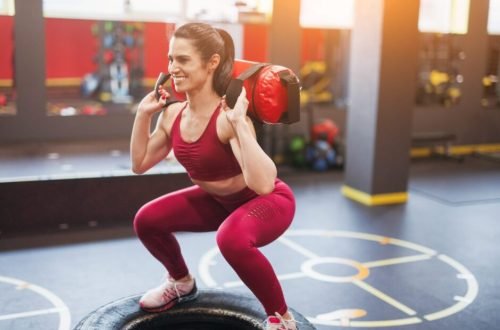
Sandbag squats.
๐ For more detail, open the sections below.
๐ Sandbags
Sandbags are beautifully unpleasant. Unlike a rigid weight, their contents can shift as the bag moves. Depending on the design and how tightly it is filled, the load may sag, roll or change position during the lift, forcing you to continually control the object rather than settling into exactly the same groove every repetition.
They lend themselves particularly well to lifting, shouldering, carrying, loading, dragging and ground-to-shoulder work. Bear-hug carries challenge the trunk and upper body while walking under load, shouldering requires an awkward object to be moved from the floor onto one side of the body, and squats or lunges can be loaded in positions that feel very different from holding a barbell or pair of dumbbells.
That gives sandbags obvious relevance when the ability to handle uncooperative loads matters.
The trade-off is precision. Because the implement is less stable and exact loading can be harder to control, a sandbag is not automatically the best choice for developing maximal strength. If you want to progressively load a heavy squat with precision, the barbell will usually do that job better. If you need experience handling awkward resistance, the sandbag earns its place.
๐ Tyres
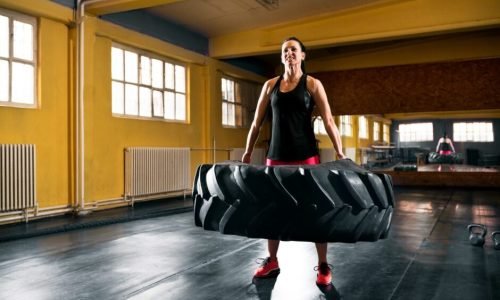
Few exercises advertise functional training as loudly as flipping a massive tyre across a yard.
The tyre flip grew out of strongman training and combines lower-body drive with substantial upper-body involvement and whole-body force production. Tyres can also be dragged, pushed, carried, jumped onto or struck with a sledgehammer, while repeated flips and drags can provide demanding conditioning.
Their limitations are equally obvious. Tyres are bulky, difficult to store and awkward to load progressively, while appropriate technique becomes increasingly important as the tyre gets heavier. A load that is far beyond someoneโs ability does not become more productive because several people are standing nearby shouting at them to flip it.
Tyres are useful, but completely optional. You can develop exceptional strength and conditioning without ever touching one.
๐จ Sledgehammer Work
Pair a tyre with a sledgehammer and it becomes a striking target.
Hammer work requires the hips, trunk, shoulders and arms to coordinate in order to accelerate the implement into the tyre. Alternating sides introduces rotational demands, while repeated strikes can quickly become a demanding conditioning exercise.
As always, the training effect depends on how the tool is used. Powerful individual strikes with adequate recovery place different demands on the body than sustained repeated swings performed for time. With any ballistic implement, control comes before aggression.
๐ช Why Awkward Matters
Awkward-load training introduces something conventional gym equipment deliberately removes: inconvenience.
The load may shift, the grip may need to change and the object may sit badly against the body. You may have to reposition your feet, brace differently or adjust your hold while continuing to produce force.
Used intelligently, that makes awkward objects a valuable complement to more predictable strength training. Sometimes you want the perfectly balanced barbell. Sometimes you want something that fights back a little.
๐ Carries, Pushes and Pulls
Some training methods require very little explanation. Pick something heavy up and carry it, push resistance across the ground or attach yourself to a load and drag it.
Tire Carry.
These simple tasks can develop a formidable combination of strength, conditioning, grip and whole-body work capacity. More importantly, their training effect can be altered substantially simply by changing the resistance, distance, speed and duration.
๐ For more detail, open the sections below.
๐ Sleds and Prowlers
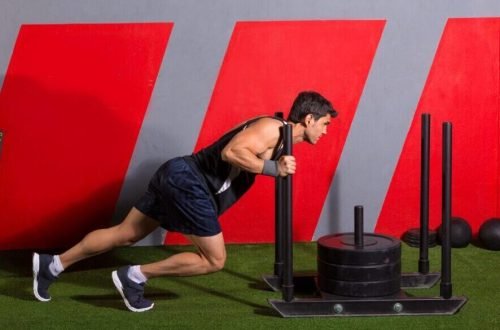
Sleds are among the most versatile tools in the functional training toolbox. Load one lightly and push it quickly, add substantial resistance and the same basic movement becomes a grinding strength effort, or attach straps and ropes to create forward, backward and lateral drags.
One useful characteristic of sled work is its relatively small eccentric component. In conventional resistance exercises, muscles frequently lengthen under load as the resistance is lowered. With a sled, the emphasis is instead on repeatedly producing force to keep the load moving, without an equivalent loaded lowering phase.
This can make sleds useful for accumulating considerable training volume while often producing less muscle soreness than heavily eccentric lower-body work. Heavy pushes can challenge leg drive and whole-body force production, lighter and faster efforts can contribute to acceleration or conditioning work, and longer pushes or drags can become demanding tests of muscular and cardiovascular endurance.
The implement is simple. The range of possible training effects is not.
๐งณ Loaded Carries
Loaded carries are even more straightforward: pick up resistance and move with it. How the load is held determines where much of the challenge falls.
Farmer carries load both hands and challenge the grip, trunk and whole-body posture. Suitcase carries place the load on one side, increasing the demand on the trunk to resist lateral movement. Front-rack carries shift more of the challenge towards the upper body and torso, while overhead carries require sufficient shoulder mobility, strength and control to maintain the load above the head while moving.
Kettlebells, dumbbells, sandbags, trap bars and other objects can all be used. The connection to physical function is also unusually clear: human beings have been picking things up and moving them from one place to another for as long as there have been things worth moving.
๐ชข Drags and Pulls
Dragging provides another way to move substantial resistance without first having to lift and support the entire load.
Sleds can be dragged forwards, backwards or laterally, while ropes and straps allow resistance to be pulled hand-over-hand or dragged while walking away from it. Depending on the setup, these variations can challenge the legs, upper body, grip and cardiovascular system in very different proportions.
A short, extremely heavy drag therefore creates a very different demand from repeatedly pulling a lighter sled over a longer distance. The movement may look similar, but physiologically the task can be completely different.
โ๏ธ Load Determines the Job
This illustrates an important principle throughout the entire toolbox: the equipment does not determine the adaptation by itself.
A sled can be used for strength, power or conditioning. A carry might involve moving an extremely heavy load over a short distance or sustaining a lighter load for considerably longer. The result depends on variables such as load, distance, speed, duration, volume and recovery.
So the presence of a sled, sandbag or pair of heavy kettlebells does not tell you what the session is training. Decide on the physical quality first, then manipulate the tool accordingly.
Sled push.
๐ฅ Power
Throw It, Slam It, Jump With It
Strength is the ability to produce force. Power is the ability to produce force quickly.
Moving a very heavy object slowly can require considerable strength, while sprinting, jumping, throwing, striking and rapidly changing direction depend on generating force in much less time. Several simple tools in the functional training toolbox are particularly useful because they allow that quality to be trained directly.
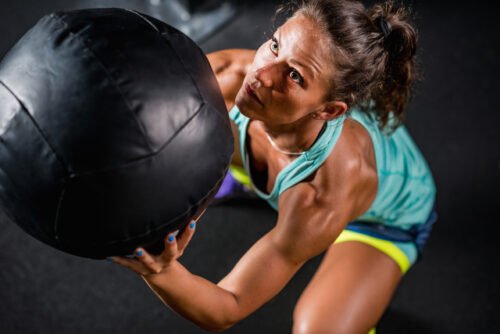
Wall balls.
๐ For more detail, open the sections below.
๐ Medicine Balls
Medicine balls allow you to do something with resistance that is usually impractical with a barbell or dumbbell: release it.
In many conventional strength exercises, the load must be decelerated towards the end of the movement. With a medicine-ball throw, you can continue accelerating through the action and project the implement away from the body.
Chest passes, overhead throws, scoop throws and rotational throws can all be used to develop explosive force in different directions. This makes medicine-ball training particularly useful for sports involving throwing, striking, rotation or rapid whole-body force production, although the principle applies anywhere power development is required.
The ball does not need to be particularly heavy. If increasing the load slows the movement so much that the exercise becomes a grind, you may no longer be training the quality you intended.
๐ฅ Slam Balls
Medicine balls and slam balls are often grouped together, but their construction and intended use can differ considerably.
A conventional medicine ball may be designed for throwing, catching or rebounding, while a slam ball is built to tolerate repeated high-force impacts against the floor and usually produces little or no bounce. That makes it particularly well suited to overhead slams and similar movements where the intention is to accelerate the ball aggressively into the ground.
Using the appropriate ball also avoids the memorable mistake of driving a highly elastic medicine ball into the floor and discovering how quickly it can come back.
๐ฆ Jumps, Hops and Bounds
External resistance is not required to train power. Jumps, hops and bounds use bodyweight to develop rapid lower-body force production, with box jumps, broad jumps, vertical jumps, lateral bounds and single-leg variations offering different options depending on the individual and the objective.
Plyometric boxes, hurdles and markers can help organise these drills, but once again the equipment is not the training method. The important part is the explosive action itself.
Landing also matters. Producing force is only half of many athletic movements; the body must also be able to absorb and control force when returning to the ground, decelerating or changing direction.
โก Power Before Fatigue
Power training should generally prioritise quality over exhaustion. If jump height is falling, throws are slowing markedly or explosive repetitions have turned into grinding efforts, the nature of the training stimulus has changed.
That does not make repeated jumps, throws or slams useless. They can become demanding conditioning work. But conditioning and power are different objectives.
When explosive performance is the priority, use an appropriate load, attack each repetition with intent and allow enough recovery to preserve speed, force and movement quality. A productive power session may finish well before you feel completely destroyed, because exhaustion is not the measure of whether the intended quality was trained.
๐ชข Suspension and Gymnastics-Based Training
Suspending the body from straps, rings or a fixed bar opens up another useful range of training options. These tools use bodyweight against gravity, while leverage, body angle and stability can be manipulated to change the difficulty of the exercise.
They are particularly effective for upper-body pulling, relative strength, trunk control and movements where the hands or shoulders benefit from greater freedom than a fixed implement allows.
๐ For more detail, open the sections below.
๐ป Suspension Trainers
Suspension trainers use adjustable straps anchored above the body, allowing exercises to be progressed or regressed largely by changing your position relative to the anchor point.
Rows demonstrate the principle clearly. Standing more upright means moving a smaller proportion of your bodyweight; walking the feet towards the anchor and bringing the body closer to horizontal makes the same movement considerably harder. Similar adjustments can be used with presses, split squats, lunges, hamstring curls, fallouts and assisted single-leg exercises.
That scalability makes suspension trainers particularly useful when working with mixed abilities or when a full bodyweight movement is currently too demanding. Someone unable to perform an unassisted pull-up, for example, can still progressively develop pulling strength through increasingly difficult suspended rows.
They are also light, portable and require little storage space, making them particularly useful for home, outdoor and travel training.
๐คธ Gymnastic Rings
Rings introduce another level of control because each ring can move independently. The athlete must therefore control both the body and the apparatus during rows, pull-ups, dips, push-ups and support holds.
Here, instability has a clear purpose because controlling the moving rings is part of the exercise itself. The instability is not being added arbitrarily to make a familiar movement more difficult.
That does not make ring exercises automatically superior to fixed-bar equivalents. If the priority is simply to apply greater force or progressively load a movement as heavily as possible, a stable apparatus may be the better option. For relative strength, coordination and upper-body control, however, rings provide a demanding and highly scalable tool.
๐ง Pull-Up Bars
Few pieces of equipment provide as much training value for such a simple setup as a solid pull-up bar.
Pull-ups and chin-ups develop upper-body pulling strength using bodyweight as resistance, while hanging knee and leg raise variations can train the trunk and hip flexors. Passive and active hangs may also be used where appropriate to develop grip and familiarity with supporting bodyweight from the hands.
Grip width and hand position can alter the movement, and additional weight can be introduced once bodyweight repetitions become too easy. The main limitation is that lifting your full bodyweight is already a substantial demand, particularly for beginners, who may need bands, assisted machines, foot-supported variations or suspension rows before progressing to unassisted repetitions.
โ๏ธ Stability Where Stability Belongs
Suspension equipment illustrates an important distinction: instability is neither inherently good nor inherently bad.
If instability prevents you from producing enough force to train the quality you want, it may be counterproductive. If controlling instability is part of the intended task, it can be entirely appropriate.
Rings move because they are supposed to. Your heavy squat platform does not need to.
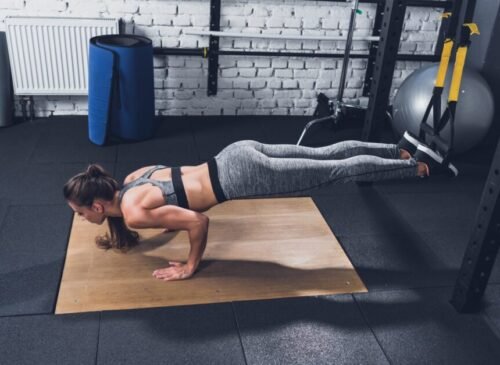
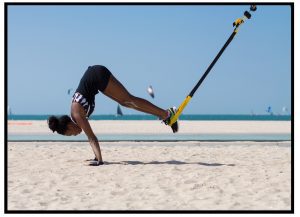
TRX Plank.
ใฐ๏ธ Resistance Bands
Portable Strength Training
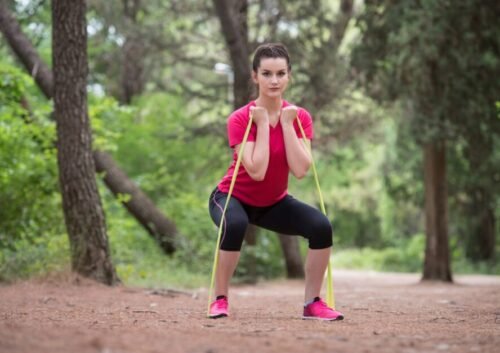
Squats using resistance bands.
Resistance bands are among the simplest and most portable tools in the functional training toolbox. They weigh almost nothing, take up very little space and can provide useful resistance for strength work, assistance exercises, rehabilitation, warm-ups, mobility drills and accessory training.
Their defining characteristic is that resistance generally increases as the band stretches. This gives them a loading profile quite different from a barbell or dumbbell and opens up several useful applications.
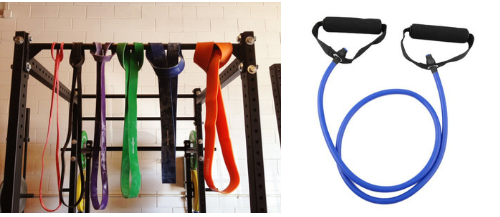
Types of Resistance bands.
๐ For more detail, open the sections below.
๐ Variable Resistance
With conventional free weights, the external load remains essentially constant throughout the repetition. With a band, tension increases as the material is stretched, meaning resistance changes through the movement.
That can be useful when the mechanics of an exercise allow greater force to be produced at certain points in the range. Bands can also be attached to barbells to provide accommodating resistance, adding progressively more tension through portions of a lift where the athlete may be mechanically stronger.
That is a more specialised use, but it illustrates why bands are considerably more than warm-up equipment.
๐ฆต Accessory and Targeted Work
Bands are particularly convenient for accessory exercises that do not require large external loads. Rows, pull-aparts, face pulls, external rotations, lateral walks, resisted hip movements, curls and extensions can all be performed with very little equipment.
Loop bands are commonly used around the thighs or ankles for lateral and hip-focused movements, while longer bands can be anchored to provide pulling or pressing resistance from a variety of directions.
This makes them useful for adding targeted work without requiring another rack of weights or a collection of machines.
๐ง Assistance as Well as Resistance
Bands can also reduce the difficulty of an exercise.
Attached to a pull-up bar, for example, a band can provide assistance while someone develops the strength required for an unassisted repetition. Similar methods can support other bodyweight movements, making bands useful as a bridge between exercise variations.
The assistance is not constant, however. A stretched band provides more help than a less stretched one, so the amount of assistance changes throughout the movement. Band-assisted repetitions can therefore be useful practice, but they should not be treated as mechanically identical to performing the exercise unassisted.
๐ Portable, Cheap and Useful
For home training, travelling or situations where equipment is limited, bands are difficult to beat. They can add resistance to bodyweight sessions, provide pulling movements where equipment is scarce and allow a considerable amount of accessory work within a very small space.
They do have limitations. Resistance can be difficult to quantify precisely, their loading characteristics differ from free weights and the material deteriorates with use. Bands should therefore be checked regularly for cracks, tears or other damage, particularly when they are being stretched towards the face or placed under substantial tension.
Band colours should also never be treated as a universal resistance system. Colours vary between manufacturers, so use the actual resistance specifications of the bands you own rather than assuming one colour always represents a particular load.
Resistance bands will not replace an entire gym, but for something that can be rolled up and thrown into a backpack, they offer an impressive amount of training potential.
๐ฅ Conditioning Tools
Conditioning does not require elaborate equipment. Running, cycling, rowing and bodyweight work can all develop the cardiovascular system, but a few simple tools provide additional ways to build work capacity, coordination and repeated-effort fitness.
Two of the most recognisable are also among the simplest: a rope you jump over and a much heavier rope you try to beat into submission.
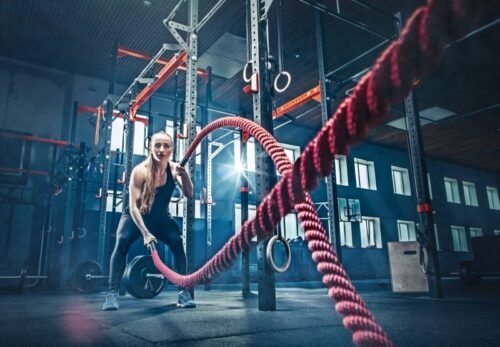
Battlerope waves.
๐ For more detail, open the sections below.
๐ฅ Jump Rope
The jump rope has been a staple of boxing gyms for generations and remains one of the cheapest, most portable conditioning tools available.
Repeated skipping challenges the cardiovascular system while demanding rhythm, timing, coordination and repeated lower-leg stiffness and force production. Unlike many stationary cardio methods, the athlete must continually organise the hands and feet while maintaining an efficient rhythm, which helps explain the ropeโs enduring popularity in combat sports.
Basic two-foot skipping can progress into alternating steps, boxer steps, lateral movements, high knees, crossovers and double-unders. These are not mandatory tricks to collect, simply different ways of altering rhythm, coordination and intensity once the fundamentals are established.
Skipping can be used for steady bouts, short intervals or as part of a warm-up, with intensity changing substantially according to cadence, technique and duration. The repeated impact also needs to be respected. Someone unaccustomed to jumping does not need thousands of contacts on day one; like running, tolerance should be built progressively.
As a combination of conditioning, coordination and portability, the humble rope remains difficult to beat.
๐ Battle Ropes
Battle ropes sit at the opposite end of the spectrum. Rather than repeatedly moving the whole body through space, the athlete produces rapid repeated movements through a long, heavy rope anchored at one end.
Alternating waves, simultaneous waves, slams, circles and lateral movements can all create demanding bouts of work, while squats, lunges and other lower-body actions may be incorporated when they serve the objective.
Battle ropes are particularly useful for short conditioning intervals and repeated upper-body-dominant efforts. They can raise heart rate quickly while challenging the shoulders, arms, grip and trunk, making them a useful option when lower-body loading needs to be limited or when a different conditioning stimulus is required.
What they do not offer is some unique metabolic effect unavailable elsewhere. Twenty seconds of savage rope waves can feel apocalyptic because you are working extremely hard for twenty seconds. The rope itself is not performing metabolic sorcery.
โฑ๏ธ Programme the Work, Not Just the Pain
Both tools illustrate why conditioning needs more thought than simply trying to become exhausted.
Ten rounds of short maximal battle-rope intervals create a very different demand from several minutes of continuous skipping. Changing work duration, recovery, total volume and intensity changes the adaptation you are asking the body to make.
That matters when conditioning is being used to support a particular goal. A fighter preparing to repeat explosive efforts, an athlete building general work capacity and someone simply improving cardiovascular fitness may all use the same tools in very different ways.
There is nothing wrong with an occasional brutal finisher. Just remember that suffering is an experience. Conditioning is an adaptation.
โ๏ธ Rotational and Unconventional Tools
Most conventional resistance equipment places the load relatively close to the hands or distributes it fairly evenly around them. Maces and clubs deliberately do the opposite.
When much of the mass is positioned at the end of a long handle, even a relatively light implement can become surprisingly demanding. The further the load sits from the hands, the greater the leverage you have to control, creating a different challenge for the grip, shoulders, trunk and coordination.
That unusual loading is what gives these tools their value.
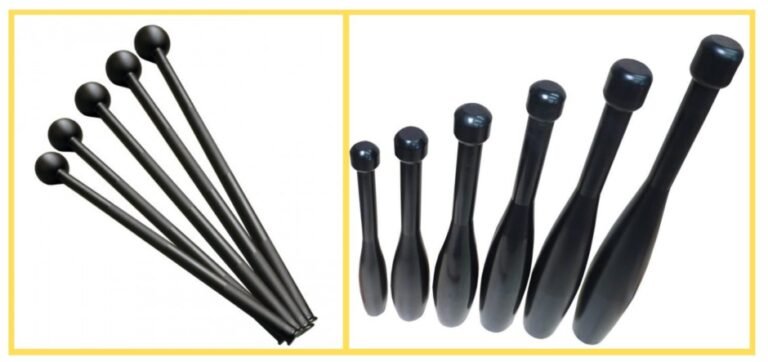
(Left) Macebells. (Right) Club-bells.
๐ For more detail, open the sections below.
๐จ Steel Maces
The modern steel mace takes its basic form from much older club and mace traditions: a long handle with most of the mass concentrated towards one end.
Because the load is heavily offset, simply holding the mace can challenge the grip, shoulders and trunk. Once it begins moving around the body, controlling momentum becomes an important part of the exercise.
The best-known movements are the 360 and 10-to-2, where the mace travels behind and around the head before being brought back under control in front of the body. These movements combine shoulder motion, elbow flexion and extension, grip, trunk control and coordination while the athlete manages a moving offset load.
Maces can also be used for presses, rows, lunges, squats, uppercuts and rotational or anti-rotational drills. Their greatest value, however, tends to come from exercises that actually exploit the implementโs unusual leverage. If you are using a mace for a movement that would be easier to load, control and progress with a dumbbell, there may be little reason to choose it beyond variety.
๐ Indian Clubs and Heavy Clubs
Club training covers a broad spectrum.
Light Indian clubs are traditionally used for flowing circular patterns involving the shoulders, elbows and wrists. Rather than supplying heavy resistance, they can be used to develop coordination, rhythm and controlled upper-body movement.
Heavier clubs shift the emphasis towards strength. As the load increases, casts, mills, shield casts and related movements demand more from the grip, arms, shoulders and trunk, while the displaced centre of mass creates a very different challenge from an evenly balanced weight.
That distinction matters. A light club moving through fluid circular patterns and a heavy club being used for strength work may look superficially similar, but they do not create the same training demand.
๐ Training Around the Body
One reason maces and clubs fit well within a broader functional programme is their ability to load movement around the body rather than simply up and down in front of it.
Human movement is not confined to straight lines. We rotate, resist rotation, reach across the body and transfer force between the upper and lower body. Maces and clubs provide one way to load those actions while also introducing momentum and leverage.
They are not the only way. Cables, medicine balls, resistance bands and bodyweight drills can all train aspects of rotation extremely well. The mace simply offers a distinctive option when momentum, leverage and continuous circular movement are part of the intended challenge.
๐บ Old Tools, Modern Training
Clubs and mace-like implements have genuine historical roots in physical culture and martial preparation across several cultures, particularly in South Asia and the Middle East. Modern steel maces and clubs draw inspiration from those traditions, although contemporary training methods have evolved considerably.
We do not need to invent an unbroken secret warrior training system to make them interesting. Their mechanics are interesting enough.
Used properly, maces and clubs can provide a distinctive combination of grip strength, shoulder movement, coordination, leverage and rotational control that is difficult to reproduce in exactly the same way with conventional weights.
And admittedly, swinging a steel mace around does look considerably more warrior-like than adjusting the seat on a resistance machine. That is not why it works, but we are allowed to enjoy it.
๐งฉ Specialist Tools
Useful, But Not Essential
Few ideas became more closely associated with early functional training than unstable-surface training. For a while, seemingly everything had to be performed on a ball, wobble board or inflatable dome. Squats became unstable squats, presses became unstable presses, and perfectly useful exercises were often made considerably harder without much thought about what the added instability was supposed to achieve.
The pendulum has since swung the other way, with unstable training sometimes dismissed entirely. Neither extreme is particularly useful.
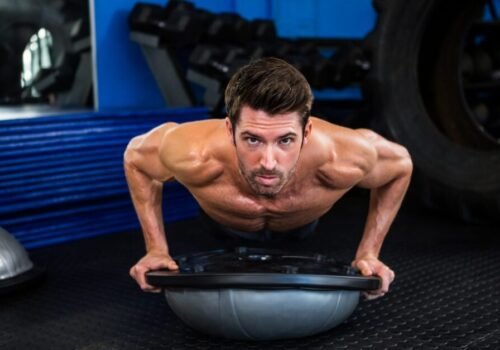
BOSU Ball push ups.
The pendulum has since swung the other way, with unstable training sometimes dismissed entirely. Neither extreme is particularly useful.
Instability is simply a training variable. If controlling an unstable surface contributes to the quality you are trying to develop, it may have value. If it prevents you applying sufficient force to train the actual objective, a stable surface will usually be the better choice.
๐ For more detail, open the sections below.
๐ต Swiss Balls
The Swiss ball, stability ball or exercise ball still has legitimate applications.
Exercises such as hamstring curls, rollouts, stir-the-pot variations and selected trunk movements use the fact that the ball can move beneath the body, requiring continual positional adjustment and control. Swiss balls can also have a place within some rehabilitation and movement programmes when those characteristics are useful.
What they are not is a universal upgrade to conventional exercise. Performing heavy strength movements while balancing on a ball generally reduces the amount of force and load that can be controlled effectively. If the objective is maximal lower-body strength, placing an unstable surface beneath your feet usually creates a limitation rather than an advantage.
โ๏ธ BOSU Trainers
The BOSU follows much the same principle.
Its unstable surface can be useful for balance drills, selected rehabilitation work and specific tasks where controlling or responding to an unstable base is deliberately being trained.
That does not make a BOSU squat inherently more functional than a squat performed on solid ground. For most strength development, a stable floor allows far greater force to be directed into the resistance rather than spending much of the effort simply maintaining balance.
There are situations where instability is exactly the challenge you want. There are plenty where it is not.
๐ฏ Give Instability a Reason
The question is the same one we have applied throughout the toolbox: what are you trying to improve?
If the answer genuinely involves balance, positional control or managing instability, specialist equipment may offer a useful option. If the goal is primarily to become stronger, faster or more powerful, there is little reason to make an exercise less stable simply because instability once became synonymous with โfunctionalโ.
Sometimes the most functional surface in the gym is simply the floor.
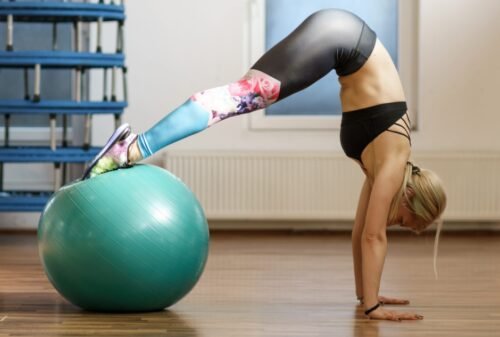
Swiss Ball Pike.
๐ฏ How to Choose Your Equipment
By this point, the functional training toolbox is getting fairly crowded. Barbells, dumbbells, kettlebells, sandbags, sleds, medicine balls, ropes, bands, suspension trainers, rings, maces, clubs and numerous other implements can all contribute to an effective programme.
That does not mean an effective programme needs all of them.
The real skill is understanding why you are choosing one tool rather than another. Equipment should make it easier to produce the training effect you want, not become the starting point around which the rest of the session is forced to fit.
๐ For more detail, open the sections below.
๐งญ Start With the Goal
Equipment selection should begin with the outcome.
If the goal is maximal strength, you need a way to apply substantial and progressively measurable resistance. If the goal is explosive power, you need movements and tools that allow force to be produced rapidly. If you need to carry awkward loads, move resistance through space or develop repeated-effort conditioning, the requirements change again.
The decision process can therefore be reduced to:
Goal โ Physical quality โ Movement โ Tool
Start with what you want to improve, identify the quality that supports it, choose an appropriate movement and only then decide which implement makes that movement practical and effective.
The equipment comes last.
โ๏ธ Match the Tool to the Quality
Different implements make certain training qualities easier to develop, but very few qualities belong exclusively to one piece of equipment.
Barbells excel when precise progressive loading matters. Medicine balls are useful when resistance needs to be accelerated and released. Sandbags provide awkward loading, while sleds make loaded pushing and dragging straightforward. Bands, suspension trainers and bodyweight movements can become particularly useful when portability or limited space matters.
The objective is not to identify one supposedly perfect tool. It is to choose the option whose characteristics best suit the adaptation, movement and individual.
๐ง Consider the Person Using It
The theoretically ideal tool is not always the most appropriate tool for the person standing in front of you.
Training experience, mobility, coordination, previous injuries, confidence and technical ability all influence exercise selection. A complicated movement may offer little advantage if the trainee cannot perform it well enough to create the intended stimulus, while a simpler exercise may provide a clearer route to progressive overload.
Equipment does not become superior because it is harder to master. Complexity is not progression.
๐ Work With the Environment
The best equipment is also equipment you can actually use consistently.
A commercial gym may offer racks, machines, cables and large selections of free weights. A garage gym might revolve around a barbell, kettlebells and sandbags, while somebody training at home may rely primarily on dumbbells, resistance bands, a pull-up bar and bodyweight.
All of those environments can support effective training because physical qualities are not tied to particular brands or pieces of equipment. Strength, conditioning, power and movement capacity can usually be developed through more than one method.
Work intelligently with what is available rather than designing a programme around equipment you do not possess.
๐จ Let the Tool Serve the Training
Functional equipment should expand your options rather than dictate them.
There is little reason to swing a kettlebell simply because kettlebells look functional, flip a tyre because tyre flips look hardcore or stand on a BOSU because instability sounds advanced. Those tools earn their place when their characteristics provide the stimulus the programme actually requires.
Instead of looking at an implement and asking โWhat can I do with this?โ, begin with โWhat am I trying to develop?โ
Then choose the tool that helps you do it.
๐งฐ You Donโt Need Everything
As functional training grew, so did the industry surrounding it. Suddenly a serious training space seemed to require kettlebells, battle ropes, sleds, sandbags, suspension systems, balance trainers, specialist bars and an expanding collection of increasingly unusual objects with handles attached to them.
Much of that equipment is useful, and some of it is excellent. You still do not need all of it.
๐ For more detail, open the sections below.
๐ฐ Donโt Confuse Equipment With Capability
A well-equipped facility gives you more options, but more options do not automatically produce better training.
Someone with access to a barbell, adjustable dumbbells and a pull-up bar can build considerable strength and muscular capacity. Add a kettlebell or two and the available options expand further. Give that person somewhere to run, jump and carry loads and you already have the foundations of an extremely capable training environment.
At the other extreme, a gym can contain thousands of poundsโ worth of specialist equipment and still produce poor programmes if the exercises are badly selected, progression is absent or the training has no clear purpose. Equipment increases possibility; it does not replace good programming.
๐ Build Around What You Have
Your own training toolbox should reflect your goals, environment and budget rather than somebody elseโs idea of what a functional gym should contain.
A home setup might begin with bodyweight training, resistance bands and a pull-up bar before gradually adding dumbbells or kettlebells. A strength-focused garage gym may revolve around a rack, barbell and plates. Someone who prefers outdoor training might get enormous mileage from kettlebells, a sandbag, rings and somewhere suitable to sprint or carry.
None of those setups is incomplete simply because it lacks every tool covered in this article. If your needs change, the equipment can change with them.
๐ Progress Beats Variety
There will always be another exercise to discover and another piece of equipment to buy, but a larger toolbox is only useful if the tools actually improve the training.
Variety can help you address different goals, work around limitations or simply keep training enjoyable. It becomes a distraction when collecting new equipment replaces getting better at the exercises and qualities that already matter.
Build enough of a toolbox to support your goals, then use it rather than continually expanding it. The next part of this series will look at how those exercises and tools are organised, progressed and varied within an actual programme.
โ๏ธ Load Determines the Job
This illustrates an important principle throughout the entire toolbox: the equipment does not determine the adaptation by itself.
A sled can be used for strength, power or conditioning. A carry might involve moving an extremely heavy load over a short distance or sustaining a lighter load for considerably longer. The result depends on variables such as load, distance, speed, duration, volume and recovery.
So the presence of a sled, sandbag or pair of heavy kettlebells does not tell you what the session is training. Decide on the physical quality first, then manipulate the tool accordingly.
๐ Summary
Tools Serve the Goal
There is no single piece of functional training equipment because there is no single function to train for. Barbells, dumbbells, kettlebells, sandbags, sleds, medicine balls, bands, ropes, suspension trainers, maces and specialist equipment all provide different ways to apply resistance, create movement and develop physical qualities. Their value comes from the problem they help solve, not from whether the fitness industry happens to label them โfunctionalโ.
Equally, you do not need all of them. A relatively simple collection of equipment can develop considerable strength, power, conditioning and movement capacity when it is selected intelligently and used consistently. More equipment gives you more options, but it does not automatically give you better training.
You do not need every piece of functional training equipment. A small, well-chosen toolbox can be enough when the tools match the goal.
The process remains straightforward. Start with the goal, identify the physical qualities involved, choose movements that develop those qualities and then select the tools that make the training effective and practical. The equipment comes after the purpose, not before it.
That gives you the toolbox, but it still does not give you a programme. You still need to decide which qualities deserve priority, how frequently they should be trained, how individual sessions should be organised, how the training week fits together, how fatigue and recovery are managed and how the programme progresses over time.
That is where the final part of the series begins. We have established what functional training means and examined the tools available to develop it. Next comes the part that determines whether any of those tools actually produce results: putting them together into a coherent programme.
The tool serves the training. The training does not serve the tool.
If you have enjoyed this post please share or feel free to comment below ๐
๐ Our Other Posts


Path of the Wolf โ The Witcher Workout
Channel your inner Witcher with this intense, monster-fighting workout designed to build the strength, agility,

Inside Kettlebell Sport: An Interview with Denis Vasilev