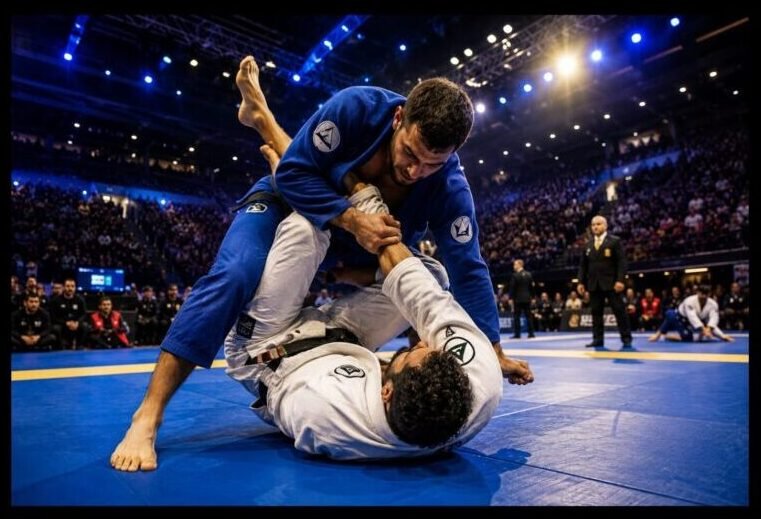
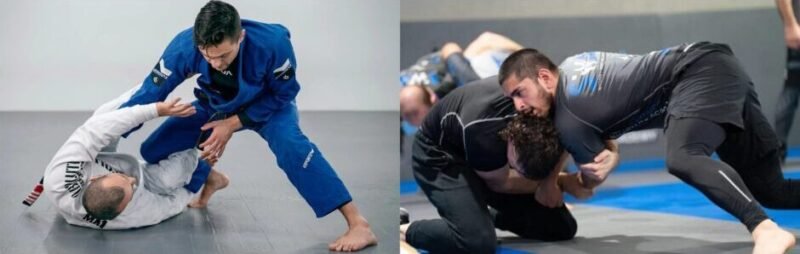
Brazilian Jiu-Jitsu competitors grappling during a tournament match, demonstrating the technical skill and live sparring that define the modern sport.

πŸ† Brazilian Jiu-Jitsu Training, Belts & Competition

Thinking about stepping onto the mats? This guide explores what happens inside a typical Brazilian Jiu-Jitsu class, how the belt system works, the differences between Gi and No-Gi training, and what to expect from competition.

Table of Contents

πŸ† Introduction

Brazilian Jiu-Jitsu is often described as a lifelong journey. Unlike many martial arts, where progress can be measured through forms, patterns, or demonstrations, BJJ places a strong emphasis on practical application. Techniques are learned, drilled, tested, and refined against resisting opponents on a regular basis.

This approach has helped shape a unique training culture. Whether your goal is self-defence, fitness, competition, mixed martial arts, or personal development, stepping onto the mats means becoming part of a system built around continuous learning and improvement.

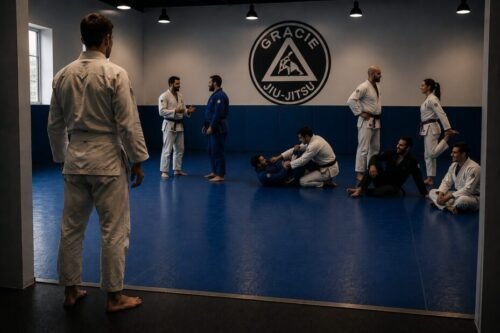
New white belt standing at the edge of a Brazilian Jiu-Jitsu academy, watching students prepare for class while an instructor speaks with practitioners on the mats.

Every Brazilian Jiu-Jitsu practitioner begins the same wayβ€”with a first step onto the mats. What may seem intimidating at first soon becomes the start of a lifelong journey of learning, challenge, and personal growth.

For newcomers, BJJ can appear intimidating. Strange terminology, unfamiliar positions, coloured belts, and experienced practitioners seemingly moving with effortless control can make the art feel overwhelming at first. Fortunately, every black belt started as a beginner, and most academies are designed to help new students learn progressively.

In this article, we examine what happens inside a typical Brazilian Jiu-Jitsu class, the differences between Gi and No-Gi training, how the belt system works, and the role competition plays within the modern sport.

πŸ₯‹ What to Expect in a BJJ Class

Walking into your first Brazilian Jiu-Jitsu class can feel daunting. You’ll likely encounter unfamiliar terminology, experienced practitioners moving effortlessly across the mats, and techniques that appear impossible to perform.

Fortunately, most classes follow a similar structure designed to help students learn progressively and safely.

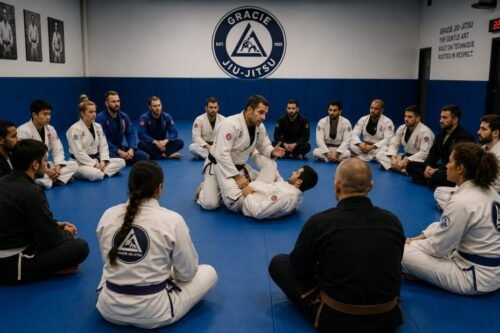
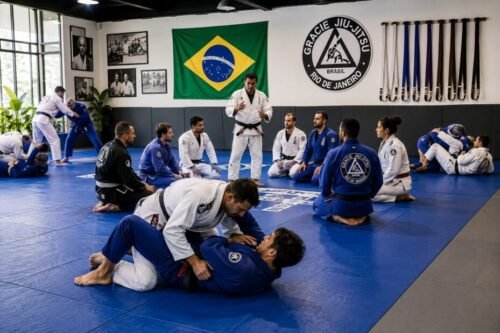
Brazilian Jiu-Jitsu instructor demonstrating a guard pass technique to a seated class of students during a structured academy lesson.

A typical Brazilian Jiu-Jitsu class combines instructor-led demonstrations with partner practice, allowing students to develop sound technique before applying it during live sparring.

Click on the links below to read more.

Classes often begin with a warm-up designed to prepare the body for grappling. This may include jogging, mobility drills, breakfalls, shrimping, bridging, rolls, and other movements commonly used in BJJ.

These exercises not only improve fitness but also help develop the movement patterns needed during training.

After warming up, the instructor will typically demonstrate one or more techniques. These may involve escapes, sweeps, guard passes, submissions, takedowns, or positional concepts.

Students then practise the techniques with a partner under supervision, focusing on correct mechanics and timing rather than speed or strength.

Once a technique has been introduced, students usually spend time drilling it repeatedly.

The objective is to develop familiarity and build muscle memory through repetition. Many academies also use positional drills, where students repeatedly practise specific scenarios such as escaping side control or defending a guard pass.

Most classes conclude with some form of live sparring, commonly known as rolling.

During rolling, practitioners attempt to apply techniques against resisting partners in a controlled environment. This allows students to test what they have learned while developing timing, adaptability, and composure under pressure.

One of the biggest surprises for beginners is how much there is to learn. Brazilian Jiu-Jitsu has a steep learning curve, and progress can sometimes feel slow during the early months.

This is perfectly normal.

Most practitioners spend their first few months learning fundamental positions, escapes, and defensive skills before gradually building a broader understanding of the art. Patience, consistency, and regular attendance are often more important than natural talent during this stage.

πŸ₯‹ First Class Survival Tips

Starting Brazilian Jiu-Jitsu can feel intimidating, but a few simple steps will make your first experience much smoother.

βœ” Trim your fingernails and toenails – Grappling involves constant close contact, and sharp nails can easily scratch training partners.

βœ” Arrive early – Give yourself time to introduce yourself, complete any paperwork, and become familiar with the academy.

βœ” Bring water and expect a workout – Even a beginner-friendly class can be surprisingly demanding.

βœ” Tap early and tap often – A tap is not a sign of failure. It is simply how practitioners train safely and avoid injury.

βœ” Leave your ego at the door – Everyone gets submitted, including experienced practitioners. Focus on learning rather than winning.

βœ” Ask questions – Instructors and training partners are usually happy to help beginners understand techniques and academy etiquette.

βœ” Be patient – Brazilian Jiu-Jitsu has a steep learning curve. Feeling confused during your first few classes is completely normal.

Most importantly, remember that every black belt in the room once stood exactly where you are now: stepping onto the mats for the very first time.

🀼 Rolling: The Heart of BJJ Training

If there is one aspect of Brazilian Jiu-Jitsu that sets it apart from many other martial arts, it is rolling.

Rolling is the term used for live sparring in BJJ. During a roll, two practitioners attempt to apply techniques against one another in real time while dealing with active resistance. The objective is not to injure a training partner, but to test skills, solve problems, and improve through experience.

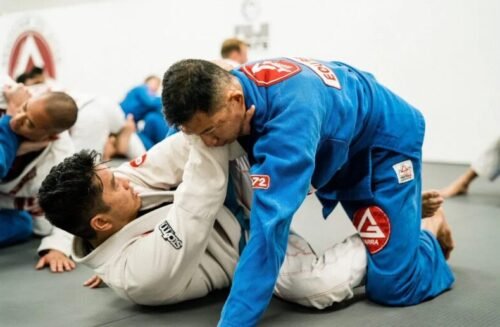
Rolling is the heart of Brazilian Jiu-Jitsu training, allowing practitioners to apply techniques against resisting opponents in a safe, controlled environment while developing timing, adaptability, and technical skill.

For beginners, rolling can feel chaotic. More experienced practitioners often seem to move effortlessly, controlling positions and escaping situations that appear impossible. This can be frustrating at first, but it is also one of the fastest ways to learn.

Click on the links below to read more.

Many martial arts teach techniques through cooperative drilling. BJJ does this too, but rolling adds another dimension.

A resisting opponent rarely behaves as expected. They move, defend, counter, and adapt. Rolling teaches practitioners how to apply techniques under realistic conditions and make decisions when things do not go according to plan.

This ability to deal with resistance is one of the reasons Brazilian Jiu-Jitsu has earned such a strong reputation for effectiveness.

Rolling quickly exposes weaknesses. A technique that works perfectly in drilling may fall apart against a skilled opponent. Likewise, bad habits are often revealed immediately.

While this can be humbling, it also provides immediate feedback and helps accelerate improvement.

Every practitioner gets submitted. Beginners submit frequently. Experienced practitioners submit less often, but it still happens.

Learning to accept mistakes, tap when necessary, and view setbacks as opportunities to improve is an important part of BJJ culture. In many ways, managing the ego becomes just as important as learning techniques.

Many practitioners consider rolling to be the true classroom of Brazilian Jiu-Jitsu.

Techniques are introduced through instruction. They are refined through drilling. But it is through rolling that they are truly understood.

For this reason, live sparring remains one of the defining features of Brazilian Jiu-Jitsu and one of the primary reasons the art continues to evolve.

πŸ‘˜ Gi and No-Gi

One of the first decisions many Brazilian Jiu-Jitsu practitioners face is whether to train in the Gi, No-Gi, or both.

While the core principles of BJJ remain the same, the two formats create noticeably different styles of grappling.

While the core principles remain the same, Gi and No-Gi training each offer distinct challenges. The Gi emphasises grips and control, while No-Gi generally features a faster pace with greater reliance on wrestling and scrambles.

πŸ₯‹ Gi Training

The Gi is the traditional BJJ uniform, consisting of a heavy jacket, trousers, and belt.

The additional material provides numerous gripping opportunities. Practitioners can use sleeves, collars, lapels, and trousers to control opponents, execute sweeps, and apply submissions.

This often results in a more methodical style of grappling where grips, control, and positional battles play a major role.

Many practitioners believe Gi training helps develop patience, technical precision, and a deeper understanding of positional control.

🀼 No-Gi Training

No-Gi removes the traditional uniform and is typically practised wearing a rashguard and shorts.

Without collars and sleeves to grip, the pace tends to increase. Scrambles become more common, and practitioners often rely more heavily on body locks, underhooks, wrestling techniques, and athletic movement.

The style shares many similarities with modern submission grappling and mixed martial arts.

βš–οΈ Which Is Better?

The answer depends largely on individual goals.

Gi training offers:

  • More grip-based techniques.
  • A wider range of submissions and controls.
  • Greater emphasis on patience and positional battles.

No-Gi training offers:

  • Faster-paced exchanges.
  • Increased emphasis on wrestling and scrambles.
  • Greater relevance to MMA and submission grappling.

Many academies teach both formats, and many practitioners choose to train in both. While each has its advocates, the fundamentals of leverage, control, positioning, and submission remain largely the same regardless of what a practitioner is wearing.

Ultimately, neither format is inherently superior. They are simply different expressions of the same art.

πŸŽ–οΈ The Belt System

Like many martial arts, Brazilian Jiu-Jitsu uses a coloured belt system to recognise progress and experience. However, BJJ is widely known for having one of the longest and most demanding promotion paths in martial arts.

Advancement is based on far more than simply attending classes. Instructors typically consider technical ability, performance during sparring, consistency, attitude, and overall understanding of the art when evaluating students.

πŸ“ˆ Adult Belt Progression

The standard adult belt progression is:

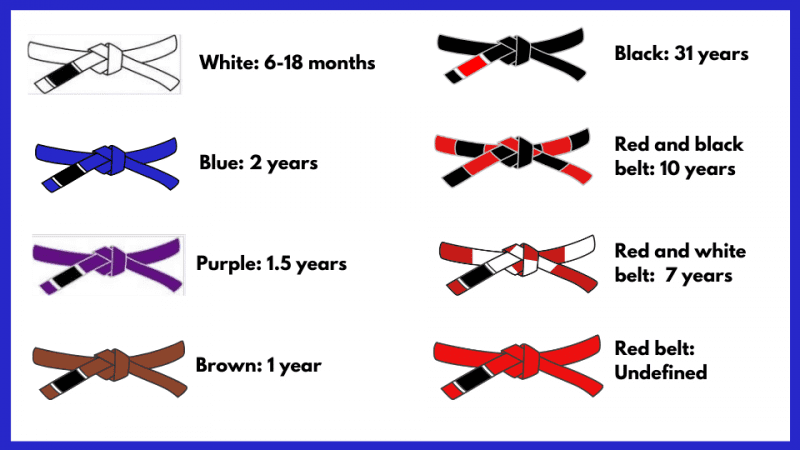
White Belt β†’ Blue Belt β†’ Purple Belt β†’ Brown Belt β†’ Black Belt

Beyond black belt are a series of honorary and instructor grades, including the highly prestigious coral belts (red-and-black and red-and-white) and the rare red belt, awarded only to a handful of practitioners who have dedicated their lives to the art.

Brazilian Jiu-Jitsu belt ranking system from white belt to black belt and beyond.

Brazilian Jiu-Jitsu follows a structured belt progression similar to Judo. Adult practitioners advance through eight belt ranks: White, Blue, Purple, Brown, Black, Red and Black (Coral), Red and White (Coral), and Red Belt, the highest rank in the art.

🎨 What the Belts Represent

While every academy has its own standards, the belts are often viewed broadly as follows:

White Belt – Learning the fundamentals and surviving the early stages of training.

Blue Belt – Demonstrates a solid understanding of basic positions, escapes, and submissions.

Purple Belt – Considered an advanced practitioner with a well-developed technical game.

Brown Belt – Refines techniques, develops strategy, and prepares for black belt level proficiency.

Black Belt – Represents a high level of technical expertise and years of dedicated training.

πŸ•°οΈ Why Promotions Take So Long

Brazilian Jiu-Jitsu promotions are generally slow and conservative. Regular live sparring makes skill levels difficult to hide, and practitioners are expected not only to understand techniques but also apply them successfully against resisting opponents.

As a result, earning a black belt is widely regarded as a significant achievement.

⏳ How Long Does It Take?

“How long does it take to get a black belt?”

The honest answer is: it depends.

Progress in Brazilian Jiu-Jitsu varies considerably depending on factors such as training frequency, natural ability, age, athletic background, instructor standards, and time spent on the mats.

That said, BJJ has a reputation for slower progression than many other martial arts.

πŸ“… Typical Timeframes

While every journey is different, a rough guide often looks something like this:

Blue Belt: 1–3 years

Purple Belt: 3–5 years

Brown Belt: 5–8 years

Black Belt: 8–12+ years

Some practitioners progress more quickly. Others take considerably longer. Breaks in training, injuries, work commitments, and life responsibilities can all influence the timeline.

πŸƒ The Long Game

Brazilian Jiu-Jitsu is often described as a marathon rather than a sprint. Progress tends to reflect genuine improvement rather than simply time served, which is one reason BJJ belts are so highly respected within the martial arts community.

πŸ’ͺ Focus on Improvement

Experienced practitioners often advise beginners not to become overly focused on belts.

While promotions provide useful milestones, the most important measure of progress is usually personal improvement. Escaping positions that once felt hopeless, surviving longer rounds, and successfully applying techniques against resisting partners are often far more meaningful indicators of growth than the colour around your waist.

In the long run, consistency tends to matter far more than speed.

🏟️ Competition in BJJ

While many people train Brazilian Jiu-Jitsu for fitness, self-defence, or personal development, competition has become an important part of the modern sport.

BJJ tournaments provide practitioners with an opportunity to test their skills against opponents from other academies in a controlled environment. For some, competition becomes a major focus. For others, it remains an occasional challenge or something they never pursue at all.

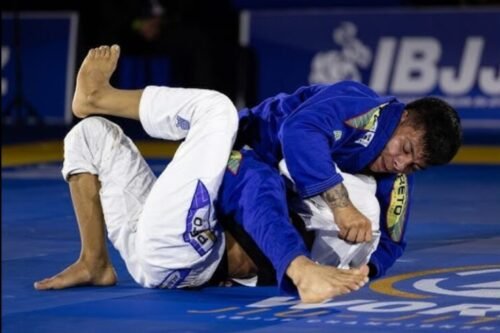
Two Brazilian Jiu-Jitsu competitors grappling during a tournament match.

Brazilian Jiu-Jitsu competition provides practitioners with an opportunity to test their skills against unfamiliar opponents in a controlled environment. For some, tournaments become a major focus; for others, they are simply another step in the learning process.

Click on the links below to read more.

Most tournaments divide competitors by:

  • Belt rank.
  • Weight class.
  • Age category.
  • Gi or No-Gi division.

This helps create fairer and more competitive matchups.

A white belt competitor, for example, will usually face opponents of a similar experience level rather than being matched against advanced practitioners.

Although rules vary between organisations, competitors generally win matches in one of three ways:

  • Submission.
  • Points.
  • Referee’s decision.

A successful submission immediately ends the match, making it the most decisive route to victory.

If no submission occurs, points are used to determine the winner.

Competition can be a valuable learning experience regardless of the result.

Preparing for a tournament often improves fitness, sharpens technique, and exposes weaknesses that may not be obvious during normal training. It also allows practitioners to experience the pressure of performing in front of spectators and against unfamiliar opponents.

For many students, competition serves as a useful benchmark for measuring progress. Others simply enjoy the challenge and camaraderie that tournaments provide.

Whether you compete regularly or never step onto a competition mat, the lessons learned through tournament preparation can often improve every aspect of your Brazilian Jiu-Jitsu.

βš–οΈ How Scoring Works

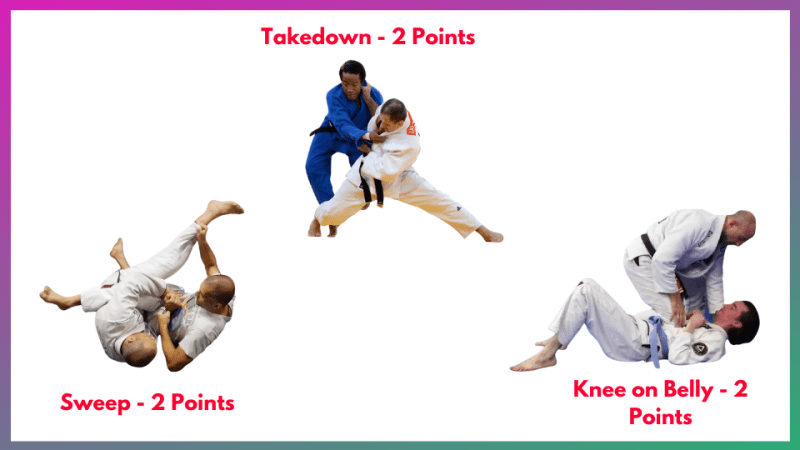
Most Brazilian Jiu-Jitsu competitions reward practitioners for achieving and maintaining dominant positions.

The philosophy is simple: if you improve your position, you score points. The more dominant the position, the more points are typically awarded.

Takedown or Throw – 2 points

Successfully bringing an opponent to the ground while establishing control.

Sweep – 2 points

Reversing position from the bottom and ending up on top.

Knee-on-Belly – 2 points

Establishing and controlling the knee-on-belly position.

Guard Pass – 3 points

Successfully moving beyond an opponent’s guard and establishing control.

Mount – 4 points

Achieving a dominant mounted position on top of an opponent.

Back Control – 4 points

Taking an opponent’s back and securing control.

Brazilian Jiu Jitsu. BJJ. Martial arts. MMA. Fight Club.

πŸ”’ Submission Trumps Everything

While points can decide a match, the ultimate objective remains the submission.

A successful choke or joint lock immediately ends the contest regardless of the score. For this reason, competitors must constantly balance positional advancement with opportunities to finish the fight.

πŸ“œ Different Rulesets

Not all tournaments use identical scoring systems.

Some organisations place greater emphasis on submissions, while others have unique rules regarding points, overtime, or match duration. Despite these differences, the underlying principles remain largely the same: achieve dominant positions, control your opponent, and seek the submission whenever the opportunity arises.

🌍 Major Organisations & Events

As Brazilian Jiu-Jitsu has grown, a number of organisations and tournaments have emerged to govern competition and showcase the sport’s best athletes.

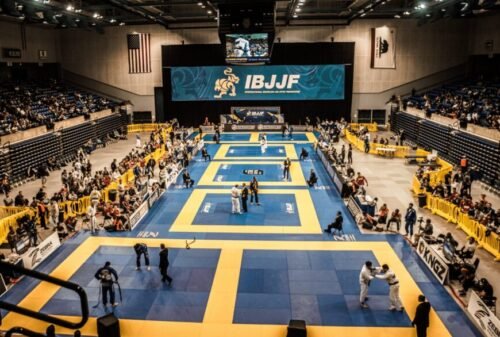
Panoramic view of a major Brazilian Jiu-Jitsu tournament with multiple competition mats, referees, competitors, coaches, and spectators inside a large indoor arena.

Events such as the IBJJF World Championship highlight the global growth of Brazilian Jiu-Jitsu, with hundreds of matches taking place simultaneously across numerous competition mats.

Click on the links below to read more.

The International Brazilian Jiu-Jitsu Federation (IBJJF) is one of the largest and most influential organisations in the sport. It oversees many of the world’s most prestigious Gi and No-Gi tournaments, including the World Championships and Pan Championships.

For many competitors, success at IBJJF events represents a major career milestone.

The Abu Dhabi Combat Club (ADCC) Submission Fighting World Championship is widely regarded as the most prestigious No-Gi grappling tournament in the world.

Unlike many BJJ competitions, ADCC attracts elite competitors from a variety of grappling backgrounds, including Wrestling, Sambo, Judo, and Submission Grappling. Winning ADCC is considered one of the highest achievements in modern grappling.

Formerly known as the UAEJJF, the Abu Dhabi Jiu-Jitsu Pro (AJP) circuit hosts tournaments across the globe and has played a major role in expanding the sport internationally.

Its professional structure and extensive event calendar have helped create more opportunities for competitors at all levels.

While the major championships attract the headlines, most practitioners gain their first competitive experience through local and regional events.

These tournaments provide an excellent opportunity to test skills, gain experience, and become part of the wider BJJ community without the pressure of competing on the sport’s biggest stages.

Whether your ambition is to become a world champion or simply challenge yourself at a local event, there are now more opportunities than ever to compete in Brazilian Jiu-Jitsu.

🎯 Should You Compete?

One of the questions many Brazilian Jiu-Jitsu practitioners eventually face is whether to enter a competition.

The answer depends entirely on your goals.

πŸ… Reasons to Compete

Competition provides an opportunity to test your skills against unfamiliar opponents under pressure. It can highlight weaknesses, sharpen techniques, improve conditioning, and expose areas of your game that might otherwise go unnoticed during normal training.

Many practitioners also find that preparing for competition gives their training greater focus and purpose.

🏑 Reasons Not to Compete

Competition is not the only measure of success in Brazilian Jiu-Jitsu.

Many people train purely for fitness, self-defence, enjoyment, stress relief, or personal development. Others have careers, families, or commitments that make the additional time and preparation required for competition impractical.

There is nothing wrong with choosing to remain a recreational practitioner.

🎭 The Reality

Competing can be exciting, rewarding, and highly educational. It can also be nerve-racking, physically demanding, and occasionally disappointing.

Win or lose, most competitors discover that tournaments reveal valuable lessons about both their technical abilities and their mindset under pressure.

βš–οΈ There Is No Right Answer

Some practitioners compete every opportunity they get. Others never compete at all.

Neither approach is inherently better.

What matters is that your training aligns with your personal goals and continues to provide value, enjoyment, and opportunities for improvement.

πŸ“Œ Final Thoughts

Brazilian Jiu-Jitsu is unlike any other martial art.

Its emphasis on live sparring, technical problem-solving, and continuous improvement creates a learning environment that challenges both body and mind. Whether your interest lies in self-defence, competition, fitness, mixed martial arts, or personal development, BJJ offers a depth of study that can keep practitioners engaged for decades.

The journey is rarely easy. Progress can feel slow, the learning curve can be steep, and success often comes through persistence rather than shortcuts. Yet these same challenges are part of what makes the art so rewarding.

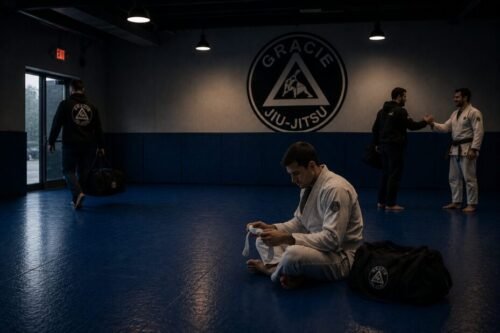
Brazilian Jiu-Jitsu student sitting quietly on the mats after class, reflecting while holding a white belt as other practitioners leave the academy.

Progress in Brazilian Jiu-Jitsu is measured not by a single class or competition, but through years of consistent training. Long after the mats have emptied, the lessons learned continue to shape the practitioner both on and off the mats.

From your first class as a white belt to the pursuit of advanced ranks, Brazilian Jiu-Jitsu is ultimately about learning to overcome resistanceβ€”both from your opponents and from yourself.

Whether you choose to train recreationally, compete regularly, or simply explore the art out of curiosity, the lessons learned on the mats often extend far beyond them.

If you have enjoyed this post please share or feel free to comment below πŸ™‚

Our Other Posts

Leave a Reply

Your email address will not be published. Required fields are marked *

This site uses Akismet to reduce spam. Learn how your comment data is processed.

error: Content is protected !!

Join the Super Soldier Project Mailing List Today!!