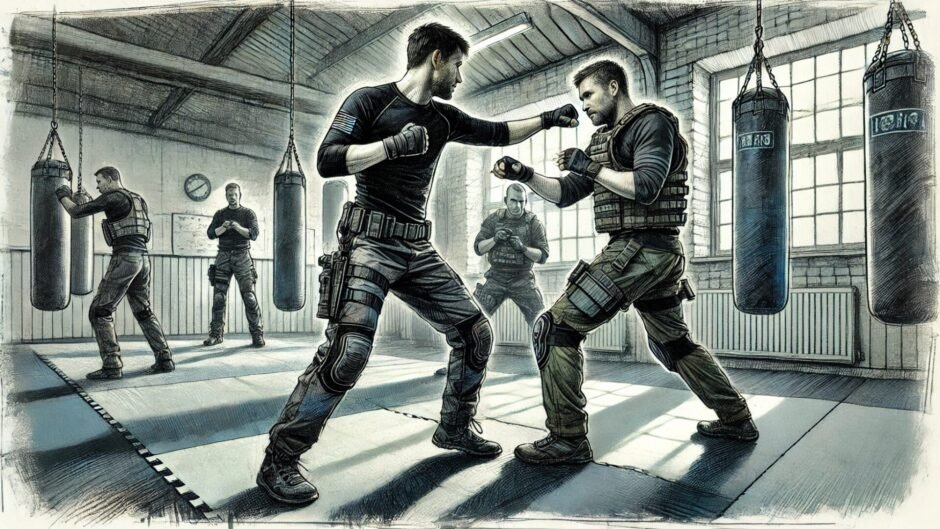
This post delves into the evolution of modern combat, exploring how classic martial arts techniques mix with new training methods and fresh strategies. It examines the practical, street-based systems and battlefield martial arts that are shaping the tactics of today’s modern armed forces.
Table of Contents
Introduction
Combat extends far beyond the cage. While MMA dominates as a sport, real-world violence demands skills beyond weight classes, gloves, and referees. Street fights, battlefield encounters, and law enforcement engagements present unpredictable threats—multiple attackers, weapons, and environments where survival, not scoring points, is the priority. Reality-Based Combat Systems (RBCS), military close-quarters battle (CQB), and even traditional martial arts have evolved to address these dangers. Mental conditioning, stress inoculation, and deception now play just as big a role as technique, shaping how fighters, soldiers, and law enforcement train for survival. Meanwhile, technology is reshaping combat preparation, with AI-driven fight analysis and VR-based training pushing the limits of how warriors prepare for real encounters. This post explores how combat has evolved, why some martial arts adapted while others stagnated, and what it really takes to fight and survive in a world where there are no referees, no rules, and no second chances.
💥 Reality-Based Combat Systems (RBCS)
Self-Defence Beyond Sport
As populations surged in the 21st century, urban crime rose alongside them. With violence becoming more unpredictable—muggings, ambushes, edged weapons, and multiple attackers—traditional martial arts were no longer enough. Their rituals and point-fighting formats didn’t prepare people for the chaos of real-world violence. In response, a new category was born: Reality-Based Combat Systems. Designed for survival, not sport, RBCS stripped away the ceremonial and embraced the brutal, offering practical solutions for modern threats—where hesitation can cost lives, and winning simply means walking away.
Click on the links below to read more.
🛡️ Reality-Based Combat Systems (RBCS) – Fighting for Survival, Not Points
Reality-Based Combat Systems didn’t evolve in dojos or under stadium lights—they were forged in back alleys, urban chaos, and unpredictable violence. As society moved away from formal battlefields and into messy civilian threats, martial systems had to adapt. RBCS emerged as a response to this shift—designed to handle armed assailants, multiple attackers, and close-quarters ambushes.
These systems strip away formality and flair, focusing instead on survival under stress. They prioritise instinctive reactions, rapid decision-making, and clear-headed judgement—especially when legal, moral, or tactical boundaries come into play. In a world without referees, weight classes, or warning bells, effective combat is measured by one thing: who walks away.
Used across civilian self-defence, military combatives, and police restraint training, RBCS represent a new combat paradigm—one rooted not in proving dominance, but in surviving the worst-case scenario.
🔑 Key Distinctions
✅ Instinctive & Reactive – Works with natural flinch responses and gross motor skills.
✅ Scenario-Based – Trains in real-world ambushes, weapons threats, and confined-space attacks.
✅ Legally Aware – Teaches escalation control, de-escalation, and legal justification.
✅ Pressure-Tested – Involves stress inoculation, decision-making under adrenaline, and live-force simulations.
✅ Tactically Efficient – Techniques are simple, brutal, and designed to end the threat fast.
🇮🇱 Krav Maga (Civilian Use)
Originally designed for military combat, Krav Maga’s civilian adaptation modifies its brutal efficiency for self-defence in urban environments. While military Krav Maga prioritises lethal force and battlefield survival, civilian Krav Maga focuses on neutralising threats quickly while staying within legal and ethical boundaries.
✅ Adapted for Legal Self-Defence – Techniques are adjusted to avoid unnecessary force escalation, ensuring compliance with self-defence laws.
✅ Rapid, Direct Techniques – Emphasises instinctive reactions, preemptive strikes, and weapon disarms to deal with common street threats.
✅ Scenario-Based Training – Incorporates realistic drills, simulating ambushes, multiple attackers, and confined-space combat.
Used globally by civilians, security personnel, and police units, civilian Krav Maga is one of the most adaptable RBCS systems available.
🇨🇦🇺🇸 SPEAR System (Tony Blauer)
Developed by Tony Blauer, the SPEAR System (Spontaneous Protection Enabling Accelerated Response) harnesses the body’s natural flinch reflex, converting it into an immediate counterattack. Unlike traditional martial arts, which rely on memorised techniques, SPEAR works with the body’s instinctive reactions, making it highly effective for military, law enforcement, and security personnel.
✅ Flinch-to-Fight Response – Instead of overriding natural reflexes, SPEAR weaponises the startle reaction, allowing rapid, decisive responses against sudden attacks.
✅ Pre-Fight Awareness & De-escalation – Integrates threat recognition, verbal control, and tactical positioning, ensuring proactive defence before physical engagement.
✅ High-Pressure Scenario Training – Full-force drills, real-time stress simulations, and unpredictable attack scenarios train fighters to react instinctively under extreme conditions.
Ideal for first responders, military, and high-stakes professionals, SPEAR fills the gap between hesitation and survival.
🇪🇸 Keysi Fighting Method (KFM)
Although the Keysi Fighting Method (KFM) gained global attention through its use in Hollywood fight choreography—most famously in Christopher Nolan’s Dark Knight trilogy—it originated on the streets of Spain. Co-created by Justo Dieguez and Andy Norman, KFM was built from firsthand experience in street fights and bar brawls, not cinematic fantasy. Designed for high-stress, real-world altercations, KFM focuses on instinctive movement, defensive shielding, and brutal close-range attacks.
✅ Pensador Stance & Defensive Shielding – Practitioners maintain a high, tucked-arm guard to protect the head and vital targets while absorbing or deflecting incoming strikes.
✅ Close-Range Destruction – KFM favours elbows, headbutts, hammer fists, and forearm strikes, making it particularly effective in confined spaces such as hallways, elevators, or bars.
✅ Multi-Opponent Strategy – Emphasis on 360-degree awareness, rapid angling, and explosive movement allows fighters to escape encirclement and counter ambushes.
While visually distinctive and tactically aggressive, KFM’s lack of structured grappling leaves it vulnerable against skilled wrestlers or submission fighters. It functions well as a striking-based survival system, but is less effective in prolonged ground engagements.
🎯 Target Focus Training (TFT)
Target Focus Training (TFT) is a self-defence system built for survival, not sport, focusing on rapid incapacitation through high-damage strikes. Emerging in the late 1990s, it gained traction among civilians seeking fast, decisive responses to real-world violence—often in response to rising concerns about street crime and unpredictable assaults. Unlike combat sports or martial arts, TFT eliminates sparring, drills, and technique refinement, prioritising instant results over skill progression.
✅ Purely Offensive Approach – Strikes target vital weak points (eyes, throat, groin, knees) to disable threats immediately.
✅ No Strength, No Speed Required – Techniques are designed to work regardless of size or athletic ability.
✅ No Rules, No Competition – TFT rejects sport training, focusing solely on what works in life-or-death encounters.
While its theory is brutally efficient, critics argue the lack of live resistance creates a dangerous gap between training and real-world performance.
🚔 Law Enforcement & Riot Control Tactics
While RBCS systems prepare civilians for worst-case survival, law enforcement must operate under tighter legal frameworks—subduing threats without overstepping use-of-force boundaries. Law enforcement combatives rely on grappling, control tactics, and measured use of force.
🟦 Core Components
🔹 Grappling Arts – BJJ, wrestling, and judo provide positional control, takedowns, and submission holds.
🔹 Catch Wrestling – For aggressive suspects, it adds brutal joint locks and riding pressure.
🔹 Pain Compliance & Restraint – Pressure point control tactics (PPCT), wrist locks, and leverage holds neutralise without escalation.
🟥 Crowd & Riot Management
🛡️ Shield Tactics – Riot teams use overlapping shields (e.g., “turtle formation”) for controlled advancement.
🔊 Non-Lethal Tools – Batons, rubber bullets, tear gas, and controlled formations are used for dispersal and defence.
🧠 De-Escalation – Modern officers are trained to reduce tension before using physical force, making verbal control a critical skill.
The best modern police forces now require BJJ or grappling certifications, recognising that control under pressure is more valuable than brute strength.

Reality-Based Combat Systems like Krav Maga and the SPEAR System focus on real-world threat response over sport-based techniques. Designed for military, law enforcement, and civilian self-defence, these systems emphasise instinctive reactions, situational awareness, and rapid neutralisation under high-stress conditions.
🥜 In a Nutshell
Reality-Based Combat Systems (RBCS) aren’t built for medals or tradition—they’re built for the moments where everything collapses and instinct decides survival.
RBCS systems prioritise:
✅ Clarity in Chaos – Cut through panic with structured, pre-trained responses
✅ Survival Over Dominance – Escape or neutralise threats, not win rounds
✅ Adaptability Over Aesthetics – No poses, no patterns—just what works under fire
💡 These systems reflect a world where the attacker sets the rules—and you have seconds to respond.
🪖 Military Combatives – Kill or Be Killed
Military martial systems were never about points, honour, or tradition—they were forged for one purpose: survival under fire. Where sport-based martial arts are governed by rules, gloves, and referees, battlefield combatives prioritise rapid incapacitation, weapon retention, and adaptability in high-stress, high-stakes environments. Whether storming trenches in WWII or clearing rooms in modern urban warfare, the goal remains the same: neutralise the threat fast—before it neutralises you.
Click on the links below to read more.
🌍 Origins: WWII and the Birth of Modern Combatives
The foundation of modern military hand-to-hand systems was laid during World War II by pioneers like William Fairbairn, Rex Applegate, and Eric Sykes. Their approach was brutally pragmatic—stripped of formality and built for lethal efficiency.
- Close-quarters chaos called for fast, instinctive strikes: edge-of-hand blows, groin shots, and eye gouges.
- The Fairbairn–Sykes fighting knife, designed for silent kills, became standard issue for Allied commandos.
- These men didn’t teach art—they taught how to kill quickly, under stress, and in full gear.
Their legacy lives on in today’s military programs like MACP, IDF Krav Maga, and Systema, where their influence shaped the doctrines of modern close-quarters combat (CQC).
🟩 MACP – Modern Army Combatives Program (USA)
Born from necessity during the Iraq and Afghanistan conflicts, the MACP was designed to give American soldiers functional fighting skills that worked in full combat gear. It blends Brazilian Jiu-Jitsu, wrestling, and striking, adapted for battlefield scenarios where armour, weapons, and confined quarters change everything.
✅ Phase 1 – Ground control and submission, adapted from BJJ.
✅ Phase 2+ – Adds takedowns, clinch work, and limited striking.
✅ Advanced Phases – Include weapon disarms, multiple-opponent tactics, and live-fire integration.
MACP continues to evolve, absorbing lessons from MMA, Krav Maga, and live military encounters. It teaches not just how to win—but how to survive and retain control in full kit, in real combat.
🦅 🇺🇸 MCMAP – Marine Corps Martial Arts Program
Introduced in 2001, the Marine Corps Martial Arts Program (MCMAP) was designed to create not just better fighters—but more complete warriors. Drawing from Boxing, Wrestling, BJJ, Judo, Muay Thai, Arnis, and even Samurai ethics, MCMAP combines physical combat with mental discipline and moral guidance. Its belt system isn’t just a measure of technique, but also leadership, judgement, and character.
✅ Hybrid Tactics – Combines strikes, throws, submissions, and weapon use (including rifle butt strikes and bayonet fighting).
✅ Combat Mindset Training – Includes scenario-based decision-making, situational awareness, and stress inoculation.
✅ Warrior Ethos – Marines learn history, ethical combat frameworks, and leadership as part of their advancement.
✅ Weapon Integration – Focuses on transitioning seamlessly between armed and unarmed scenarios—something many civilian arts neglect.
MCMAP stands out not just as a fighting system, but as a military philosophy—teaching when to fight, how to fight, and why fighting is sometimes a last resort. In that sense, it bridges the gap between battlefield readiness and martial identity.
🇮🇱 IDF Krav Maga – Ruthless Battlefield Survival
The Israeli Defence Forces (IDF) refined Krav Maga into one of the most battle-hardened military systems on the planet. It’s designed for high-threat, high-pressure urban warfare, where soldiers must neutralise threats with immediate force.
✅ Lethal Simplicity – Strikes to the groin, throat, eyes—whatever ends the fight fastest.
✅ Weapon Retention & Disarms – CQB training for close-range gun and knife encounters.
✅ Stress-Driven Drills – Live-scenario sparring, sensory overload, and fatigue simulation.
IDF Krav Maga is pure function over form—there’s no style, no showmanship, only survival. Its effectiveness lies in its clarity: react first, react hard, and walk away alive.
🇷🇺 Spetsnaz Systema – Chaos, Psychology, and Control
Developed for Russian special forces, Systema prioritises disruption over technique—targeting balance, rhythm, and psychology through deception and control. It thrives on adaptability and improvisation in asymmetrical warfare, where unpredictability is a weapon in itself.
Systema consists of two primary branches:
🔹 Ryabko Systema – Emphasises breathwork, relaxed movement, and intuitive flow under pressure.
🔹 Kadochnikov Systema – Focuses on biomechanical efficiency, joint leverage, and scientific disassembly of human movement.
Key principles include:
✅ Pain Compliance & Joint Manipulation – Exploiting muscular tension and structural weaknesses.
✅ Blindfolded Sparring – Developing reactive instincts through sensory deprivation.
✅ Weapon Integration – Fluid transitions between knives, firearms, and improvised tools.
✅ Mental Disruption – Using breath control, fear cues, and rhythm breaks to destabilise the opponent’s mindset.
These principles aim to cultivate unpredictable, reflexive fighters who excel in chaotic, multi-threat environments.
Though controversial due to its lack of sparring realism, Systema’s defenders argue it’s built for survival, not sport—where surprise, deception, and psychological dominance often outweigh crisp technique.
🇷🇺 Combat Sambo – Aggression, Domination, and Destruction
Developed in the early Soviet era for the Red Army, Combat Sambo (Боевое Самбо) was engineered for maximum battlefield efficiency—a hybrid of Judo, catch wrestling, boxing, and indigenous martial arts from across the former USSR. Unlike its sport counterpart, Combat Sambo incorporates lethal strikes, joint breaks, and weapons tactics designed to overwhelm and destroy opponents in real-time combat.
Combat Sambo is still taught to Spetsnaz, OMON, and other elite Russian security forces. It emphasises aggressive forward pressure, brutal submissions, and rapid threat neutralisation, especially in close quarters and full kit.
Key principles include:
✅ Dirty Striking – Headbutts, groin kicks, eye gouges, and open-hand blows to disorient and injure.
✅ Throws & Takedowns – Judo-inspired but adapted for combat gear and weapon retention.
✅ Joint Destruction – Not submission—breaks. Elbows, shoulders, and knees are targeted with full-force intent.
✅ Weapon Disarms – Knife, rifle, and pistol counters integrated seamlessly into the grappling flow.
✅ Ground Domination – Positional control followed by strikes, chokes, or bone breaks—designed to end the fight decisively.
While Systema focuses on fluid deception, Combat Sambo favours relentless pressure and brutal efficiency—designed to overwhelm opponents with speed, violence, and tactical superiority.
🇨🇳 PLA Combat Sanda – Strikes, Takedowns, and Tactical Control
The modern Chinese military, through the People’s Liberation Army (PLA) and People’s Armed Police (PAP), continues to train personnel in a militarised form of Sanda (Sanshou)—a hybrid striking and takedown system developed for practical battlefield use. Unlike its sporting counterpart, Combat Sanda is stripped of rules and formality, tailored for urban warfare, riot control, and asymmetrical conflict.
✅ Striking Arsenal – Punches, low kicks, elbows, and knees, designed to overwhelm and incapacitate.
✅ Takedowns & Sweeps – Adapted from Shuai Jiao, for balance disruption and spatial dominance.
✅ Joint Manipulation (Chin Na) – Employed in restraint and non-lethal control scenarios.
✅ Weapons Integration – Bayonet drills, rifle-butt strikes, and weapon retention built into close-range scenarios.
Combat Sanda forms the foundation of unarmed combat training in PLA units and is further refined within elite formations such as the Snow Leopard and Falcon commandos, who adapt it for high-stakes counter-terror and urban operations.
While traditional Chinese martial arts remain symbolically present in military culture, Combat Sanda represents a modern evolution—focused on efficiency, aggression, and survivability in real-world engagements.
🌐 Global Derivatives and Special Forces Hybrids
Beyond the major systems, many nations have developed tailored combatives programs influenced by Traditional combat arts as well as WWII methods, Krav Maga, and MCMAP.
🇬🇧 British Forces integrate Judo, BJJ, and Fairbairn-style combatives via SAS and SBS training.
🇫🇷 French RAID and GIGN blend Savate, Judo, and Systema-inspired techniques with urban counter-terror doctrine.
🇩🇪 German SEK units fuse Krav Maga with native arrest-control protocols, adapting techniques for police and rapid response.
🇵🇪 Peruvian special forces are known to train in Bakom (Vacón)—a street-hardened system blending ambush tactics, knife use, and fake compliance.
🇵🇭 Philippines – Philippine Force Recon and PNP SAF integrate Kali and Arnis, specialising in live blade engagements and close-quarters ambush tactics.
🇮🇩 Indonesia – Military Silat (Pencak Silat Tempur) is used by Kopassus (Indonesian special forces). Emphasises brutal joint breaks, deceptive movement, and multi-opponent strategies.
🇮🇷 Iran – Razmafzar is a modern Iranian military combatives system drawing from Varzesh-e Bastani, wrestling, and blade work, adapted for modern asymmetric warfare.
🇮🇳 India – Modified Kalaripayattu is used by MARCOS and Para SF, focusing on close-quarters adaptations for unarmed combat, disarms, and agile takedowns.
🇰🇷 South Korea – Teukgong Moosool, employed by special forces and presidential security, blends Taekwondo, Hapkido, and Judo with knife defence, pressure-point striking, and urban CQB.
These hybrid programs share DNA with MACP, MCMAP, and Krav Maga—but evolve based on terrain, mission, and cultural realities. In every case, they prove that modern combatives are adaptive by necessity, not static by design.

Modern military combatives programs like the U.S. Marine Corps Martial Arts Program (MCMAP) blend striking, grappling, weapon handling, and mental conditioning to prepare troops for close-quarters combat. Designed for versatility across battlefield and urban scenarios, MCMAP integrates principles from various martial arts with an emphasis on aggression, control, and mission effectiveness.
🥜 In a Nutshell
✅ Born in war, forged for survival—these systems are about results, not rituals.
✅ Technique comes second to timing, aggression, and awareness.
✅ Real-world combat isn’t clean—and these systems don’t pretend it is.
🧠 Who They’re For:
Soldiers, security personnel, and law enforcement dealing with chaotic, high-risk situations where success isn’t winning a round—it’s making it home alive.
Whether you’re defending against an ambush, clearing a building, or caught in a weapon retention struggle, military combatives aren’t about control—they’re about consequence.
⚔️ Battle Tested: The Reckoning of Traditional Martial Arts
There was a time when every martial art claimed supremacy—until MMA dragged them into the cage and asked one simple question: does it work? When tradition met reality, theories shattered, legends crumbled, and only pressure-tested systems endured. This wasn’t just evolution—it was judgment. Some arts rose, adapting to survive in the age of full contact. Others stayed trapped in forms, fading from relevance as the modern battlefield left them behind. What came next was a reckoning—earned in sweat, not stories.
✅ Martial Arts That Adapted
These martial arts didn’t just survive the rise of MMA and modern combat testing—they evolved. By embracing pressure-tested training, live resistance, and cross-disciplinary tactics, they proved their relevance in both sport and self-defence. Rather than clinging to tradition, they adapted to new realities—refining techniques, discarding what didn’t work, and re-establishing themselves as functional, combat-ready systems.
Click on the links below to read more.
🥋 Karate’s Comeback
Once dismissed as outdated, point-fighting Karate lacked real-world applicability due to its emphasis on controlled, non-contact exchanges. But fighters like Lyoto Machida and Stephen Thompson proved its value through elusive footwork, blitz-style attacks, and precision counter-striking. When adapted for modern rulesets, Karate became a viable and effective striking base.
Not all Karate styles needed reinvention—Kyokushin Karate, developed by Mas Oyama, has always been full-contact. With knockdown rules, body conditioning, and powerful strikes (including full-force kicks and knees to the body), Kyokushin continues to produce durable, dangerous strikers, even without punches to the face.
Some Karate offshoots, like Kudo (Daido Juku), pushed evolution further—blending striking, throws, and submissions into a helmeted combat sport that bridges the gap between traditional Karate and modern MMA.
🇰🇷 Taekwondo’s Evolution into Modern Striking
In early MMA, Taekwondo fighters struggled against wrestlers and boxers, exposing the art’s weaknesses in clinch control, ground defence, and punching fundamentals. But modern fighters like Yair Rodriguez and Edson Barboza have revived Taekwondo’s spinning back kicks, wheel kicks, and sidekicks, proving their effectiveness in full-contact combat.
Known for their speed, precision, and unpredictability, these kicks create distance and generate knockout power when combined with cross-training. Though impractical as a standalone system, Taekwondo’s unorthodox striking has become a potent supplement for fighters with strong boxing, wrestling, or Muay Thai foundations.
🤼 Judo, BJJ, and Wrestling – Grappling’s Reign
Unlike many striking-based arts, Judo, Brazilian Jiu-Jitsu (BJJ), and wrestling didn’t just adapt—they dominated. Their success came from decades of live competition, technical refinement, and resistance-based training.
Early MMA exposed a critical flaw: strikers couldn’t stop takedowns or survive on the ground. Grapplers exploited this with throws, submissions, and relentless positional control, proving that the fight often goes where the grappler wants it. These systems remain essential in both sport and self-defence.
🇨🇳 Sanda/Sanshou – Kung Fu’s Evolution
As traditional Kung Fu diverged into Taolu (forms) and Wushu (performance), China developed Sanda/Sanshou—a full-contact hybrid combining kickboxing, throws, and footwork from classical styles.
With its integration of striking and wrestling, Sanda became China’s answer to modern combat sports. Fighters like Zhang Weili and Cung Le demonstrated that a modernised, pressure-tested version of Kung Fu could thrive in elite competition.
🇫🇷 Savate – Precision in Motion
Savate, or French kickboxing, retained its traditional roots while evolving into a sharp, tactical striking art. By incorporating boxing-style punches, feints, and footwork, it became distinct from Muay Thai and Dutch kickboxing.
Its hallmark techniques—like the chassé (thrust kick) and fouetté (round kick)—emphasise speed, accuracy, and tactical distancing, all amplified by striking with shoes. Though underrepresented in MMA, Savate’s mechanics and concepts have influenced modern striking frameworks.
🇲🇲 Lethwei – The Last Bare-Knuckle Art
Often described as Muay Thai’s brutal cousin, Lethwei evolved by reintroducing headbutts, bare-knuckle strikes, and a knockout-only win condition. Its structure demands extreme toughness, close-range aggression, and unrelenting pace.
Though rarely seen outside Southeast Asia, its techniques have influenced bare-knuckle boxing and close-range MMA striking, proving that Lethwei’s raw, aggressive style still has a place in modern combat.
🇺🇸 Catch Wrestling – Grappling’s Forgotten Weapon
Once thought lost to history, Catch Wrestling returned to prominence by influencing modern submission grappling and MMA ground fighting. Known for neck cranks, leg locks, and top pressure, it brought an aggressive, control-heavy style that contrasted with BJJ’s positional philosophy.
Fighters like Kazushi Sakuraba, Josh Barnett, and Ken Shamrock carried its legacy into MMA. Today, Catch continues to shape no-gi grappling and hybrid submission wrestling.
💥 Martial Arts for the 21st Century
Some martial arts didn’t just survive the modern era—they defined it. Systems like Boxing, Wrestling, BJJ, and Muay Thai became the blueprint for both sport and self-defence, seamlessly integrating into MMA, law enforcement, and real-world combat training. Their emphasis on live resistance, efficient mechanics, and adaptive strategy made them essential across every arena.
Alongside them, arts inspired by military combatives—such as Krav Maga, Combat Sambo, and modern civilian self-defence hybrids—translated battlefield lessons into accessible systems focused on simplicity, aggression, and real-world application.
These are the martial arts of the 21st century: not defined by lineage, but by what works under pressure—whether on the mat, in the cage, or in real-world confrontation.
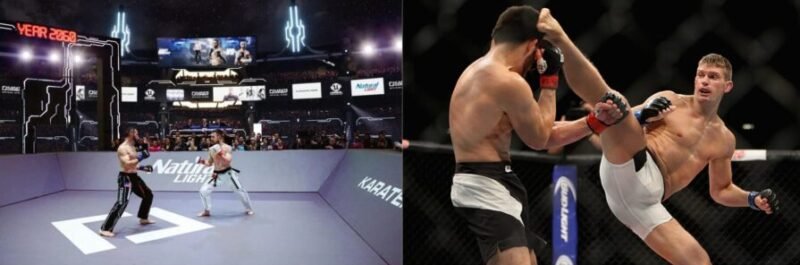
To stay relevant in the modern fight landscape, some martial arts have had to adapt to forward pressure and full-contact demands. Karate is one such example, with promotions like Karate Combat showcasing its evolution. Fighters like Lyoto Machida and Stephen Thompson have proven that, when adapted, karate remains highly effective at the elite level.
❌ Stagnant Arts? – Ritual Over Reality
These systems may have rich traditions, but their refusal to evolve has limited their real-world effectiveness. Without live resistance, adaptation, or pressure-testing, many have prioritised aesthetics, ritual, or theory over functional combat. While they may preserve cultural heritage, their relevance in modern fighting has faded—outpaced by systems that embraced reality over repetition.
Click on the links below to read more.
🉐 Traditional Kung Fu – Splintered and Stylised
Once a dominant battlefield art, Kung Fu was designed for practical combat—its techniques forged through real fights, armed clashes, and self-defence scenarios. Over time, however, it shifted away from resistance training, evolving into a system focused more on forms, demonstration, and theoretical movement.
Kung Fu eventually split into two branches: Taolu, which preserved traditional sequences, and Wushu, a state-promoted performance sport focused on aesthetics and athleticism over combat utility. This shift mirrored the trajectory of Olympic Taekwondo, which also moved from full-contact combat to point-based competition.
As MMA and modern combat sports exposed the need for pressure-tested techniques, many traditional Kung Fu schools struggled to adapt—clinging to stylised theories without functional evolution. While some schools influenced by Sanda or cross-training now seek realism, these remain exceptions in a vast landscape dominated by choreographed movement and cultural exhibition.
🌀 Aikido – The Art That Never Evolved
Designed as a defensive system rooted in harmony and control, Aikido emphasises redirection over aggression. Founded by Morihei Ueshiba in the early 20th century, it blended elements of Jujutsu, Kenjutsu, and spiritual philosophy, aiming to neutralise aggression through joint locks and circular movement.
However, Aikido’s near-total lack of live sparring has left it disconnected from real-world combat. Without pressure-testing or resistance, its techniques often fail against trained opponents. While a few offshoots like Shodokan and Yoshinkan have introduced sparring frameworks—sometimes used in police settings—most Aikido lineages remain rooted in compliant drills and theoretical applications.
Unlike related arts like Judo and Kendo, which evolved through combat realism, Aikido has stagnated—more philosophy than fight. Unless more schools embrace resistance and adaptation, Aikido risks fading into symbolic irrelevance as a self-defence system.
👊 Wing Chun – Limited by Its Own Structure
Wing Chun, made famous by Ip Man and Bruce Lee’s early training, was built for close-quarters encounters. It emphasises centreline control, trapping, and fast hand strikes. In theory, its linear structure was ideal for confined combat—but in practice, it has struggled against more dynamic, modern fighters.
The system’s rigid stance and linear movement leave practitioners vulnerable to angles, footwork, and range changes. Without clinch control, defensive adaptation, or striking diversity, Wing Chun fighters often falter against wrestlers, Muay Thai strikers, and boxers.
Some modern practitioners have begun integrating boxing-style movement, head defence, and resistance-based drills, but the majority of schools remain committed to traditional structure. Compared to its cousin systems like boxing, which evolved through full-contact adaptation, Wing Chun largely remains frozen in tradition.
☯️ Tai Chi – From Battlefield to Wellness
Originally, Tai Chi (Taijiquan) combined close-range strikes, joint locks, and throws, powered by internal mechanics (Fa Jin) and sensitivity drills like push hands. Once used by bodyguards and warriors, it was a legitimate martial art focused on redirecting energy and off-balancing opponents.
As China modernised and firearms reshaped battlefield needs, Tai Chi transitioned into a health practice, especially during the 20th century. Today, most schools teach it as a form of moving meditation, focusing on relaxation, balance, and well-being.
Though certain lineages still preserve Tai Chi’s martial core, they are the minority. Unlike Sanda, which emerged from traditional roots and evolved into a combat-tested system, Tai Chi’s mainstream path diverged. Without pressure-testing or real engagement, its effectiveness as a fighting system has largely faded.
🕺 Capoeira – A Dance More Than a Fight?
Developed by enslaved Africans in Brazil, Capoeira was originally a disguised combat art, masked as dance to avoid colonial repression. It used unpredictable footwork, off-angle kicks, and fluid motion to confuse and disable opponents. Over time, however, it became more ritualised and performance-driven.
Capoeira’s acrobatic movement, rhythmic flow, and evasive strikes are visually impressive, but its lack of structure and grappling makes it difficult to apply in full-contact settings. Fighters like Michel Pereira and Marcus Aurélio have used Capoeira’s deceptive techniques in MMA—but only after integrating them into more complete striking frameworks.
Modern schools like Capoeira Contemporânea have introduced live sparring and combat adaptation, but many traditional styles remain theatrical rather than tactical. Without structural refinement, Capoeira struggles to compete against combat-tested striking systems.

While many martial arts have adapted to the demands of modern combat sports, others like Aikido and Wing Chun have struggled to remain relevant in full-contact settings. Though rich in tradition and philosophy, their techniques often rely on cooperative training environments, making real-world application more challenging without significant modification.
🎯 The Impact of Sportification on Traditional Martial Arts
While sportification diluted the combat effectiveness of some arts, it also refined others—Judo’s throws, Muay Thai’s clinch work, and boxing’s mechanics remain top-tier in real combat. Fighters trained under rulesets often developed superior timing, distance management, and composure. The key is adaptability—arts that maintain live resistance and pressure-testing stay relevant. Those that rely on point-scoring, showmanship, or compliant drills fade into impracticality.
🔹 Judo & Taekwondo – Adapted to Olympic systems, often favouring flair over function.
🔹 Wushu & Capoeira – Became performance-driven, focused more on aesthetics than combat.
🔹 Boxing & Muay Thai – Thrived under sport refinement, remaining brutally effective in real fights.
Sport helped preserve these arts—but also created a divide. When rules replace realism, effectiveness suffers.
⚔️ The Disconnect: Why Traditional Training Falls Short
The biggest flaw in many traditional martial arts isn’t their techniques—it’s how they train compared to the chaos of real combat.
🔻 Common problems in outdated systems:
- Pre-arranged drills instead of unpredictable, live encounters.
- Cooperative demos, not pressure-based sparring.
- Ritualised forms (kata) over practical application.
🔺 What functional systems do instead:
- Full-contact sparring & constant resistance.
- Competition and scenario-based application.
- Adaptation to modern striking, grappling, and tactics.
Example: Olympic Taekwondo’s shift to point-scoring damaged its defensive structure. Similarly, many Kung Fu schools avoided pressure testing, leaving fighters unprepared for modern combat realities.
☠️ Evolve or Die: Tradition Alone Doesn’t Win Fights
Traditional martial arts now stand at a crossroads—adapt or fade into history.
🔹 Styles like Judo, BJJ, and Muay Thai remain relevant because they evolve under pressure.
🔹 Others—Aikido, Tai Chi, and much of traditional Kung Fu—risk extinction without radical adaptation.
🔹 Systems like Kyokushin Karate and Sanda prove that tradition and combat effectiveness can coexist.
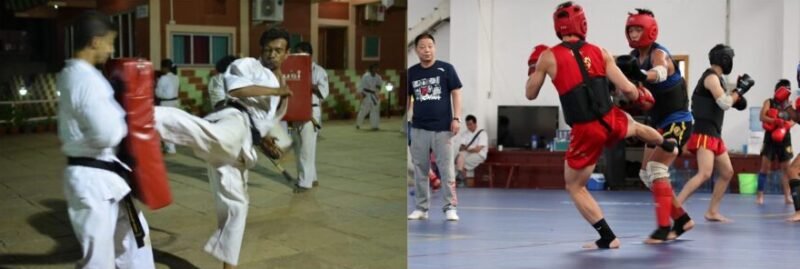
Traditional martial arts like Kyokushin Karate and modern adaptations such as Sanda have shown that tradition and combat effectiveness can coexist. By preserving core principles while embracing full-contact realism, they prove that heritage and functionality don’t have to be at odds.
🥜 In a Nutshell
The rise of MMA shattered long-held illusions, forcing traditional martial arts to confront a hard truth: function beats form. Systems that embraced live resistance, pressure-testing, and modern integration—like BJJ, Muay Thai, Wrestling, and Sanda—proved their worth in real combat. Others, grounded in ritual or compliant practice, faltered.
Sportification refined some arts, like boxing and Judo, while diluting others through over-regulation and aesthetic focus. The true divide isn’t between tradition and modernity—it’s between performance under pressure and theatre without consequence.
In the 21st century, a martial art must evolve to stay alive. Legacy alone isn’t enough—only effectiveness earns relevance.
🧠 The Psychological Aspect of Combat
For centuries, martial training focused on technique, strength, and repetition, while mental conditioning was often left to warrior codes and philosophy—from Bushido and Zen to the Spartan agoge. But real combat doesn’t follow script. Even elite fighters can freeze under pressure, overwhelmed by adrenaline, fear, or confusion. That moment of hesitation? It can be fatal.
Combat psychology became a frontline priority when militaries realised that technique alone wasn’t enough. Stress inoculation, fear management, and decision-making under pressure are now essential in elite training—military, law enforcement, and modern self-defence. Whether you’re in a street ambush or the octagon, the mind is your first weapon.
Click on the links below to read more.
😱 Fear Management & Stress Inoculation
WWII pioneers like William Fairbairn and Rex Applegate revolutionised training by exposing soldiers to stress-based drills—simulating exhaustion, chaos, and ambushes. Modern systems took this further.
🔹 Krav Maga, MACP, and SPEAR condition fighters through high-stress, scenario-based simulations. Real-world attacks trigger adrenaline dumps and freeze responses, so these drills aim to override panic with rapid, instinctive action.
🔹 Muay Thai and Dutch Kickboxing create mental grit through constant, pressure-heavy sparring—training fighters to stay calm in the storm.
🔹 Brazilian Jiu-Jitsu (BJJ) pushes practitioners into uncomfortable positions during “rolling,” forcing calm problem-solving under physical stress.
Takeaway: If training doesn’t include emotional chaos, it won’t hold up in a real fight. Mental strength is about control—not just courage—when everything goes sideways.
👁️ Pre-Fight Psychology – Reading & Controlling Conflict
In real encounters, most fights are won before the first punch. Systems like SPEAR and Krav Maga train fighters to spot danger early, de-escalate when possible, or strike first if the threat is imminent.
🔹 Tony Blauer’s SPEAR teaches recognition of pre-attack cues—body language, posture shifts, micro-expressions—that precede violence.
🔹 Law enforcement uses similar tactics, blending verbal de-escalation with physical readiness.
🔹 Boxers and Muay Thai fighters master the “feint game”—creating doubt, luring reactions, and mentally controlling opponents before a shot is thrown.
This is where combat becomes psychological warfare. The best fighters don’t just defend—they shape the fight, mentally and tactically, before it starts.
🧱 Mental Toughness – Building an Indomitable Mindset
Whether it’s a special forces operator or a bare-knuckle fighter, mental toughness isn’t just “being hard”—it’s thinking clearly while under fire.
🔹 Judo and BJJ develop grit through progressive sparring and competition—instilling belief through hard-earned wins and controlled losses.
🔹 Muay Thai and boxing breed toughness through full-contact exposure, teaching fighters they can take hits and keep going.
🔹 Military elite units (Navy SEALs, Spetsnaz, IDF) use gradual stress exposure—freezing drills, pain thresholds, and techniques like box breathing—to build calm under chaos.
True dominance begins in the mind. Strength and technique matter, but the ability to stay composed, assess threats, and act decisively is what separates survivors from victims.

Fight psychology is a critical component of real-world combat, involving the ability to manage the fight-or-flight response, read aggressive body language, and remain composed under pressure. Modern reality-based combat systems (RBCS) place strong emphasis on developing both physical and mental toughness, training practitioners to stay calm, assertive, and responsive in high-stress situations.
🥜 In a Nutshell
The rise of MMA shattered long-held illusions, forcing traditional martial arts to confront a hard truth: function beats form. Systems that embraced live resistance, pressure-testing, and modern integration—like BJJ, Muay Thai, Wrestling, and Sanda—proved their worth in real combat. Others, grounded in ritual or compliant practice, faltered.
Sportification refined some arts, like boxing and Judo, while diluting others through over-regulation and aesthetic focus. The true divide isn’t between tradition and modernity—it’s between performance under pressure and theatre without consequence.
In the 21st century, a martial art must evolve to stay alive. Legacy alone isn’t enough—only effectiveness earns relevance.
🤖 The Future of Combat:
AI, VR & Enhanced Training
Combat training is evolving fast. Artificial intelligence, virtual reality simulations, and biometric tracking are no longer experimental—they’re actively shaping how fighters, soldiers, and law enforcement train for real-world encounters. AI fight analysis now pinpoints weaknesses and predicts opponent tendencies with machine-level accuracy. Meanwhile, VR sparring immerses users in high-stress scenarios, refining skills without the physical wear and tear.
Just as gloves and video analysis once transformed training, these technologies represent a new evolution—one that optimises performance beyond natural limits. But will these tools sharpen human instinct, or replace it?
Click on the links below to read more.
🧠 AI-Driven Combat Training & Machine Precision
From the UFC Performance Institute to elite military programs, technology is pushing fighters past the boundaries of instinct and repetition.
🔹 AI coaching systems analyse reaction times, strike patterns, and grappling transitions to craft individualised gameplans.
🔹 Neuroscience-based drills now target decision-making under pressure, building split-second clarity during chaotic engagements.
🔹 VR & AR sparring platforms simulate ambushes, weapon threats, and unpredictable attackers—letting fighters rehearse high-risk scenarios with zero consequence.
🔹 Real-time biometric feedback tracks stress, fatigue, and breathing, helping fighters train smarter—not just harder.
But there’s a hidden risk—can training become too clean, too controlled? Will the absence of real fear dilute the primal grit that combat demands?
⚔️ Warriors or Weapons?
The next leap could blur the line between fighter and machine. What happens when:
- AI strategy surpasses human coaching?
- VR opponents learn and adapt in real time?
- Biotech implants enhance reflexes, pain tolerance, or muscular output?
Will tomorrow’s elite fighters be defined by mental resilience and adaptability, or by how well they integrate neural feedback and machine-guided precision?
Combat has always been about adaptation. But as tech accelerates, we must ask:
Will the future be fought by warriors—or engineered by machines?
🥜 In a Nutshell
The next evolution of combat isn’t just physical—it’s digital. AI, VR, and biometric tracking are reshaping how fighters train, analyse, and adapt. These tools enhance decision-making, stress management, and precision—but they also raise a critical question:
Will future warriors be sharpened by tech—or replaced by it?
As machines grow smarter and training becomes more immersive, the defining edge may no longer be brute strength or instinct—but the ability to merge grit with guided intelligence.
Combat Evolution
Real-World Lessons in Violence & Adaptation 🥊🧠📚
As martial arts moved from traditional dojos to octagons and urban streets, a new understanding of combat emerged—one defined not by points, belts, or rituals, but by survival under chaos. The modern era of real-world fighting has been shaped by practical necessity, global security shifts, and the rapid evolution of technology. This is a world where gloves come off, the environment becomes a weapon, and mental resilience is often the deciding factor. These are the themes that define today’s combative frontier:
🛡️ Survival-First Mindset Over Tradition or Sport
In both military combatives and reality-based self-defence systems (RBCS), the primary goal isn’t victory—it’s survival. Systems like Krav Maga, SPEAR, and MCMAP were built for scenarios where hesitation means death. They strip combat down to its essence: brutal efficiency, legal awareness, and the ability to end or escape a fight fast. Unlike traditional arts, these systems don’t prize form—they prize outcome.
🧠 Stress Inoculation & Combat Psychology
A recurring theme across every effective modern system is stress training and mental resilience. From WWII pioneers to today’s elite military and law enforcement programs, success in combat now hinges on fear management, emotional control, and cognitive clarity under pressure. SPEAR, MACP, and BJJ all incorporate high-adrenaline scenarios to replicate the chaos of real violence—training the mind as much as the body.
🥊🤼 Integration of Striking, Grappling & Weapons
The best systems today are multi-dimensional. Whether it’s MACP’s BJJ and clinch work, Combat Sambo’s hybrid aggression, or Krav Maga’s armed disarms, modern combatives fuse striking, grappling, and weapons seamlessly. There are no silos—everything is blended to adapt to close quarters, gear restrictions, and unpredictable environments. A fighter must be able to strike, control, and defend with or without a weapon—fluidly.
🏙️⚔️ Tactical Realism Over Sport Aesthetics
Combat has returned to its tactical roots. Gone are the choreographed drills of compliant training—today’s systems simulate ambushes, urban riots, and knife attacks in elevators. This shift prioritises scenario-based training, 360-degree awareness, and improvisation under pressure. Whether civilian or soldier, practitioners now train for the fight that happens when you’re tired, disoriented, and outnumbered.
🥋📉 Revival & Reckoning of Traditional Martial Arts
Modern MMA became the great filter. Arts that adapted—like Muay Thai, Judo, and BJJ—continued to thrive through pressure testing and integration. Others that resisted live resistance or failed to modernise—Aikido, traditional Kung Fu, and Tai Chi—saw their practical relevance fade. This era exposed the gap between theory and application, and sparked either evolution or extinction in many traditional systems.
🤖📊 Technology-Driven Training & the Rise of AI
Combat training has entered the digital age. AI-assisted fight analysis, VR simulations, and biometric feedback are now sharpening instinct, reaction time, and stress control. Fighters no longer rely solely on sparring—they now simulate high-risk encounters in virtual environments, track psychological stress in real time, and train smarter with tech-enhanced data. The future of combat may no longer be purely human.
🚓🏘️ Urban & Law Enforcement Adaptation
Today’s threats aren’t just found on battlefields—they emerge in parking lots, public protests, and high-crime areas. Law enforcement and riot teams now blend BJJ, catch wrestling, de-escalation tactics, and crowd control formations, adjusting traditional combat methods for legal, ethical, and spatial constraints. Combat in the modern age must factor in not only how to win, but when to walk away.
🌐🪖 Global Hybridisation of Special Forces Combatives
Across the world, elite military and law enforcement units have created customised combat systems that blend traditional arts with modern methods. From Kali in the Philippines to Bakom in Peru, and from Pencak Silat in Indonesia to Teukgong Moosool in Korea, each reflects a unique blend of cultural identity and combat practicality, often shaped by local terrain, mission types, and historical conflict styles.
🧠🎭 Psychological Warfare & Pre-Fight Manipulation
One of the most advanced aspects of modern combat is control before contact. Systems like SPEAR and law enforcement training now emphasise pre-fight awareness, verbal manipulation, and psychological triggers to shape a confrontation before the first strike. Fighters who master these tools can often defuse or dominate a situation without throwing a punch.
🪙🏚️ Weapon Integration & Environmental Adaptability
Finally, the modern fighter is taught to see everything as a weapon—a wall, a pen, a belt, a glass. From Arnis and Systema to law enforcement training, adaptability in chaotic environments is now essential. Fighters are trained not just to punch and kick, but to improvise, retain control of weapons, and exploit surroundings. Combat is no longer confined to mats—it happens in stairwells, vehicles, and city streets.
This modern combat era isn’t about style—it’s about what survives under stress. The systems that dominate today embrace adaptation, mental fortitude, technological integration, and raw practicality. Fighters now train not just for victory—but for survival, legality, and real-world chaos. From Spetsnaz to street defence, from MMA to riot control, this is the age of functional, flexible, and future-facing combat.
Martial arts are no longer judged by heritage—they’re judged by what works when nothing else does.
🧩 Conclusion
While MMA remains the pinnacle of modern combat sport, the broader evolution of martial arts tells a much deeper story—one shaped by survival, warfare, and adaptability. Reality-Based Combat Systems like Krav Maga, SPEAR, and Systema emerged not for points or pride, but to prepare fighters for ambushes, weapons, and chaos. Military and law enforcement adapted similarly, blending BJJ, wrestling, and tactical striking to function under high-stress conditions where hesitation can cost lives.
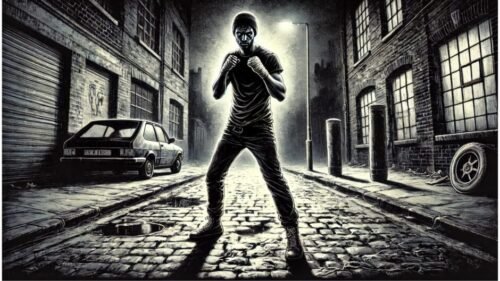
At the same time, traditional martial arts, once dismissed as relics, found new meaning—some thriving through competition and refinement, others preserving cultural identity and philosophical roots. And now, with AI-driven fight analysis, VR simulations, and neuroscience-based training, the future of combat lies in both human instinct and technological evolution.
But across every shift, one constant remains: fighters evolve to meet the moment. In every age, under every challenge, warriors adapt—or they fall behind.
Timeline 🕰️📈
| Date | Development/Technique/Event | Region | Significance |
|---|---|---|---|
| 1940s CE | WWII-Era Combatives Developed: Fairbairn, Sykes, and Applegate design battlefield close-quarters combat. | UK, USA | Created a practical, aggressive system for military close combat. |
| 1950s CE | Military Hand-to-Hand Combat Evolves: Integration of Judo, Catch Wrestling, and Jiu-Jitsu in military training. | Global | Blended traditional martial arts with battlefield-tested tactics. |
| 1960s CE | Systema Refined for Spetsnaz: Kadochnikov & Ryabko enhance biomechanical combat techniques. | Soviet Union (Russia) | Focused on fluid movement, adaptability, and psychological warfare. |
| 1970s CE | IDF Krav Maga Formalised: Becomes a structured military hand-to-hand system. | Israel | Emphasised simple, rapid neutralisation of threats. |
| 1980s CE | Krav Maga Introduced for Civilians: Adapted into a self-defence system for law enforcement and public use. | Global | Expanded Krav Maga’s reach beyond military applications. |
| 1980s CE | Law Enforcement Integrates BJJ & Wrestling: Used for suspect control and restraint. | USA, UK, Global | Improved grappling efficiency in police engagements. |
| 1990s CE | Reality-Based Combat Systems (RBCS) Gain Popularity: Focus on self-defence beyond sport combat. | Global | Shifted training towards realistic scenarios and threat-based responses. |
| 1993 CE | UFC 1 Debuts: Exposes traditional martial arts to real-world pressure testing. | USA | Redefined martial arts effectiveness and influenced combative training. |
| 2000s CE | Military Combatives Programs (MACP) Shift: Transition from BJJ-dominant grappling to balanced striking-wrestling approach. | USA Military | Ensured soldiers could handle both standing and ground engagements. |
| 2002 CE | Tony Blauer’s SPEAR System Adopted: Law enforcement and military units integrate instinctive defence tactics. | USA, Global | Focused on natural reactions to real-world violence. |
| 2005 CE | Keysi Fighting Method (KFM) Gains Attention: Close-quarters combat system used in films like Batman Begins. | Spain, Hollywood | Popularised defensive elbow-based combat and aggressive shielding techniques. |
| 2010s CE | Neuroscience-Based Training: Stress inoculation drills incorporated into modern combat training. | Global | Enhanced soldiers' ability to function under high-pressure situations. |
| 2015 CE | Hybrid Training Methods Emerge: Blending MMA, military combatives, and RBCS for tactical efficiency. | USA, Global | Created a new standard for real-world self-defence training. |
| 2020s CE | VR Sparring & AI Fight Analysis Introduced: Used for combat sports and tactical training. | Global | Revolutionised fight preparation and real-time performance assessment. |
Related Posts
In our next and final post, we’ll step back from the techniques, systems, and strategies to reflect on the bigger picture. From caveman grappling to AI-assisted warfare, we’ll explore what 12,000 years of combat evolution has truly taught us.
Which principles endured? What ideas collapsed under pressure? And what does the future of fighting—human or hybrid—really look like?
Join us as we close the series with 🔥 Evolution Complete: Lessons from 12,000 Years of Combat.