The History of La Boxe Française

Before Savate became a refined combat sport, it was forged in the violent ports, alleyways, and street gangs of 19th-century France — evolving through sailors, criminals, soldiers, and fighters into one of the world’s most distinctive striking arts.

Table of Contents

🇫🇷 Introduction

Before Savate became a refined combat sport fought under bright lights and strict regulation, it was shaped by the harsher realities of 19th-century France. In the ports of Marseille, sailors developed brutal kicking methods suited to unstable ship decks and cramped dockside brawls. In Paris, street fighters navigated violent alleys, gambling dens, red-light districts, and rising urban crime using low kicks, open-hand strikes, and close-quarters survival tactics.

From these rough beginnings emerged a uniquely French fighting system forged through violence and necessity. Savate absorbed influences from street fighting, maritime combat, duelling culture, cane fighting, and eventually English boxing, evolving into the disciplined striking art known as La Boxe Française.

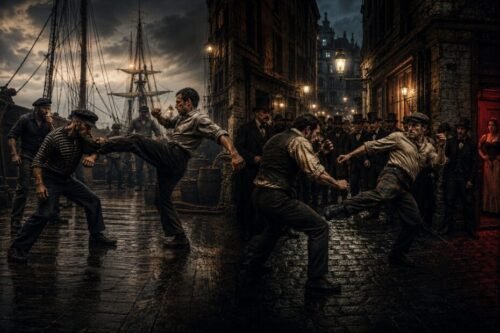
The violent streets and dockyards of 19th-century France helped shape the brutal early foundations of Savate before its evolution into La Boxe Française.

This transformation turned Savate from a rough collection of fighting methods into one of the world’s most refined striking systems. Yet beneath the elegance and precise kicking mechanics, the art never lost sight of its origins. Its history remains tied to the sailors, soldiers, criminals, police, and fighters who shaped it across generations of French society.

The history of Savate is therefore more than the evolution of a martial art. It reflects how violence, regulation, social change, and national identity combined to create one of the modern martial arts world’s most distinctive combat systems.

⚓ Origins

Ports, Sailors, and Street Violence

The roots of Savate emerged from the violent ports and streets of 19th-century France, particularly in southern cities like Marseille, where sailors, dockworkers, soldiers, labourers, and criminals lived among gambling dens, organised crime, prostitution, and frequent street violence. In these harsh environments, practical fighting methods developed through experience rather than formal instruction, prioritising balance, mobility, and quick striking in crowded or unstable surroundings.

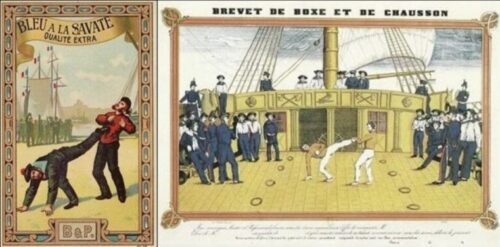
One of the earliest influences on Savate was Chausson, also known as Jeu Marseillais (“the Game of Marseille”), a kicking art associated with sailors from the southern ports of France. Chausson emphasised high, fluid kicks and open-hand strikes, partly because closed-fist blows were often punished more severely under French law. Life aboard unstable ship decks also encouraged balance, agility, and controlled movement over reckless exchanges of force.

Chausson, a high-kicking style popular among sailors in Marseille, was eventually incorporated into the development of modern savate.

At the same time, the rough urban districts of northern France (particularly Paris) were developing far harsher forms of street fighting focused on survival in violent urban environments. Together, these regional fighting traditions laid the foundations for what would eventually become La Boxe Française. Savate was not born as a sport or philosophy, but as a practical response to the violence and instability of everyday life in 19th-century France.

🗡️ Savate des Rues

Parisian Street Fighting

While the southern ports developed the more fluid kicking style of Chausson, the streets of Paris produced a far harsher form of combat known as Savate des Rues (“Savate of the Streets”). Emerging from the slums, alleyways, gambling dens, and red-light districts of the capital, this version of the art focused less on style and more on survival in violent urban environments.

Unlike the higher, more mobile kicks associated with sailors, Parisian street Savate relied heavily on low-line attacks delivered with heavy boots or work shoes. Kicks targeted the shins, knees, ankles, and groin to quickly damage mobility and end confrontations fast. Open-hand strikes such as la baffe (slaps and palm strikes) were common, alongside sweeps, trips, headbutts, elbows, and crude grappling methods when fights closed to short range.

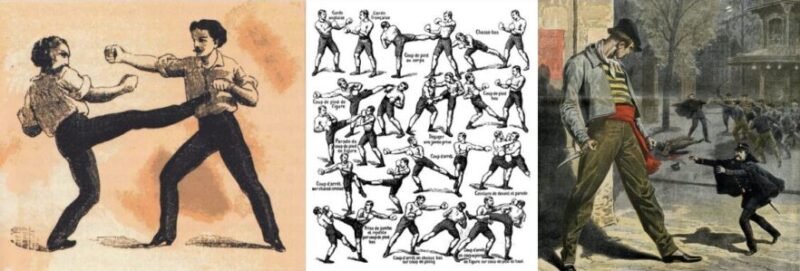
Savate des Rues was a self-defense art for those navigating society’s wilder side, including the upper class in risky areas like Parisian red-light districts.

Savate des Rues was not used exclusively by criminals or gangs. During periods of rising urban violence, even wealthier citizens moving through dangerous districts sometimes learned elements of street Savate for personal protection. Paris in the 19th century could be unpredictable and dangerous, particularly after dark, and practical self-defence carried real value.

Although modern La Boxe Française would later evolve into a refined combat sport, traces of these rough Parisian origins remained embedded within the art through its emphasis on tactical movement, low-line kicking, and controlling violence through positioning and timing.

🇬🇧 English Boxing and French Fighters

A major turning point in Savate’s development came through its contact with English boxing during the early 19th century. While the French kicking systems were highly adaptable in street encounters, they lacked the refined punching mechanics, guard structures, and combination striking used by English prizefighters.

As trade, travel, and sporting exchanges between Britain and France increased, French fighters were exposed to English boxing’s disciplined approach to punching and stand-up combat. English prizefighting demonstrated the effectiveness of structured hand combinations, defensive guards, and controlled striking exchanges, influencing a new generation of French instructors and fighters.

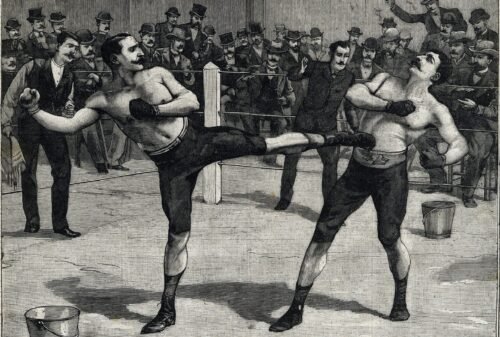
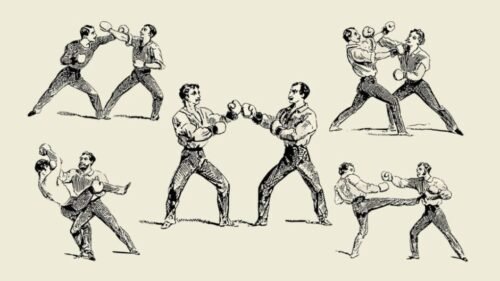
Early bouts with English boxers led Savate to adopt boxing hand strikes, refining its style.

The figure most associated with this transition was Charles Lecour. According to popular accounts, Lecour recognised the weaknesses in traditional Savate after losing a friendly bout to Owen Swift. Whether embellished over time or not, the story reflects a genuine shift in the art’s evolution and the growing influence of English boxing on French combat systems.

📖 Regulation and Codification

As Savate evolved during the 19th century, efforts were increasingly made to transform the art from a rough collection of regional fighting methods into a structured and teachable combat system. This process was essential in moving Savate away from its reputation as a street-fighting method and toward recognition as a legitimate martial art and regulated sport.

One of the most influential figures in this transition was Michel Casseux, also known as Pisseux. In 1825, he opened one of the first dedicated Savate training establishments in Paris, introducing a more disciplined and controlled approach to instruction. Dangerous techniques associated with street violence — such as headbutts, eye gouging, and certain forms of grappling — were gradually removed or restricted within formal training.

Michel Casseux and Charles Lecour unified regional fighting styles into the refined combat sport of la boxe française, laying its foundations in the 19th century.

Casseux’s student, Charles Lecour, continued this process while integrating English boxing into the system, helping establish many of the foundations of modern La Boxe Française. Over time, Savate developed standardised techniques, formal instruction, organised competition, and structured ranking systems, gradually gaining wider social acceptance beyond the criminal underworld and working-class districts from which much of the art had originally emerged.

Later figures such as Joseph Charlemont refined the system further through written works like L’Art de la Boxe Française, helping preserve and codify the art for future generations. By the late 19th century, Savate had completed a remarkable transformation — from sailor fighting and urban street violence into a regulated national combat sport built around technical striking, tactical movement, and disciplined instruction.

🦯 Canne de Combat — The Weapon Tradition

Savate’s evolution during the 19th century extended beyond unarmed striking into the use of weapons, particularly the cane and walking stick. This led to the growth of Canne de Combat, a French weapons system closely linked to the development and evolution of La Boxe Française.

Joseph Charlemont L’Art de la Boxe Française codified Savate as a regulated sport. He also expanded Savate to include cane and baton defence techniques.

During this period, walking canes were common everyday accessories in French society, but they also served a practical defensive purpose in an era marked by street violence, robbery, and gang activity. Under figures such as Joseph Charlemont and later his son Charles Charlemont, cane fighting became increasingly structured and systematised alongside Savate training.

Canne de Combat emphasised footwork, timing, angular attacks, evasive movement, and rapid striking combinations, sharing many of the same movement principles found within Savate itself. Rather than developing as a completely separate art, it evolved as a natural extension of the same combat philosophy.

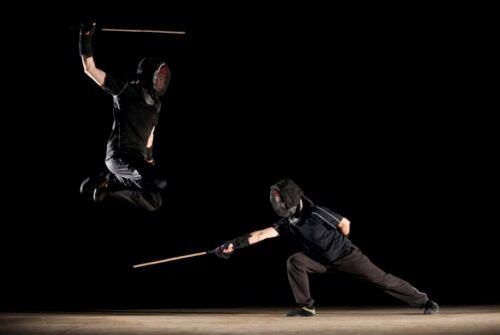
Canne de Combat

Using a light wooden cane, practitioners learned to deliver fast whipping strikes, thrusts, defensive parries, and flowing combinations while maintaining mobility and positional control. Like Savate, Canne de Combat eventually evolved into both a practical self-defence method and a regulated sporting discipline, remaining an important part of French martial culture to this day.

🎩 The Apache Era

Parisian Street Fighting

During the Belle Époque (late 19th and early 20th centuries), France experienced rapid industrial growth, cultural flourishing, and expanding urban nightlife. Yet beneath the glamour of Parisian cafés, theatres, and boulevards existed a darker reality shaped by poverty, overcrowding, organised crime, and growing social tension.

It was within this environment that the Apaches emerged, notorious Parisian street gangs whose reputation for robbery, intimidation, knife attacks, and brutal street violence spread throughout the capital.

Their fighting methods combined striking, crude grappling, improvised weapons such as knives, clubs, and belts, alongside psychological intimidation designed to overwhelm opponents quickly in chaotic urban environments.

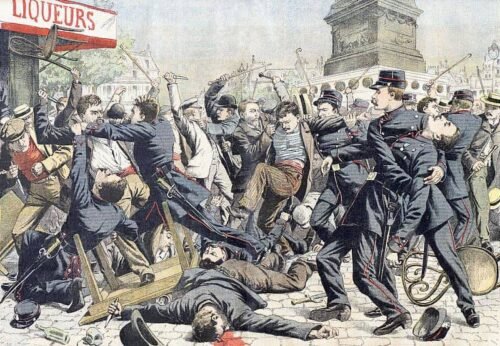
During the Apache era, violent Parisian gangs helped drive the development of police units trained in Savate and close-quarters combat.

Their infamy helped inspire the development of Savate d’Apache, a rough street-fighting variation of Savate adapted for survival rather than formal competition. Unlike regulated La Boxe Française, Savate d’Apache retained many harsher elements, including low-line kicking, open-hand striking, sweeps, trips, and improvised weapon use.

The violence of the Apache era also influenced French policing. In response to rising gang activity, specialised units such as the Brigades du Tigre (“Tiger Brigades”) were established to modernise law enforcement and combat organised urban crime more effectively. Elements of Savate and practical close-quarters combat became associated with police training during this period.

The outbreak of World War I ultimately marked the decline of the Apache era, as many gang members were conscripted into military service and the social conditions that fuelled the gangs began to change. Even so, the Apache era left a permanent imprint on Savate, preserving the art’s connection to both regulated sport and practical urban violence.

🛡️ Défense dans la Rue

Not all branches of Savate evolved toward sportive competition. Alongside regulated La Boxe Française, another side of the art remained focused on practical self-defence and urban survival. Known as Défense dans la Rue (“Defence in the Street”), this approach preserved many of the harsher realities that sportive Savate gradually removed through regulation and competition.

Rooted in the violence of 19th-century French streets, Défense dans la Rue prioritised efficiency, adaptability, and immediate functionality over technical scoring or sporting etiquette. The system remained heavily influenced by both Savate des Rues and the Apache era. It retained low-line kicking, open-hand striking, sweeps, trips, close-range disruption, and limited grappling methods designed for chaotic real-world encounters.

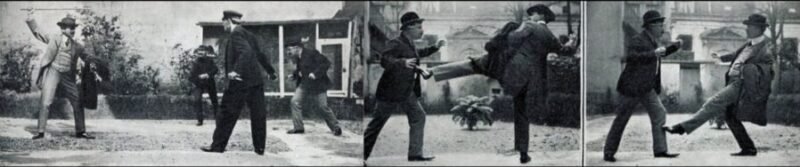
Rooted in the violent streets of 19th-century Paris, Défense dans la Rue evolved as a practical self-defence system focused on survival and adaptability.

Low kicks such as the coup de pied bas remained central, targeting the legs, knees, and ankles to weaken balance and mobility without relying on prolonged exchanges. Open-hand strikes were also favoured at close range due to their practicality and reduced risk of hand injury during uncontrolled fights.

Weapons awareness played an important role as well. Cane and baton methods influenced defensive training, alongside responses to knives and improvised weapons commonly encountered during street violence of the period.

Even as Savate became increasingly refined and sport-oriented, Défense dans la Rue preserved the art’s connection to practical self-defence and survival under pressure, preserving the harsher realities from which the art originally emerged.

🪖 World War I

Military and Practical Application

World War I marked another important stage in Savate’s evolution. Although firearms dominated the battlefield, close-quarters combat still occurred in trenches, raids, patrols, and confined fighting positions where soldiers could suddenly find themselves grappling or fighting at extremely short range.

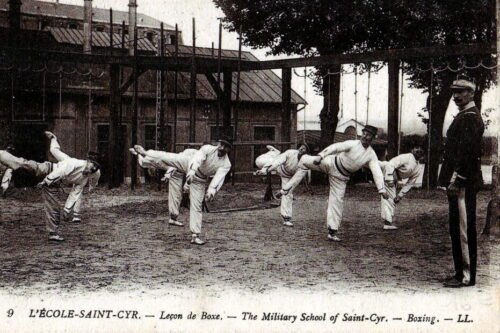
Within this environment, elements of Savate and related French combat methods were adapted for military and law-enforcement use. The art’s emphasis on mobility, balance, rapid striking, and tactical positioning made it well suited for close-range self-defence training under pressure.

During World War I, Savate evolved into a practical system of close-quarters combat, weapon use, and self-defence for military and police training.

Training during this period focused less on sportive exchange and more on direct practicality, particularly when dealing with armed opponents or chaotic battlefield conditions. Cane and baton methods also remained relevant within military and police instruction, reinforcing Savate’s longstanding connection to functional combat rather than purely competitive fighting.

World War I therefore strengthened one of the central themes running throughout Savate’s history: the art repeatedly evolved through exposure to real violence, adapting to the demands of survival, control, and practical combat application.

🌍 International Expansion and Modern Development

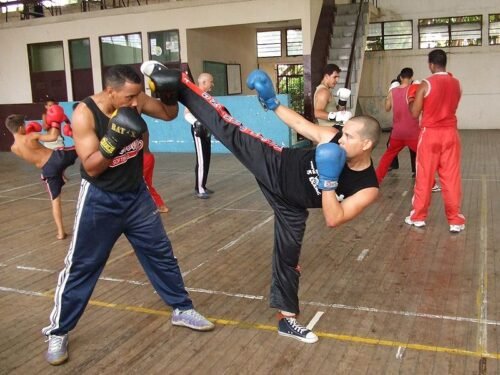
By the mid-20th century, Savate had entered a new phase of development as both a modern combat sport and an internationally recognised martial art. As global interest in martial arts grew during the mid-to-late 20th century, Savate gradually spread beyond France into Europe, North America, and Australia, attracting practitioners drawn to its blend of technical kicking, boxing integration, and tactical footwork.

National federations helped establish formal training structures, instructor certification systems, and increasingly standardised competition formats:

  • Assaut — controlled technical contact.
  • Pré-Combat — heavier contact with protective equipment.
  • Combat — full-contact competition with minimal protection.

By the late 20th century, Savate had evolved into an international combat sport practised across the world.

Although Savate never achieved the global popularity of arts such as Karate, Muay Thai, or Taekwondo, it developed a dedicated international following built around movement, precision, and technical striking. Organisations such as the Fédération Internationale de Savate also helped regulate competition and promote the art internationally while preserving its uniquely French identity.

By the late 20th century, Savate had completed a remarkable transformation — from the rough ports and violent streets of 19th-century France into a modern international combat sport practised across the world.

🧠 Savate’s Influence Beyond France

Although Savate remained relatively niche compared to some global martial arts systems, its influence extended well beyond France through its kicking mechanics, footwork, and highly adaptable approach to striking.

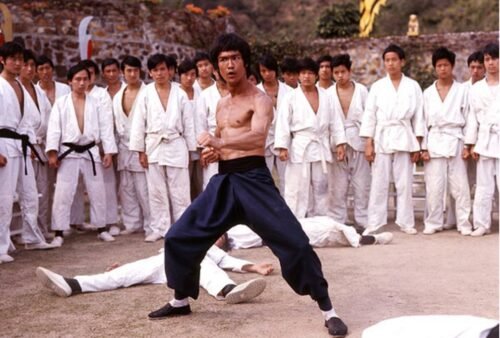
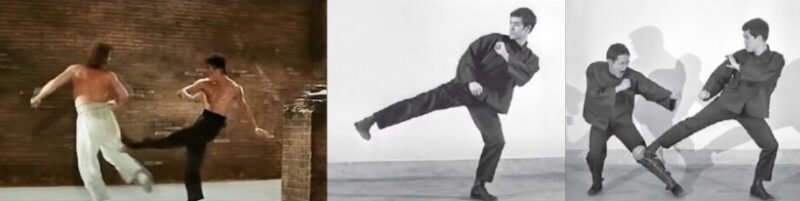
One of the most notable figures associated with Savate’s influence abroad was Bruce Lee, whose development of Jeet Kune Do drew from multiple combat systems across the world. Lee admired Savate’s efficiency, low-line kicking, and emphasis on fluid movement, incorporating elements such as the chassé bas and stop-kick concepts into his own fighting philosophy.

Bruce Lee. Martial Art Evolution.

Bruce Lee sought to fuse practical techniques from various martial arts, including Savate, into his own philosophy of Jeet Kune Do.

Savate’s emphasis on angular attacks, lead-leg kicking, distance control, and intercepting strikes aligned closely with Lee’s broader ideas surrounding efficiency, interception, and fluid combat. Its approach also helped demonstrate that striking systems could rely on timing, footwork, and intelligent positioning rather than purely aggressive exchanges of force.

Bruce Lee incorporated Savate’s low-line kicks, footwork, and intercepting strikes into his Jeet Kune Do philosophy.

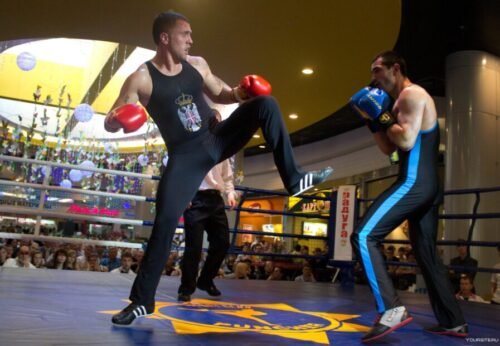
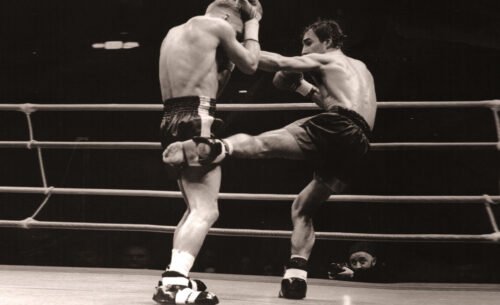
Cross-style competition further increased awareness of the art internationally. Fighters such as François Pennacchio showcased Savate’s effectiveness against practitioners from other striking systems, using movement, speed, and technical adaptability to compete successfully under kickboxing rules.

François Pennacchio’s victory over Ramon Dekkers showcased Savate’s technical adaptability against elite-level striking competition.

While Savate never became a dominant global martial art, its influence continues to resonate with practitioners interested in tactical movement, precision striking, and highly mobile stand-up fighting systems.

🔮 The Future of Savate

Modern Savate occupies a unique position within the martial arts world. While smaller than globally dominant combat sports such as Boxing, Muay Thai, or Mixed Martial Arts, it continues to maintain a dedicated international following drawn to its disciplined striking, fluid footwork, and uniquely French character.

Modern federations continue promoting the art through international competition, instructor development, and global training networks, while events such as the World Combat Games have helped increase Savate’s international visibility.

Savate’s inclusion in events such as the World Combat Games reflects its continued growth as a respected and internationally recognised combat sport.

Although unlikely to rival the commercial popularity of larger combat sports, Savate has preserved many of the qualities that make it distinctive: disciplined progression, precise striking, intelligent movement, and strong historical continuity.

Rather than constantly reinventing itself around modern trends, Savate has continued evolving while remaining closely tied to the characteristics that shaped it from the beginning.

🧩 Final Reflection

The history of Savate is ultimately the story of transformation.

What began in the ports, alleyways, gambling dens, and dangerous streets of Paris gradually evolved into one of the world’s most distinctive striking systems. Along the way, the art absorbed influences from sailors, street fighters, duelling culture, English boxing, military training, and organised sport, constantly evolving alongside the changing realities of French society.

Yet beneath the disciplined footwork and elegant kicking mechanics, Savate never fully lost sight of its origins. The same principles that once helped sailors maintain balance on unstable decks and fighters survive the dangerous streets of Paris still underpin the art today through balance, distance, and control.

Savate’s blend of sport, self-defence, and historical tradition continues to attract practitioners drawn to its technical depth, adaptability, and distinctive identity.

This balance between refinement and practicality is part of what continues to make Savate unique. Few martial arts maintain such a direct connection between street survival, national culture, and modern combat sport.

From rough beginnings emerged a combat system built on discipline, intelligence, and movement, one that still carries the echoes of the ports, streets, and fighters who shaped it more than two centuries ago.

Leave a Reply

Your email address will not be published. Required fields are marked *

This site uses Akismet to reduce spam. Learn how your comment data is processed.

error: Content is protected !!

Join the Super Soldier Project Mailing List Today!!