



For weight management, getting your energy needs right doesn’t have to require Einstein-level calculations. Keep it simple with our easy-to-follow guide on monitoring your intake.
Table of Contents
Introduction
Most people assume managing bodyweight requires detailed calculations, strict dieting, or constant tracking. It doesn’t.
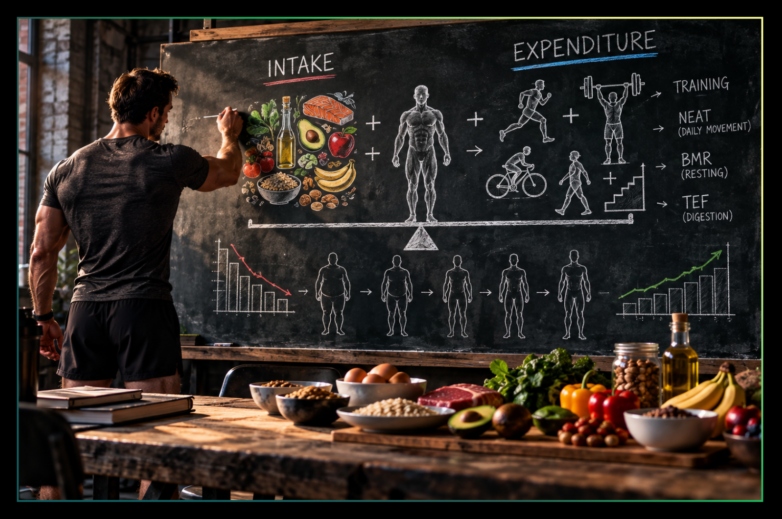
At its core, bodyweight is governed by a simple principle:energy balance. The relationship between how much energy you consume and how much you expend determines whether you gain, lose, or maintain weight. The problem is not that this is complicated. The problem is that it is often overcomplicated.
This post strips it back to what actually matters—how energy balance works in practice, how to estimate your needs, and how to adjust your intake based on real-world results rather than perfect calculations.
⚙️ Energy Balance — The Controlling Principle
Energy balance is what ultimately drives weight change.
This is not a theory or a trend. It is how the body operates over time.
What varies between individuals is not the principle—but the numbers involved and how consistently they apply it.
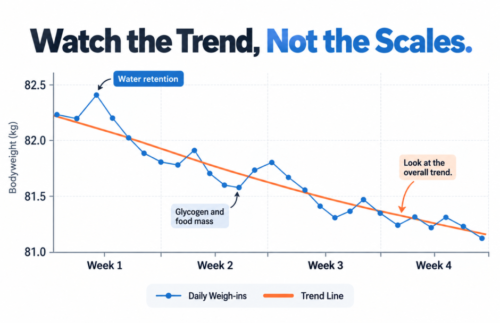
This is also not a day-to-day equation. Bodyweight is influenced by trends over weeks, not single days of eating or training.
📊 What Determines Your Energy Needs
Your daily energy requirements are influenced by a small number of key factors.
Body size and muscle mass:Larger or more muscular individuals require more energy. Muscle mass is metabolically active tissue, meaning individuals with more lean mass require more energy even at rest.
Activity level: Training, steps, and general movement significantly increase demand. Daily movement outside of training (often referred to as NEAT) can contribute more to total expenditure than formal exercise.
Lifestyle: Sedentary vs active routines shift total expenditure.
Other factors—such as sleep, stress, and hormones—play a role, but they do not override energy balance. They influence it. Keeping this simple avoids paralysis. You don’t need to account for everything—you need to understand what matters most.
🧮 Estimating Your Needs — A Starting Point, Not a Solution
You can estimate your daily energy needs using a concept known as Total Daily Energy Expenditure (TDEE). This combines your baseline energy requirements with your activity level to give a rough idea of how many calories you burn in a day.
Formulas exist that use bodyweight, height, age, and activity level to generate this estimate. These can be useful if you have no reference point.
However, this is where many people go wrong.
TDEE is not precise. It does not fully account for individual differences, daily variation, or how your body adapts over time. Two people with identical stats on paper can have very different energy needs depending on lifestyle, movement patterns, and metabolic variation.
Used correctly, TDEE gives you a starting point. What matters is what happens next.
📌 From Theory to Practice
🔁 The Real Method — Start, Monitor, Adjust
Your body does not respond to calculations—it responds to consistency over time.
Instead of chasing perfect numbers:
Start with a reasonable intake based on your size and activity.
Track your bodyweight over 1–2 weeks.
Adjust based on the outcome.
If your weight is not changing, your intake is not aligned with your goal. If it is changing too quickly, adjustments are needed in the opposite direction.
Daily fluctuations are normal—focus on weekly averages rather than single weigh-ins.
This is how energy balance is managed in practice—not through precision, but through feedback.
⚖️ Deficit, Maintenance, and Surplus
Once your baseline is established, you adjust intake depending on your goal.
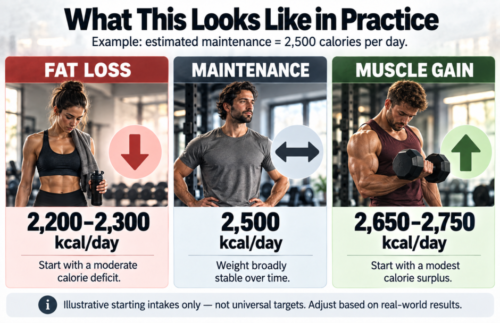
Fat loss: Create a small calorie deficit (typically around 300–500 calories depending on body size and goal).
Maintenance: Match intake to expenditure.
Muscle gain: Introduce a controlled surplus.
Aggressive changes are rarely sustainable. Smaller, consistent adjustments produce better long-term results.
🚫 Why People Get This Wrong
Most issues with weight management do not come from misunderstanding the principle—they come from poor application.
Common problems include:
Inconsistent tracking or awareness of intake.
Underestimating portion sizes or liquid calories.
Overestimating calorie burn from exercise.
Making large, unsustainable changes.
Constantly changing approach before results can stabilise.
The system works. The breakdown happens in execution.
📱 Tracking Intake — Keeping It Practical
You do not need to track everything perfectly, but you do need some level of awareness.
Most tracking errors come from underestimating portions rather than the food itself.
The goal is not perfection. It is visibility.
📍 What This Looks Like in Practice
A simple example:
You estimate your intake at 2,500 calories per day.
After two weeks, your weight has not changed → this is your maintenance level.
If your goal is fat loss → reduce slightly (e.g. 2,200–2,300).
If your goal is muscle gain → increase slightly (e.g. 2,700).
No guesswork beyond that. The result tells you what to do next.
This process repeats—adjust, monitor, refine.
🥗 Energy Balance vs Macronutrients
Macronutrients and calories are not competing ideas—they work together.
Macronutrients determine the quality of your intake (fuel, recovery, function).
Calories determine the quantity (gain, loss, or maintenance).
You can have perfect macros and still gain weight if intake is too high. You can control calories and still feel terrible if food quality is poor.
Protein intake, in particular, plays a key role in satiety and muscle retention during a calorie deficit.
Both matter—but for bodyweight, energy balance is the controlling factor.
📌 Summary
Energy balance is what ultimately determines whether you gain, lose, or maintain bodyweight. Not specific foods, not timing, and not isolated strategies—just the relationship between intake and output over time.
You do not need perfect calculations to make this work. You need a system you can apply consistently. Estimate your intake, monitor your results, and adjust based on what actually happens.
When this is in place, weight management stops being confusing. It becomes something you can control.
Now that intake is under control, the next step is building it properly.
In Post 3, we break down macronutrients—protein, carbohydrates, and fats—and how to structure them in a way that supports your training rather than working against it.
⚠️ Disclaimer
Nutrition is complex and individual. While these principles provide a solid foundation, factors such as allergies, medical conditions, and specific deficiencies will influence what works best for you.
Use these guidelines as a starting point. If you require personalised advice, consult a qualified professional such as a registered dietitian.