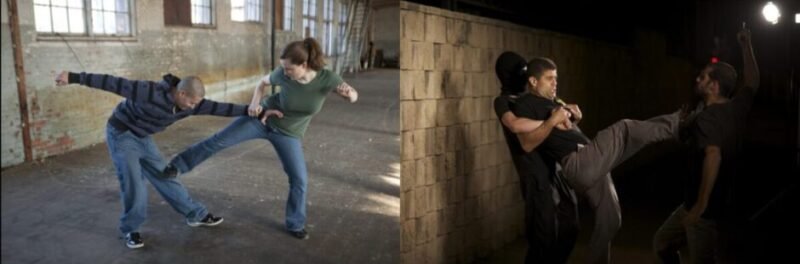
Krav Maga isn’t built around perfect technique. It’s built around making simple, workable decisions under pressure—within a training environment that removes ideal conditions.
Table of Contents
🔥 Introduction
Krav Maga is often described in terms of its techniques—strikes, defences, and responses. But those alone don’t explain how the system functions.
To understand Krav Maga properly, you have to look at the principles behind it. These determine how techniques are applied, how decisions are made under pressure, and why the system is structured the way it is.
This section focuses on those principles and how they are trained—how Krav Maga operates when conditions aren’t controlled.
Krav Maga targets vulnerable areas to end a threat quickly. In training, these are controlled and adapted. No one’s losing an eye in sparring.
🧠 Core Operating Principles
Krav Maga runs on a small set of ideas that repeat across every situation. They’re simple by design, because complexity breaks down under stress.
Awareness Comes First
Everything starts before contact.
Krav Maga training builds the habit of scanning your surroundings and reading intent early. Not in a paranoid sense, but in a practical one—understanding where you are, who’s around you, and what might change quickly.
This isn’t passive. It’s active observation:
Positioning yourself with exits in mind.
Noticing behaviour shifts before escalation.
Avoiding the kind of distraction that gets people caught off guard.
Most situations are decided before the first strike, and awareness is what shifts those odds. In practice, that might mean recognising someone closing distance too quickly, spotting a second person circling, or identifying when a situation is shifting from verbal to physical.
Simultaneous Defence and Attack
In controlled training environments, actions are often separated, defend, then respond.
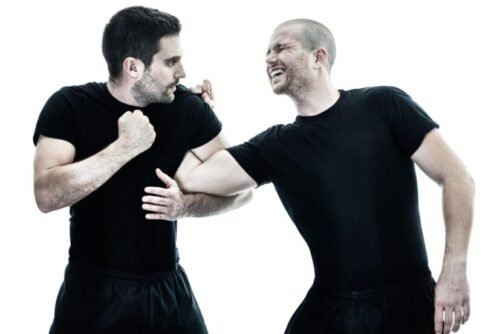
In many traditional settings, defence and counter are taught as separate steps. Under pressure, that gap becomes a problem. Krav Maga removes it by treating defence and attack as a single action.
The system emphasises responding in one movement—covering while striking, deflecting while stepping in, disrupting the attacker immediately. The aim is to break momentum early rather than absorb it.
You are not trying to “handle” the attack. You are trying to interrupt it.
Controlled Aggression
Aggression here is functional. It isn’t emotional or uncontrolled—it’s the ability to commit fully when hesitation would cost you time. Once a decision is made, the response needs to bedecisive enough to create space to move.
That doesn’t mean escalating every situation. In fact, most training reinforces avoiding conflict wherever possible.
But if avoidance fails, half-measures don’t help.
This shows up in training as short, committed bursts—closing distance, striking decisively, and creating space rather than hesitating or trading.
Targeting and Efficiency
Krav Maga prioritises areas that produce quick reactions:
Eyes.
Throat.
Groin.
Knees.
Krav Maga focuses on disrupting an attacker quickly by targeting vulnerable areas and immediately shifting from defence into aggressive counter-action.
These targets are chosen because they disrupt movement, balance, or vision quickly. The aim is not precision striking under ideal conditions, but reliable reactions under pressure.
This isn’t about being extreme—it’s about reducing time spent in danger. When size, strength, or numbers aren’t in your favour, efficiency becomes more important than technique depth.
Escape Over Engagement
This is the principle that ties everything together.
Krav Maga is not trying to build fighters who stay in exchanges. It’s trying to give people a way to create an exit under pressure.
That changes intent completely, you are:
Not trying to dominate.
Or trying to prove anything.
You’re trying to leave.
Everything else supports that outcome.
This is where Krav Maga differs from most combat sports. The goal isn’t to stay and win—it’s to create a moment to disengage before the situation escalates further.
⚙️ Training Methodology
The principles only matter if they hold up under pressure. The way Krav Maga is trained determines whether it works.
At its best, training is built around exposing people to pressure in a controlled way—not replicating violence perfectly, but removing the comfort of ideal conditions.
Scenario-Based Work
Training often places techniques inside situations rather than isolating them.
Examples include:
Being approached aggressively.
Limited space or movement.
Multiple attackers.
Sudden escalation.
The focus is on decision-making, not just repetition. These situations aren’t about perfect execution—they’re about recognising what’s happening and responding quickly enough to create space..
Working from Disadvantage
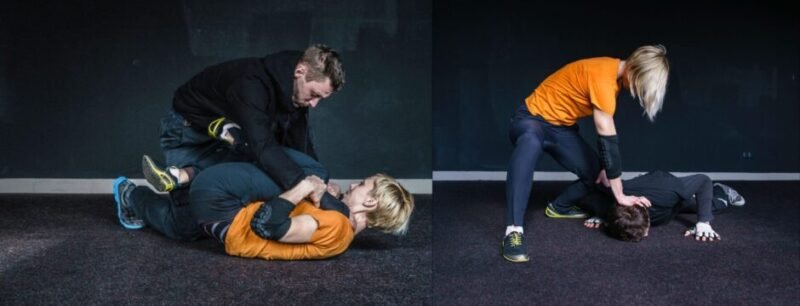
A consistent theme in training is starting from bad positions. This removes the assumption that you’ll be ready. Most real encounters don’t start on your terms.
Being able to defend yourself from any position is a key element in Krav Maga training.
You might be:
Off-balance.
Late reacting.
Restricted by space or movement.
Already under pressure.
The reasoning is straightforward. If something only works when everything is set up correctly, it won’t hold up when it matters.
Stress and Fatigue
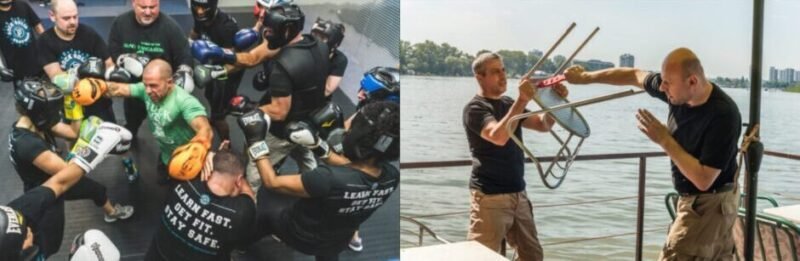
Krav Maga training often introduces intensity to force decisions under fatigue. Decision-making changes under fatigue, and training exposes that early.
This might involve continuous drills, time pressure, or dealing with multiple opponents in sequence. The aim is not to simulate reality perfectly, but to remove the comfort of fresh, calm conditions.
You learn to act while tired, not just when you feel read
Krav Maga training develops both resilience under pressure and the ability to adapt to the environment, using movement, positioning, and available objects to improve the chances of escape or control.
Environment and Improvisation
The environment is treated as part of the system. This could be as simple as using distance, barriers, or objects to create time—anything that helps break contact.
That includes:
Awareness of obstacles and exits.
Use of available objects to create space.
Basic understanding of weapon threats.
Nothing is assumed to be clean or controlled. The setting is always a variable.
⚖️ Where Training Can Go Wrong
This is where the gap appears between theory and reality. Like any system, Krav Maga depends on how honestly it’s trained.
Common problems:
Techniques drilled without resistance.
Predictable attack patterns.
Over-reliance on compliance.
Lack of pressure testing.
When that happens, students learn movements—but not application. This isn’t a flaw in the system. It’s a training issue.
🧱 What the System Is Trying to Build
At a deeper level, Krav Maga is trying to develop a specific response pattern:
Recognise the situation early.
Act quickly and decisively.
Stay aware while engaged.
Leave as soon as the opportunity appears.
Krav Maga training emphasises rapid response under pressure, teaching students to recover from disadvantageous positions and act before hesitation takes over.
Over time, this becomes automatic. The goal isn’t to think through each step, but to reduce hesitation and respond quickly enough to stay ahead of the situation.
It’s less about technical perfection and more about reducing hesitation under pressure.
🧠 Summary
Awareness drives everything.
Defence and attack happen together.
Aggression is controlled, not emotional.
Targeting is based on efficiency.
The environment is always a factor.
Escape is the objective.
🧱 Final Reflection
Krav Maga doesn’t rely on complexity. It relies on removing anything that doesn’t hold up under pressure.
That makes it accessible, but also dependent on how it’s trained. When training is realistic, the system works as intended: simple, direct, and repeatable under stress. When it isn’t, the same principles lose their value.
Krav Maga prioritises simple, repeatable responses that can still function under pressure, fatigue, and resistance rather than relying on technical complexity.
That distinction matters more than the techniques themselves.
It won’t make you invincible, but it will prepare you to respond under pressure. That’s the point.
In the next section, we’ll look at where those techniques come from, how Krav Maga draws from other systems, and how it has evolved by keeping what works and discarding what doesn’t.