





Kajukenbo – Born in Battle, Rooted in Tradition

Kajukenbo was built on a simple idea: real violence is unpredictable. Combining striking, grappling, conditioning, and self-defence, the system became one of America’s earliest true hybrid martial arts.

Table of Contents

🔥 Built for Survival

Long before modern MMA gyms became mainstream, Kajukenbo was already challenging the idea that one martial art alone had every answer.

Forged in the violent environment of post-war Hawaii, Kajukenbo emerged as a practical response to street-level violence and unpredictability. It was not designed for tournaments or rigid tradition. It was created by martial artists searching for techniques that could hold up under pressure in real confrontations.

The U.S. state of Hawaii was the birthplace of Kajukenbo, a hybrid martial art forged in the violent streets of post-war Honolulu.

🥊 A Hybrid System Before Hybrid Systems

Instead of remaining loyal to one style, Kajukenbo blended striking from Karate and Kenpo, throws and locks from Judo and Jujitsu, and fluid movement from Chinese martial arts.

Its founders tested techniques under pressure, discarded what failed, and refined what proved functional. The result was one of the earliest truly integrated martial arts systems in the United States.

⚖️ Between Tradition and Reality

Even today, Kajukenbo occupies an unusual space within martial arts culture. It sits somewhere between traditional martial arts and modern self-defence systems—combining old-school discipline with a pragmatic willingness to evolve.

Some schools emphasise hard-contact realism. Others preserve stronger traditional influences. That flexibility is both one of Kajukenbo’s greatest strengths and one of its biggest challenges.

At its core, however, the philosophy remains simple:

Take what works. Discard what does not. Adapt to the reality in front of you.

🌍 Origins and History

The Black Belt Society

Kajukenbo was born in the rough neighbourhoods of post-war Honolulu, particularly around the Palama Settlement—an area known at the time for frequent street violence involving locals, gangs, and U.S. servicemen.

Violence was a normal part of the environment. Fights were sudden, chaotic, and often unavoidable. Many traditional martial arts of the era focused heavily on forms, rigid structure, or narrow approaches to combat. A group of local martial artists believed something more practical was needed.

👊 The Black Belt Society

Five martial artists from different disciplines formed what became known as the Black Belt Society:

  • Adriano Directo Emperado (Kenpo).
  • Peter Young Yil Choo (Karate, Tang Soo Do).
  • Joseph Holck (Judo).
  • Frank Ordonez (Jujitsu).
  • Clarence Chang (Kung Fu).

Some of the original Kajukenbo founders. (From left to right- Yung Yil Choo, Joseph Holck, Frank Ordonez.  Bottom – Adrian Emperado).

Together, they began combining techniques from their respective systems into a more adaptable approach to self-defence.

⚒️ Pressure, Testing, and Evolution

Kajukenbo’s early development revolved around hard sparring, live resistance, and practical application. Techniques considered ineffective or unrealistic were modified or removed.

This gave Kajukenbo its reputation as a direct, no-nonsense martial art focused on function rather than appearance.

Side Note:
Kajukenbo’s “street-tested” reputation should be understood in context. It was developed for the realities of its era, not magically immune to the evolution of modern combat sports and self-defence training.

Early training was notoriously demanding. Adriano Emperado became known for an aggressive training culture designed to build toughness, conditioning, and composure under pressure.

🧬 What the Name Means

The name Kajukenbo reflects the systems that shaped its foundation:

  • Ka: Karate (Tang Soo Do, Shotokan).
  • Ju: Judo and Jujitsu.
  • Ken: Kenpo (Kosho Ryu Kenpo).
  • Bo: Chinese Boxing (Kung Fu).

The name itself reflects the system’s core philosophy: take useful concepts from multiple sources, refine them through experience, and adapt to changing situations.

By the early 1950s, Kajukenbo had become formally organised, with the first Kajukenbo Self Defence Institute established in Hawaii before the system gradually spread to the mainland United States and beyond.

🧱 What That Origin Actually Means

Kajukenbo’s origin story matters not because it makes the system mythical or unbeatable, but because it explains why the art developed the way it did. Its founders recognised early that real violence rarely fits neatly inside the boundaries of a single martial art. Fights could involve striking, grappling, weapons, multiple attackers, or complete chaos, so Kajukenbo attempted to combine different combat approaches into one adaptable framework.

Long before Mixed Martial Arts became mainstream, Kajukenbo was already experimenting with hybridisation rather than treating combat ranges as completely separate systems.

🕰️ Then and Now

At the same time, Kajukenbo must be viewed within the context of its era. The martial arts world of the 1940s and 1950s was very different from today, with limited cross-training, less developed combat sports, and inconsistent sparring standards between schools.

Modern fighters now have access to refined striking systems, advanced grappling through Brazilian Jiu-Jitsu and wrestling, structured live resistance, and far better conditioning methods.

Kajukenbo’s strength is that it recognised the limitations of single-style training early and remained open to evolution, later absorbing ideas from kickboxing, MMA, and modern self-defence systems. Its weakness is that this same flexibility can create inconsistency when schools lose focus or stop training realistically.

More than most martial arts, Kajukenbo reflects the standards and mindset of the people teaching it.

🧠 Philosophy and Principles

Kajukenbo’s philosophy is built around adaptability, resilience, and practical self-defence. While the system has traditional martial arts roots, its mindset has always leaned more toward function than ritual.

Its well-known motto:

“Through this fist way, one gains long life and happiness.”

reflects the idea that martial arts training should strengthen both the individual and their ability to handle difficult situations responsibly.

The Kajukenbo coat of arms reflects the system’s hybrid roots and warrior ethos. The central clover references the Old Pine Tree style of Kenpō-Jūjutsu, while many schools incorporate additional martial symbolism tied to lineage and identity.

🥋 Adaptability Over Rigidity

One of Kajukenbo’s defining principles is the belief that no system should remain frozen in time.

Rather than protecting tradition for its own sake, Kajukenbo encourages practitioners to test techniques honestly, refine what works, discard what does not, and remain open to evolution.

At its best, this creates practitioners who are flexible, pragmatic, and comfortable adapting under pressure rather than relying purely on rehearsed patterns.

⚖️ The Balance Between Tradition and Reality

Despite its practical reputation, Kajukenbo still retains many traditional martial arts elements, including ranking systems, forms, dojo etiquette, and strong respect for lineage and discipline.

Some schools lean heavily into hard-contact realism and modern cross-training. Others maintain a more traditional atmosphere focused on structure, discipline, and preservation of lineage.

Neither approach is automatically wrong. Problems usually arise when schools become too extreme in either direction:

  • Pure tradition can become rigid and unrealistic.
  • Pure “street combat” mentality can become reckless and performative.

Kajukenbo tends to function best when both sides remain balanced.

🧠 Mental Toughness and Composure

Kajukenbo training often places strong emphasis on composure under pressure.

Hard sparring, conditioning drills, and aggressive training environments are designed to develop confidence under stress, emotional control, physical resilience, and the ability to react decisively during chaotic situations.

That pressure-based mindset remains one of Kajukenbo’s strongest qualities when taught responsibly.

At the same time, good instruction should also reinforce awareness, restraint, and judgement. The goal of self-defence is not proving toughness—it is managing danger effectively and getting home safely.

🥊 Why Train Kajukenbo Today?

Kajukenbo appeals to people looking for a martial art that balances traditional structure with practical self-defence training.

Rather than focusing entirely on one combat range or competitive ruleset, Kajukenbo exposes practitioners to striking, grappling, conditioning, and practical self-defence within a broader hybrid framework.

Kajukenbo is built for real-world survival, blending multiple disciplines into a combat-proven system.

👥 Who Is It Best Suited For?

Kajukenbo may appeal to:

  • Beginners wanting exposure to both striking and grappling.
  • People interested in practical self-defence rather than competition.
  • Martial artists looking to cross-train outside rigid systems.
  • Practitioners who enjoy demanding, pressure-oriented training.
  • Individuals seeking confidence, discipline, and resilience through martial arts.

⚙️ Techniques and Training

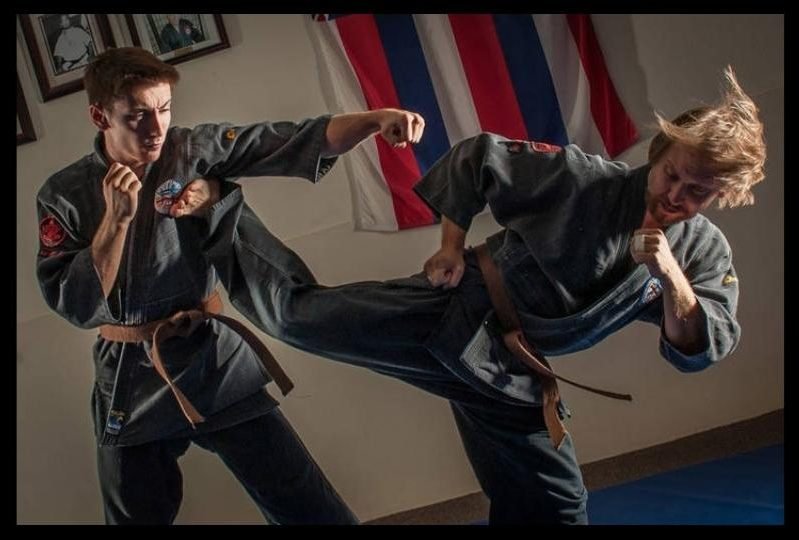
Kajukenbo training combines striking, grappling, conditioning, sparring, and self-defence into one broad hybrid system. Rather than specialising in a single combat range, the system attempts to prepare practitioners for varied and unpredictable situations.

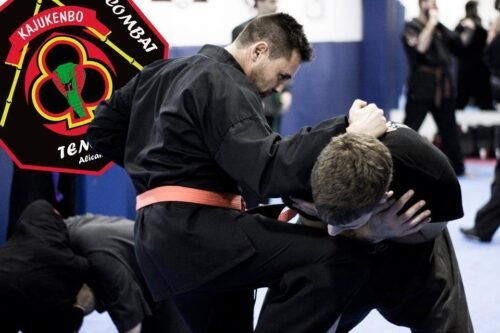
Kajukenbo students train across multiple combat ranges, combining striking, grappling, throws, joint locks, and practical self-defence concepts into one adaptable system.

Training methods vary between schools, but most programmes include a mixture of:

  • Striking drills.
  • Throws and takedowns.
  • Sparring and conditioning.
  • Self-defence scenarios.
  • Basic weapon awareness.

The emphasis is usually placed on practicality, aggression under pressure, and adaptability rather than stylistic purity.

👊 Striking

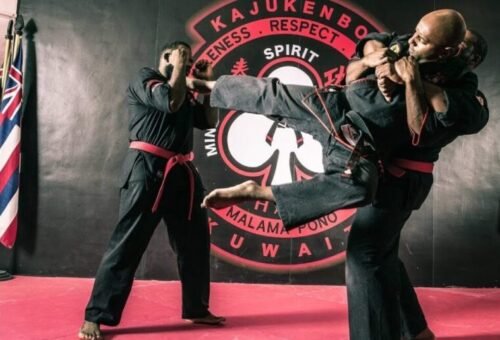
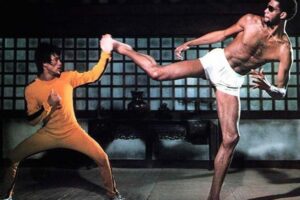
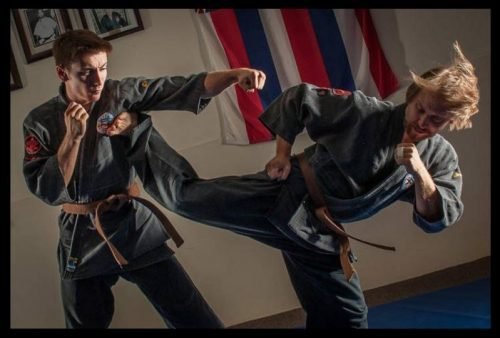
Kajukenbo striking draws heavily from Karate and Kenpo, combining linear power with aggressive combinations and close-range attacks.

Kajukenbo training emphasises hard sparring, practical self-defence, and conditioning under pressure.

Students commonly learn:

  • Punches and rapid striking combinations.
  • Low kicks and body kicks.
  • Knees and elbows.
  • Close-range counters and follow-up attacks.

Many schools emphasise forward pressure and overwhelming an opponent quickly rather than staying at long range exchanging techniques.

Compared to modern Boxing or Muay Thai, Kajukenbo striking is often less refined technically, but tends to place greater emphasis on disruption and self-defence application.

🤼 Grappling and Control

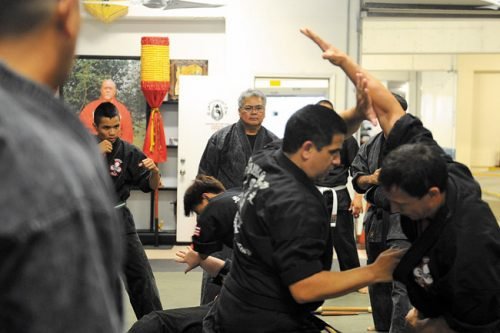
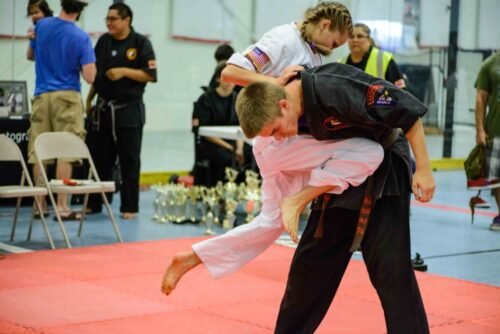
Kajukenbo incorporates grappling concepts from Judo and Jujitsu, including throws, sweeps, joint locks, basic submissions, and clinch control.

This gives practitioners exposure to standing grappling and close-quarters control rather than relying entirely on striking.

Ground fighting exists within Kajukenbo, but usually lacks the positional depth found in systems like Brazilian Jiu-Jitsu or modern submission grappling.

Most schools place greater emphasis on escaping bad positions, regaining the feet quickly, and maintaining mobility during chaotic situations rather than prolonged ground engagement.

🔪 Weapons and Dirty Fighting

Kajukenbo includes defences against common street weapons such as knives, sticks, and improvised weapons, alongside tactics aimed at vulnerable targets including groin strikes, eye attacks, throat strikes, and joint manipulation. These methods reflect the system’s self-defence roots and focus on survival over sporting etiquette.

Side Note:
Weapon disarms should never be viewed as guaranteed solutions. Under stress, even experienced practitioners can struggle against fast, committed attacks involving blades or improvised weapons. Good training acknowledges this reality rather than presenting unrealistic confidence.

🏋️ Training Culture

Kajukenbo developed a reputation for hard-contact training, conditioning, and composure under pressure. While some schools maintain realistic sparring and functional resistance training, others rely more heavily on compliant drills or traditional structure with limited pressure-testing.

As with most martial arts, effectiveness depends less on the style itself and more on the honesty and quality of the training involved.

🔄 Modern Evolution and Cross-Training

Kajukenbo was designed to evolve. Historically, the system has remained open to adaptation and cross-training rather than rigid stylistic purity. Over time, many schools incorporated concepts from Kickboxing, Brazilian Jiu-Jitsu, Mixed Martial Arts, wrestling, and modern self-defence systems. That openness helped Kajukenbo evolve alongside modern combat training.

The rise of MMA exposed weaknesses across many traditional martial arts, particularly in areas such as live resistance, takedown defence, and ground fighting. Kajukenbo schools that adapted to these realities generally became stronger and more functional, while others became overly reliant on compliant drills or theory-based self-defence.

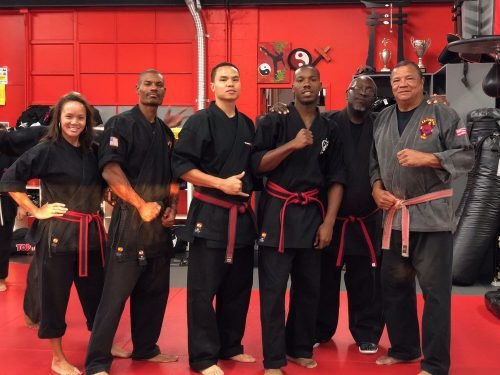
Despite its hard training culture, Kajukenbo often fosters strong camaraderie, discipline, and respect, with some schools also reflecting Hawaiian and Christian influences.

Today, many practitioners supplement Kajukenbo with boxing, wrestling, BJJ, and strength training to develop a more rounded skill set—an approach consistent with Kajukenbo’s long-standing emphasis on practicality and adaptation.

At the same time, constant evolution creates a challenge. As schools absorb more material from MMA and modern combat sports, there is always a risk of losing the system’s identity and becoming generic hybrid training.

Kajukenbo tends to work best when it evolves without abandoning the practicality, structure, and realism that defined it in the first place.

🥋 Street Effectiveness

How Well Does It Hold Up?

Kajukenbo was designed with self-defence in mind from the beginning. Unlike many traditional martial arts that later moved toward sport competition, Kajukenbo’s original focus was dealing with unpredictable violence outside controlled environments.

Rather than prioritising points or clean technical exchanges, Kajukenbo generally focuses on disruption, aggression, close-range pressure, and escaping dangerous situations quickly. In chaotic real-world confrontations, that approach can be highly effective.

✔ Strengths

  • Built around practical self-defence rather than sport competition.
  • Combines striking, grappling, and close-range fighting concepts.
  • Encourages adaptability and reaction under pressure.
  • Balances traditional martial arts structure with functional training.
  • Develops conditioning, resilience, and mental composure.

Kajukenbo blends striking, grappling, and weapon defence into a practical system built around adaptability and self-defence.

✘ Limitations

  • Training quality varies heavily between schools and organisations.
  • Technical depth may be limited compared to specialist combat sports.
  • Some schools rely too heavily on compliant drills or unrealistic weapon defences.
  • Ground fighting is generally less developed than systems like Brazilian Jiu-Jitsu.
  • Broad hybrid systems can become unfocused without strong instruction and honest sparring.

🧠 Multiple Attackers and Situational Awareness

One area where Kajukenbo often differs from combat sports is its focus on environmental awareness and uncontrolled situations.

Many schools include discussion or training around multiple attackers, confined spaces, surprise aggression, escape routes, positioning, and basic weapon awareness.

This reflects the system’s self-defence roots and recognition that real violence rarely resembles a controlled one-on-one match.

At the same time, these scenarios should be approached realistically. No martial art reliably “solves” multiple attackers or weapon threats. Good instruction should reinforce avoidance where possible, escape over prolonged engagement, and situational awareness before physical confrontation occurs.

⚖️ Legal Reality and Self-Defence

Kajukenbo includes techniques intended for extreme self-defence situations, including eye attacks, joint destruction, and weapon defences. While these methods may have practical value in genuine danger, they also carry serious legal and ethical consequences.

In both the United Kingdom and the United States, self-defence generally revolves around the principle of reasonable force. Good instruction should therefore emphasise not only physical technique, but also awareness, restraint, avoidance, and understanding when force is legally justified.

⚠️ Realism Over Fantasy

Like any self-defence system, Kajukenbo works best when taught with realism rather than fantasy. No technique works every time, and no martial art guarantees safety in violent situations.

The goal of self-defence is not ego or domination—it is recognising danger early, responding appropriately, and getting home safely.

🏫 Choosing a Good Instructor

Because Kajukenbo has no single universal standard, the quality of instruction matters enormously.

A strong school will usually include controlled but realistic sparring, drills performed against resistance, practical striking and grappling integration, and instructors willing to acknowledge limitations honestly.

Be cautious of schools built around fantasy-based self-defence, “too deadly to spar” claims, or unrealistic demonstrations performed without resistance.

Ultimately, Kajukenbo works best when trained with realism, consistency, and open-mindedness. Like most martial arts, the effectiveness of the system depends less on the style itself and more on how honestly it is taught and pressure-tested.

♣️ Uniforms, Symbolism, and Organisations

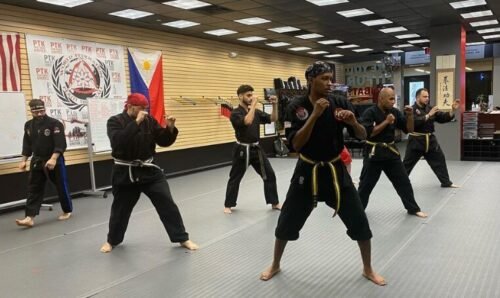
Kajukenbo practitioners traditionally train in black gi-style uniforms reflecting the system’s Japanese and Hawaiian martial arts roots. Many schools also maintain symbolic crests, lineage traditions, and dojo etiquette alongside the system’s practical self-defence focus.

Over time, Kajukenbo has grown into a global martial art supported by organisations dedicated to preserving its lineage, structure, and continued evolution.

🥋 Uniforms and Symbolism

Kajukenbo uniforms are traditionally black, often accompanied by patches, crests, and insignia reflecting school lineage and martial identity. Many schools also preserve traditional dojo etiquette and symbolic elements tied to the system’s hybrid roots.

Kajukenbo practitioners wear black kimono as uniforms. The colours used symbolically by the system are black, red, and white.

🏛️ Organisations

Several organisations help preserve Kajukenbo’s lineage, rankings, and continued development across different branches and schools worldwide.

🧾 Verdict - A Practical Hybrid System

Kajukenbo was built around the idea that real combat cannot be confined to a single style.

By combining striking, grappling, takedowns, weapon awareness, and self-defence principles into one adaptable framework, the system anticipated many ideas that later became common within modern hybrid combat training.

At its best, Kajukenbo produces practitioners who are tough, adaptable, and comfortable operating across multiple combat ranges. At the same time, its broad approach can create inconsistency between schools, particularly when realistic sparring and honest resistance are absent.

Kajukenbo’s strength has always been versatility rather than specialist dominance. While it may not match the technical depth of modern combat sports in individual areas, it remains a practical and respected hybrid system when trained with realism, resistance, and modern awareness.

More than most martial arts, Kajukenbo’s effectiveness depends entirely on how honestly it is trained today.

Conclusion

Kajukenbo was built around a simple idea: real violence is unpredictable, and adaptability matters.

Forged in post-war Hawaii and shaped through practical experience, it remains a martial art that values realism, resilience, and evolution over rigid tradition.

Kajukenbo prioritises practical self-defence, adaptability, and decisive action under pressure.

“Adapt to the reality in front of you.”

If you have enjoyed this post please share or feel free to comment below 🙂

Related Posts

Our Other Posts

Kettlebell Hell

Minimal rest. Maximum punishment. Kettlebell Hell is an 10-station conditioning assault built to test endurance,

Read More »

2 thoughts on “Kajukenbo – Born in Battle, Rooted in Tradition

Leave a Reply

Your email address will not be published. Required fields are marked *

This site uses Akismet to reduce spam. Learn how your comment data is processed.

error: Content is protected !!

Join the Super Soldier Project Mailing List Today!!