Gladiators were built through method, not myth. In this post, we examine the principles, drills, equipment, and physical preparation behind gladiator training, then consider what those methods can still teach us today.
📑 Table of Contents
🔥 Introduction
Before the crowd, the armour, and the arena came the training ground. Inside the ludus, fighters spent countless hours learning how to move, strike, defend, manage their equipment, and keep functioning as fatigue accumulated. The spectacle might last minutes. Preparing for it took months and years.
Gladiator training was designed for one unforgiving purpose: preparing fighters to perform in the arena. Strength and aggression alone were not enough. A gladiator needed technical skill, physical conditioning, discipline, and the ability to execute what he had learned when another trained fighter was actively trying to stop him.
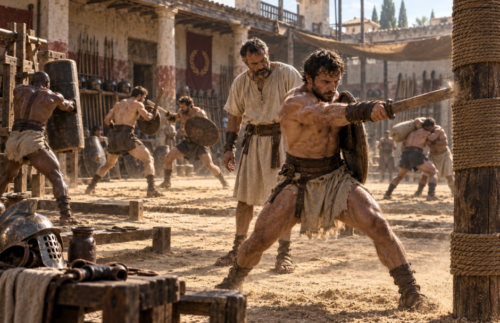
Before the arena came the ludus, where gladiators developed technique, conditioning, discipline and combat skill through repeated drills, specialist instruction and years of physical preparation.
We do not possess a complete gladiator training manual. Practices varied between schools, periods, instructors, and individual fighting styles, while much of what happened inside the training ground was never recorded in detail. What does survive, combined with evidence from the wider Greek and Roman training tradition, allows us to reconstruct some of the principles and methods that shaped their preparation.
Those methods are surprisingly recognisable. This article looks first at the principles behind gladiator training, then at how they were applied in practice. Finally, we can separate what still makes sense today from what belongs firmly in the ancient world.
🧠 Core Training Principles
Behind the individual drills was a broader approach to physical preparation. Here, however, an important distinction needs to be made. We have direct evidence for some aspects of gladiator training, including practice weapons, the palus, specialist instruction, and training within the ludus. We do not have a surviving gladiator training manual describing a complete system of physical preparation.
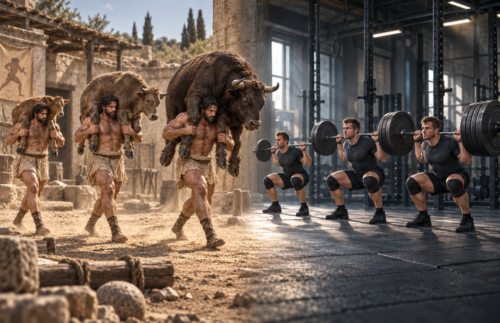
From the legend of Milo and the bull to the modern barbell, progressive overload follows the same principle: gradually increase the demand and the body adapts.
To understand the wider principles that may have influenced that training, we therefore have to look beyond the ludus to the Greek and Roman athletic and medical tradition. Writers such as Galen and Philostratus tell us how exercise, effort, and recovery were understood in the broader physical culture in which gladiators existed. Their methods provide context, not proof that every gladiator trained according to them.
Taken together, the evidence reveals a training culture that recognised differences between skill, strength, speed, fatigue, and recovery, even if it did not describe them using modern terminology.
🔎 To explore each topic in greater detail, click the headings below.
⚔️ Progressive Development
A new gladiator did not walk through the gates of the ludus and immediately begin fighting at full intensity. Before he could survive an opponent, he first had to learn how to move, handle his weapons, defend himself, and fight with control. Technique had to be learned, physical capacity developed, and increasingly demanding work introduced as the fighter became more competent.
Practice weapons, repetitive drills, work against the palus, and eventually training against other fighters provided different levels of challenge. The progression was not necessarily measured through percentages, training volumes, or carefully calculated loads as it might be today, but the underlying logic is familiar.
The idea of gradual physical development was certainly understood within the wider ancient athletic tradition. The famous story of Milo of Croton, who supposedly developed his strength by repeatedly carrying a growing calf, may be legend, but its message is unmistakable. Greater physical capacity comes from adapting gradually to greater demands. Milo is not evidence for a gladiatorial training method, but the story illustrates an idea already present in ancient thinking about physical development.
For the gladiator, progression also involved skill. Learning to produce more force was of little value if control disappeared with it. Physical development and technical development had to advance together.
⚙️ Structure and Variation
Gladiator training was not simply endless combat practice. Different demands required different forms of work.
Technical drilling developed movement and weapon handling. Partner work introduced timing and resistance. Physical training developed the strength and conditioning needed to support those skills. Rest and recovery allowed the fighter to continue training.
This distinction matters because training quality deteriorates under excessive fatigue. A fighter who is exhausted cannot practise precise movement indefinitely, while constant hard sparring creates unnecessary injury risk. Separating different forms of training allowed specific qualities to be developed without every session becoming a test of survival.
The surviving evidence does not allow us to reconstruct a universal gladiatorial timetable, and there almost certainly was not one. What we can see is the underlying principle: preparation involved more than one type of work, and those different demands had to be managed.
🧱 The Tetrad System
The wider ancient athletic world gives us a clearer example of how training intensity could be organised.
The Greek writer Philostratus describes the tetrad, a repeating four day training cycle used by athletes. Each day had a different purpose:
- Day 1 – Preparation: a relatively short session intended to prepare the athlete for harder work.
- Day 2 – Intense Training: the hardest day of the cycle, involving demanding physical work.
- Day 3 – Recovery: a period of relaxation and lighter activity following the previous day’s exertion.
- Day 4 – Moderate Training: exercise at a more controlled intensity before the cycle began again.
There is no evidence that the tetrad was a standard gladiatorial programme. Its importance here is contextual. It demonstrates that the wider athletic culture understood that hard work should not simply be repeated at the same intensity every day.
Effort could be sequenced. Recovery could be deliberate. Training could change according to what had been done previously and what was expected next.
That is a surprisingly familiar idea.
🧠 Galen and the Classification of Exercise
The physician Galen provides another window into ancient ideas about physical preparation. His writings discuss exercise according to the nature and intensity of the effort rather than treating all physical activity as interchangeable.
He recognised distinctions between exercises involving force, speed, and more vigorous combinations of movement. Ancient terminology does not map perfectly onto modern categories such as strength, power, and conditioning, but the underlying observation is important.
Different forms of exercise place different demands on the body.
Again, Galen is evidence for the broader Greco-Roman training culture, not a surviving syllabus from a gladiator school. But the connection to gladiatorial training is clear. A gladiator had to develop force to strike and control an opponent, speed to attack and react, and the conditioning to maintain those abilities as a fight progressed.
His training therefore had to develop these qualities together, not simply make him stronger or fitter in a general sense. Galen’s writings show that the wider culture surrounding the ludus already understood this distinction, even if we cannot say precisely how individual gladiator schools applied it.
⚙️ Function Over Appearance
Gladiators were trained to perform, not to satisfy a modern idea of what an athlete should look like.
A fighter had to move effectively while carrying his equipment, control a weapon repeatedly, maintain balance during contact, and continue making decisions as fatigue accumulated. The physical demands also varied considerably between gladiator types.
This meant that strength, endurance, movement, and technique could not be completely separated. They existed to support a specific task.
The gladiator’s physique was therefore a consequence of preparation, diet, fighting style, and circumstance. The arena did not care how a gladiator looked. It cared whether he could fight.
🧠 Mental Conditioning
No physical programme could remove the psychological demands of the arena. Gladiators trained in an environment where injury was an occupational reality and where an eventual contest would take place in front of a large and demanding audience. Technique therefore had to remain available when the fighter was frightened, fatigued, or under attack.
Repeated drilling helped. So did controlled practice against another fighter. By rehearsing the same movements and responses again and again, and then applying them against resistance, gladiators were training themselves to act without having to consciously process every decision. Familiarity could not eliminate fear, but it could make effective responses more automatic when pressure increased.
This makes mental conditioning part of gladiator training itself, rather than something separate from the physical preparation. Repetition developed more than technique. Progressive exposure to resistance, fatigue and an unpredictable opponent taught the gladiator to perform under pressure. When the gates opened and the roar of the arena replaced the familiar sounds of the ludus, the objective was simple: the body had to know what to do before fear had time to take control.
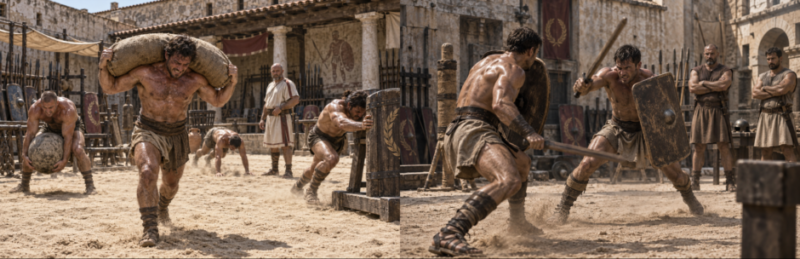
Gladiator preparation combined physical conditioning with repeated, supervised sparring, building the strength and endurance to support combat skills while teaching fighters to keep performing under fatigue, resistance and pressure.
⚔️ Training Methods in Practice
Principles mattered, but gladiators were ultimately being prepared to fight. Inside the ludus, those principles were translated into hours of practical, repetitive training designed to turn technique into instinct.
Combat was broken into manageable components, with individual movements and skills developed through repetition before being tested against the uncertainty of an opponent. The methods were simple, purposeful, and closely tied to what a gladiator would eventually face in the arena.
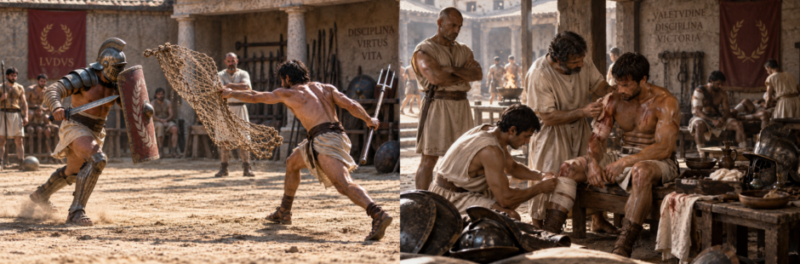
Gladiator preparation was highly specific, with fighters trained for the demands of their weapons and expected opponents, while medical care and recovery helped preserve the men whose ability to train and perform had real value.
🔎 To explore each topic in greater detail, click the headings below.
🤼 Controlled Combat and Sparring
Eventually, a fighter had to practise against another fighter. Partner work allowed techniques developed in isolation to be tested against movement and resistance. Distance changed. Attacks had to be recognised. Defensive movements had to happen at the correct moment rather than simply being performed on command.
But training also had to preserve the gladiator. To the lanista, a trained fighter was capital. Money and resources had been invested in acquiring, feeding, housing, equipping and training him, with the expectation that he would eventually generate a return through appearances in the arena. The more experienced and successful the gladiator became, the more valuable that investment could become. A serious training injury therefore meant more than losing a fighter for a few weeks. It could damage or destroy an income-producing asset that had taken considerable time and money to develop.
Practice combat therefore occupied a middle ground. It needed enough resistance and uncertainty to prepare the fighter for a real opponent without unnecessarily risking the investment before he reached the arena.
This distinction remains fundamental to combat training. A fighter needs resistance to develop skill, but training cannot continually carry the cost of competition.
🪵 The Rudis and Weapons Training
Wooden practice weapons allowed gladiators to repeat techniques without relying on sharpened steel. The rudis, a wooden sword associated with gladiatorial training, allowed attacks, defensive actions, positioning, and combinations to be practised repeatedly. Ancient accounts also refer to training equipment being deliberately heavier than fighting equipment, although we should be cautious about assuming that every gladiator school followed exactly the same practice.
The important feature was repetition. A movement performed once could be understood. Repeated hundreds or thousands of times, it could become dependable. But the real test came when that movement had to survive pressure: when the fighter was tired, his breathing was heavy, his opponent was moving, and there was no time to consciously assemble the correct response. Repetition turned technique into something the gladiator could still call upon when conditions were working against him.
This was particularly important because gladiatorial combat was specialised. The movement patterns required by a secutor carrying shield and sword were not those required by a retiarius working with trident and net. Weapons training therefore reinforced the techniques demanded by the fighter’s particular role.
🎯 The Palus
One of the most recognisable tools of ancient weapons training was the palus, a wooden post used as a target. Working against a fixed target allowed a fighter to practise without waiting for a partner. Attacks could be repeated, foot position adjusted, distance judged, and movement around the target drilled again and again.
Its simplicity was part of its usefulness. The post did not fight back, which meant the gladiator could concentrate on mechanics before adding the complexity of another person.
There is a useful training logic here. First reduce the variables, then reintroduce them. Technique can be developed in isolation, but eventually it must survive movement, resistance, fatigue, and an opponent who is trying to prevent it from working.
🛡️ Specialisation and Fighting Style
A defining feature of gladiator training was specialisation. Gladiators were associated with recognised fighting types, characterised by particular combinations of weapons, armour, and tactical demands. Their preparation therefore had to reflect not simply how to fight, but the kind of fighter they were being trained to become.
The clearest example is the secutor and retiarius. The secutor carried a sword and large shield, with substantial protection and a smooth, enclosed helmet designed in part to give the retiarius’ net fewer opportunities to catch. His task was to close the distance, maintain pressure, and force the lightly protected retiarius into a fight at close range.
The retiarius, armed with net, trident, and dagger, faced almost the opposite problem. Without a large shield or heavy armour, he relied on mobility, reach, timing, and control of distance. He needed space in which to use the trident and net effectively, while the secutor needed to take that space away. One fighter wanted to close the distance; the other wanted to preserve it.
Other traditional pairings created different tactical problems. A murmillo, protected by a large shield, might face a Thraex carrying a smaller shield and curved sica, or a hoplomachus using a spear to threaten from greater range. Each combination altered the balance between protection, mobility, reach, and attacking opportunity.
These differences affected more than technique. They changed the physical demands placed on the fighter. A heavily equipped gladiator needed the strength and conditioning to move efficiently under additional weight and maintain defensive structure. A lighter fighter might depend more heavily on speed, movement, reaction, and the ability to repeatedly create or escape distance.
Training therefore had to prepare the gladiator not simply to fight, but to fight in a particular way against particular kinds of opposition. His weapons, armour, and expected opponent helped determine the skills and physical qualities he needed to develop.
In modern terms, the principle is straightforward: training was specific to the performance requirement.
🪨 Strength and Resistance Work
Gladiators clearly required considerable physical strength, but reconstructing exactly how they developed it is more difficult than identifying their weapons drills.
The wider ancient training world made use of halteres, stones, weighted implements, digging, carrying, and other forms of resistance exercise. Gladiatorial practice also involved working repeatedly with weapons, shields, and training equipment, all of which imposed their own physical demands.
The problem is that no gladiator training manual has survived to fill in the details. We have fragments of evidence, references to ancient training practices and the physical demands of gladiatorial combat, but no convenient programme telling us what happened inside the ludus from Monday to Friday. It is easy to fill those gaps with familiar exercises and create something resembling a modern gym routine. That would tell us more about modern training than gladiator training.
What we can reasonably say is that resistance was not foreign to ancient training. Strength could be developed through loaded movement, repetitive weapon work, manual resistance, and the handling of external weight.
For the gladiator, that strength ultimately had to support the task. He needed to control his equipment, his own body, and, when necessary, another human being.
🤼 Bodyweight and Unarmed Work
Not every physical demand required equipment. The broader Greek and Roman training tradition included wrestling and other forms of unarmed exercise, and armed combat did not always remain neatly at weapons distance. Fighters could collide, become entangled, lose balance or find themselves too close to use their weapons effectively. In those moments, grappling, balance and body control could help a gladiator stay on his feet, control an opponent, create space and bring his weapon back into play.
That makes bodyweight and unarmed training relevant to the physical culture surrounding the ludus, although it does not prove that every gladiator followed a formal programme of wrestling or grappling. The exact drills used are not documented in enough detail to recreate such a programme with confidence.
The useful distinction is between what is plausible within the training culture and what is directly recorded. We know far more about some aspects of gladiatorial preparation, such as weapons practice and the palus, than we do about a supposed gladiatorial catalogue of push ups, climbing drills, or other modern looking exercises.
🏃 Movement, Balance and Coordination
For a gladiator, survival depended on movement. A weapon offered little protection if he could not evade an attack, control the distance or put himself in a position to strike back. Footwork, balance and positioning therefore formed part of the practical business of staying alive. A gladiator needed to advance, retreat, change direction, maintain a useful stance, and respond to the movement of an opponent without sacrificing control.
Again, the requirements depended on fighting style. A retiarius managing distance needed different movement from a heavily protected secutor attempting to close it.
This is why conditioning and technique cannot be completely separated. Fatigue changes posture, slows reactions, and makes movement less efficient. A fighter had to retain coordination while working hard enough for those qualities to be challenged.
♨️ Preparation, Medical Care and Recovery
When the spectacle ended, the surviving gladiator still had to deal with its consequences. Cuts, bruises, fractures and deeper wounds did not disappear when he left the arena. Some injuries required immediate attention; others needed time, rest and continued treatment before the fighter could safely return to training. Survival was only the first step. The task now was to make the gladiator fit enough to fight again.
That made medical care and recovery a practical part of maintaining the fighting population of the ludus. Roman physical culture placed considerable importance on bodily care, with rest, bathing, massage, food, and medical treatment forming part of the wider management of athletes and gladiators. Gladiatorial establishments could also have access to physicians. Galen himself famously treated gladiators at Pergamon, gaining considerable experience in trauma and wound care.
Recovery should not be romanticised as an ancient equivalent of modern sports science. The Romans did not possess our understanding of physiology, tissue adaptation, or rehabilitation.
They did, however, understand the practical consequence of neglect. A fighter who could not recover could not train effectively, and a fighter who remained injured could not perform.
🍲 Diet and Physical Management
Food had the same practical purpose: keeping the fighter capable of training and performing.
Evidence from both ancient writing and archaeology suggests that gladiators consumed substantial amounts of barley, legumes, and other plant foods. The nickname hordearii, often translated as “barley men”, reflects the association. Analysis of gladiator remains from Ephesus has also contributed to the picture of a diet heavily based on plant foods. Ancient accounts refer to drinks containing plant ash, which may have provided additional minerals after training.
This does not mean gladiators followed one universal diet, nor should their food be presented as an ancient performance nutrition plan. Cost, availability, location, and the needs of feeding groups of fighters all mattered.
Their physique may also have differed from the lean, highly defined image favoured by modern cinema. A degree of body fat may have offered some protection against superficial cuts, although the extent and deliberate nature of this remains debated.
The important point is simpler. Gladiators were fed to sustain training and combat, not to look good with their shirts off.
🏋️ What Can We Take From Gladiator Training?
This is where historical reconstruction ends and modern application begins.
There is little value in pretending that a modern trainee can reproduce life inside a Roman ludus, and even less in copying ancient practices simply because they are ancient. What is useful is identifying the training principles that remain sound after two thousand years of advances in physiology, medicine, and coaching.
Strip away the arena, the weapons, and the brutality, and several of those principles still have a place in modern training.
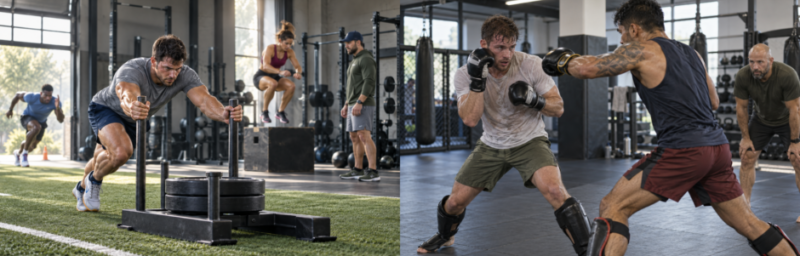
The methods have changed, but many of the underlying principles remain: build strength and conditioning for a purpose, practise skills under resistance, introduce fatigue progressively, and learn to keep performing when pressure rises.

Resistance training in the ancient and modern worlds.
🔎 To explore each topic in greater detail, click the headings below.
🧠 Progression and Structure
The first lesson is straightforward: build capacity rather than constantly test it.
The gladiators understood progression through practice and experience. Modern training goes much further. Load, volume, intensity, frequency, and recovery can now be deliberately manipulated, measured, and adjusted to the individual. We can track performance, manage fatigue, and progressively overload the body rather than relying largely on observation and tradition. The fundamental process, however, remains the same: gradual adaptation to increasing demands.
Structure matters for the same reason. Hard training creates a stimulus, but improvement occurs only if the body is given sufficient opportunity to adapt to it. Modern programming therefore balances overload with recovery rather than treating every session as a test. Constant maximal effort eventually compromises technique, recovery, or both.
This is where the wider ancient ideas represented by the tetrad remain interesting. We have far more sophisticated ways of organising training today, so the precise four day sequence is not something we need to reproduce. The principle behind it is what survives: intensity has to fluctuate.
🪨 Strength With a Purpose
Gladiator training also reminds us that strength is most useful when it supports a task.
That does not mean modern isolation exercises or machine training are somehow inferior. They are tools, and very effective ones when used for the right purpose. But strength developed in the gym eventually has to transfer to whatever performance matters outside it. A stronger squat may help an athlete accelerate, a stronger pull may improve grappling or climbing, and greater trunk strength may help someone control and transfer force through the whole body.
For a gladiator, that meant controlling weapons and shields, moving under load, resisting an opponent, and continuing to produce force while tired.
For a modern trainee, the required outcome may be completely different. The principle remains the same: train the qualities your objective actually requires.
⚡ Power, Movement and Coordination
Strength alone does not determine athletic performance.
Force often has to be produced quickly and from a useful position. That requires timing, balance, coordination, and the ability to move efficiently before force is applied.
Modern training can develop these qualities far more precisely through sprinting, jumping, throwing, Olympic lifting, medicine ball work, and other power based methods. Which methods are appropriate depends on the athlete and the objective.
The gladiator faced the same basic requirement in a far less forgiving environment. Strength meant little if he could not step, turn, evade, strike, or recover his balance at the right moment, often while carrying a weapon and shield and reacting to an opponent trying to do exactly the same to him. Physical capacity had to become usable movement.
🏃 Conditioning and Performance Under Fatigue
Gladiators did not need endurance simply for the sake of enduring. They needed to preserve useful performance as fatigue accumulated.
That distinction remains valuable. A person can possess excellent general cardiovascular fitness and still struggle when a particular activity combines repeated muscular effort, technical movement, and decision making. Conditioning becomes more specific as the demands become more specific.
Modern training should therefore develop both general conditioning and task specific conditioning. Build the aerobic base through steady cardiovascular work and develop higher intensity capacity through intervals, circuits, and repeated efforts. Then make some of that conditioning specific to the activity itself. A fighter might work combinations, footwork, or grappling under controlled fatigue; an athlete might repeat sprints, carries, jumps, or sport specific movements with limited recovery.
The goal is not to make every workout exhausting. Fatigue should be introduced deliberately, without allowing technique and movement quality to collapse. Over time, the body becomes better at sustaining the movements, decisions, and physical output the activity actually requires.
The objective is not merely to become tired. It is to remain effective while tired.
🧱 Repetition and Skill
The palus represents one of the simplest and most enduring lessons from gladiator training: important skills require repetition.
Repetition allows movement to become more efficient and dependable. But repetition alone is not enough. A gladiator could drill strikes repeatedly against the palus, but those movements ultimately had to work against a moving, resisting opponent.
The same principle carries directly into modern skill training. Technique is first learned and repeated under controlled conditions, then gradually tested against movement, resistance, and pressure. Learn the movement. Repeat it. Add variation. Introduce resistance. Increase pressure.
Too much novelty prevents a skill from stabilising. Too little variation produces a skill that works only under familiar conditions.
The balance is between reliability and adaptability.
♨️ Recovery and Longevity
A gladiator who could not recover could not train, and a gladiator who could not train was unlikely to last long in the arena. The Romans may not have understood the physiology behind recovery, but their trainers understood its practical value.
Today, we know considerably more. Sleep, nutrition, fatigue management, rehabilitation, and planned changes in training load allow athletes to develop while reducing unnecessary injury risk. These are areas where modern practice should move well beyond ancient precedent rather than imitate it.
Recovery is not something added after the programme has been designed. It is part of the programme itself. Training only works when you can recover from it, adapt, and return capable of doing more. Anyone can survive a brutal session. The real measure of a programme is whether it leaves you stronger for the next one.
🧠 Mental Discipline
A gladiator was not trained simply to perform techniques in the safety of the ludus. He had to reproduce them in the arena, facing an armed opponent, physical exhaustion, injury, noise, and the pressure of a watching crowd. Composure under pressure was part of the job.
That principle still matters. Composure under pressure has to be practised under pressure. First learn the movement, skill, or technique under controlled conditions. Then gradually introduce difficulty through heavier loads, harder conditioning, timed efforts, competition, sparring, or performing technical work while fatigued. The aim is not simply to make training harder. It is to learn to maintain technique and make good decisions as the pressure increases.
The key word is controlled. Pressure should be introduced progressively and with a purpose. Modern training can create demanding situations without reproducing the danger or brutality of the ancient arena.
Confidence built this way is not simply motivational. It comes from experience. You have been tired before. You have been under pressure before. And you know that when things become uncomfortable, you can still perform.
⚖️ Where Modern Training Has Moved Beyond It
There is a danger in looking backwards and assuming that because an ancient method was effective, it must also have been optimal.
Gladiator training existed within the medical knowledge, technology, and social conditions of its time. Fighters represented a significant investment, so keeping them healthy, recovering from training, and capable of returning to the arena clearly mattered. But this was not the same as modern concern for an athlete’s long term health. Serious injury remained an occupational reality, medical options were limited, and many of those within the system had little control over the risks they were expected to take.

Modern training builds on enduring principles of progression, preparation and recovery, but advances in sports science, rehabilitation, biomechanics and performance testing allow those principles to be applied with far greater precision and considerably less unnecessary risk.
Modern training has enormous advantages. We understand adaptation, nutrition, biomechanics, fatigue, rehabilitation, and injury management far better. Equipment allows load to be controlled precisely. Performance can be measured. Programmes can be adjusted before a problem becomes catastrophic.
This does not make the ancient system primitive. It puts it in context.
The useful approach is therefore neither to dismiss gladiator training nor romanticise it. Keep the principles that withstand scrutiny and leave the unnecessary risks in the arena.
🏛️ Conclusion
Gladiator training was shaped by an unforgiving objective. Fighters had to develop technical skill, physical capacity, and enough composure to apply both under extreme pressure.
The methods available to them were relatively simple. Wooden weapons, the palus, specialised instruction, partner practice, physical conditioning, food, rest, and repetition formed the machinery through which fighters were prepared.
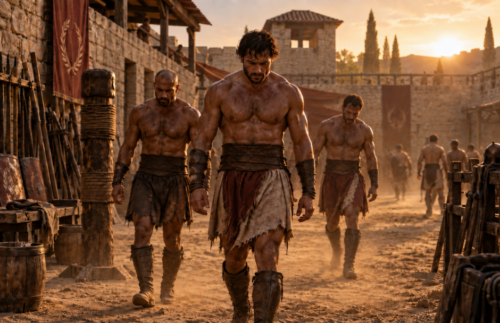
The tools were simple and the world was brutal, but the underlying logic still holds: progress deliberately, practise specifically, recover properly, and learn to perform under pressure.
Around that practical evidence sits a wider Greco-Roman training culture that already recognised differences in exercise, changes in intensity, and the importance of recovery. We should be careful not to turn those ideas into a modern sports science programme that never existed, but neither should we underestimate the thought that went into ancient physical preparation.
Modern training has given us safer methods, better measurement, and a far deeper understanding of adaptation. What remains recognisable is the underlying logic: develop progressively, practise deliberately, prepare specifically, recover properly, and learn to perform when conditions are no longer comfortable.
That is the part of gladiator training worth carrying forward.