Best martial arts. Jim Arvanitis. Pankration. Greek culture. Greek history. Best martial arts for self defence. Best martial arts for street fighting. Neo-Pankration. Mu Tau Pankration.

Digging Up the Dead — The Revival of Pankration

Pankration did not survive into the modern world—it had to be rebuilt.
What followed was not a single revival, but competing attempts to interpret the same idea.
Only one of those attempts endured.

Table of Contents

📖 Introduction

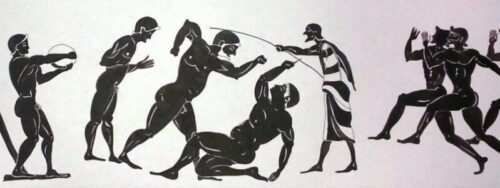
For over a thousand years, pankration existed only in fragments—preserved in ancient texts, artwork, and archaeological remains. It was studied as part of classical history, but no longer practised as a living combat system.

That began to change in the twentieth century.

As interest in historical combat systems and martial arts expanded, both historians and practitioners began to re-examine pankration—not just as a cultural artefact, but as a potential system of combat.

This revival did not emerge from a single source or unified movement. It developed through independent efforts, shaped by different goals, interpretations, and training priorities.

🧭 Parallel Paths of Revival

As interest grew, two broad approaches began to emerge. One focused on structured competition, aiming to reintroduce pankration as a regulated sport. This approach prioritised safety, organisation, and accessibility, eventually leading to the development of modern Pankration Athlima.

The other took a different direction. Rather than reconstructing a sport, some practitioners explored pankration as a combat concept—a system defined by the integration of striking and grappling, rather than fixed rules or formats.

These approaches developed in parallel, often independently. Over time, however, they produced very different outcomes—one evolving into a structured, competitive system, the other remaining a conceptual approach without a unified framework.

🧠 Jim Arvanitis and Early Combat Interpretation

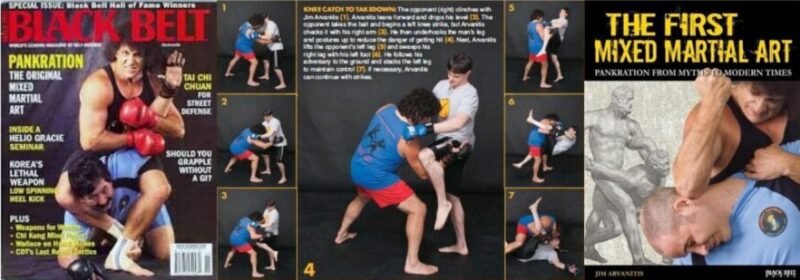
During the 1960s and 1970s, Jim Arvanitis became one of the key figures exploring pankration as a functional combat system. At a time when most martial arts were practised in isolation—boxing, karate, wrestling—Arvanitis was drawn to the idea of a system that combined multiple ranges of combat into a single approach.

Jim Arvanitis developed Neo-Pankration by integrating striking and grappling, interpreting ancient sources through modern training before such approaches became standard.

Using historical references alongside his own martial arts background, he began developing a method based on this principle. This approach would later become known as Neo-Pankration. Arvanitis was not restoring a preserved system. He was interpreting an idea—using available evidence as a foundation, but shaping it through modern training and experience.

Crucially, this work emerged before integrated combat became standard practice. What he was attempting in isolation would later become a defining feature of modern combat sports.

🏺 A Revival, Not a Reconstruction

Any attempt to revive pankration faces a fundamental limitation: the original system is incomplete.

No technical manuals survive. What remains are written descriptions, artistic depictions, and scattered references—enough to suggest structure, but not enough to define it precisely.

As a result, modern interpretations rely on reconstruction. Practitioners combine historical evidence with contemporary knowledge to build systems that reflect what pankration may have been.

This distinction is critical.

Modern pankration is not a direct continuation of the ancient sport. It is a reinterpretation—shaped by both historical insight and modern understanding of combat.

With no surviving manuals, modern attempts to revive pankration rely on written accounts and artistic depictions—interpreted through contemporary understanding to reconstruct the system.

🇨🇦 Aris Makris and the Sporting Revival

While Jim Arvanitis approached pankration as a combat system, a separate movement developed with a different objective: to re-establish it as a modern sport.

Aris Makris played a central role in this direction, working to formalise pankration within a structured competitive framework. Rather than attempting to replicate the conditions of ancient contests, this approach introduced rules, safety measures, and organised formats.

Aris Makris. Pankration. Greek culture. Greek history. Best martial arts. Combat sports. Best martial arts for self defence. Best martial arts for street fighting.

Aris Makris led the sporting revival of pankration, developing Pankration Athlima—a regulated format combining striking and grappling within a structured competitive framework.

This led to the development of Pankration Athlima.

Within this system, striking and grappling were retained—but regulated—allowing the discipline to function within modern sporting environments.

⚖️ Two Paths, One Origin

By the late twentieth century, the revival of pankration had produced two distinct approaches. One led to Neo-Pankration—an attempt to reconstruct the art as a combat-oriented system focused on integration and adaptability. The other led to Pankration Athlima—a regulated sport designed for structured competition.

These approaches did not develop together. They emerged independently, shaped by different priorities. One focused on functional combat application without a formal structure. The other prioritised organisation, safety, and competitive legitimacy.

Over time, these differences led to very different outcomes. Pankration Athlima developed into a structured, governed sport with a competitive framework. Neo-Pankration, by contrast, did not establish a unified system or sustained method of development. Its ideas persisted, but the approach itself did not.

Both draw from the same historical source—but they do not occupy the same place in the modern landscape. One exists as a living system. The other no longer exists in practice, surviving only as a concept.

➡️ Transition Forward

The next article focuses on Neo-Pankration, examining its development as a modern reconstruction and how its ideas were later absorbed into contemporary combat training.

Leave a Reply

Your email address will not be published. Required fields are marked *

This site uses Akismet to reduce spam. Learn how your comment data is processed.

error: Content is protected !!

Join the Super Soldier Project Mailing List Today!!