Arnis – Filipino Martial Arts for the Real World

This post dives into Arnis, the fast and fluid Filipino martial art of sticks, blades, and hand-to-hand combat—honed through generations for battlefield and self-defence mastery.

Table of Contents

⚔️ Introduction – Built for Survival

Arnis, also known as Eskrima or Kali, is the national martial art of the Philippines — a fast, fluid combat system built around sticks, blades, and empty-hand fighting. What distinguishes it immediately from most modern martial arts is a simple but ruthless premise: the weapon comes first.

From day one, students train with tools designed to cause harm. Whether holding a rattan stick, a blade, or nothing at all, the same movement principles apply. Range, timing, angles, and economy of motion are non-negotiable. Arnis does not ask what should happen in a fight — it trains for what does.

Arnis? Escrima or Kali?

Filipino Martial Arts are known by different names depending on region. Arnis is commonly used in the north and derives from a Spanish term meaning “armour.” Eskrima comes from esgrima (“fencing”) and is more common in central regions. Kali is often associated with southern traditions and may derive from kalis, a pre-Hispanic term linked to bladed combat.

These terms are broadly interchangeable. For clarity and consistency, this article uses Arnis or Filipino Martial Arts (FMA) throughout.

Arnis. Filipino Martial Arts. Kali. Escrima. World martial arts. Philippines.

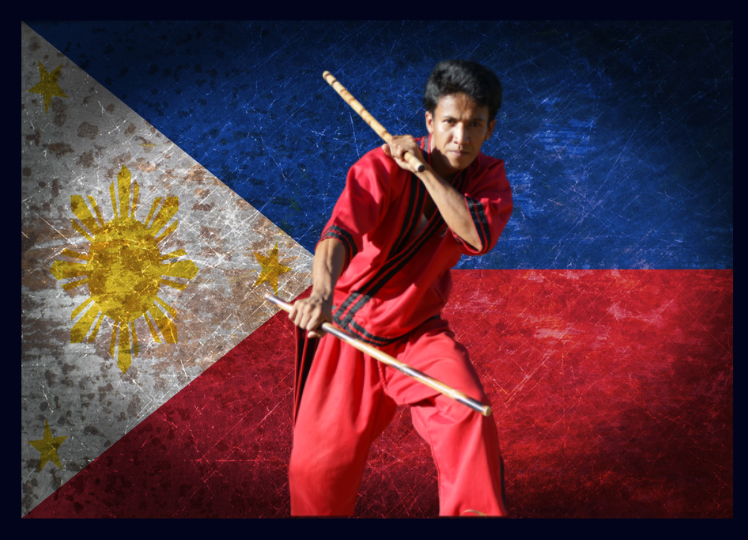
The Philippines. The island country of Southeast Asia in the western Pacific Ocean. Home of the deadly fighting art of Arnis.

🔁 A System Built on Adaptability

Arnis did not emerge in a vacuum. It was shaped under pressure — forged through centuries of real conflict including tribal warfare, coastal raids, colonial occupation, guerrilla resistance, and later urban violence. That history explains why the system values adaptability over rigidity and function over form.

Each era stripped the art down to what worked and discarded what did not. There are no sacred techniques here, only principles that survive stress. Practitioners learn to transition seamlessly between weapons and empty hands, between ranges, and between offence and defence, using the same underlying mechanics throughout.

This article focuses on how Arnis functions today and why those principles remain relevant.

A full historical deep dive — into FMA’s evolution and why these methods were tested, banned, hidden, and refined in blood — is available in our companion piece:

🪶 Weapons First, Always

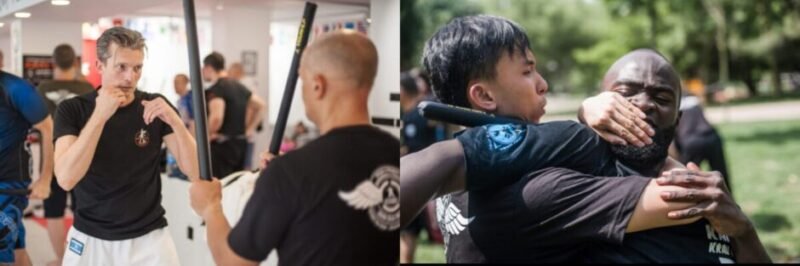
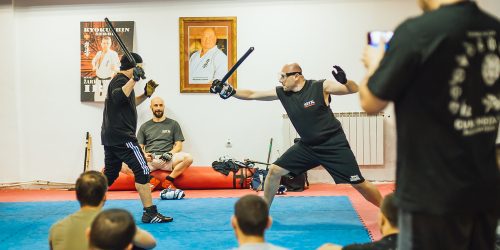
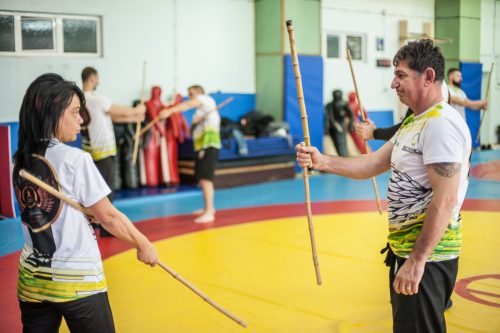
In Arnis, weapons are not an advanced phase — they are the foundation. Training begins with the baston (rattan stick), teaching distance, targeting, and striking angles long before empty-hand exchanges. The logic is blunt: if you can survive armed violence, unarmed fighting becomes a subset — not the other way around.

The stick acts as a training bridge. Its mechanics transfer directly to knives (daga), blades (bolo, kampilan), and improvised weapons such as batons, umbrellas, pipes, or tools. Timing, distance, and structure do not change — only the consequences do.

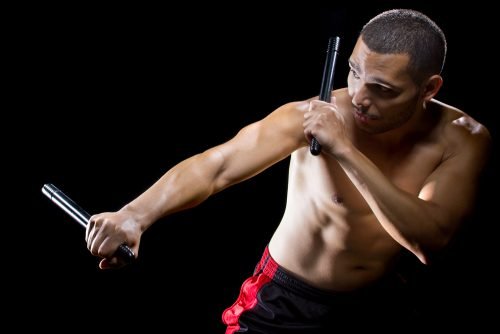
Arnis weapons training covers double baston (sinawali) for coordination and angles, plus solo and twin knife drills to sharpen timing, control, and close-range finishing.

Why Weapons-First Training Changes Everything

Weapons training accelerates learning. Reflexes sharpen, spatial awareness improves, and hesitation is punished immediately. Arnis builds precision and composure under threat, not comfort under rules.

Most martial arts begin with assumptionssport systems rely on referees and time limits, while many self-defence systems assume verbal escalation first. Arnis assumes none of this. It starts with the most dangerous variable: weapons in motion, at unpredictable range, under stress. From there, distance, angles, and timing become survival skills, and empty-hand work remains a continuation of the same problem, not a separate domain.

🪵 From Stick to Survival

One of Arnis’ great strengths is how easily it scales. Single stick, double stick, blade, mixed weapons—once the angles and footwork are understood, the system stays coherent.

The stick lets dangerous ideas be trained safely, building coordination, grip strength, forearm endurance, and conditioning without live blades. With repetition, blocks, counters, checks, and disarms shift from conscious choices to reflex.

Weapons aren’t fetishised in Arnis—they sharpen awareness. The real advantage is perception: reading distance, intent, and timing before damage occurs.

⚔️ The Weapons of Filipino Martial Arts

Weapons are not accessories in Arnis — they are the starting point. Filipino Martial Arts developed in a blade-oriented culture where carrying a weapon was normal and unarmed fighting was often a contingency rather than a preference. As a result, tools are treated with respect, familiarity, and technical depth.

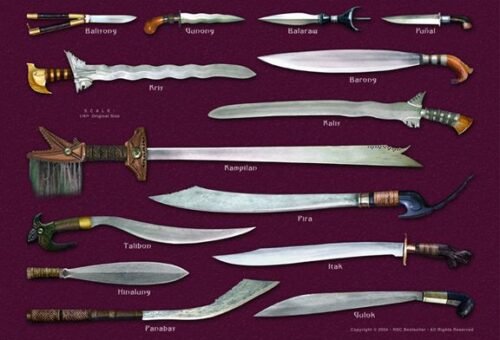
Arnis weapons vary widely in blade length, shape, and purpose—from short daggers to long chopping blades—reflecting regional needs, terrain, and function.

Click on links below to read more on some of the weapons found in FMA.

The baston (rattan stick) is the most recognisable weapon in Arnis, not because it is symbolic, but because it is practical. Lightweight, durable, and safe enough for live training, it allows practitioners to train speed, timing, and impact without bladed consequences.
Single-stick training forms the foundation, while Doble Baston develops ambidexterity, coordination, and flow under pressure. The same angles, footwork, and hand mechanics apply regardless of whether one or two weapons are used.

Bladed weapons sit at the heart of FMA. Historically, knives and machete-style tools were everyday items — carried for work, travel, and defence. Training reflects this reality.
Weapons such as the bolo, kris, balisong, and karambit are not treated as exotic artefacts, but as functional tools with specific handling characteristics. The emphasis is not on collecting techniques, but on understanding range, targeting, and consequences. Blade awareness informs everything — including how Arnis approaches distance, footwork, and limb control.

Weapons in Arnis are neither romanticised nor avoided. They are respected. Training acknowledges that blades change the nature of violence instantly, which is why principles like defanging the snake exist — neutralising the weapon-bearing limb rather than trading strikes.
This mindset carries through to improvised weapons as well. Batons, pipes, tools, and everyday objects are treated as extensions of the same logic. The weapon itself matters less than how it is used.
In Arnis, weapons are not about dominance or intimidation. They are about responsibility, awareness, and efficiency — understanding that distance, timing, and intent matter more when consequences are immediate.

🥋 Empty Hand, Same Principles

Empty-hand Arnis (Mano Mano) is not taught as a separate system. It grows directly out of weapons training. The same movements used with a stick or blade are simply performed with the hands when a weapon is lost or unavailable.

Hands are trained to function like weaponsdirect, economical, and purpose-driven. Every strike, parry, and counter follows the same angles, footwork, and timing used with sticks or knives. The tool changes, but the underlying structure does not.

Mano Mano is Arnis at clinch range—striking, trapping, off-balancing, and finishing when the weapon is gone and it’s hands-on.

🖐️ The Live Hand

A defining feature of Arnis is the live hand — the non-weapon hand used to trap, check, disarm, or strike. It’s never passive. Whether armed or unarmed, the live hand maintains control of the opponent’s weapon, space, and timing. This dual-hand coordination turns Arnis into one of the most complete close-quarters systems in the world.

Training Mano Mano refines reflexes, balance, and spatial control. Practitioners learn to close distance, counter strikes, and transition instantly from armed combat to grappling or takedowns. The goal isn’t to trade blows — it’s to end the fight fast through precision, control, and economy of motion.

The live hand is Arnis’ second weapon—checking, trapping, controlling, and clearing lines while the weapon hand strikes.

💥 Efficiency Over Flash

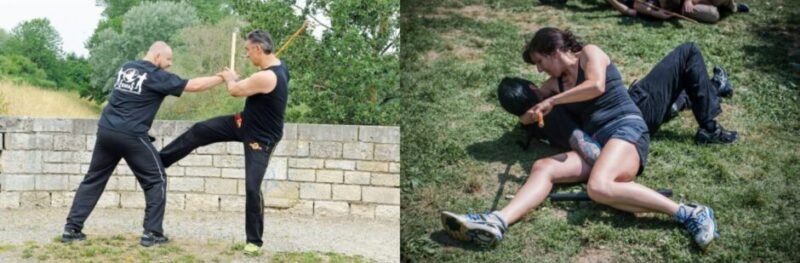
Unlike systems that rely on high kicks or elaborate forms, Arnis keeps every movement grounded in practicality. Low-line kicks, joint strikes, and limb destructions dominate the Mano Mano arsenal. These aren’t moves for show — they’re designed to disable, break structure, and create an opening to escape or finish.

Because the same mechanics apply across all ranges, Arnis builds true adaptability. Whether holding a stick, a knife, or nothing at all, the Arnisador moves with one seamless language of motion.

Arnis keeps it practical—low-line kicks, limb destructions, and takedowns built to break structure fast, using the same mechanics across every range and weapon.

🧠 Decisive Mindset, Minimal Waste

Arnis assumes any opponent may be dangerous. Training conditions practitioners to expect threat, act early, and respond decisively. Hesitation is treated as a liability, not a pause.
Movement reflects that mindset. Strikes are direct, economical, and purpose-driven. There is no telegraphing and no excess motion — actions are designed to disrupt structure quickly while conserving energy. The aim is not to trade techniques, but to end danger efficiently and move on.

🦵 Kicking in Arnis – Low, Direct, Functional

Unlike martial arts that prioritise high or acrobatic kicks, Arnis keeps kicking low and purposeful. The goal isn’t display — it’s disruption. Targets are chosen for reliability: groin, thighs, knees, shins, ankles, feet, and toes. Kicks are used to damage structure, interrupt movement, or create an opening rather than to score or trade blows.

Common applications include:

  • Heel smashes: Driving the heel into joints or soft tissue to disrupt movement.
  • Low-line kicks: Fast, damaging kicks aimed at the legs to reduce mobility.
  • Toe kicks: Precise strikes to vulnerable targets at close range.
  • Trips and sweeps: Used to destabilise and set up rapid follow-ups.
  • Stomps and knee strikes: Designed to break balance and compromise structure.

In keeping with the rest of the system, Arnis kicking prioritises efficiency over range and control over spectacle. The objective is simple: take away movement, create an opening, then disengage.

📐 Angles, Flow, and Range

Arnis views combat geometrically. Strikes follow defined lines — commonly taught as 12 angles of attack — covering every plausible direction of threat. Once internalised, fighters stop reacting emotionally and start responding structurally.

Ranges of Combat

  • Largo (Long Range): Weapon reach, footwork, evasion.
  • Medio (Medium Range): Checking, trapping, limb control.
  • Corto (Close Range): Clinch, breaks, takedowns, Mano Mano.

A skilled Arnisador flows between these ranges without pause, using footwork to dictate distance and tempo. Defence becomes counter-attack in a single motion.

🌊 Flow and Timing

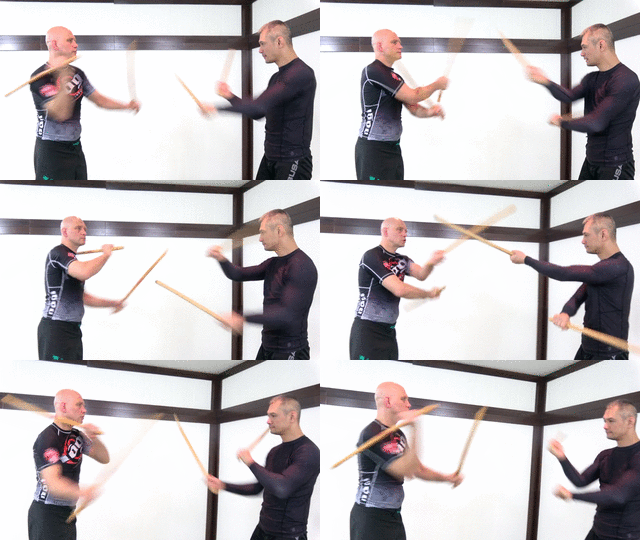
Arnis drills like Sinawali (“to weave”) develop timing, coordination, and rhythm. The continuous weaving pattern teaches how to switch between offense and defence instinctively. Over time, these drills become more than repetition — they build the flow state that defines Filipino martial arts: awareness without thought, reaction without hesitation.

In Arnis, rhythm is everything. Flow beats force, and timing beats speed. Once you master movement, the opponent’s weapon, size, or strength stop mattering.

Sinawali drills build timing, coordination, and ambidexterity—training Arnis angles and flow until offence and defence become automatic.

🐍 Defanging the Snake

One of the most feared concepts in Arnis is “defanging the snake” — the idea of neutralising a threat by attacking the weapon limb instead of blocking it. Rather than stopping an incoming strike, the Arnisador targets the hand, wrist, or forearm, breaking bones, cutting tendons, or disarming instantly.

It’s simple anatomy and ruthless logic: destroy the hand that holds the weapon, and the weapon no longer matters. This approach trains pre-emptive action, precision, and calm aggression. Practitioners learn to read intent early and respond decisively — not after damage is already inbound.

⚡ Target the Source, Not the Strike

In real combat, hesitation is costly. Arnis prioritises pre-emptive, decisive action — countering before an attack is completed rather than absorbing it defensively. By targeting the source of the threat early, practitioners reduce chaos instead of managing it.

Training reinforces this mindset through repetition and pressure. Over time, distance recognition and targeting become automatic — the body responds before conscious analysis has time to interfere.

🇵🇭 Training the Filipino Way

Arnis training is pragmatic. There are no ritualised forms for their own sake. Drills exist to build attributes that survive stress.

Sessions emphasise footwork, angles, reaction drills, and progressive resistance. As skill improves, training becomes increasingly livecontrolled sparring with sticks, protective gear, and minimal rules. The aim is composure in chaos, not point-scoring.

Arnis. FMA. Filipino Martial Arts. Escrima. Kali. World Martial Arts.

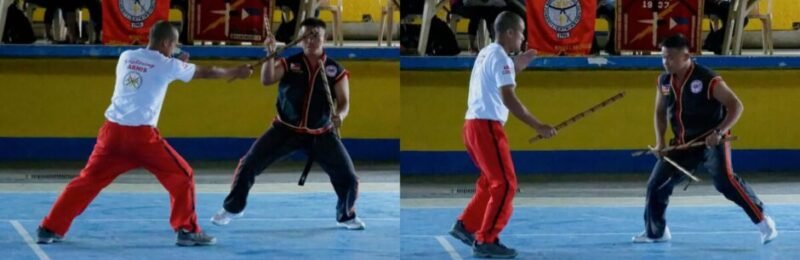
One of the most important practices in classical Arnis was dueling, without any form of protection. In rural areas throughout the Philippines today, modern Arnis matches are still held in dueling arenas. Thankfully most modern Arnesadores stick to in-class sparring.

💪 Conditioning and Combat Fitness

Arnis is deceptively demanding. The repetitive striking patterns develop forearm and shoulder strength, while the fast-paced drills boost cardiovascular endurance. Footwork and evasive movement build leg stamina and balance, and sparring adds a layer of functional conditioning under fatigue.

It’s fitness built for survivalfast, reactive, and adaptable. Whether for combat readiness or general conditioning, Arnis builds a fighter’s engine: speed, stamina, and composure under stress.

The kris (keris) is a Javanese dagger, often wavy-bladed, used in Arnis and Pencak Silat—and traditionally regarded as a talisman with spiritual power.

🧍‍♂️ Arnis for Self-Defence

Weapon Awareness and Survival Instinct

Few martial arts prepare you for the chaos of real violence like Arnis.

It isn’t built for points, medals, or forms — it’s built for survival. Every movement is designed to end danger quickly, whether that means disarming, escaping, or disabling an attacker.

Click on links below to read more on the self defense benefits of FMA.

Arnis assumes reality, not fairness. Opponents may be larger, stronger, intoxicated, armed, or multiple. There are no referees and no clean starts.

That’s why training begins with weapons-first principles. From the moment you pick up a baston, knife, or improvised object, you learn to manage range, angle, and timing before strength ever comes into play. Every drill builds instinct — how to control space, interrupt attacks, and neutralise threats before they fully unfold.

Unlike sport-based systems that rely on rules or pauses, Arnis conditions you for close quarters, sudden escalation, and weapon awareness under stress. The drills replicate chaos, not choreography.

The heart of Arnis is composure rather than aggression. Training is designed to work under speed, resistance, and adrenaline. Over time, this rewires how you respond to threats. Instead of freezing or overcommitting, you learn to recognise danger early, move decisively, and act when it counts.

Arnis doesn’t encourage prolonged exchanges. It favours early disruptionbreaking rhythm, damaging structure, or creating space to disengage. The objective isn’t dominance; it’s ending danger and staying intact.

Arnis doesn’t rely on size or brute strength. It’s built around attributes anyone can develop: awareness, timing, accuracy, and adaptability.

Its effectiveness comes from how it functions across all ranges:

  • Long range: Using sticks, pipes, or improvised tools to manage distance.
  • Mid range: Trapping, checking, and weapon control.
  • Close range: Mano Mano, joint breaks, takedowns, and clinch work.
  • Environmental use: Walls, furniture, terrain, and available objects.

Weapons-first training builds immediate understanding of threat range and angles. Live, reactive drills develop instinctive responses under pressure. There’s no wasted motion and no theatrical techniqueefficiency beats flair.

Whether the threat is armed or unarmed, Arnis trains you to counter early, reduce chaos, and prevent escalation rather than manage damage after the fact.

Arnis isn’t about domination — it’s about control and survival.

Training develops:

  • Recognising danger before it escalates.
  • Reacting decisively under adrenaline.
  • Adapting instantly if disarmed or outnumbered.
  • Using improvised weapons — bottles, belts, pens, everyday objects.
  • Staying explosive under fatigue and stress.

Principles like defanging the snake and flow training reinforce one core idea:
Target the source of danger early and prevent escalation before it compounds.

Arnis doesn’t promise safety or dominance. It teaches preparedness.

Training increases capacity, not entitlement. Awareness, avoidance, and disengagement remain the preferred outcomes whenever possible. Force is treated as a last resort, guided by judgment rather than ego.

When violence does occur, Arnis provides a framework to stay functional — to move first, act decisively, and leave on your feet.

Practitioners of the Arnis are commonly called ‘Arnisador’ (male) ‘Arnisadores’ (prl) or ‘Arnisadora’ (female), or ‘Arnisadoras’ (plural). Some prefer the terms ‘Eskrimador’ (male, plural ‘Eskrimadores’) or ‘Eskrimadora’ (female, plural ‘Eskrimadoras’).

✅ Pros – Why Arnis Works

Weapons-first training builds real-world awareness from day one.
Versatile system — transitions easily between weapons, empty hand, and improvised tools.
Full-body coordination develops athletic balance, timing, and reflex speed.
Functional conditioning improves grip strength, shoulder endurance, and reaction under fatigue.
Practical for self-defence — trains realistic violence, not sport assumptions.
Cognitive benefits — left-right patterning sharpens focus, awareness, and adaptability.
Cultural depth — connects practitioners to the rich warrior heritage of the Philippines.

❌ Cons – The Trade-Offs

Limited ground work — lacks submissions or grappling beyond basic takedowns.
Training quality varies — some schools prioritise stick drills over full combative context.
Protective gear dependence in sport Arnis can mask real impact and timing.
Few live weapon sparring opportunities outside advanced or military settings.
Requires cross-training for complete MMA or ground control proficiency.

💪 Health and Fitness Benefits

Arnis is physically demanding in ways that are difficult to replicate in conventional training. The constant striking, footwork, and reactive drills create a form of conditioning built around movement, coordination, and sustained effort rather than isolated strength.

Escrima drills and sparring can provide an excellent full body workout.

Click on links below to read more on the health benefits of training in FMA.

Training sessions are fast-paced and continuous. Footwork drills, striking combinations, and sparring place sustained demands on the heart and lungs, improving aerobic capacity and recovery under fatigue. Double baston work in particular is deceptively taxing, forcing the upper and lower body to work continuously under coordination stress.

Weapons-based training places consistent load on the hands, wrists, and forearms. Over time, this develops strong grip endurance, joint stability, and tissue resilience — qualities that carry over into both combat and everyday physical tasks. The circular striking patterns and figure-eight movements also promote shoulder mobility and durability rather than rigid strength.

Arnis demands constant hand-eye coordination and bilateral movement. Drills progress from controlled patterns to live, reactive exchanges, sharpening reflexes, timing, and decision-making. The body learns to move efficiently under pressure, improving balance, spatial awareness, and reaction speed.

While Arnis is not a replacement for resistance training, it builds functional strength through multi-directional movement. Striking, footwork, and clinch work engage the core, hips, and lower body continuously, reinforcing balance, posture, and controlled power generation.

Perhaps its most overlooked benefit is neurological. Training under speed, resistance, and contact conditions the nervous system to remain functional under stress. Practitioners learn to regulate adrenaline, maintain focus, and act decisively rather than freeze or panic.
Arnis does not train the body for appearance. It conditions it for output, control, and endurance — the kind that holds up when fatigue and pressure are real.

🏁 Final Thoughts – Why Train Arnis

Arnis endures because it works under pressure. It develops awareness, timing, and decision-making that transfer directly into real-world self-defence and functional athleticism.

It is fully integrated: weapons, empty-hand work, clinch, and movement follow the same principles, building adaptability rather than dependence on rules or ideal conditions. As training, it develops coordination, grip strength, footwork, endurance, and composure without relying on size or ego.

Arnis has earned global respect because of its relevance. Its influence across modern combatives, law enforcement, and professional martial arts reflects a system that remains effective when pressure is real.

It is not defined by tools or tradition, but by what continues to work when conditions turn hostile. For those willing to train honestly, Arnis offers something rare: competence — the ability to stay composed, act decisively, and remain functional when others falter.

If you have enjoyed this post please share or feel free to comment below 🙂

Related Posts

Our Other Posts

Leave a Reply

Your email address will not be published. Required fields are marked *

This site uses Akismet to reduce spam. Learn how your comment data is processed.

error: Content is protected !!

Join the Super Soldier Project Mailing List Today!!