An Introduction to Steel Mace Training

Steel mace training, rooted in ancient warrior traditions, offers a unique and powerful way to build functional strength, enhance mobility, and improve overall fitness. This post delves into its rich history and explores the benefits of incorporating this type of dynamic training into your weekly workouts.

Table of Contents

Introduction

Steel mace training is a form of functional fitness that involves using a steel mace (also known as a macebell), which is a long, weighted bar with a heavy, ball-shaped end. This type of training is rooted in ancient warrior training techniques, particularly from India, where the gada (a traditional mace) has been used for centuries.

The macebell is a long-handled strength training tool with an off-center weighted head, designed to challenge grip, core stability, and functional movement through dynamic swinging exercises.

The design of the macebell, with its uneven weight distribution, challenges your grip strength, core stability, and overall body coordination. Exercises with the steel mace often involve swinging motions, rotational movements, and full-body dynamic exercises, making it an excellent tool for developing strength, power, endurance, and mobility.

Macebells come in various sizes and weights, typically ranging from light (5-10 lbs) for beginners to heavy (20-30+ lbs) for advanced users, allowing for progressive training tailored to different strength levels and exercise goals.

History and Origins

Steel mace training has a rich history that dates back centuries, with its origins deeply rooted in ancient warrior cultures, particularly in India. Here’s an overview of its historical development and how it evolved into the modern fitness practice we know today.

🇮🇳 Ancient India – Home of the Gada

The modern steel mace traces its origins to the gada, a traditional weapon and training tool used in ancient India.

Constructed from wood or metal, with a long handle and weighted spherical head, the gada created uneven resistance that challenged stability and control.

Click on the links below for more on Indian traditions and Steel Mace training.

The gada was widely used by Indian warriors and pehlwani wrestlers, forming a core part of their training.

Training developed:

  • Shoulder endurance.
  • Grip strength.
  • Core stability.

These qualities supported grappling, striking, and sustained combat.

In traditional wrestling schools known as akharas, the gada was a foundational tool.

Athletes performed repetitive swinging drills to build:

  • Strength under fatigue.
  • Movement efficiency.
  • Mental resilience.

Training was intense and consistent, built around repetition and load.

The gada holds deep symbolic value in Hindu mythology, most notably through Hanuman, the warrior deity of the Ramayana.

He is commonly depicted wielding a gada, representing:

  • Strength.
  • Loyalty.
  • Unyielding power.

It was not just a weapon, but a symbol of discipline and warrior spirit.

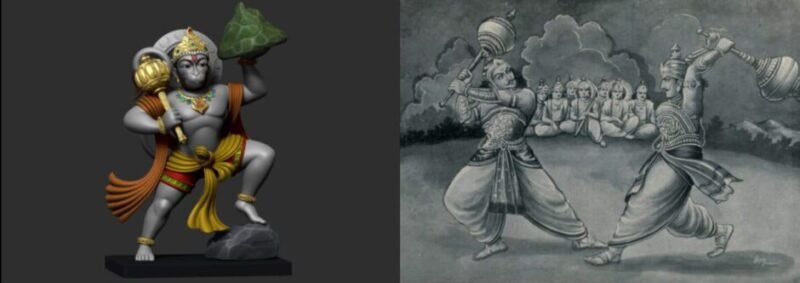
In Indian mythology, the gada stands as a powerful symbol of immense strength, famously wielded by legendary figures such as Hanuman (left), the revered monkey god known for his heroic deeds and unwavering devotion, and Bhima (right), the formidable warrior in the Mahabharata.

🇮🇷 Ancient Persia – The Meel and Warrior Tradition

A similar approach developed in ancient Persia through the meel, a traditional club used in Pahlevani training systems. While different in shape, its purpose mirrored the gada—developing strength, endurance, and control through movement.

Click on the links below for more on Iranian influences in Steel Mace training.

Meel training is central to Pahlevani, a system combining strength work, martial practice, and ritual discipline.

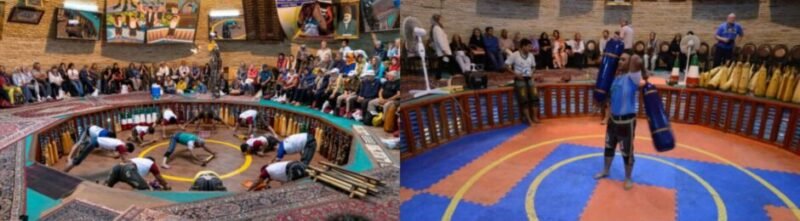
Sessions take place in the Zurkhaneh (“House of Strength”), a sunken training space where athletes train using:

  • Meels (clubs).
  • Sang (shield-like weights).
  • Kabadeh (bow-shaped resistance tools).

Training is structured and rhythmic, blending physical conditioning with cultural identity.

The meel was not a weapon, but a conditioning tool for warriors.

It developed:

  • Shoulder endurance.
  • Rotational power.
  • Grip strength.

Like the gada, it prepared fighters for sustained engagement.

Beyond physical training, Pahlevani emphasised:

  • Discipline.
  • Humility.
  • Moral strength.

The practice shaped both physical capability and character, embedding it within Persian culture.

Iranian Zoorkhaneh training.

⚔️ Gada vs Meel – Shared Purpose, Different Worlds

The gada and meel share clear similarities, but developed in distinct cultural and martial systems.

Both tools were used to develop:

  • Functional strength through swinging movements.
  • Shoulder endurance and resilience.
  • Grip strength and rotational power.

The aim was the same—build bodies capable of handling sustained physical stress.

The gada is rooted in Indian wrestling culture and mythology, closely tied to Hanuman and the akhara system.
The meel belongs to Persian Pahlevani traditions, embedded in the Zurkhaneh’s ritual framework.

One is tied to mythology and wrestling culture.
The other to ritualised training and moral philosophy.

There may be overlap through Central Asian warrior cultures, including the Mongols, Turks, and Timurids.

These groups valued:

  • Functional strength.
  • Weapon control.
  • Combat conditioning.

As they moved across regions, they may have influenced the use of mace-like tools in both India and Persia.
Direct historical links remain unclear.

Both traditions influenced modern steel mace and club training.

What remains is a blend of:

  • Indian gada strength principles.
  • Persian rotational training systems.

Different origins. Same outcome—resilient shoulders, brutal grip, and strength that carries over to real-world movement.

Adoption in Western Fitness: The Birth of Modern Steel Mace Training

While the gada has existed in India for thousands of years, it only entered Western training culture in the late 20th and early 21st centuries, as coaches began exploring non-traditional methods for functional strength.

Today, steel mace training is widely used across strength and conditioning, rehabilitation, and sports performance.

Click on the links below for more on Modern Steel Mace training.

The adaptation of the gada into the steel mace we see today began as fitness enthusiasts sought new and effective ways to build functional strength. The steel mace, with its durable construction and standardised weights, was designed to be more accessible and versatile for modern fitness settings.

Coaches and fitness experts in the West, such as Rick Brown, played a significant role in popularising steel mace training. These pioneers introduced the practice to a broader audience, demonstrating the benefits of mace exercises for building strength, mobility, and endurance.

The rise of functional fitness in the 2000s, with its emphasis on movements that mimic real-life activities, further boosted the popularity of steel mace training. It appealed to athletes, martial artists, and fitness enthusiasts looking for more dynamic and full-body workouts.

Steel mace training is utilised in different settings, from CrossFit gyms to martial arts studios, and even in physical therapy. The unique mechanics of the mace, particularly its focus on rotational and anti-rotational movements, make it a valuable tool for improving core strength, stability, and overall athletic performance.

While modern steel mace training has evolved, it still honours its roots in the ancient practice of gada training. Many practitioners see it not just as a physical workout but also as a way to connect with a long tradition of warrior training, blending the old with the new.

The popularity of steel mace training continues to grow, with more people appreciating its benefits for building functional strength and enhancing mobility. Online communities, instructional videos, and workshops have made it more accessible, allowing people around the world to incorporate this ancient training method into their fitness routines.

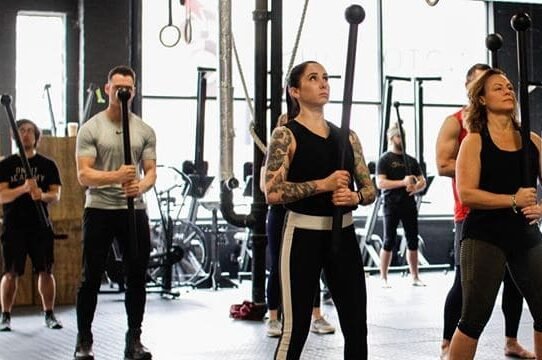
Modern steel mace training was introduced to the West by pioneers like Rik Brown (left), and it has since gained widespread popularity, with dedicated classes and training programs now being offered in gyms and fitness studios around the world.

Steel mace training is a modern evolution of the ancient Indian practice of gada training, brought into contemporary fitness as a versatile and effective tool for building functional strength, conditioning, and mobility. Its history is a testament to the enduring value of traditional training methods, adapted to meet the needs of today’s athletes and fitness enthusiasts.

Benefits

Steel mace training offers several unique benefits compared to other forms of functional training, primarily due to the distinctive design and mechanics of the macebell. Here are some key advantages:

1. Improved Grip Strength

The uneven weight distribution of the mace challenges your grip more than many other functional training tools. This constant demand on your grip can lead to significant improvements in grip strength, which is essential for various sports, daily activities, and other forms of resistance training.

Macebell workouts are particularly effective for improving grip strength, an often overlooked but crucial aspect of overall fitness that supports everything from lifting performance to daily tasks.

2. Enhanced Core Stability and Strength

The off-centre weight of the mace requires continuous engagement of your core to stabilise and control the movements. This leads to improved core strength and stability, which is crucial for overall body balance and injury prevention, especially in dynamic or rotational activities.

Macebell workouts are highly effective for building core strength due to the constant need to stabilize and control the uneven weight distribution during dynamic movements.

3. Increased Rotational Power

Mace training involves a lot of rotational movements, such as swings and twists, which are less emphasised in other forms of functional training. These movements help develop rotational power, which is beneficial for athletes involved in sports like tennis, golf, baseball, and martial arts.

Rotational movements in macebell workouts help enhance core stability, improve functional strength, and increase overall mobility, making them highly effective for real-world physical activities.

4. Full-Body Conditioning

Macebell exercises often engage multiple muscle groups simultaneously, offering a comprehensive full-body workout. This not only improves muscle coordination but also increases calorie expenditure, making it effective for conditioning and fat loss.

Macebell workouts provide full-body conditioning, effectively targeting multiple muscle groups while improving overall strength and endurance.

5. Functional Strength and Mobility

The dynamic and multi-planar nature of macebell training mirrors real-life movements, enhancing functional strength. Additionally, the flowing, swinging motions promote joint mobility, particularly in the shoulders, hips, and spine, which can be a great complement to more rigid, linear exercises like deadlifts or squats.

6. Improved Shoulder Health

The mace’s swinging exercises, like the 360s and 10-to-2s, are excellent for shoulder mobility and stability. These exercises can help improve shoulder joint health and reduce the risk of injuries, which is particularly beneficial for those who have previously suffered from shoulder issues.

Macebell workouts are excellent for shoulder health, promoting increased mobility, stability, and strength while helping to prevent injuries.

7. Mental Focus and Coordination

The complexity of many macebell exercises requires a high level of mental focus and coordination. As you learn to control the mace through different planes of motion, your neuromuscular coordination improves, which can translate into better performance in other physical activities and sports.

Macebell workouts demand a high level of mental focus and concentration to maintain control and execute movements with precision.

8. Versatility and Minimal Equipment

A steel mace can be used for a wide variety of exercises, making it a versatile tool for functional training. Its compact size also makes it easy to use in small spaces or to take with you when travelling, providing a highly efficient and portable workout option.

9. Injury Prevention

Because steel mace training emphasises functional movement patterns and core stability, it can help correct muscle imbalances and improve overall movement quality. This can contribute to injury prevention, particularly in sports or activities that involve a lot of rotational or asymmetrical movements.

10. Engaging and Fun

Macebell training can be a refreshing and engaging alternative to traditional weights or bodyweight exercises. The unique movements and the challenge of mastering them can keep workouts interesting, which is important for maintaining long-term motivation and adherence to a fitness routine.

Macebell workouts are not only challenging but also add a fun, dynamic twist to your exercise routine, keeping things fresh and engaging.

While other forms of functional training offer their own benefits, steel mace training stands out for its emphasis on grip strength, rotational power, core stability, and overall functional movement, making it an excellent tool for developing a well-rounded, resilient body.

Starting Out

Choosing the right weight for steel mace training depends on several factors, including your experience level, strength, and the type of exercises you plan to perform. Here’s a general guideline to help you select the appropriate weight:

1. Beginners

  • Women: 5-10 lbs (2-4.5 kg).
  • Men: 10-15 lbs (4.5-7 kg).

For those new to mace training, it’s recommended to start with a lighter mace. Even though these weights might seem low, the uneven distribution and the dynamic nature of mace exercises make the movements challenging. Starting lighter allows you to focus on form, control, and mastering the movements without risking injury.

2. Intermediate

  • Women: 10-15 lbs (4.5-7 kg).
  • Men: 15-20 lbs (7-9 kg).

Once you’ve developed good technique and are comfortable with the movements, you can gradually increase the weight. Intermediate users can handle slightly heavier maces, which will further challenge your strength, endurance, and stability.

3. Advanced

  • Women: 15-20 lbs (7-9 kg).
  • Men: 20-30 lbs (9-14 kg).

For advanced users who have mastered the macebell movements and built up significant strength and stability, heavier maces can be introduced. These weights are more suitable for experienced practitioners performing more complex and powerful movements like 360s, 10-to-2s, or more intense full-body exercises.

4. Specialised Training

For some exercises, such as single-arm movements, presses, or exercises that require a high degree of control and precision, you might want to use a lighter mace, even if you’re advanced. Conversely, for exercises that involve lower body strength, such as squats or lunges, a heavier mace might be appropriate.

By starting with an appropriate weight and gradually progressing, you’ll build strength, stability, and proficiency in steel mace training while minimising the risk of injury.

Basic Exercises

Some common exercises in macebell training include:

  1. 360s and 10-to-2s: These are traditional swinging exercises where you swing the mace in a controlled arc around your head, engaging your shoulders, core, and grip.
  2. Lunges and Squats: Incorporating the mace into lunges and squats adds an additional stability challenge due to the uneven weight distribution.
  3. Presses and Rows: These exercises work the upper body and can be done in various stances to engage different muscle groups.
  4. Mace Slams: Similar to medicine ball slams, but with the mace, adding a rotational element to the movement.
  5. Core Work: Holding the mace in different positions while performing core exercises strengthens the core and improves stability.

Summary

Incorporating steel mace training into your fitness routine offers a unique way to build functional strength, enhance mobility, and boost overall conditioning. Rooted in ancient warrior traditions, this dynamic workout challenges your body in ways that traditional exercises often overlook. By starting with the right weight, focusing on form, and gradually progressing, you can safely integrate steel mace exercises into your weekly regimen. As you grow more proficient, you’ll notice improvements in strength, endurance, coordination, and mental focus, bringing new energy and variety to your fitness routine.

Purchasing Macebells (US/UK/Worldwide)

Interested in your own macebell? For the US and UK see below, these are the well known brands there that I have dealt with and are recommended.  For the rest of the world, try the Amazon global page. There are many good dealers of steel maces available (I bought my first steel mace on there).

United States

Rest of the World

If you have enjoyed this post please share or feel free to comment below 🙂

Related Posts

Our Other Posts

Leave a Reply

Your email address will not be published. Required fields are marked *

This site uses Akismet to reduce spam. Learn how your comment data is processed.

error: Content is protected !!

Join the Super Soldier Project Mailing List Today!!