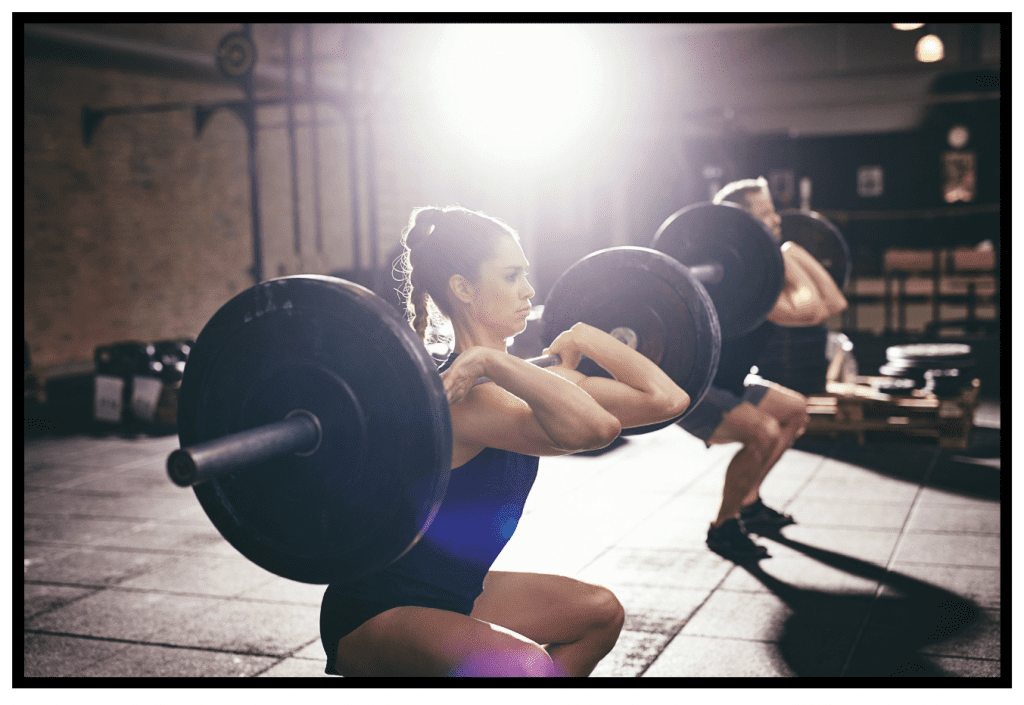
Want more strength, more muscle, and real-world power from your training? This two-part series breaks down why compound lifts work — and how to apply them for consistent results.
Table of Contents
👑 The Basics: What Makes Compound Lifts King
Before diving into the deeper benefits, it’s crucial to understand what compound lifts actually are — and why they form the backbone of effective strength training. This section defines the core principles and explains what sets compound movements apart from isolation work.
🔥 Introduction
Compound exercises are the backbone of real-world strength and functional movement. They recruit multiple joints and interconnected muscle chains, training the body as a unified system instead of isolating single muscles. This makes them the most efficient and highest-return strength training you can do.
Lifts like the deadlift, squat, bench press, and row mirror the way humans naturally move — lifting, carrying, pushing, pulling, and bracing under load. That’s why they build strength that transfers into sport, combat, manual work, and everyday life.
This is a two-part series on compound training. Part 1 explains what compound exercises are and why they matter — from joint health and neural development to strength progression and real-world performance. Part 2 shows how to apply those principles — structuring your training, applying progressive overload, and building a compound training programme that delivers consistent results.
📌 Key Takeaway: Compound lifts build usable strength — power and control that goes far beyond the gym.
🧩 What Exactly Is a Compound Exercise?
A compound exercise is any movement that requires multiple joints and major muscle groups to work together as one coordinated system. These lifts usually involve free weights or bodyweight, and they mirror natural human movement patterns like squatting, hinging, pushing, pulling, and carrying.
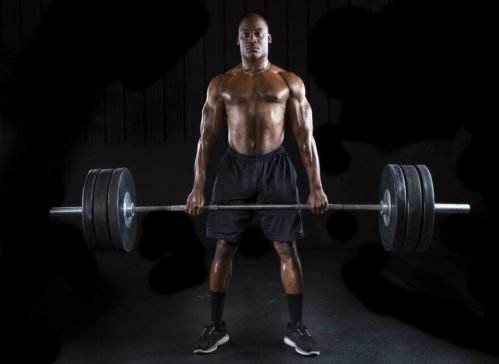
The Hex bar deadlift. A compound lift requiring many muscle groups to work together.
Classic compound lifts include the deadlift, squat, bench press, barbell row, and overhead press — all foundational to building strength that transfers beyond the gym.
📌 Key Takeaway: Compound lifts train movements, not just muscles — developing strength you can actually use.
❓ Why Are They Important?
Compound vs Isolation — The Key Difference
Resistance training movements fall into two primary categories:
Isolation exercises: Single-joint movements targeting a small, specific muscle group (e.g. biceps curls, triceps pushdowns, leg extensions).
The Deadlift takes on the biceps curl. Which exercise gives the most bang for its buck?
Both approaches have value — but compounds deliver far greater performance and strength return for your time and effort.
🏋️ Why Compound Lifts Outperform Isolation Work
Compound exercises provide advantages that isolation work simply cannot match:
More total muscle recruitment → stronger strength adaptations.
Better motor coordination across multiple joints.
Increased joint stability and structural resilience.
Higher metabolic demand and energy expenditure.
Direct carryover to sport, labour, and everyday movement.
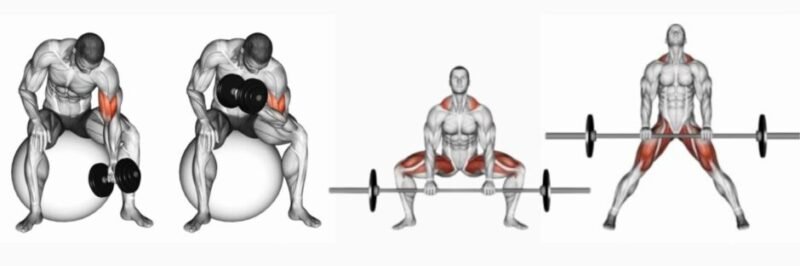
The biceps curl (left) isolates a single muscle through one joint, while the sumo deadlift (right) engages multiple joints and major muscle groups to develop full-body strength.
For these reasons, compound movements should be prioritised at the start of a training session — when energy levels, focus, and nervous system readiness are highest.
📌 Key Takeaway: Build your programme on compounds — isolation lifts polish the edges, but compounds build the foundation.
💪 Stronger Everywhere
Strength isn’t useful if you can’t apply it. This section explores how compound lifts improve movement quality, joint stability, muscular balance, and real-world capability — giving you strength that works anywhere, not just under gym lighting.
💪 Joint Involvement and Muscle Group Recruitment
Compound exercises make multiple muscle groups generate and stabilise force together. As the prime movers drive the lift, the stabilisers work to control every joint involved — creating balanced, powerful strength that holds up under real conditions.
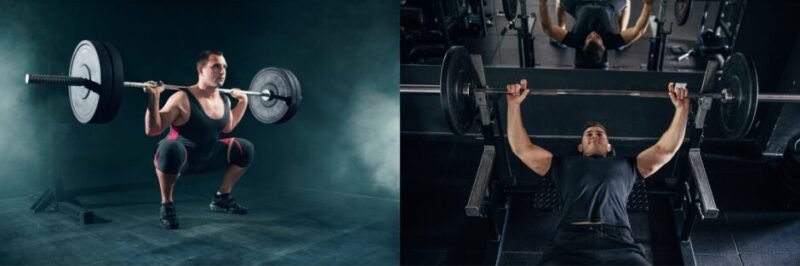
Example: Front Squat (Above Left) Recruits the glutes, hamstrings, quadriceps, and a deeply braced core to control the spine and hips under load.
Example: Bench Press (Above Right) The pectorals deliver the force, while the triceps, deltoids, and core maintain alignment and stability throughout the lift.
This coordinated activation strengthens the entire kinetic chain, reducing muscular imbalances and improving joint resilience. Over time, tendons, ligaments, and deep postural muscles become stronger and more capable of handling unpredictable force.
Whether you sprint, grapple, lift at work, or simply move through daily life — this is strength that stands up to pressure, fatigue, and impact.
📌 Key Takeaway: Compound lifts build strong, stable strength that protects your joints and performs when intensity rises.
🧱 Core Involvement
Every major compound lift demands a braced, powerful core to stabilise the spine and transfer force between the hips and upper body. When the core is engaged, power moves efficiently. When it fails, force leaks and joints take stress they weren’t built to handle.
Compound lifts train the core the way it’s designed to function:
Bracing under load.
Resisting rotation.
Maintaining control through movement.
The overhead squat (great core involvement for stability and to power the move) Vs the leg extension (little of no core involvement).
Machines remove this challenge by providing stability for you — meaning the core contributes far less.
A strong core keeps the torsorigid, the spineprotected, and power connected — resulting in better posture, stronger athletic performance, and resilience in real-world movement.
📌 Key Takeaway: A strong core keeps your spine safe and your power connected — lift with stability, perform with confidence.
🌍 Real-World Carryover
Compound lifts build strength that actually shows up when life gets demanding. They reinforce the same patterns you rely on when you run, jump, lift, carry, brace, and fight for position under pressure.
Rugby demands more than raw strength — it requires powerful muscles, durable joints, and resilient ligaments to support explosive sprints and rapid changes in direction.
This means better:
Acceleration and changing direction at speed.
Impact control through the hips and legs.
Rotational power for striking and throwing.
Grip and stability when lifting or carrying awkward loads.
Strength you can express even when fatigued.
From sport to physically demanding work — this is strength that performs when the situation isn’t neat, controlled, or perfectly balanced.
📌 Key Takeaway: Compound lifts create usable strength — the kind you can rely on when the world pushes back.
🔧 Technique & Safety Fundamentals
Compound lifts create massive progress — but only if technique remains disciplined and consistent. Good form protects your spine, improves force transfer, and ensures every rep builds strength instead of bad habits.
Core principles for safe, effective lifting:
Neutral spine — Avoid excessive rounding or hyperextension. The spine should remain stable, not mobile, under load.
Braced core — Create intra-abdominal pressure before each rep to stabilise the torso and protect the lower back.
Stable base — Strong foot engagement provides the foundation for generating force during squats, hinges, and presses.
Efficient bar path — Keep the load close to the centre of mass to reduce torque and improve mechanical efficiency.
Technique before ego — End a set the moment form deteriorates. Poor reps build poor habits — and injuries.
Appropriate support — Use a spotter or safety system when lifting heavy on bench or squat. Warm up properly — not by loading the bar cold.
Compound lifts demand disciplined technique — stable posture, strong core engagement, and controlled movement to protect the spine and joints under load.
📌 Key Takeaway: Good technique is performance insurance — the only way to lift heavy for years, not months.
🔥 The Engine Room
What happens inside your body when you lift big? From neural efficiency to hormonal release and cardiovascular demand, this section reveals the internal systems that compounds upgrade — and why those changes lead to faster, more powerful progress.
📈 Better Strength Progression
Compound lifts allow multiple muscles to produce force together — which means you can lift heavier loads and expose your body to a far greater growth stimulus than isolation work ever could.
Big lifts like the deadlift, squat, and bench press recruit prime movers and stabilisers at the same time.
This creates:
Stronger overall force output.
Greater mechanical tension — the #1 driver of strength and hypertrophy.
More muscle fibres pushed to adapt each session.
They also make progressive overload intuitive. When the body adapts, you increase the challenge: The principle is simple: As you get stronger, increase the challenge — more load, more reps, more complexity.
📌 Key Takeaway: Compound lifts enable heavier loading and continuous progression — the fastest and most reliable route to getting stronger.
⚡ The Nervous System Advantage
Compound lifts train the central nervous system (CNS) to generate and coordinate force more efficiently. Your brain must recruit many muscles at once, stabilising the body while delivering power through the correct movement pattern.
This improves:
Motor unit recruitment — activating more muscle fibres when needed.
Rate of force development — producing power faster.
Intermuscular coordination — muscles working together more efficiently.
Movement precision under load and fatigue.
It’s also why strength increases often outpace visible muscle growth at first — the nervous system adapts before the muscle tissue does. Isolation exercises simply do not create enough systemic demand to trigger this level of neural development.
The result: more strength without needing more size — a major advantage for athletes who must stay fast, agile, and within a weight class.
📌 Key Takeaway: Compound lifts sharpen the nervous system — unlocking more power from the strength you already have.
❤️ Cardiovascular Benefits
Because compound lifts activate large muscle regions at once, your heart and lungs must work harder to deliver oxygen and remove fatigue by-products. Even moderate sets spike heart rate and improve conditioning alongside strength.
Increased cardiac output due to energy demands from major muscle groups.
This leads to improvements in:
Cardiac efficiency — stronger heart per beat.
Oxygen delivery and utilisation — better aerobic and anaerobic performance.
Tolerance to high-intensity efforts — less burning out mid-set.
Session density — more work in less time.
This carries into competition and real life — sprinting, stairs, grappling, and physical labour demand less effort and produce less fatigue.
📌 Key Takeaway: Compound lifts build the engine capacity needed to stay powerful when intensity rises.
🧬 Hormone Release
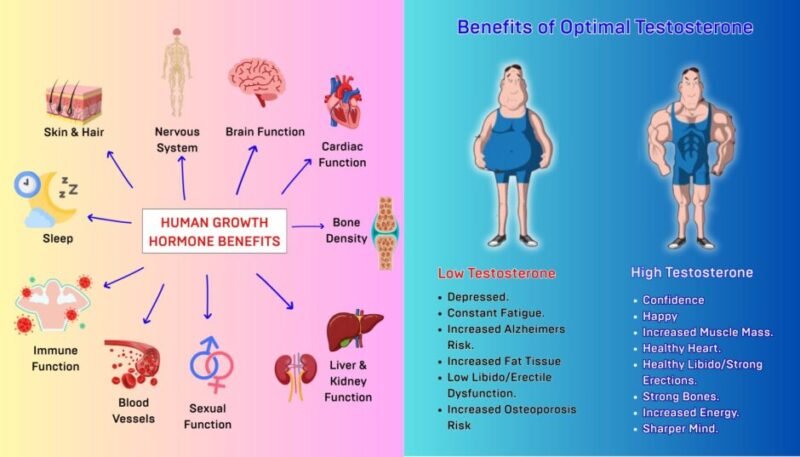
Heavy, multi-joint lifts push your body hard enough to trigger the release of power-building hormones like testosterone and growth hormone. These hormones increase the size and strength of the motor units you recruit — not just the ones you can see in the mirror.
Compound Training. Hormonal benefits.
You also get improvements in:
Recovery speed between sessions.
Explosive power and aggression under load.
Lean muscle gain with less wasted effort.
Lower body-fat levels at the same caloric intake.
Isolation lifts simply don’t stress enough muscle to create this level of adaptation.
📌 Key Takeaway: When the whole system is pushed, the whole system gets stronger — inside and out.
🏁 Final Thoughts
Compound lifts outperform isolation exercises in every way that affects performance. They improve movement efficiency, joint stability, and the internal systems that drive strength over the long term. More importantly, they develop usable power — the kind that doesn’t fade when you’re tired, reacting at speed, or under physical pressure.
The almighty deadlift! King of all resistance lifts!!
If you want to sprint faster, hit harder, lift smarter, and stay durable through the demands of sport and life, this is where your training begins. Machines and single-muscle movements can refine the details — but the foundation is built on full-body force production.