






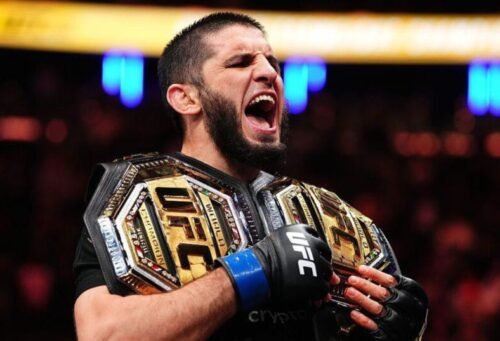
Made in Dagestan – The Islam Makhachev Workout

Welcome to the Islam Makhachev Workout. The seventh of our MMA Legend workouts. Based on the training regime of UFC double champion Islam Makhachev.

Want to skip the intro and go straight to the Islam Makhachev workouts? Click below!

Table of Contents

Introduction

Welcome to Made in Dagestan – The Islam Makhachev Workout.
The seventh entry in our MMA Legend series, this post explores the training principles behind one of the most dominant athletes in modern combat sports — and translates them into a structured strength and conditioning programme accessible to anyone drawn to this style of training.

🏔️ The Dagestani Method

Pressure Over Spectacle

Islam Makhachev’s success isn’t built on flash or chaos. His approach is defined by pressure, repetition, efficiency, and composure under fatigue — shaped by the harsh training culture of Dagestan, where endurance, control, and steady pace matter more than spectacle.

Before breaking down the training itself, this post briefly explores Makhachev’s journey from the mountains of Dagestan to the top of the UFC, touching on the foundations of his sambo-based grappling, the evolution of his striking, and the training philosophy behind his calm, suffocating style.

From Method to Training

This programme uses MMA-inspired striking drills, combinations, and wrestling-based conditioning to reflect the rhythm, pressure, and movement patterns of Makhachev’s training. The sessions are practical, demanding, and suitable whether you already train martial arts or are simply drawn to this style of athletic preparation.

Alongside this, the plan includes functional strength, structured cardio, and two full-spectrum core sessions, developing the physical qualities behind Makhachev’s approach: strong hips, endurance, positional strength, and calm output under fatigue.

Made in Dagestan reflects that method. Grind-heavy, deliberate, and repeatable. No gimmicks. No shortcuts. Just structured work that keeps going when others fade.

Send Dagestan, 2-3 years, forget....

- Islam Makhachev advise on how to toughen modern kids up

Background

Click on the links below for Islam’s history and background.

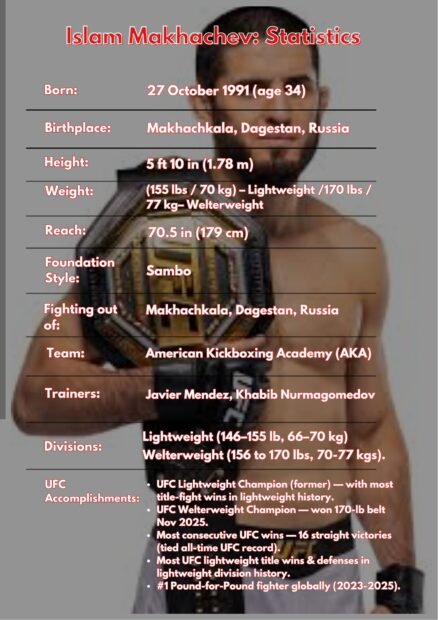
Born October 27, 1991, in Makhachkala, Dagestan, Russia, Islam grew up in the small village of Burshi. From a young age, he was immersed in martial arts, training under Abdulmanap Nurmagomedov (Khabib’s father) in sambo and wrestling. Islam became a Combat Sambo World Champion in 2016, showcasing early his exceptional grappling control and mental toughness.
Raised in the harsh mountain environment of Dagestan, he developed incredible physical and mental resilience. His upbringing emphasised discipline, humility, and an unwavering work ethic, all central to the Dagestani fighting spirit.

Islam Makhachev began his ascent through the Russian regional circuits, where he quickly established himself as a rising force with a strong amateur record. Even early on, his fighting style reflected the classic Dagestani formula — relentless wrestling pressure combined with a steadily developing striking game. As he transitioned to the professional ranks in 2010, Islam wasted no time making an impression. His reputation grew with each bout as he showcased smothering grappling, airtight top control, and an ability to finish fights with ruthless efficiency. He racked up 12 straight wins without a loss, dominating opponents across Russia and abroad. This undefeated streak, coupled with his sambo world championship pedigree, caught the attention of the UFC — who signed him in 2015, setting the stage for his rise on the global stage.

Islam Makhachev made his UFC debut on May 23, 2015, against Leo Kuntz, securing a second-round submission and instantly showcasing the sambo skills that had defined his early career. While he suffered a rare setback later that year — a knockout loss to Adriano Martins — the defeat served as a pivotal moment. Rather than derail his momentum, it fueled his commitment to sharpening his striking and defensive game, turning a weakness into another weapon. From there, Islam embarked on a dominant run through the lightweight division, notching impressive victories over the likes of Nik Lentz, Arman Tsarukyan, Davi Ramos, Drew Dober, and Dan Hooker. Most of these wins came by submission or suffocating decision, with Islam barely taking damage as he controlled every aspect of the fight. His composed, methodical style and elite grappling made him one of the most feared and respected contenders in the sport, steadily climbing toward the title picture with each performance.

Islam’s lone career defeat in 2015 cast a long shadow early on, but instead of letting it define him, he used it as a turning point for evolution. Recognising the need to round out his game, he began refining his striking under the guidance of Javier Mendez at the renowned American Kickboxing Academy (AKA) — the same camp that produced champions like Khabib Nurmagomedov and Daniel Cormier. With newfound focus and upgraded skills, Islam returned to the octagon a more complete fighter. What followed was an 11-fight win streak, during which he systematically dismantled contenders using a mix of calculated pressure, precise grappling, and ever-improving striking. His ability to neutralise opponents without taking damage became a trademark, and that early setback ultimately became the fuel for his rise to the top.

Islam Makhachev captured the UFCLightweight Championship at UFC 280 in October 2022, submitting Charles Oliveira — the record holder for most submissions in UFC history — in a statement victory that cemented his place among MMA’s all-time elite grapplers. It wasn’t just a win; it was a passing of the torch in one of the sport’s deepest divisions. He followed up by defending the belt against Alexander Volkanovski at UFC 284 in February 2023, edging out the pound-for-pound king in a closely contested five-round battle that showcased Islam’s composure under striking pressure. Their rematch at UFC 294 later that year ended even more decisively, with Makhachev delivering a stunning head-kick knockout — proving his evolution into a truly well-rounded and dangerous champion. Now widely considered the best lightweight on the planet.

With his historic victory over Jack Della Maddalena in late 2025, Islam Makhachev has achieved what only the sport’s rarest elites ever touch: double-champ status. Moving up to welterweight and dominating over five rounds, he proved that his suffocating pressure, technical discipline, and grappling brilliance translate seamlessly across divisions.

What was once a rumoured ambition is now a reality — a legacy-defining milestone that cements Makhachev as one of the greatest fighters of his era and the new standard for Dagestani excellence inside the UFC.

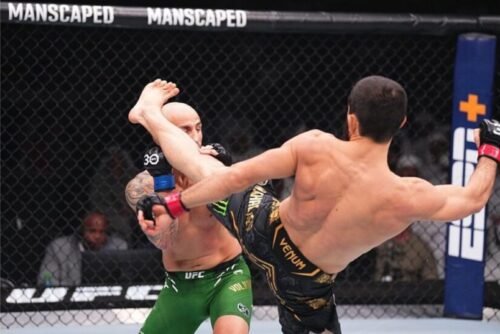
At UFC 294, Islam Makhachev delivered a first-round head-kick KO against Alexander Volkanovski, handing the featherweight great his first finish loss and cementing Makhachev atop the lightweight division.

Style

Islam Makhachev’s fighting style is rooted in sambo mastery, but it’s his ability to blend that base with clinical striking, positional dominance, and elite fight IQ that makes him a nightmare matchup for nearly anyone. He suffocates opponents with relentless top pressure, chaining takedowns together until they break, all while avoiding damage and controlling every exchange. His transitions are seamless — from takedown to back control, from clinch to mount — leaving his foes trapped in a puzzle they can’t solve.

Standup

On the feet, Islam has evolved from a cautious striker into a measured and dangerous one. He uses clean straight punches, body kicks, and sharp counters to set up entries or force mistakes. While not known for volume, every strike is purposeful — aimed at disrupting rhythm or opening the path to the ground. Defensively, he’s hard to hit cleanly, keeping distance with smart footwork and using feints to bait reactions. His composure under pressure, especially against high-level strikers like Volkanovski, shows just how far his stand-up has come.

Makhachev’s calm striking disguises the inevitable—once he grabs hold, his elite sambo grappling takes over, dragging opponents down into suffocating top control and submissions.

Ground Game

But Islam’s true domain is still the mat. There, he dominates with pressure, wrist control, and an arsenal of submissions. Whether passing guard, flattening opponents, or threatening with arm triangles and rear-naked chokes, he keeps constant threats alive. Makhachev’s style is not built for flash — it’s built for control, exhaustion, and inevitable defeat. He fights like a chess master who always sees five moves ahead — and rarely makes a mistake.

Stats

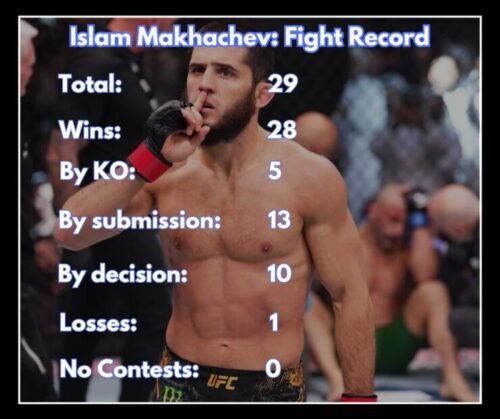
Fight Record

Significant Professional Fights

Click on the links below for more details on Islam Makhachev’s significant fights.

Makhachev submitted Dober in the third round via arm-triangle choke. This fight exemplified his grappling dominance and helped build the narrative of his control and finishing ability.

Makhachev claimed the UFC Lightweight Belt by dropping Oliveira with a right hand and submitting him with an arm-triangle choke in Round 2.
This fight marked his arrival as the division’s new force: striking setup, grappling finish.

A five-round title defence where Makhachev won by unanimous decision.
It showcased his ability to control a fighter of Volkanovski’s calibre, proving his positional dominance and tactical depth.

In the rematch, Makhachev exploded early: landed a head kick, followed by ground strikes, finishing Volkanovski in Round 1 via KO/TKO.
This demonstrated a new level of evolution — not just grappling supremacy but knockout power and elite striking.

Makhachev moved up to welterweight and dominated Della Maddalena over five rounds, winning by unanimous decision to become a two-division champion.
This cemented his legacy: cross-division success, a continued long win streak, and a refined blend of elite wrestling and striking at a higher weight class.

Training

Islam Makhachev’s training is built on Dagestani sambo and refined at American Kickboxing Academy, where discipline, structure, and pressure define every session. Under Javier Mendez, with Khabib Nurmagomedov often present, the emphasis is on control — positional dominance, defensive responsibility, and imposing a pace opponents cannot sustain.

At the elite level, training often involves multiple daily sessions, combining high-intensity wrestling rounds, chain takedowns, trips, and prolonged top-control sequences. Ground work prioritises pressure, balance, and incremental damage rather than reckless submission chasing. Striking sessions focus on efficiency: southpaw counters, measured kick setups, and disciplined distance management designed to close space safely and transition into grappling exchanges.

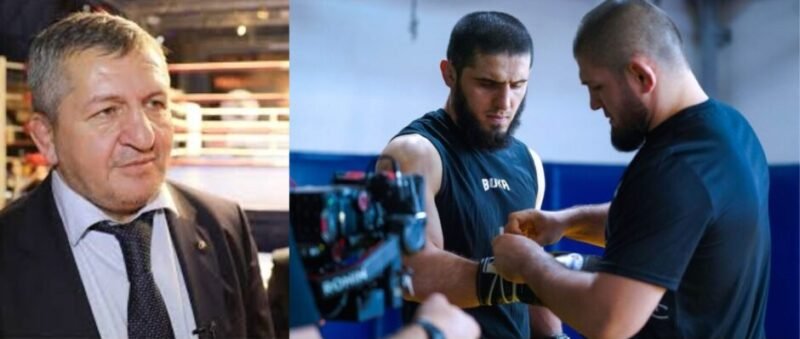
Trained under Abdulmanap Nurmagomedov (left) and now coached by Khabib (right), Makhachev carries the Dagestani sambo-wrestling legacy — disciplined, relentless, and the clear heir to the dynasty’s dominance.

Conditioning for Control

Strength and conditioning follow a grappler’s endurance modelexplosive lifts, sled pushes, grip training, and isometric holds that mirror clinch battles and extended ground exchanges. There is no emphasis on size or aesthetics; strength is functional, repeatable, and sustainable across five rounds. Recovery and nutrition remain straightforward and disciplined, supporting durability, weight management, and long-term consistency.

As fight week approaches, intensity tapers into precision drilling, flow rolling, and strategic refinement. By fight night, Makhachev enters composed and methodical, prepared to dictate where the contest takes place and maintain control from the opening exchange to the final bell.

The Circuits

(Credit to Miz Tyabo for the amazing illustration)

This programme is inspired by the training style of Islam Makhachev — built around the same pillars that make him such a dominant, pressure-driven athlete: functional strength, elite conditioning, sharp striking, relentless grappling endurance, and a bulletproof core. Every session contributes to forging a more powerful, more efficient, and better-conditioned version of yourself.

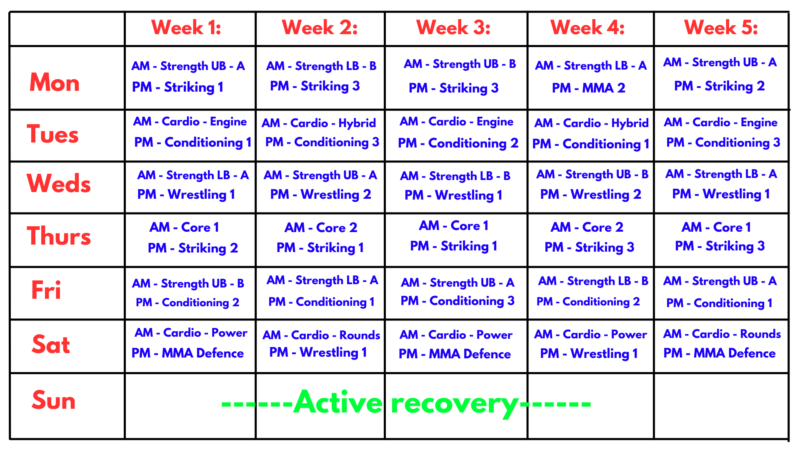
Across five weeks you’ll rotate through four strength sessions, three conditioning circuits, two cardio formats, three striking sessions, two wrestling-conditioning sessions, one defensive striking session, and two core workouts. Everything is staggered for balance, giving every session its turn and developing a Dagestan-worthy engine without burning you out. This programme is the closest a non-pro can get to Dagestani combat conditioning without moving to the mountains of Makhachkala

Stay focused, trust the grind, and train with intention. 👊

📅 Structure

The plan follows a 6-day training week, with Sunday reserved for active recovery. Each day includes:

  • AM Session (30–45 mins):
  • PM Session (30–45 mins):

Sessions rotate to maintain balance — strength, conditioning, cardio, striking, wrestling, and core all get their turn. This staggered approach mirrors the rhythm of Dagestani camps: consistent, tough, and deliberately structured to build a complete athlete across five weeks.

🧩 Breakdown of Sessions in This Programme

Click on the links below for more details on the structure of the Islam Makhachev Workouts.

Four functional strength workouts developing real-world power, explosive hips, stable shoulders, and grappler-style endurance. Clean lifts, steady progress, and no wasted movement.

Three circuits delivering explosive power, wrestling-style grit, and a non-stop engine. Tough rounds that build fight-ready lungs and serious mental resilience.

A blend of steady-state engine work and HIIT intervals. Together they build the aerobic–anaerobic capacity Islam uses to dominate late rounds.

Three striking sessions focused on crisp, efficient combinations and pressure-based movement. These sharpen timing, accuracy, footwork, and technical discipline.

Two wrestling-inspired conditioning sessions built around shots, scrambles, odd-object lifts, and grappler movement patterns. Builds chain-wrestling endurance and positional strength.

A focused defensive session developing slips, rolls, checks, frames, and counter-timing. Enhances composure, reaction speed, and positional awareness.

Two full-spectrum core workouts hitting every part of the midlineupper/lower abs, obliques, deep core, anti-rotation, hip stability, and posterior chain strength.

Fight Camp Schedule

Active Recovery and Flexibility

Islam Makhachev’s durability isn’t accidental. His training intensity is balanced by disciplined recovery, allowing him to train hard year-round without breaking down. In Dagestani systems, recovery is treated as maintenance, not rest — keeping the body mobile, resilient, and ready for the next hard session.

These sessions are deliberately low-intensity and ego-free. The goal is to restore joints, maintain mobility, regulate fatigue, and reset the nervous system so high-output training can continue uninterrupted.

🔥 Heat & Cold Therapy

  • Sauna: 10–15 minutes.
  • Cold Exposure: 1–2 minutes.

Purpose: Circulation, inflammation management, and nervous-system reset after heavy training blocks.

🧘 Mobility & Flexibility

  • Mobility Flow: 5–10 minutes.
  • Stretching Routine: 5–10 minutes.
  • Foam Rolling: 2–3 minutes per muscle group.
  • Soft Tissue Ball Work: 2–3 minutes per tight spot.
  • Massage Gun: 3–5 minutes per area.

Purpose: Maintain joint range, reduce stiffness from wrestling and lifting, and preserve movement quality under volume.

🚶 Light Movement

  • Light Walk: 20–30 minutes.
  • Easy Cycling: 10–20 minutes.
  • Swimming: 10–20 minutes.

Purpose: Active circulation without fatigue. Keeps the body loose while supporting recovery between hard sessions.

🌬️ Breathwork & Reset

  • Breathing Work: 3–5 minutes (box breathing or slow nasal work).

Purpose: Downshift the nervous system, improve recovery quality, and reinforce composure under stress — a defining trait of Makhachev’s approach.

Diet and Nutrition

Islam’s nutrition is strict and clean, often following a moderate-carb, high-protein intake with fresh meats, grains, and vegetables typical of Dagestani diets.

Key Foods

  • Proteins: Chicken, turkey, steak, salmon, eggs, protein shakes.
  • Carbs: Oatmeal, quinoa, brown rice, bananas.
  • Fats: Avocados, olive oil.
  • Greens: Kale, spinach.

Foods to Avoid

  • Sugar.
  • Junk food.
  • Refined and processed foods.
  • Hydrogenated fats.
  • Artificial ingredients.

Example Daily Meal Plan

  1. Breakfast: Five large whole eggs with a big bowl of porridge.
  2. Midday Snack: Low-sugar protein shake.
  3. Lunch: A large bowl of pasta with chicken.
  4. Evening Snack: Another low-sugar protein shake.
  5. Dinner: Steak, baked potato, and broccoli.
  6. Before Bed: Low-sugar protein shake.

Whichever workout you undertake. Remember to always cool down, stretch and drink water!

Workout Complete!!

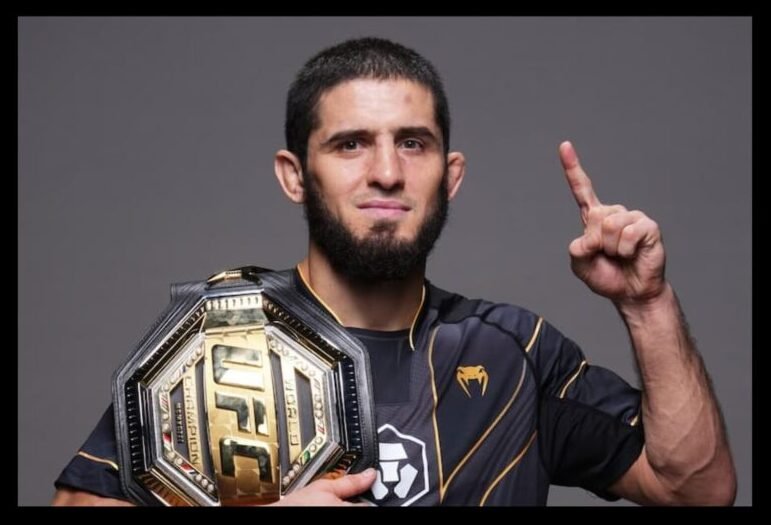
Welterweight ruler. Pound-for-pound king. Islam stands at the summit.

If you have enjoyed this workout please share or feel free to comment below 🙂

Warning!

Please be aware that I am not a professional fighter or instructor. This MMA workout is intended for fun and general fitness, not expert training. Prioritize safety by using proper techniques and gear. Practice moves cautiously and avoid excessive force, especially with throws and striking. If you’re looking for more intense training, consider seeking guidance from a professional MMA gym. Remember, this workout carries inherent risks, and you assume responsibility for any potential injuries.

Related Posts

Our Other Posts

Leave a Reply

Your email address will not be published. Required fields are marked *

This site uses Akismet to reduce spam. Learn how your comment data is processed.

error: Content is protected !!

Join the Super Soldier Project Mailing List Today!!