














Compound Reboot: Smarter Programming & Progression

Welcome to Part 2 of the Compound Training series — Compound Reboot: Smarter Programming & Progression, where you’ll learn how to structure compound training, apply progressive overload, and build efficient workouts that produce consistent results.

Table of Contents

🔥 Applying the Fundamentals

Part 1 established why compound lifts matter — building real-world strength, improving coordination, and developing the systems that drive long-term performance. Now it’s time to apply those principles.

Compound Reboot: Smarter Programming & Progression provides the practical framework for training compound lifts effectively and safely. You’ll learn how to warm up properly, select appropriate rep and set ranges for your goals, apply progressive overload, and build time-efficient sessions that produce consistent results.

Think of this section as a practical manual. Whether you’re new to resistance training, returning after time away, or refining your approach as an experienced lifter, the methods and templates here will help you train with greater structure and intent. If Part 1 explained the why, this section delivers the how.

🔥 Warm-Up & Mobility

Proper preparation improves movement quality and reduces unnecessary strain. A structured warm-up does not need to be long, but it should be deliberate and focused.

Mobility Priorities

Mobility requirements vary by lift, but several regions consistently influence compound mechanics:

  • Ankles – Adequate dorsiflexion supports squat depth and stable knee tracking.
  • Hips – Essential for hinge efficiency and squat stability.
  • Thoracic spine – Influences upright posture in squats and overhead positioning.
  • Shoulders – Required for pressing, pulling, and overhead stability.
  • Wrists – Important for front rack positions and pressing mechanics.

Mobility limitations often appear as compensation elsewhere in the chain. Address restrictions directly rather than forcing depth or increasing load.

Activation & Ramp-Up

After mobility work, activate key stabilisers:

  • Glute bridges or hip extensions.
  • Core bracing drills or bird dogs.
  • Light scapular retraction work for upper-body sessions.

Follow with 2–3 progressive ramp-up sets before reaching working weight. Gradually increase load while rehearsing bar path, bracing, and positioning.

A focused 5–8 minute preparation is sufficient for most sessions. The objective is not fatigue — it is readiness.

📌 Key Takeaway: Preparation improves performance — don’t skip the work that makes good movement possible.

💥 Introducing the Heavy Hitters

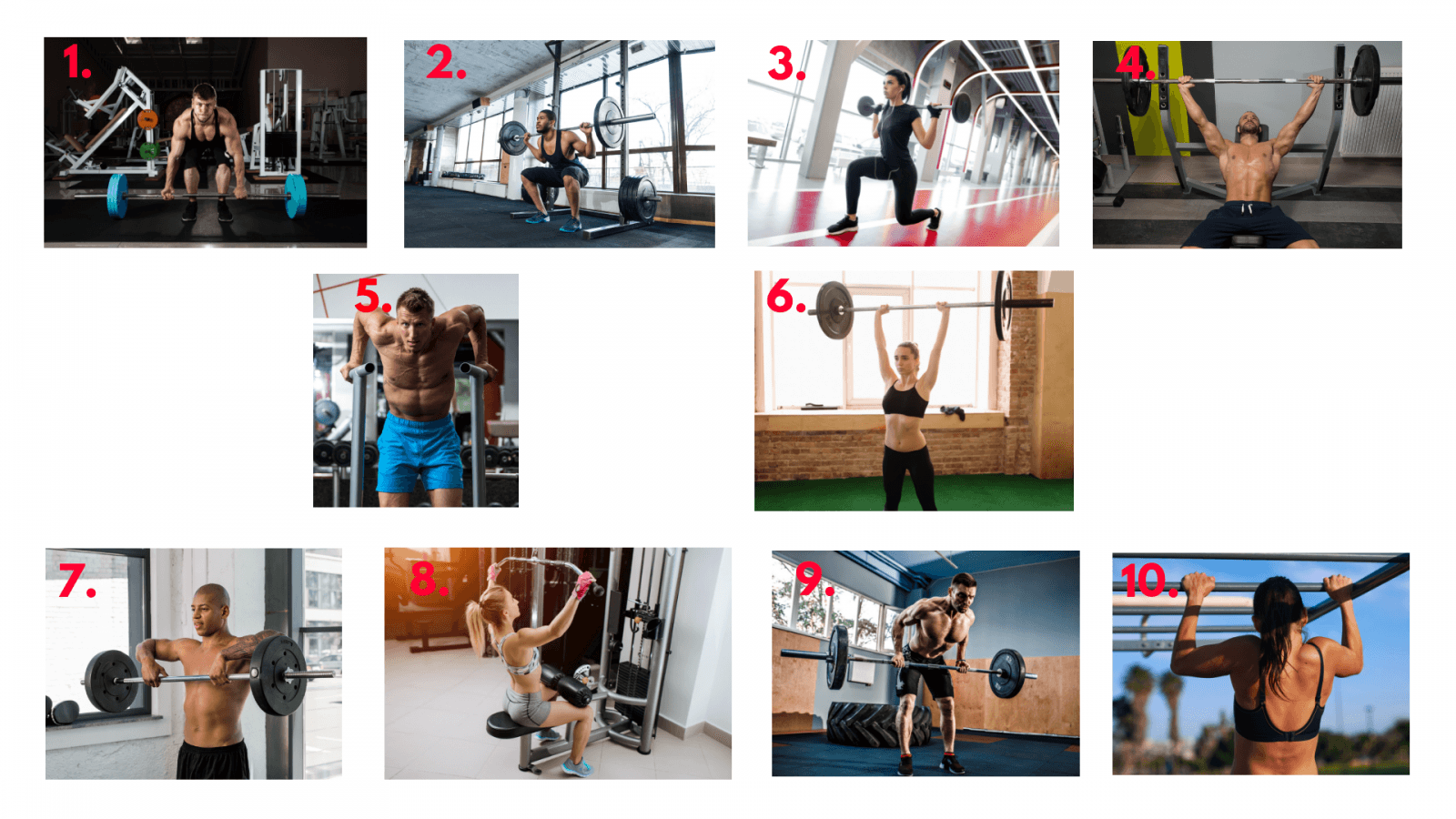
For a powerful and effective compound workout, build your routine around movements that recruit the most muscle and deliver the greatest return on effort. These exercises involve multiple joints working together, allowing you to develop strength, coordination, and work capacity in fewer movements.
Depending on experience, they can be loaded heavily, performed with moderate resistance, or scaled to bodyweight variations.

Key Compound Lifts

  1. Deadlifts — posterior chain strength through the glutes, hamstrings, back, and core.
  2. Hip Thrusts / Glute Bridges — powerful hip extension for glute development and pelvic stability.
  3. Squats — foundational lower-body strength involving the quadriceps, glutes, and core.
  4. Lunges / Split Squats — single-leg strength, balance, and coordination.
  5. Bench Press — horizontal pushing strength for the chest, shoulders, and triceps.
  6. Chest Dips — bodyweight pressing movement targeting the chest and triceps.
  7. Overhead Press — vertical pressing strength and shoulder stability.
  8. Pull-Ups / Chin-Ups — vertical pulling strength for the upper back and arms.
  9. Lat Pulldowns — accessible vertical pulling alternative for beginners.
  10. Bent-Over Rows — horizontal pulling strength for the back and posterior chain.
Compound lifts. Resistance Training. Super Soldier Project.

 1. Deadlifts. 2. Back squats. 3. Barbell Lunges. 4. Chest Press. 5. Triceps Dip. 6. Military Press. 7. Upright rows. 8. Lat Pulldowns. 9. Bent over rows. 10. Pull-ups. 

These lifts form the backbone of a strong, balanced, and athletic physique. Mastering them provides a foundation of strength that carries over into sport, functional movement, and everyday physical tasks.

📌 Key Takeaway: Build your training around movements that deliver the greatest return on effort.

⚙️ Exercise Selection

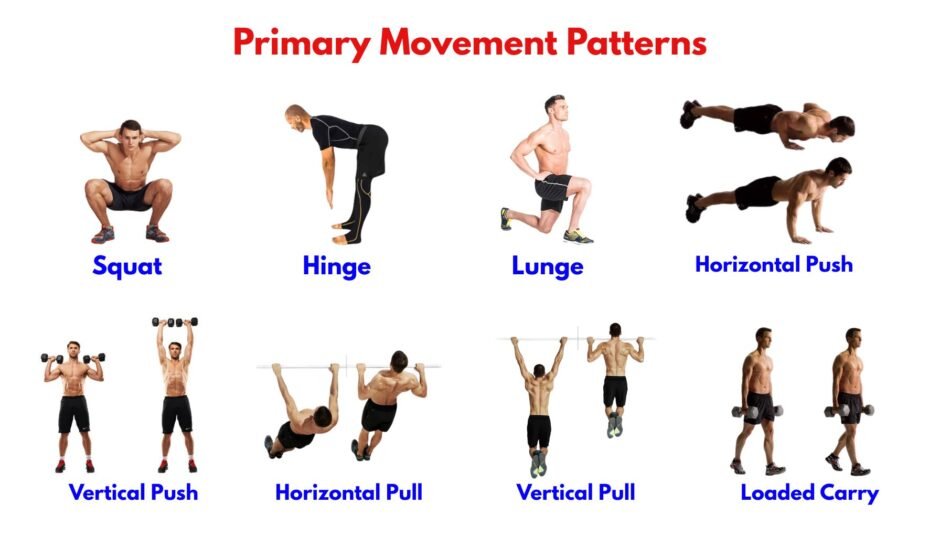
Compound training should be organised around fundamental movement patterns rather than random exercise choice. This approach promotes structural balance, reduces injury risk, and prevents overemphasis on one area while neglecting another.

Primary Movement Patterns

Compound training should be organised around fundamental movement patterns rather than random exercise choice. This approach promotes structural balance, reduces injury risk, and prevents overemphasis on one area while neglecting another.

Fundamental movement patterns: squat, hinge, lunge, push, pull, carry. Train them all.

Click below to read more on common mistakes with compound training.

Involves coordinated flexion and extension of the hips, knees, and ankles.
Examples: Back squat, front squat, goblet squat.

Hip-dominant movement with minimal knee travel.
Examples: Deadlift, Romanian deadlift, hip thrust.

Single-leg strength and stability through hip and knee flexion.
Examples: Forward lunges, reverse lunges, split squats.

Pressing away from the body at chest level.
Examples: Bench press, push-ups, dumbbell press.

Pressing overhead with shoulder flexion.
Examples: Overhead press, dumbbell shoulder press.

Pulling weight toward the torso.
Examples: Barbell row, dumbbell row, cable row.

Pulling downward or upward in a vertical plane.
Examples: Pull-ups, chin-ups, lat pulldowns.

Walking under load while maintaining posture and core bracing.
Examples: Farmer’s carry, suitcase carry, front rack carry.

A balanced compound session should typically include at least one lower-body pattern and one upper-body push and pull. From there, volume and exercise selection can be adjusted according to training goals, experience level, and recovery capacity.

Choosing movements based on patterns rather than preference ensures comprehensive development and long-term structural balance.

📌 Key Takeaway: Train movement patterns, not individual muscles, to build balanced and resilient strength.

📌 Exercise Order

Compound lifts. Resistance Training. Super Soldier Project.

The Hex bar deadlift. A compound lift requiring many muscle groups to work together.

Compounds First

Compound lifts should be performed at the beginning of a resistance-training session. These movements demand the highest levels of coordination, force production, and neuromuscular control. Performing them while fresh allows for better technique, higher-quality repetitions, and safer load handling.
As fatigue accumulates, motor control declines. This increases the likelihood of compensatory movement patterns, particularly in technically demanding lifts such as squats and deadlifts. Placing compound movements first protects performance and reduces unnecessary injury risk.

A simple ordering structure:

  1. Primary compound lift — squat or hinge.
  2. Secondary compound lift — push or pull.
  3. Accessory compound or unilateral work.
  4. Optional isolation or conditioning work.

Pre-Exhaust & Advanced Sequencing

Some lifters use pre-exhaust methods, performing an isolation exercise immediately before a compound movement for the same muscle group. For example, chest flyes before bench press or leg extensions before squats.

This approach can increase local muscular fatigue and alter stimulus distribution, but it also reduces the load that can be lifted during the compound movement.

For beginners and intermediate lifters, it is generally more effective to prioritise heavy, technically sound compound work first.

Pre-exhaust techniques are best reserved for specific hypertrophy phases or advanced programming strategies, not foundational strength development.

📌 Key Takeaway: Perform compound lifts first — quality and control drop as fatigue rises.

🔢 Repetitions & Sets

Your repetition range and set structure should reflect your primary training objective. Compound lifts can be adapted for strength, muscle growth, or muscular endurance depending on load, volume, and rest periods.

Planning Reps and Sets

Strength Development

For maximal strength, use heavier loads with lower repetition ranges.

Typical structure:

  • 3–5 sets of 3–5 reps.
  • Longer rest periods (2–4 minutes) allow adequate recovery between sets and help maintain bar speed and technical quality.
  • The focus is full-body tension, controlled execution, and consistent progression.

Hypertrophy (Muscle Growth)

For muscle development, moderate loads and moderate repetition ranges are effective.

Typical structure:

  • 3–4 sets of 6–12 reps.
  • Rest periods of 60–90 seconds maintain training density while allowing sufficient recovery.
  • Controlled tempo and consistent range of motion help maximise mechanical tension and muscular stimulus.

Muscular Endurance

For endurance-focused goals, lighter loads and higher repetition ranges are used.

Typical structure:

  • 2–4 sets of 12–20+ reps.
  • Rest intervals are shorter and heart rate remains elevated.
  • This approach builds fatigue resistance and work capacity, but it should not completely replace heavier strength work if long-term progression is the goal.

Across all ranges, the final repetitions of each set should be challenging without technical breakdown. Progress comes from consistent training and gradual overload — not from sacrificing form to complete extra repetitions.

📌 Key Takeaway: Match your rep range to your goal — strength, muscle, or endurance.

📈 Progressive Overload

Progressive overload is the principle that drives adaptation. Without gradually increasing training demand, strength and muscle development will eventually plateau. The increase does not need to be dramatic — it simply needs to be consistent over time.

Progressive overload means increasing the demand over time — adding weight or improving range of motion, such as squatting deeper with control.

Primary Overload Methods

Add Weight
Increase the load while keeping repetitions and sets constant. This is the most direct method for developing strength.

Add Repetitions
Perform additional reps with the same load before increasing weight. This approach is particularly effective during hypertrophy phases.

Add Sets
Increase total training volume by adding another working set.

Secondary Overload Methods

Reduce Rest Periods
Shorter rest intervals increase training density and overall session difficulty.

Manipulate Tempo
Slower eccentric phases increase time under tension and improve movement control.

Pause Repetitions
Adding pauses at the bottom of squats or presses develops positional strength and stability.

Increase Range of Motion
Using deeper squats or deficit deadlifts increases mechanical demand on the muscles involved.

Overload should be gradual and planned. Small increases each week accumulate into significant long-term progress. Attempting to increase load, volume, and intensity simultaneously often leads to stagnation or injury.

Track your performance, make incremental adjustments, and ensure recovery keeps pace with training demand.

📌 Key Takeaway: Progress comes from small, consistent increases in demand over time.

⏱️ Training Efficiency

Compound training allows you to stimulate the entire body with fewer exercises. Because each lift recruits multiple muscle groups simultaneously, a small number of movements can deliver an effective full-body training stimulus without sacrificing quality.

A simple structure built around one lower-body pattern, one push, and one pull can train the majority of the body in 30–45 minutes. Additional work can then be layered in depending on goals and recovery capacity.

Efficiency is not about rushing. It is about selecting movements that deliver the greatest return on effort.

Minimalist Structure

For time-limited sessions, focus on three primary movements:

  • One squat or hinge.
  • One upper-body push.
  • One upper-body pull.

Perform 3–4 working sets of each movement. With appropriate rest periods, this provides meaningful training stimulus without unnecessary volume.

Interval or Density Structure

For time-limited sessions, focus on three primary movements:

  • EMOM (Every Minute on the Minute).
  • Timed circuits.
  • Alternating push–pull supersets.

These formats increase training density and work capacity, but loads should be adjusted to maintain technical integrity. Heavy barbell lifts performed under excessive fatigue increase the risk of technical breakdown.

📌 Key Takeaway: A few well-chosen lifts can outperform long, unfocused sessions.

⚠️ Common Mistakes

Compound lifts are highly effective, but poor execution can limit progress and increase injury risk. Most mistakes are preventable with attention to technique, preparation, and sensible programming.

The Hex bar deadlift. A compound lift requiring many muscle groups to work together.

Click below to read more on common mistakes with compound training.

Selecting weight beyond current capacity often leads to compensatory movement patterns — rounded backs in deadlifts, knee collapse in squats, or unstable pressing mechanics. Progression should follow technical mastery, not the other way around.

Inadequate core bracing reduces spinal stability under load. Before initiating a heavy lift, create intra-abdominal pressure, maintain a neutral spine, and control the descent. A strong brace supports force transfer and protects the lower back.

Jumping directly into working weight increases strain on joints and connective tissue. Gradual ramp-up sets allow rehearsal of technique while preparing muscles and the nervous system for heavier loads.

Restricted ankles, hips, thoracic spine, or shoulders can alter lifting mechanics and reduce movement quality. Mobility limitations often appear as compensations elsewhere in the chain.

Performing heavy compound lifts under excessive fatigue — particularly in poorly structured circuits — increases the likelihood of technical breakdown. Maintain load discipline and reduce volume when form begins to deteriorate.

Technical consistency over time produces better results than sporadic maximal effort. Compound training rewards patience, control, and precision.

📌 Key Takeaway: Technical consistency beats chasing weight — poor execution limits progress.

🥗 Nutrition

Training adaptation depends on adequate fuel and recovery. Compound lifts place significant mechanical and neurological stress on the body, so nutritional support should match training demand and recovery needs.

Recovery eating. Compound lifts. Resistance Training. Super Soldier Project.

Protein & Muscle Repair

Protein intake supports muscle repair and adaptation following resistance training. Aim for consistent daily intake distributed across meals rather than relying on a single post-workout feeding.

For most active individuals, a practical guideline is approximately 1.6–2.2 g of protein per kilogram of bodyweight per day, adjusted for total activity level and energy intake.

Carbohydrates & Performance

Carbohydrates replenish muscle glycogen, which becomes increasingly important when training volume or frequency is high. While not every lifter requires high carbohydrate intake, insufficient carbohydrates can reduce performance during demanding compound sessions.

Pre-training meals can include a moderate combination of protein and carbohydrates. Post-training nutrition should prioritise recovery rather than strict “window” timing — overall daily intake remains the primary driver of adaptation.

Recovery eating. Compound lifts. Resistance Training. Super Soldier Project.

Energy Balance

Body composition outcomes ultimately depend on overall energy balance:

  • Calorie deficitFat loss.
  • Calorie surplusMuscle gain (typically with some fat gain).
  • MaintenanceBody recomposition possible for newer lifters.

Compound training improves the quality of these adaptations by preserving lean mass and increasing strength, but nutrition ultimately determines the direction of change.

📌 Key Takeaway: Training provides the stimulus, but nutrition determines the outcome.

😴 Recovery

Training provides the stimulus. Recovery allows adaptation.

Compound lifts place significant stress on the muscular system, connective tissue, and the central nervous system. Without adequate recovery, performance declines and long-term progress stalls.

Sleep

Consistent, high-quality sleep supports hormone regulation, tissue repair, and neural recovery. Most adults require 7–9 hours per night. Chronic sleep restriction can impair strength output, reduce recovery capacity, and increase injury risk.

Rest Days & Load Management

Strength gains occur between sessions, not during them. Planned rest days help prevent excessive fatigue and allow the body to adapt to training stress.

For most lifters, training compound movements 2–4 times per week per movement pattern provides sufficient stimulus while allowing adequate recovery.

If performance plateaus or joint discomfort begins to appear, temporarily reduce volume or intensity. Strategic deload weeks — lowering load or total sets for one week — allow recovery without losing long-term momentum.

Active Recovery

Light activity such as walking, mobility work, or low-intensity cardio can improve circulation and reduce stiffness without interfering with adaptation.

Recovery is not passive weakness. It is the planned management of stress that allows consistent progress over months and years.

📌 Key Takeaway: Adaptation happens during recovery — manage fatigue to sustain progress.

🏁 Final Thoughts

Compound movements form the structural foundation of effective strength training. When organised around fundamental movement patterns, sequenced correctly, and progressed methodically, they provide a balanced stimulus for strength, muscle development, and overall fitness.

The principles in this section are straightforward:

  • Select movements by pattern.
  • Perform compound lifts while fresh.
  • Match repetitions and sets to your goal.
  • Apply progressive overload gradually.
  • Support training with adequate nutrition and recovery.
Compound lifts. Resistance Training. Super Soldier Project.

There is no complexity for its own sake. Progress comes from the consistent execution of fundamentals.

Build sessions around the major lifts, refine technique over time, and increase demand intelligently. Done properly, compound training remains one of the most reliable systems for long-term physical development.

📘 Appendix — Training Templates

The following templates provide practical examples of how to structure compound-focused sessions. They can be adapted according to experience level, available equipment, and recovery capacity.

Strength Day (≈45 Minutes)

Focus: Lower repetition ranges, longer rest periods, technical precision.

  • Deadlift: 3×5.
  • Bench Press: 3×5.
  • Barbell Row: 3×6.
  • Overhead Press: 2×5.
  • Weighted Lunges: 2×8–10 each leg.

Rest 2–3 minutes between primary lifts. Maintain strict technique and consistent bracing throughout.

Hypertrophy Day (45–60 Minutes)

Focus: Moderate loads, controlled tempo, moderate rest intervals.

  • Squat: 4×8
  • Pull-Ups or Lat Pulldown: 4×8–10.
  • Romanian Deadlift: 3×10.
  • Dips or Dumbbell Press: 3×10.
  • Bent-Over Row: 3×10–12.

Rest 60–90 seconds between sets. Prioritise full range of motion and controlled eccentric phases.

Minimalist Day (20–30 Minutes)

Focus: High return on time invested.

  • Squat: 3×5.
  • Press (Overhead or Bench): 3×5.
  • Deadlift: 1–2×5.

Rest as needed to maintain technical quality. This format covers the major movement patterns while keeping total training time short.

These templates are starting points rather than fixed programmes. Adjust load, volume, and frequency according to your training history, recovery capacity, and specific goals.

If you have enjoyed this post please share or feel free to comment below 🙂

Related Posts

Our Other Posts

Leave a Reply

Your email address will not be published. Required fields are marked *

This site uses Akismet to reduce spam. Learn how your comment data is processed.

error: Content is protected !!

Join the Super Soldier Project Mailing List Today!!