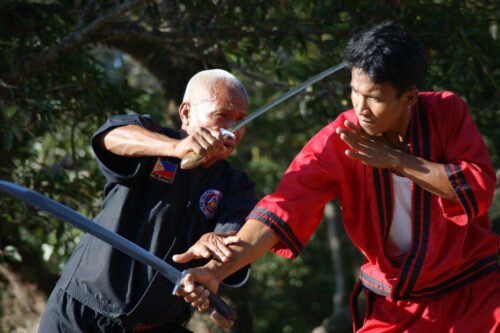
Blood and Blades – The Hidden History of Filipino Martial Arts.

Born from tribal warfare and colonial resistance, Arnis is the Filipino art of sticks, blades, and bare hands. From Lapu-Lapu’s victory over Magellan to underground duels and wartime guerrillas, it has survived bans, invasions, and war. Discover how this martial art became a symbol of resilience and combat mastery.

Table of Contents

Origins of Arnis (FMA)

If you already know what Arnis is—a fluid blend of blade, stick, and close-range fighting—the real question is not what it looks like, but why it looks the way it does.
Filipino Martial Arts did not emerge from a single founder, philosophy, or defining moment. They evolved through repetition: conflict, invasion, suppression, and survival. Over centuries, Filipino communities were forced to solve the same problems under changing conditions, with limited resources and no margin for error.

Arnis evolved over centuries of conflict and survival, shaped by what worked under pressure—weapons-first, adaptable, and refined over time rather than designed in theory.

What survived was not ceremony or doctrine, but what worked.
Arnis, Eskrima, and Kali are modern labels applied to an older reality: a shared combat logic shaped by environment and necessity rather than abstract ideals. That logic explains why weapons take priority, why adaptability outweighs rigid structure, and why the arts resisted standardisation long before codification was attempted.
To understand Filipino Martial Arts, you have to begin before they had a name—in a world where violence was expected, not exceptional does.

🗺️ Life Before Empire

Survival Without Armies

Before colonisation, the Philippine archipelago was a patchwork of independent communities rather than a unified nation. Authority was local. Defence was personal. There were no standing armies and no professional soldier class.
Conflict was not constant, but it was familiar. Disputes over land, resources, alliances, and honour were settled through raids, reprisals, and sudden confrontations. These were rarely prolonged battles. They were short, sharp, and close.

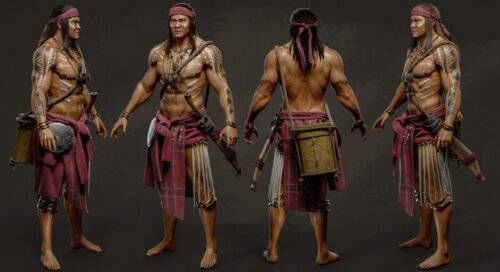
The Visayans were renowned seafarers and fierce warriors, known for their tattooed bodies and mastery of bladed combat. This computer-generated depiction showcases their appearance.

Raiding was central. Attacks relied on speed, surprise, and coordination, aiming to overwhelm before resistance could organise and withdraw before retaliation arrived. Endurance and formation mattered less than timing and decisiveness.
Geography reinforced this logic. Dense jungle, narrow paths, and crowded village spaces collapsed distance quickly. Coastal communities faced sudden threats arriving by sea. Under these conditions, rigid structures failed. Adaptability under pressure succeeded.

🛡️ Warrior Cultures of the Archipelago

Historical accounts offer glimpses into how these conditions shaped behaviour, without pointing to a single unified tradition.
Spanish chroniclers described the Pintados of the Visayascommunities where raiding, seafaring, and martial participation were tied to status and identity. In Mindanao, resistance produced episodes such as the Juramentado attacks, where individual fighters closed distance against armed occupiers with blades at extreme personal risk.

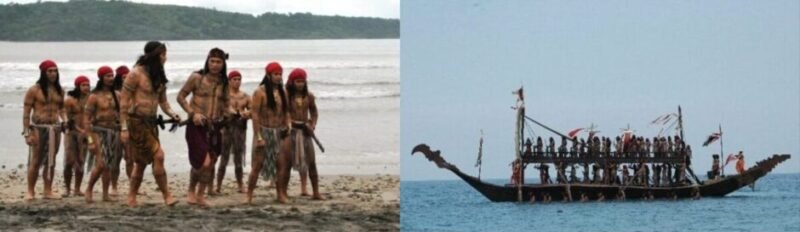
Left: Visayan raiders land on a beach, armed and ready for battle. Right: A Visayan warship, built for swift attacks and naval dominance.

Note these are not preserved systems or direct ancestors of modern Filipino Martial Arts. They are illustrations of a recurring pattern.
Across regions and eras, Filipino fighters repeatedly faced close-range violence, uncertain threats, and encounters where hesitation was fatal. The priorities that emerged—decisiveness, psychological commitment, and rapid action—were not cultural flourishes. They were survival requirements.

⚔️ Combat Before Codification

Within this environment, Filipino fighting traditions developed as weapons-first, integrated responses to real threats.
Blades, impact weapons, grappling, off-balancing, and close-range striking were not separate disciplines. They were overlapping solutions to collapsing distance and unpredictable violence. Empty-hand methods mirrored weapon mechanics and emerged naturally when a blade was lost, broken, or unavailable.

There were no manuals and no unified systems. Knowledge moved through direct practice within families and local groups, prioritising effectiveness over preservation. Variation between regions was inevitable and functional, not a flaw.
Most written references appear only after Spanish contact, describing resistance using tools such as the kampilan, bolo, kris, and barongpractical implements shaped by labour and environment rather than ceremony.
Modern terms like Arnis, Kali, Dumog, and Panantukan are later labels applied to functional domains that long predate their names. What existed was not an ancient art to preserve, but a combat logic forged by necessity.
There were no styles to protect, only problems to solve, and solutions that survived.

🇪🇸 The Shock of Empire

When Spanish expeditions reached the Philippines in the 16th century, they encountered societies already shaped by raiding, ambush, and close-range violence. What followed was not a simple conquest but a clash between two different models of war.

Spanish forces relied on hierarchy, formations, and central command to impose control. Filipino fighters operated through local, decentralised decision-making, shaped by terrain, timing, and opportunity. Engagements were fast, situational, and designed to end before an opponent could adjust.

Neither side lacked discipline. They simply understood violence through different assumptions — a clash that would shape centuries of conflict.

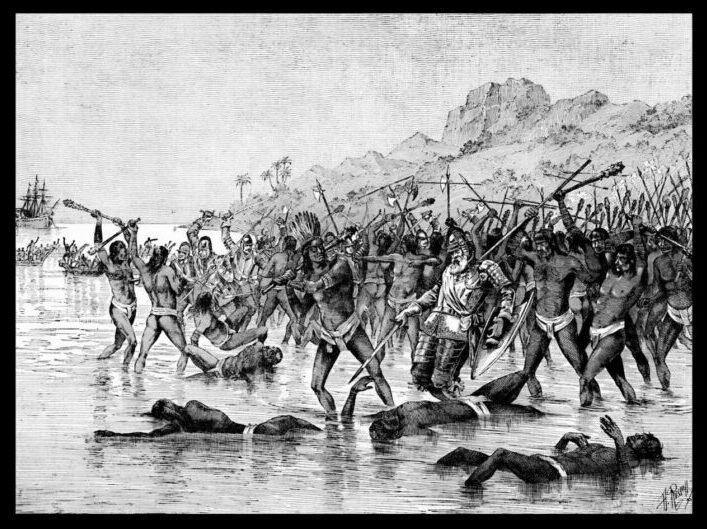
(The Death of Magellan) Filipino islanders defeated Ferdinand Magellan’s armoured, musket-bearing Spanish conquistador forces when they tried to initially tried to invade.

Click on the links below for more on the Spanish invasion.

In 1521, Ferdinand Magellan intervened in a local dispute on Mactan Island, attempting to assert Spanish authority through force and intimidation. One chieftain, Lapu-Lapu, refused submission.
Magellan assumed superior weapons, armour, and discipline would decide the encounter. Instead, his force was drawn into shallow water, broken ground, and close rangeconditions that neutralised firearms and formations.
Lapu-Lapu’s warriors, armed with local blades and spears, used mobility, numbers, and terrain knowledge to overwhelm the Spaniards. Magellan was killed. The expedition withdrew.
Mactan did not prove that empire could be defeated outrightSpain would return in force. It demonstrated something more important: superior enemies could be disrupted by refusing to fight on their terms.

Spanish control was established gradually, not through single decisive battles but through alliances, religious conversion, fortified settlements, and sustained presence. By the late 1500s, Spain dominated key ports and population centres while never fully controlling the interior or the southern regions.
With control came a persistent concern: an armed population.
Filipinos were already accustomed to blades, ambush, and close-range violence. In pacified areas, indigenous weapons and fighting practices were restricted or discouraged—not because they were symbolic, but because they were effective. A population skilled in irregular violence was difficult to govern across a fragmented archipelago.
Enforcement varied by region, but the pressure was real. Open weapon culture became risky. Combat knowledge adapted accordingly.

Spanish control was established gradually, not through single decisive battles but through alliances, religious conversion, fortified settlements, and sustained presence. By the late 1500s, Spain dominated key ports and population centres while never fully controlling the interior or the southern regions.
With control came a persistent concern: an armed population.
Filipinos were already accustomed to blades, ambush, and close-range violence. In pacified areas, indigenous weapons and fighting practices were restricted or discouraged—not because they were symbolic, but because they were effective. A population skilled in irregular violence was difficult to govern across a fragmented archipelago.
Enforcement varied by region, but the pressure was real. Open weapon culture became risky. Combat knowledge adapted accordingly.

Cultural exchange was unavoidable. Spanish soldiers introduced European fencing concepts: structured footwork, paired weapons, and ideas of measure and timing. Filipino fighters did not adopt these systems wholesale, nor abandon their existing logic.
Foreign methods were tested against local realities: terrain, speed, deception, and unpredictability. What worked was absorbed. What did not was discarded.
The result was not a Europeanised system, but a selectively sharpened oneindigenous at its core, refined only where external ideas survived contact with reality.

During this period, rattan stick training became increasingly prominent—not as symbolism, but necessity.
The stick allowed full-speed, full-intent practice without constant fatalities. It preserved blade mechanics while reducing the cost of bloodshed during training. Rattan was cheap, replaceable, and socially less provocative than live blades in many colonial contexts.
Stick training did not replace blade knowledge. It preserved it in a form that could be practised openly.

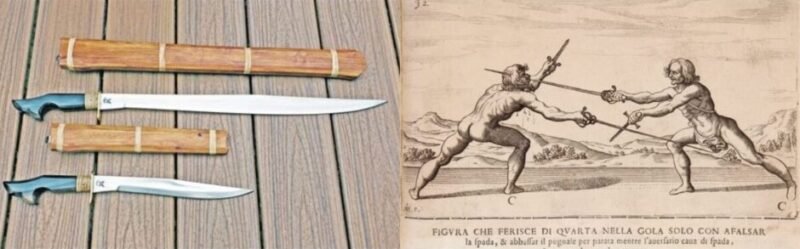
One indicator of Spanish influence in Arnis is Espada y Daga (sword and dagger), a term and method also found in Spanish fencing. Romeo Macapagal, a Kali archivist, estimated that around 40% of blade-oriented styles show European influence introduced during Spanish rule.

🔥 War Without Reinvention

(1896–1945)

From the Philippine Revolution (1896–1898) through the Philippine–American War (1899–1902) and into the Japanese occupation (1941–1945), the scale and technology of conflict changed repeatedly. The underlying conditions did not.

The Philippine Revolution

By the late 19th century, Spanish control was extensive but brittle. Authority weakened beyond cities and ports. When rebellion emerged, Filipino combat knowledge did not need to be reinvented. It resurfaced.
The Philippine Revolution mobilised civilians rather than professional soldiers. Fighters armed themselves with what could be concealed, replaced, and used effectively at close range. Ambush, night attacks, and sudden violence dominated. Engagements were brief and disorienting, designed to deny the enemy time to respond.

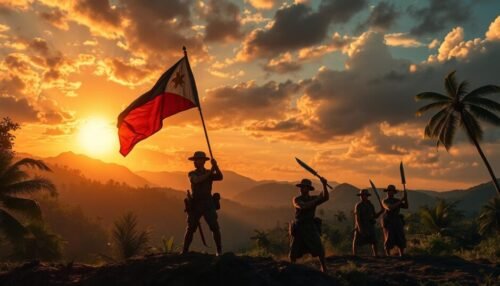
The Philippine Revolution (1896–1898) was a struggle for independence against Spanish colonial rule, marked by guerrilla warfare and the widespread use of bolo knives in combat.

Arnis in the Philippine-American War

The same pattern repeated under American rule. Filipino fighters faced technologically superior forces and responded with terrain, deception, and close-quarters violence. Blades, particularly bolos, acted as equalisers. They required no ammunition or supply chain and worked at the ranges where ambush occurred.

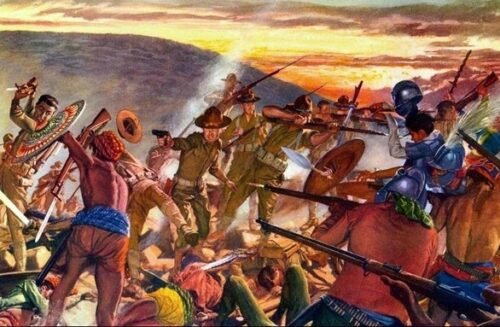
The Philippine-American War (1899–1902) was a brutal guerrilla conflict where Filipino fighters, many trained in Arnis, used bolo attacks, ambush tactics, and close-quarters combat to resist American forces.

World War II

World War II confirmed these lessons under modern conditions. Japanese occupation returned the familiar realities of foreign control, unequal firepower, and limited resources. Resistance depended on guerrilla warfare, short decisive action, and close-range violence.
The wars of the late 19th and early 20th centuries did not invent new Filipino martial systems.

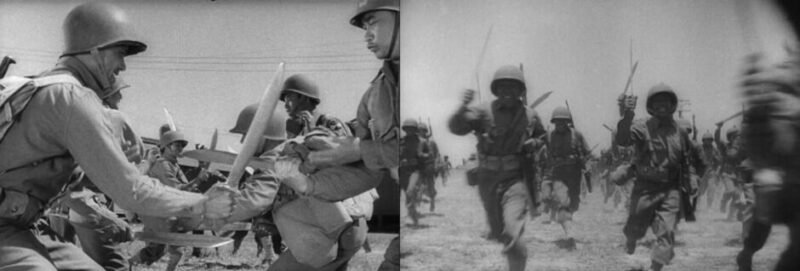
During World War II, Japan occupied the Philippines in 1941, triggering fierce Filipino and American resistance through guerrilla warfare until liberation in 1945.

🥋 Pre-Modern Arnis Training

How Filipino Fighters Actually Trained

This section expands on how Filipino martial skills were developed before codification, formal schools, or safety constraints. It is optional, but essential context for understanding why Modern Arnis represented a shift in delivery, not principle.

Click on the links below for more on the Spanish invasion.

From ancient times onward, Filipino martial training was shaped almost entirely by use rather than by preservation, pedagogy, or aesthetics. These systems were not designed to be “arts” in the modern sense. They were skills embedded in daily life, developed because violence, labour, and defence were unavoidable realities.
There was no clear separation between training, work, and survival. Movement patterns, strength, timing, and coordination were developed through repetition of practical tasks long before they were ever formalised as drills.

Before any formal “training,” physical preparation came from labour. Farming, fishing, carrying loads, climbing, paddling, chopping, and clearing land built grip strength, shoulder endurance, leg strength, and cardiovascular capacity. Blade tools were used daily, meaning familiarity with edge alignment, range, and consequence developed organically.
Children grew up around tools and weapons. By adolescence, basic weapon handling was already normalised. This created fighters who were conditioned long before they were trained.

Weapons training came first because weapons were the reality of conflict. Blades and sticks were faster to learn, more decisive, and more accessible than prolonged empty-hand skill development. Training focused on:

  • Distance management.
  • Angles of attack.
  • Timing and interception.
  • Targeting that ended fights quickly.


Empty-hand fighting existed, but largely as a fallback — when weapons were lost, broken, or impractical. This explains why empty-hand techniques in FMA mirror weapon mechanics rather than stand alone as separate systems.

Training occurred within families, clans, and small communities, not open academies. Instruction was personal and selective. Skills were passed to those who needed them or were trusted with them.

This created:

  • No standard curriculum.
  • No universal ranking.

No obligation to teach everything to everyone.
Knowledge was earned through proximity, loyalty, and time, not through payment or certification.

Instruction relied heavily on:

  • Imitation rather than verbal explanation.
  • Trial and correction, often under stress.
  • Testing through controlled violence, not abstract drills.


Mistakes were punished by pain, injury, or humiliation. This was not cruelty for its own sake — it was feedback. Survival systems do not tolerate ambiguity.

There was little concern for symmetry, beauty, or consistency. If something worked once under pressure, it stayed. If it failed, it was discarded.

Training often included:

  • Hard contact sparring with minimal protection.
  • Challenge matches between villages or lineages.
  • Duels tied to honour, land disputes, or personal conflict.


In some regions, bladed encounters were not rare. This imposed a brutal selection pressure on techniques. Anything that required fine motor precision under stress or long setup time was unlikely to survive.

This is why Filipino systems prioritise economy, angles, and disruption rather than elaborate sequences.

There was no concept of preserving a system “as it was.” Techniques evolved with:

  • New weapons.
  • Changing threats.
  • Shifts in terrain or occupation.


If firearms entered the environment, blade tactics adapted. If law enforcement pressure increased, training became quieter. Adaptation was constant and expected.

What endured was not form, but logic.

🧠 Bottom Line

Before Modern Arnis, Filipino martial training was:

  • Informal.
  • Brutally practical.
  • Embedded in daily life.
  • Weapons-first by necessity.
  • Taught through pressure rather than explanation.
  • Adapted constantly, preserved accidentally.

Modern Arnis did not invent Filipino Martial Arts. It saved them by making them teachable in a world that no longer produced fighters by default.

🌏 Post-War (1945-)

Modern History

After WWII ended, the Philippines emerged devastated but independent. Filipino martial knowledge had not disappeared—but neither had it consolidated. Across the archipelago, techniques refined through centuries of conflict continued to exist within families, regions, and small communities.
There was no single “art” to preserve. There were only methods that worked.
Weapons training, close-range striking, grappling, and off-balancing endured not because they were formalised, but because they remained useful. Knowledge survived through demonstration, repetition, and trust rather than written curriculum or shared terminology.

⚖️ Survival vs. Marginalisation

Filipino Martial Arts had survived occupation and guerrilla warfare, but the threat now was not extinction through violence. It was irrelevance.

Urbanisation accelerated. Western sports such as boxing and basketball spread rapidly. Formal education systems expanded. Informal, punishing training methods no longer fit modern life or public institutions.

The arts still worked, but the way they were taught did not. Survival in the modern era required visibility, structure, and legitimacy. The problem was no longer combat effectiveness—it was transmission.

🪖 First Contact – U.S. Servicemen and FMA

Early Western exposure to Filipino Martial Arts came through military contact, not formal schools.
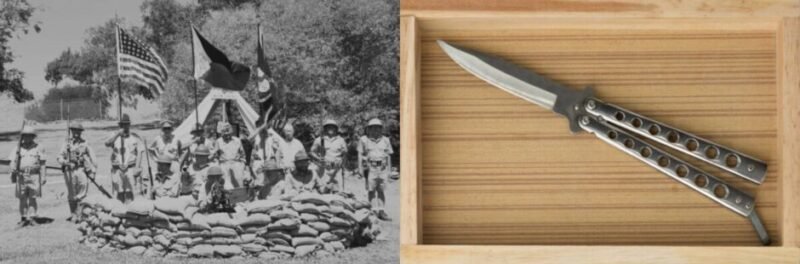
During World War II and the post-war U.S. presence in the Philippines, American servicemen encountered Filipino fighters using blades, sticks, and improvised weapons in close quarters. These interactions were informal and practical — based on observation, exchange, and necessity rather than structured teaching.
Some returned home with weapons, training tools, and an interest in Filipino weapon logic. This did not codify FMA, but it seeded awareness, helping create a receptive audience when Filipino instructors later began teaching abroad. Eventually, FMA would be opened up to a new audience.

 It was after this exposure to Arnis that weapons such as Escrima batons and the Balisong knife (butterfly knife) began to appear on US shores.

⚔️ Remy Presas and the Birth of Modern Arnis

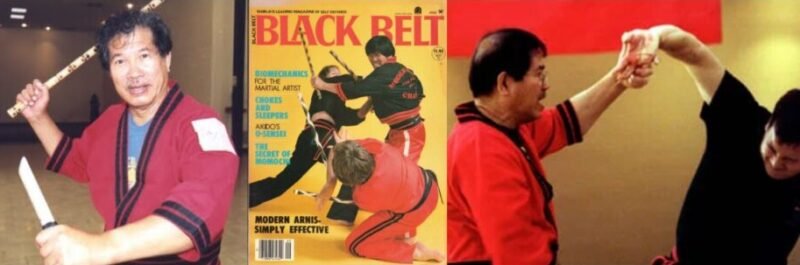
By the mid-20th century, Filipino Martial Arts still worked, but the conditions that had sustained them no longer existed. Informal, high-risk transmission was incompatible with modern civilian life and public institutions. Remy Presas, a Filipino martial artist from Negros Occidental, recognised that the problem was not effectiveness, but delivery. Trained in Filipino fighting traditions as well as structured arts such as judo and karate, he understood both weapons-based combat and institutional teaching. He saw that Filipino martial knowledge did not need reinvention — it needed translation. That insight would lead to Modern Arnis and allow Filipino Martial Arts to survive visibility without losing their core logic.

Remy Presas, the founder of Modern Arnis, sought to preserve and adapt traditional Filipino martial arts by blending various Arnis styles into a structured, accessible system. 

Click on the links below for more on the Spanish invasion.

By the mid-20th century, Filipino martial knowledge had survived war and occupation, but it had not adapted to peace. The arts still worked, but the way they were passed on no longer fit modern life. Training remained informal, physically punishing, and dependent on close personal relationships. This limited who could learn, where instruction could take place, and how widely knowledge could spread.
The problem was no longer combat effectiveness. It was transmission. Without a way to teach safely, openly, and consistently, Filipino martial systems risked fading not through suppression, but neglect.

In 1966, Remy A. Presas, a martial artist from Negros Occidental, began formalising what would become Modern Arnis. His aim was not reinvention, but survival. Remy was unusually well placed to address this problem. Raised in Filipino martial traditions, he was also deeply familiar with structured Asian martial arts such as Judo and Karate. This gave him first-hand exposure to curriculum design, safety protocols, progression systems, and institutional teaching environments.
Where many Filipino systems relied on personal lineage and informal apprenticeship, Presas understood how arts survived at scale. He recognised that Filipino martial logic did not need to change — but its method of delivery did.

Modern Arnis was Presas’ practical response to this transmission failure. Rather than reinventing Filipino combat, he translated it.

Key changes included:

  • Structured progression: Clear learning pathways replaced purely informal instruction.
  • Safer training methods: Injury was reduced to allow sustained practice in schools and universities.
  • Single-stick foundation: Core weapon mechanics were preserved in a format that could be trained openly and repeatedly.
  • Pedagogical clarity: Drills and concepts were organised so they could be taught consistently across settings.

Stick training did not replace blade knowledge. It preserved blade mechanics in a form that could survive visibility.

Presas’ contribution was not ideological modernisation, but pedagogical translation — ensuring Filipino Martial Arts could be taught at scale without abandoning the logic that made them effective.

Political and economic instability in the Philippines, combined with growing interest abroad, led Remy Presas to relocate to North America. In the United States, he expanded Modern Arnis through seminars and instruction for civilian, law enforcement, and military audiences. His functional, adaptable approach appealed to practitioners dissatisfied with rigid, form-heavy traditions, offering weapon logic taught with clarity and practical accessibility.
After Presas’ death in 2001, Modern Arnis fragmented into multiple lineages due to organisational disagreement rather than technical failure. Despite this, the system continued to spread globally. Presas’ contribution was not widespread recognition, but durability—ensuring Filipino Martial Arts could exist beyond their place of origin without losing their underlying logic.

Codification did not unify Filipino Martial Arts. It multiplied interpretations. As systems moved into public view, organisational splits followed. Some instructors prioritised lineage, others pedagogy, others sport or self-defence. Disagreement increased, but so did survivability.
Despite these divisions, the underlying logic remained consistent. Filipino systems continued to emphasise weapons-based problem solving, angular mobility, and adaptation over fixed form. Not every lineage followed a strict weapons-first progression, but historically, weapon logic continued to shape timing, distance, and decision-making across the art.

🎬 Arnis in the Spotlight

In the late 20th century, Filipino Martial Arts gained wider visibility through people rather than organisations. Dan Inosanto was central to this shift. Through seminars, cross-training, and instruction, he exposed Western practitioners to Filipino weapon logic, movement, and training methods without attempting to unify, sanitise, or rebrand them. What was transmitted was not a single system, but a way of approaching combatadaptable, weapons-aware, and practical.
That exposure increased dramatically through cinema. Bruce Lee brought Filipino concepts into public view by using them openly in training and on screen, acknowledging their effectiveness and influence.

🎥 From Training Hall to Screen

That visibility snowballed in the decades that followed. As action cinema shifted toward faster, closer, and more weapon-centric choreography, Filipino Martial Arts became a quiet backbone of modern fight scenes. The blade-and-stick work in The Bourne Identity, The Hunted, Collateral, and later entries in John Wick reflected Filipino weapon logic more than traditional cinematic martial arts. The emphasis was on angles, interception, close-range decisiveness, and rapid transitions between empty hand and weapon — all core FMA priorities.

FMA helped get a big push from martial arts legends Daniel Inosanto (left) and Bruce Lee (right).  Inosanto studied many of the obscure Southeast Asian martial arts such as Escrima and Silat.  Bruce Lee would go on from becoming a screen legend to incorporating elements of FMA into his own martial arts system, Jeet Kune Do.

As a result, Arnis and related Filipino methods became familiar to global audiences long before they were widely recognised by name. Their profile rose not through formal promotion, but through repeated exposure to what looked efficient, modern, and believable under pressure. Once again, Filipino Martial Arts spread the same way they always had: not as spectacle, but as solutions that worked when tested.

🏆 From Battlefield to Arena – Arnis as Sport

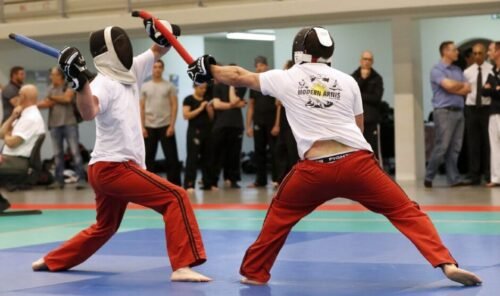
As Arnis gained international exposure, pressure grew to formalise it — not just for teaching, but for recognition. In 2009, it was declared the National Martial Art and Sport of the Philippines, bringing institutional backing, standardised rules, and competitive formats.

Competition Arnis emphasizes controlled combat, with fighters wearing protective gear such as headgear, gloves, and padded armor to ensure safety while maintaining the intensity of full-contact sparring.

This visibility ensured survival, but introduced a divide. Sport Arnis prioritised safety, scoring, and accessibility, while combative Arnis retained decisiveness, adaptability, and tactical emphasis. The movements remained recognisable; the intent did not.

This divergence was not a betrayal. It was specialisation. One path preserved Arnis as a regulated, visible sport. The other preserved it as a functional response to close-range violence. Both emerged from the same logic, responding to different modern pressures.
The mistake was never the split itself, but the assumption that only one path could be authentic.

🪖 Military and Law Enforcement Integration

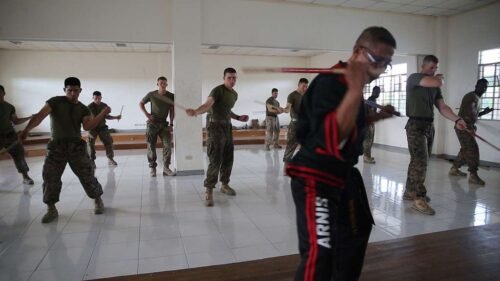
In the modern era, Arnis has remained relevant within military and law enforcement contexts, particularly in close-range combat, weapon control, and confined environments. In the Philippines, elements of the Armed Forces of the Philippines and the Philippine National Police incorporate Arnis-based principles into aspects of training.

Abroad, Filipino Martial Arts have influenced instruction within select military, police, and tactical units, especially where adaptability and efficiency are prioritised. Rather than being adopted as full systems, FMA concepts are typically integrated as practical modules for managing violence at close range.

This continued use reflects Arnis’ original purpose: a flexible, problem-solving approach that adapts to changing tools and environments.

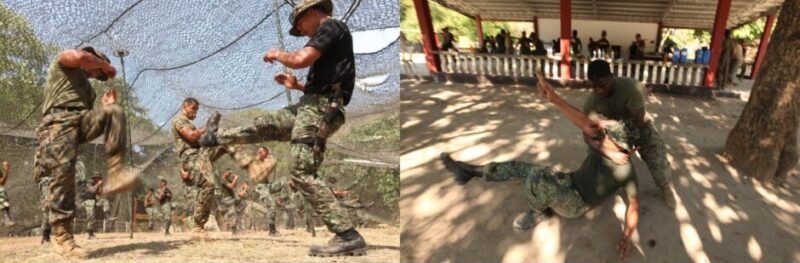
Arnis is widely used in law enforcement and military training in both the Philippines and the U.S., teaching officers and soldiers practical weapon disarming, close-quarters combat, and defensive tactics against armed threats.

Abroad, Filipino Martial Arts have influenced instruction within select military, police, and tactical units, particularly where adaptability and efficiency are prioritised. Rather than being adopted as full systems, FMA concepts are often integrated as functional modulesweapon awareness, angle-based entry, limb control, and close-range finishing. This is especially compatible with the U.S. Marines’ MCMAP approach, which is designed as a baseline combatives framework that can absorb useful methods from other systems. In practice, FMA elements tend to complement MCMAP by strengthening its performance in blade and improvised-weapon contexts, where speed, positioning, and decisiveness matter more than extended exchanges.

U.S. Marines have trained in Arnis/FMA concepts and integrated elements into MCMAP, using them as practical add-ons for close-range weapon awareness, angles, and rapid control rather than adopting an entire system.

🧭 Conclusion — Why Arnis Endures

Arnis did not survive because it was carefully preserved. It survived because it worked under conditions that left no room for error. Across centuries of raids, occupation, rebellion, and war, Filipino fighters faced the same recurring problem: surviving violence with limited resources, little warning, and no guarantee of support.

Each era applied pressure. What failed was discarded. What endured was reinforced. The result was a system that prioritised practicality over appearance, adaptability over doctrine, and decentralisation over rigid authority. Weapons were favoured because they ended encounters quickly. Fluid movement mattered because chaos punished rigidity. Local variation persisted because central control would have made the art easier to suppress.

Arnis stands as a living legacy of Filipino warrior traditions, blending history, practicality, and adaptability into a martial art that continues to thrive, preserving its roots while evolving for modern combat and sport.

What looks like fragmentation is better understood as resilience. Arnis never depended on a single founder or fixed form. It evolved as a shared logic—able to change shape without losing purpose. Seen this way, Arnis is not frozen in history, but built for reality. And as long as violence remains unpredictable, its logic remains relevant.

Leave a Reply

Your email address will not be published. Required fields are marked *

This site uses Akismet to reduce spam. Learn how your comment data is processed.

error: Content is protected !!

Join the Super Soldier Project Mailing List Today!!