The Improvised Gym — Training Without Equipment

When gyms, routines, and ideal conditions disappear, training adapts. This post explores improvised methods for maintaining strength, conditioning, and resilience using the environment around you.

Table of Contents

🎯 Introduction — Training Under Constraint

Training does not stop because circumstances change. Time, space, money, and equipment matter, but they are not excuses for becoming physically useless. Gyms are valuable tools, not mandatory ones.

Improvised training is not about gimmicks, “life hacks”, or trying to turn a broomstick into a barbell. It is about adaptability, maintaining strength, conditioning, and general physical capability when ideal conditions are unavailable. Soldiers train this way on deployment. Travellers train this way out of hotel rooms. Shift workers do it between long hours and limited recovery. During lockdowns, millions rediscovered it out of necessity.

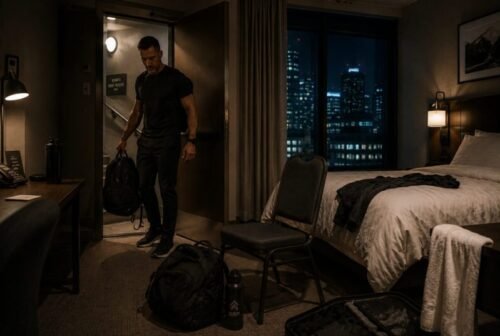
A man enters a hotel room carrying a backpack while assessing the limited space and ordinary surroundings he will use for improvised training away from the gym.

Working or travelling away from home means adapting the environment for training.

Floors, stairs, walls, backpacks, furniture, towels, and everyday objects can all become training tools when used properly. The goal is not perfection. The goal is to remain capable.

This article explores a practical approach to training under imperfect conditions, limited space, restricted equipment, irregular schedules, and real-world constraints.

⚙️ Core Training Principles

Improvised training only works when it follows structure. Without it, sessions quickly become random movement and wasted effort. The environment can replace equipment, but it cannot replace training principles.

This approach prioritises simplicity over novelty. Reliable basic movements performed with discipline will outperform complicated “hack” exercises every time. The goal is not to invent circus tricks with furniture. The goal is to stay strong, mobile, and capable under less-than-ideal conditions.

Before looking at specific tools or environments, it helps to understand the core factors that make improvised training effective in the first place.

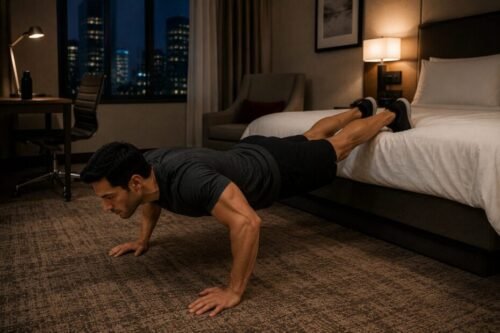
A man performs decline push-ups with his feet elevated on a hotel bed during improvised bodyweight training.

Simple environmental adjustments can make bodyweight exercises significantly harder.

Click on the links below for more.

When equipment is limited, the environment becomes the resistance. Gravity, leverage, elevation, friction, and body position can all be manipulated to increase or decrease difficulty.

Stairs replace machines. Backpacks replace weighted carries. Towels become rowing tools. A park bench becomes a platform for step-ups, dips, split squats, or incline push-ups.

The objective is not to perfectly imitate gym equipment, but to apply meaningful resistance to fundamental human movement.

Human beings developed strength long before commercial gyms existed. Labourers, soldiers, wrestlers, dock workers, climbers, and manual workers built physical capability through carrying, climbing, lifting, dragging, and moving across difficult environments as part of daily life.

Improvised training reconnects with some of those older movement demands, practical work performed under imperfect conditions rather than fixed machine movements inside a gym.

Instability has value when it is controlled. Uneven surfaces, shifting loads, and asymmetrical positions force the body to stabilise and coordinate under tension.

A heavy shopping bag carried on one side. A backpack shifting during stair climbs. A slippery hill during loaded walking. Real-world movement is rarely perfectly balanced.

None of this excuses sloppy mechanics. Posture, range of motion, and tempo still matter. Instability should challenge stability, not replace it.

Carrying awkward weight is one of the oldest forms of strength training in existence. Before machines and cable stacks, human beings lifted, dragged, carried, climbed, and transported objects as part of daily survival.

Suitcases, sandbags, water containers, shopping bags, or overloaded backpacks all force the body to stay balanced and controlled under continuous tension. Grip strength improves naturally. The trunk works constantly. Posture is challenged with every step.

This is practical strength. The kind that transfers beyond the gym floor.

Modern life removes a lot of natural movement. Escalators replace stairs. Cars replace walking. Flat indoor flooring replaces uneven terrain. Many people now spend most of the day seated before attempting to “exercise” inside another controlled indoor environment.

As a result, many people train intensely while barely moving through space at all.

Stairs, hills, crawls, loaded walking, and incline work help reintroduce these neglected physical movements. They build conditioning, endurance, and resilience without requiring large spaces or specialist equipment.

Movement over distance remains one of the simplest and most effective forms of physical training available. Walking uphill under load, climbing stairs repeatedly, or moving across uneven terrain challenges the body in ways machines often cannot replicate.

This type of training also develops environmental awareness, learning to read surfaces, gradients, footing, and stability before committing to movement. That awareness has value far beyond exercise.

🧳 Training While Working Away From Home

For many people, the biggest obstacle to training is not motivation, but mobility. Working away from home often means unfamiliar spaces, irregular schedules, limited privacy, and little or no access to equipment. Hotels, temporary rentals, work sites, and staff accommodation are rarely built with structured training in mind.

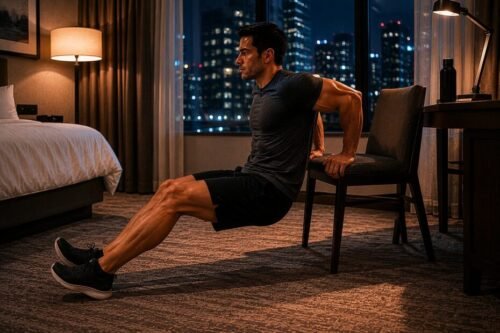
A man performs triceps dips using a hotel desk chair during an improvised hotel room workout.

Everyday hotel furniture can be used to maintain upper-body strength when equipment is unavailable.

In these situations, the goal changes. Training becomes less about progression and more about simply staying in shape. Joint health, posture, movement quality, and general conditioning take priority over chasing personal bests.

Travel and mobile work rarely create ideal recovery conditions. Poor sleep, irregular meals, long drives, flights, shift work, shared accommodation, and mental fatigue all affect training quality. In these periods, chasing maximal performance often becomes counterproductive.

Sometimes success simply means not deteriorating.

A few consistent sessions each week under difficult circumstances will preserve far more strength and conditioning than doing nothing while waiting for routines to normalise.

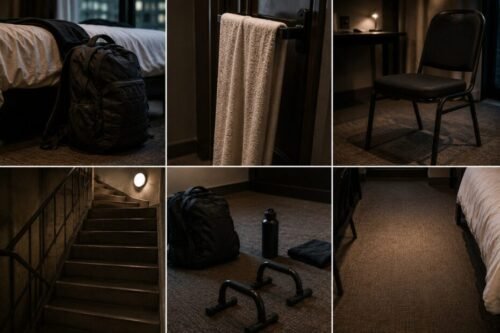
A montage showing improvised training tools and environments including stairs, towels, chairs, tables, backpacks, and hotel room floor space used for bodyweight and conditioning exercises.

Chairs, stairs, towels, tables, and backpacks can all become part of the workout environment.

The advantage of improvised training is that the tools are usually already there. Backpacks, suitcases, towels, chairs, beds, stairwells, walls, and floors can all be used to create effective sessions with minimal setup. Once training adapts to the environment instead of fighting against it, consistency becomes far easier to maintain during long periods away from home.

🏗️ Primary Improvised Tools

When gym equipment is unavailable, a few simple everyday objects can still provide surprisingly effective training. Backpacks, stairs, floors, walls, chairs, and basic household items are often enough to maintain strength, conditioning, and general fitness when used properly.

These tools require little setup, are available almost everywhere, and allow the body to be trained in multiple ways without needing a full gym environment.

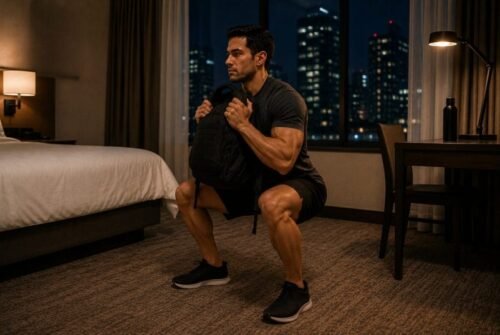
A man performs goblet squats using a loaded backpack inside a hotel room during improvised strength training.

Loaded backpacks can provide effective resistance for squats, carries, and lower-body training.

Click on the links below for more.

When working away from home, load carriage becomes one of the simplest and most reliable ways to maintain strength. A backpack or suitcase provides adjustable resistance, requires no assembly, and already exists as part of travel itself.

The suitcase in particular functions almost like a modern strongman tool — awkward, uneven, heavy, and designed to be carried under load.

Used properly, it can train most basic movements:

  • Squats and lunges.
  • Hip hinges and deadlift patterns.
  • Rows and presses.
  • Loaded carries and step-ups.

Books, water bottles, clothing, or work gear can all be used to adjust load gradually. The emphasis should remain on control and sustained tension rather than maximal effort. Zips, handles, and straps should always be checked beforehand unless you want your “farmer’s carry” turning into a luggage explosion across a hotel corridor.

Beyond muscular work, loaded carries develop grip strength, postural integrity, trunk stability, and coordination under fatigue — qualities that transfer well into both training and everyday life.

Stairs are one of the most effective and underused conditioning tools available. They provide built-in elevation, repeatable distance, and natural resistance without requiring equipment or large spaces.

Walking stairs under fatigue is brutally honest conditioning. Add load, increase pace, or extend duration, and the demand rises quickly.

Step-ups, loaded carries, controlled ascents, and repeated climbs all work well here.

Hotels, office buildings, car parks, apartment blocks, and public spaces often contain usable stairwells even when no gym is available. Short sessions can be layered throughout the day or combined into longer conditioning work without disrupting schedules.

Outdoors, hills and uneven terrain provide the same vertical challenge while adding surface variation and stabilisation demands.

Used sensibly, stairs build conditioning, coordination, and leg endurance while remaining relatively time-efficient and joint-friendly.

The floor and wall provide stable reference points for controlled bodyweight training, even in confined spaces.

Push-ups, planks, bridges, crawls, and floor-based core work reinforce posture, alignment, and full-body tension without requiring external load.
Push-ups, planks, crawls, bridges, and wall-supported positions all fit naturally here.

Difficulty is adjusted through leverage, tempo, pauses, and range of motion rather than additional equipment.

Walls add support, feedback, and positional awareness. They can assist squat mechanics, reinforce posture, support balance work, or increase difficulty through wall planks and inverted positions.

Together, floor and wall training encourage precision over chaos. That becomes especially valuable during periods of fatigue, poor recovery, travel stress, or inconsistent routines.

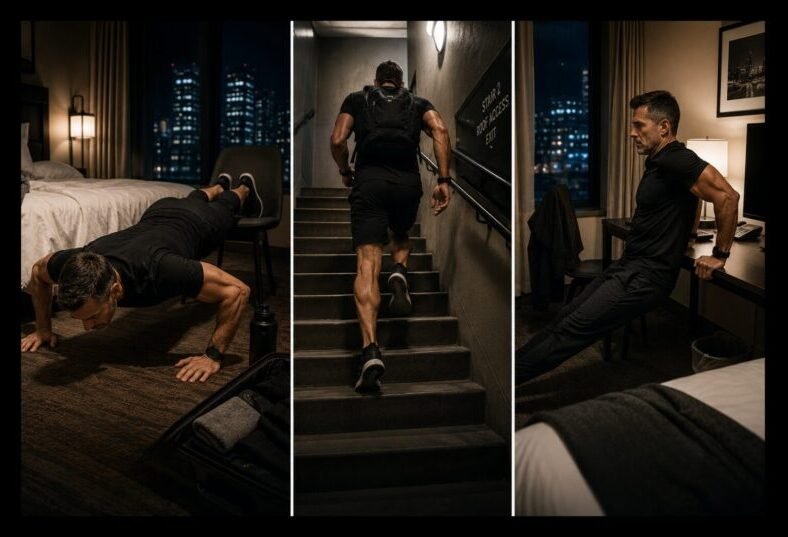
Furniture can be surprisingly effective for training provided stability and common sense are respected.

Tables, chairs, and bed frames allow incline presses, rows, split squats, step-ups, balance work, and support-based movements that are otherwise difficult to perform without equipment.

Incline or decline presses, supported squats, and single-leg movements all work well within these setups.

Changing height, angle, or hand position can dramatically alter difficulty without changing load, making furniture useful across different ability levels.

That said, hotel furniture is not commercial gym equipment. Stability should always be checked beforehand, movements should remain deliberate, and dynamic loading should be avoided unless you enjoy explaining broken furniture to reception.

🌲 The Outdoors as a Training Environment

🌍 Terrain, Load & Movement

Outdoor training is unpredictable by nature. Hills, weather, uneven ground, distance, and changing surfaces all force the body to constantly adapt instead of repeating the exact same movement under controlled gym conditions.

Grass, trails, sand, woodland paths, steep inclines, and rough terrain all create resistance naturally without requiring machines or equipment. Walking, climbing, carrying weight, and moving outdoors place far greater demands on balance, coordination, posture, and joint control than smooth indoor flooring ever will.

A steep hill changes pacing instantly. Wet grass alters footing. Uneven ground forces constant adjustment through the ankles, knees, and trunk.

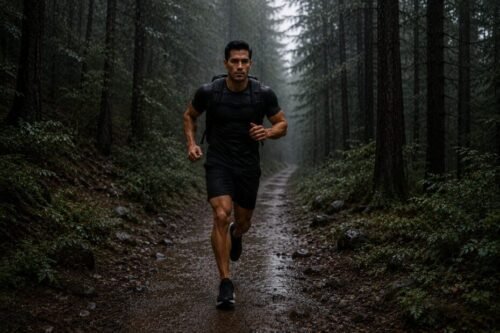
A man runs along a forest trail in light rain carrying a backpack during outdoor conditioning training.

Modern running and mapping apps make it easier to find trails, parks, and outdoor routes while away from home.

Outdoor conditioning also shifts focus away from machines and towards practical movement. Distance, terrain, elevation, and carried load become the challenge rather than numbers on a screen.

The outdoors also provides awkward and uneven loading. Stones, logs, water containers, sandbags, and natural objects rarely distribute weight perfectly. Unlike balanced gym equipment, these loads shift, drag, pull, and challenge posture throughout movement.

That unpredictability builds practical strength, the ability to stay balanced, move well, and produce force outside perfectly controlled environments.

🧠 Awareness, Conditions & Judgement

Outdoor training develops more than physical conditioning. It sharpens awareness.

Footing, gradients, obstacles, weather, visibility, and surface stability all require constant assessment before moving at all. Over time, this builds the habit of reading the environment rather than blindly moving through it.

That awareness transfers well beyond training.

Weather should also be treated as a training variable rather than a test of toughness. Cold, heat, wind, and rain all increase fatigue and recovery demands. Training should adapt accordingly.

Sometimes reducing intensity is the correct decision. Sometimes cutting a session short is the correct decision. And sometimes the smartest option is abandoning the session entirely rather than turning poor conditions into an avoidable injury.

Outdoor training rewards judgement just as much as effort.

🧰 Secondary Tools

(Situational & Supplementary)

These tools are not essential, but they can add variety, resistance, or extra challenge when available. The key is simplicity. Improvised tools should support training, not turn it into a DIY engineering project.

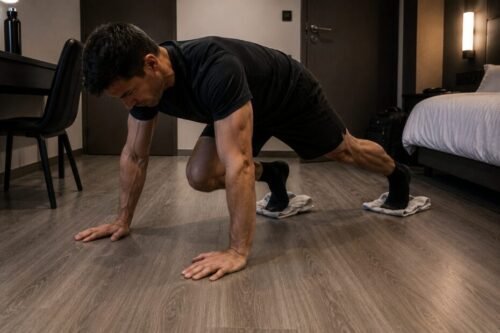
A man performs mountain climbers using towels beneath his feet on a hotel room floor during improvised conditioning work.

Towels or floor sliders can turn simple movements into demanding conditioning exercises.

Click on the links below for more.

Towels and floorcloths work well as basic sliding tools on smooth surfaces. By removing fixed points of contact, they increase core engagement and force greater control during movement.

They are particularly useful for pikes, knee tucks, hamstring curls, crawls, and sliding plank variations. Anchored towels can also assist with certain pulling patterns.

The emphasis should remain on controlled tension rather than speed. On unsuitable surfaces they lose effectiveness quickly, and forcing the issue usually creates more frustration than benefit.

Books, bottled water, and filled containers provide simple adjustable resistance when heavier loading is unavailable.

They work best for tempo work, unilateral movements, carries, shoulder training, and supplementary trunk exercises rather than maximal loading.

Presses, rows, carries, and controlled rotational work all fit naturally within this kind of loading.

A backpack filled with books or water bottles can become surprisingly effective when combined with slower tempo, pauses, or longer carries. The goal is not to perfectly recreate gym equipment, but to maintain muscular tension and solid mechanics with whatever load is available.

Soft surfaces introduce mild instability that challenges balance, coordination, and joint control.

Cushions, pillows, folded towels, or softer ground surfaces can all be used to increase ankle engagement or alter plank and push-up variations slightly.

Their role should remain supplementary. Excessive instability often adds complexity without meaningful benefit, particularly under fatigue.

Used sparingly, however, they can improve proprioception and body awareness without compromising movement quality.

⚠️ DIY Equipment

(Use With Judgement)

Some fitness personalities promote highly improvised training equipment (sandbags/suspension trainers) for entertainment or online attention. While certain methods can be effective in the right environment, many carry unnecessary risk when copied without proper experience or setup.

This type of equipment is great for increasing loading, instability, or complexity within training. However, poor design, weak materials, or unstable anchoring can increase injury risk significantly.

Improvisation has value, but so does recognising the limits of equipment and environment. Proper training equipment is designed, tested, and reviewed for durability, stability, and load tolerance. Homemade setups rarely come with those same guarantees.

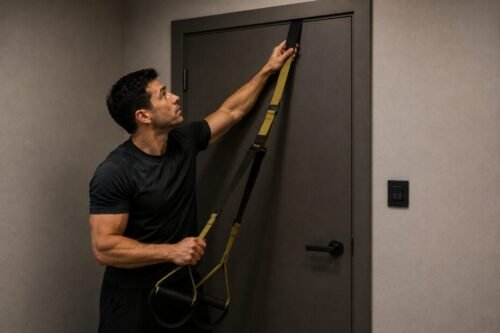
A man cautiously checks the stability of an improvised suspension trainer attached to a hotel room doorway.

Unstable anchors and poor setup can increase injury risk significantly during suspension training.

DIY suspension systems, overloaded furniture, unstable anchors, or poorly secured equipment can fail unexpectedly under fatigue or dynamic movement. Some improvised methods can still work when approached carefully, but in many situations properly manufactured equipment is simply the safer and more reliable option.

If fatigue, instability, poor anchoring, bad weather, or limited space compromise control or technique, reverting to simpler options is usually the smarter choice. In many situations, bodyweight training or properly manufactured equipment offers a safer and more reliable long-term option.

Click on the links below for more.

Sandbags can provide useful unstable resistance for carries, squats, lifts, and conditioning work. Because the load shifts during movement, they challenge grip, posture, coordination, and trunk stability differently from fixed weights.

If using DIY sandbags, durability and safety matter. Bags should be securely sealed and checked regularly for weak seams, leaks, or handle failure. Loads should remain controlled and manageable, particularly when training alone or outdoors.

In most cases, professionally manufactured training sandbags are the safer and more reliable option.

Chains, ropes, straps, and improvised suspension setups can add variety to bodyweight and conditioning work, but they require caution and common sense.

Anchor points must be secure, equipment should be checked regularly, and movements should remain controlled rather than overly explosive or unstable.

These setups are best suited to trainees experienced enough to judge stability, loading, and environmental risk properly. When in doubt, simpler and professionally designed equipment usually offers a far better risk-to-reward ratio.

📋 Programming the Improvised Gym

Improvised tools only work when training stays structured. Without some level of organisation, sessions quickly become random activity rather than productive work.

The goal is not perfect programming. The goal is regular training that covers the basics and can still be repeated when routines and environments become inconsistent.

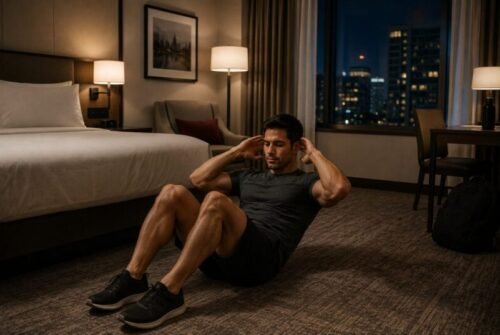
A man performs sit-ups on the floor of a hotel room during an improvised bodyweight workout away from the gym.

Even limited floor space can be used effectively for core and conditioning work.

Modern fitness culture often pushes people towards endless optimisation, perfect routines, perfect recovery, perfect tracking, perfect timing. While these things can help, they can also make people overly dependent on ideal conditions before training even begins.

Improvised training works differently. It prioritises consistency, adaptability, and getting useful work done even when circumstances are less than ideal. A simple session performed regularly will almost always outperform the “perfect” plan that never survives real life.

🧩 Full-Body Priority

When time, recovery, and equipment are limited, full-body sessions are usually the most efficient approach.

Each session should ideally include:

  • A push.
  • A pull.
  • A hinge.
  • A squat or step.
  • A carry or locomotion.

This keeps the major movement patterns active without unnecessary complexity or excessive training volume.

In practical terms, a simple session could involve:

  • Push-ups.
  • Backpack rows.
  • Stair climbs.
  • Split squats.
  • Loaded carries.

⏱️ Time-Efficient Structure

Improvised training works best when sessions are short, repeatable, and easy to recover from.

Simple circuits, carries, stair work, and bodyweight combinations allow strength and conditioning to be trained together without excessive setup or wasted time.

Not every session needs strict timing or perfect structure. In many situations, rest happens naturally while moving between exercises, changing floors, climbing stairs, or resetting equipment.

Not every session needs to be optimal to be worthwhile. Twenty minutes in a hotel room, stairwell, or park still maintains movement, conditioning, and routine. Consistency survives through adaptation, not perfection.

The goal is productive work, not collapsing on the floor after twenty minutes of chaos.

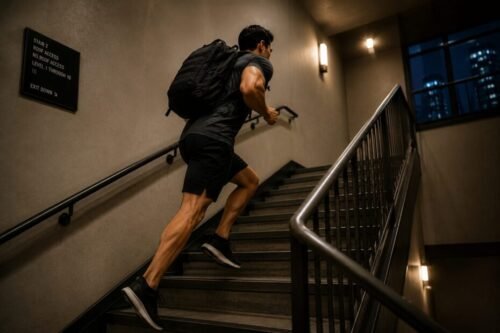
A man runs up a hotel stairwell carrying a backpack during improvised conditioning training away from the gym.

Hotel back stairwells can provide an effective conditioning space during quieter hours.

🚧 Training While Travelling

When working away from home, consistency matters more than intensity.

Training during travel is usually about maintenance rather than progression. The priority is preserving movement, conditioning, joint health, and general strength until normal routines return.

Short sessions performed consistently will usually outperform occasional all-out workouts followed by days of fatigue and missed training.

Training should support work demands and recovery, not compete against them.

🧭 The Takeaway — Capability Is Portable

Physical capability should not disappear the moment convenience does. Gyms, equipment, and structured environments are useful, but they are not the foundation of movement itself.

When circumstances change, training adapts.

Improvised training is not a shortcut or a replacement for proper training. It is a practical way to maintain strength, conditioning, mobility, and resilience when ideal conditions are unavailable.

A fit man leaves a hotel at night with a backpack over his shoulder after completing an improvised workout session.

Capability can be maintained almost anywhere through adaptation and consistency.

What matters is the ability to adapt training to the environment instead of abandoning it altogether. That adaptability matters. It allows training to continue even when schedules, locations, and routines keep changing.

Because ultimately, capability is portable.

If you have enjoyed this post please share or feel free to comment below 🙂

Related Posts

Our Other Posts

Leave a Reply

Your email address will not be published. Required fields are marked *

This site uses Akismet to reduce spam. Learn how your comment data is processed.

error: Content is protected !!

Join the Super Soldier Project Mailing List Today!!